

Case Background
The case arose from service disciplinary action against a government employee of the Industries Department, Government of Bihar.
By an order dated 4 December 1995, the petitioner was appointed as an Extension Officer and joined at the Headquarter, Palamu under the Industries Department. Later, on 17 October 2012, he was promoted and joined as Circle Officer in Roh Circle Office.
On or about 15 October 2014, one Rakesh Kumar made a complaint against the petitioner alleging that he had accepted illegal gratification. Based on this complaint, the Vigilance Investigation Bureau (V.I.B.) laid a trap. The petitioner was allegedly caught red-handed while accepting a bribe of Rs. 5,000/-. He was arrested and Vigilance Case No. 75 of 2014 under various provisions of the Prevention of Corruption Act was registered against him. The judgment records that this criminal case is still under trial and the petitioner is contesting it.
The judgment also mentions that criminal cases had earlier been instituted against the petitioner, namely Roh P.S. Case No. 8 of 2006, Warsaliganj P.S. Case No. 113 of 2007 and Nawada P.S. Case No. 681 of 2014.
After his arrest in the vigilance trap case, the petitioner was placed under suspension. Subsequently, he was released on bail and reinstated in service by order dated 16 December 2014.
On the basis of the complaint lodged by the competent officer of the V.I.B., a departmental proceeding was initiated against him. On 19 February 2015, the petitioner was served with a Memorandum of Charges under the signature of the Deputy Secretary, Industries Department, Government of Bihar.
The petitioner submitted his written explanation on 7 April 2015, denying the charges levelled against him. An enquiry was then conducted in the departmental proceeding.
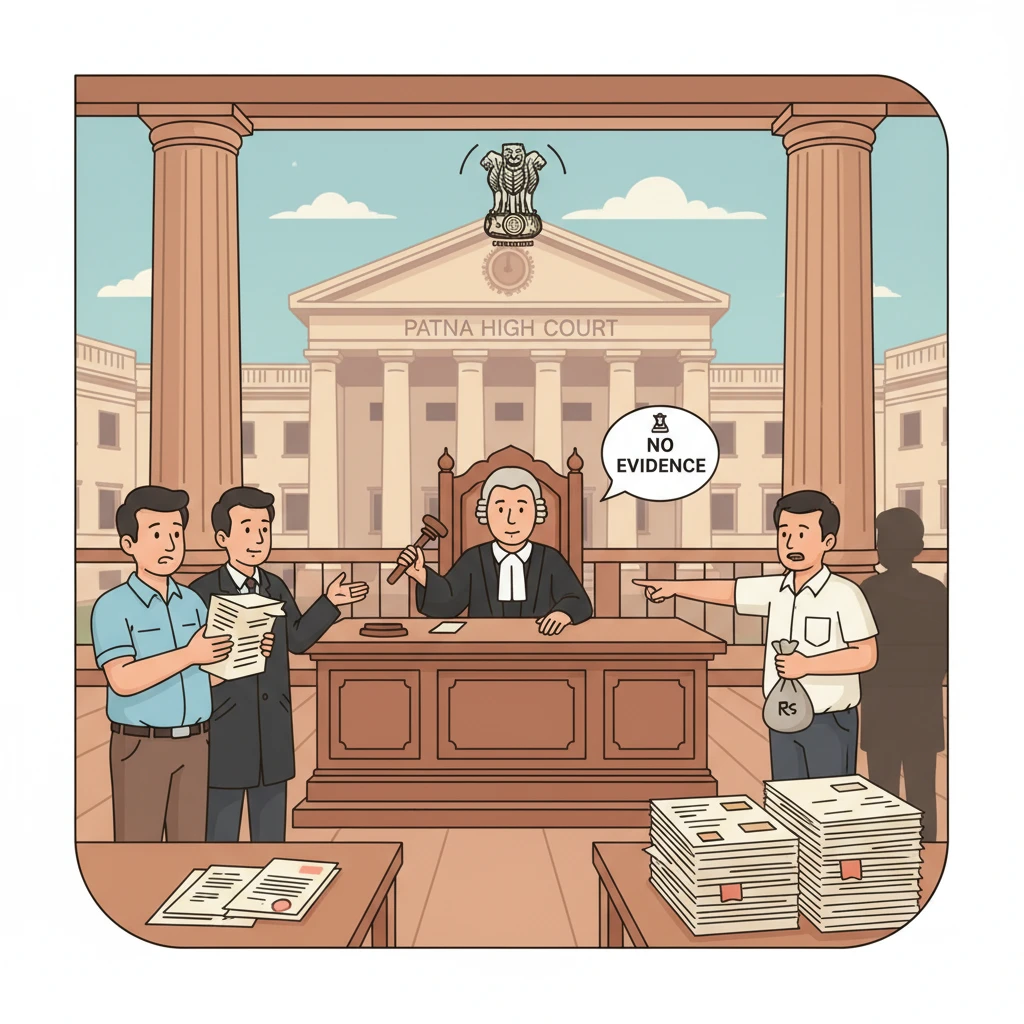
On 19 August 2015, the Enquiry Officer submitted his report. He recorded that the Department had failed to examine even a single witness against the petitioner to prove the charges. The Enquiry Officer held that the charges had not been established and described it as a case of “no evidence”.
Despite this report, on 3 August 2016 the Principal Secretary, Department of Industries, Government of Bihar passed an order dismissing the petitioner from service.
The petitioner approached the Patna High Court earlier by filing C.W.J.C. No. 18257 of 2016 challenging this dismissal order. By order dated 11 May 2022, the High Court disposed of that writ petition and directed the petitioner to file a fresh revision before the competent authority.
In compliance with that direction, the petitioner filed a revision petition before the Principal Secretary (respondent no. 2) on 3 June 2022. However, by order dated 20 September 2022, the revision was rejected with reference to Rule 29 of the Bihar Government Servant (Classification, Control and Appeal) Rules, 2005 (C.C.A. Rules), on the ground that it was barred by limitation.
Aggrieved, the petitioner again approached the Patna High Court under Article 226 of the Constitution in C.W.J.C. No. 526 of 2023, seeking quashing of the dismissal order and the revisional order, and a direction for reinstatement with consequential benefits.
What the Court Examined and Decided
The Patna High Court, through Hon’ble Mr. Justice Bibek Chaudhuri, heard counsel for the petitioner and counsel for the State. The core focus was whether the dismissal order dated 3 August 2016 and the revisional order dated 20 September 2022 were sustainable in law.
The petitioner’s case was that the departmental proceeding was conducted in violation of basic principles of natural justice because no witness was examined, even though multiple opportunities were given to the Department. The Enquiry Officer had therefore rightly concluded that the charges were not proved and that the case was one of “no evidence”.
Despite this, the Principal Secretary imposed the major punishment of dismissal, mainly relying on the complaint and materials from the Vigilance Investigation Bureau. The petitioner argued that such documents, without examination of witnesses, cannot form legal evidence in a departmental enquiry.
The petitioner contended that the appellate and revisional authorities acted arbitrarily by ignoring the Enquiry Officer’s findings and by treating the V.I.B. complaint and trap records as sufficient evidence without subjecting them to examination and cross-examination.
It was further submitted that the revisional authority wrongly rejected the revision on the technical ground of limitation under Rule 29 of the C.C.A. Rules, even though the High Court in C.W.J.C. No. 18257 of 2016 had directed that the petitioner’s case be considered on merits.
Counsel for the petitioner relied on the Supreme Court decision in Kuldeep Singh v. The Commissioner of Police and Others, AIR 1999 SC 684. Paragraphs 41 and 42, quoted in the judgment, highlight that when there is absolutely no evidence to support the charge in a departmental enquiry, the findings are perverse, and that an enquiry officer must conduct an impartial enquiry without bias towards the department. If complainants and material witnesses are not produced, the charge cannot be held proved.
The petitioner also cited several unreported decisions of coordinate Benches of the Patna High Court in support of similar propositions:
(i) C.W.J.C. No. 15747 of 2016 (Vinod Kumar Bimal v. State of Bihar and Others)
(ii) C.W.J.C. No. 18779 of 2019 (Vijendra Prasad v. State of Bihar and Others)
(iii) C.W.J.C. No. 16091 of 2014 (Naushad Alam v. The Bihar State Minorities Finance Corporation Limited and Others)
(iv) C.W.J.C. No. 12980 of 2017 (Naresh Prasad Sinha v. The State of Bihar and Others)
Particular reliance was placed on C.W.J.C. No. 18779 of 2019, where the facts were described as almost similar. In that case too, a government employee was arrested by the Vigilance team and faced a departmental proceeding for alleged acceptance of illegal gratification. The Enquiry Officer in that matter also held that there was no occasion for the employee to demand or accept a bribe because the Department had failed to examine any witness. The High Court there had not only quashed the dismissal but also imposed costs on the Department.
On the other hand, the State respondents contended that the trap laid by the V.I.B., the alleged acceptance of bribe, recovery of tainted money, and the complaint lodged by the V.I.B. were all placed before the appellate and revisional authorities. According to the State, these documents themselves were sufficient evidence to justify dismissal. It was argued that the case against the petitioner was not vitiated merely because no witness was examined in the departmental enquiry.
The State also maintained that the petitioner’s departmental revision was barred by limitation under Rule 29 of the C.C.A. Rules and was therefore rightly rejected.
In rejoinder, the petitioner reiterated that in absence of oral evidence, the Enquiry Officer had no option but to treat the matter as a “no evidence” case and hold that charges were not proved. The disciplinary and revisional authorities, according to the petitioner, acted with bias in favour of the Department.
The Court then considered the materials on record and the legal position. It noted the specific finding of the Enquiry Officer, recorded in Hindi, to the effect that despite repeated attempts, witnesses and the informant did not appear and therefore the case was heard as an ex parte one-sided matter. On that basis, the Enquiry Officer concluded that the charges could not be proved and that the matter should be decided by the vigilance department itself.
The Court found that when the order of dismissal was passed, the most basic rule of natural justice had not been complied with. There was no examination of any witness in the departmental enquiry to support the charges, despite opportunities.
The Principal Secretary’s dismissal order (Annexure-6) was found to have been passed primarily on the basis of the initial statement and complaint filed by the V.I.B. The High Court clarified that a complaint filed by the Special Branch of Police, including the V.I.B., cannot, by itself, be treated as “evidence” in a departmental proceeding. Only when witnesses cited in the charge-sheet come forward and their statements are tested in examination and cross-examination can the disciplinary authority arrive at a finding of guilt on a standard of preponderance of probability.
The petitioner also advanced a legal argument that because a criminal case under the Prevention of Corruption Act was pending before the Special Court, the Department could take disciplinary action only after the criminal court’s decision. The High Court expressly rejected this contention. It held that criminal cases require proof beyond reasonable doubt, whereas departmental proceedings are decided on the lower standard of preponderance of probability. Therefore, the mere pendency of a criminal case does not prevent a department from proceeding departmentally under applicable service rules.
However, the Court emphasised that in this particular case the departmental proceeding suffered from a fatal defect: there was simply no evidence brought on record to prove the charges. The Enquiry Officer had clearly recorded that the Department had failed to examine any witness and that the case was one of “no evidence”.
For these reasons, the Court held that the order of punishment dated 3 August 2016 was passed despite the failure of the respondent authorities to produce witnesses or any other evidence in support of the charges. This rendered the dismissal order, and the revisional order dated 20 September 2022 confirming it, in gross violation of statutory provisions and of the principles of natural justice.
The Court observed that the petitioner had been victimised by the disciplinary authority without any basis or evidence. Consequently, the High Court set aside and quashed both the dismissal order dated 3 August 2016 and the revisional order dated 20 September 2022.
The writ petition was allowed. The Court directed that the petitioner be reinstated in service with consequential benefits. No order as to costs was made.
Why This Judgment Matters
This judgment of the Patna High Court has practical importance for government employees facing departmental action, especially in vigilance and bribery cases.
First, it reinforces that a departmental punishment like dismissal cannot be sustained when there is no evidence on record. Mere existence of a vigilance complaint, trap report, or criminal case is not enough. The Department must produce and examine witnesses in the enquiry, and give the delinquent employee a fair chance to cross-examine them.
Second, the judgment makes clear that even in serious allegations such as acceptance of bribe, basic principles of natural justice cannot be ignored. A government employee cannot be removed from service only on the strength of untested documents.
Third, the Court clarified that while departments are free to conduct disciplinary proceedings even when a criminal case is pending, they must still follow proper procedure and prove charges on the standard of preponderance of probability.
For employees in Bihar and elsewhere, this decision shows that if dismissal is ordered without any evidence being led in the enquiry, the Patna High Court may intervene and grant relief, including reinstatement with consequential benefits.
Legal Issues and Answers
- Issue: Whether a government employee can be dismissed from service in a departmental proceeding based solely on vigilance complaint and trap documents, without examination of any witness.
Answer: No. The Patna High Court held that dismissal based only on such documents, without examining witnesses and without evidence on record, violates statutory provisions and principles of natural justice, and is unsustainable. - Issue: Whether pendency of a criminal case under the Prevention of Corruption Act prevents the Department from taking disciplinary action.
Answer: No. The Court held that a delinquent employee can be departmentally punished during pendency of a criminal case, as the standard of proof in departmental proceedings (preponderance of probability) is different from that in criminal trials (beyond reasonable doubt). - Issue: Whether the revisional authority was justified in rejecting the petitioner’s departmental revision on limitation without considering the merits despite a prior High Court direction.
Answer: The Court found that the revisional order dated 20 September 2022, which confirmed the dismissal without addressing the lack of evidence, was unsustainable and in violation of natural justice, and therefore quashed it.
Cases Cited by the Court
- Kuldeep Singh v. The Commissioner of Police and Others, AIR 1999 SC 684.
- C.W.J.C. No. 15747 of 2016 (Vinod Kumar Bimal v. State of Bihar and Others) – unreported decision of Patna High Court.
- C.W.J.C. No. 18779 of 2019 (Vijendra Prasad v. State of Bihar and Others) – unreported decision of Patna High Court.
- C.W.J.C. No. 16091 of 2014 (Naushad Alam v. The Bihar State Minorities Finance Corporation Limited and Others) – unreported decision of Patna High Court.
- C.W.J.C. No. 12980 of 2017 (Naresh Prasad Sinha v. The State of Bihar and Others) – unreported decision of Patna High Court.
Case Details
Case Number: Civil Writ Jurisdiction Case No. 526 of 2023
Case Title: Bhola Paswan v. The State of Bihar & Others
Citation: 2024(2) PLJR 754
Court: High Court of Judicature at Patna
Coram: Hon’ble Mr. Justice Bibek Chaudhuri
Date of Judgment: 07-05-2024
Nature of Case: Writ petition under Article 226 of the Constitution of India challenging dismissal from service and rejection of departmental revision.
Reliefs Sought: Setting aside dismissal order dated 03.08.2016; setting aside revisional order dated 20.07.2022 (treated in the body as 20.09.2022); direction for reinstatement with consequential benefits.
Advocates for Petitioner: Mr. Awadhesh Kumar Mishra, Advocate; Mr. Dwivedy Surendra, Advocate; Mr. Jitendra Kumar George, Advocate; Mr. Biswak Sen Misra, Advocate.
Advocate for State: Mr. Ravish Chandra, AC to SC-6.
Result: Writ petition allowed; dismissal order dated 3 August 2016 and revisional order dated 20 September 2022 quashed; petitioner directed to be reinstated with consequential benefits; no order as to costs.
Link to Judgment: View full judgment on Patna High Court website
If you found this explanation helpful and wish to stay informed about how legal developments may affect your rights in Bihar, you may consider following Samvida Law Associates for more updates.







