

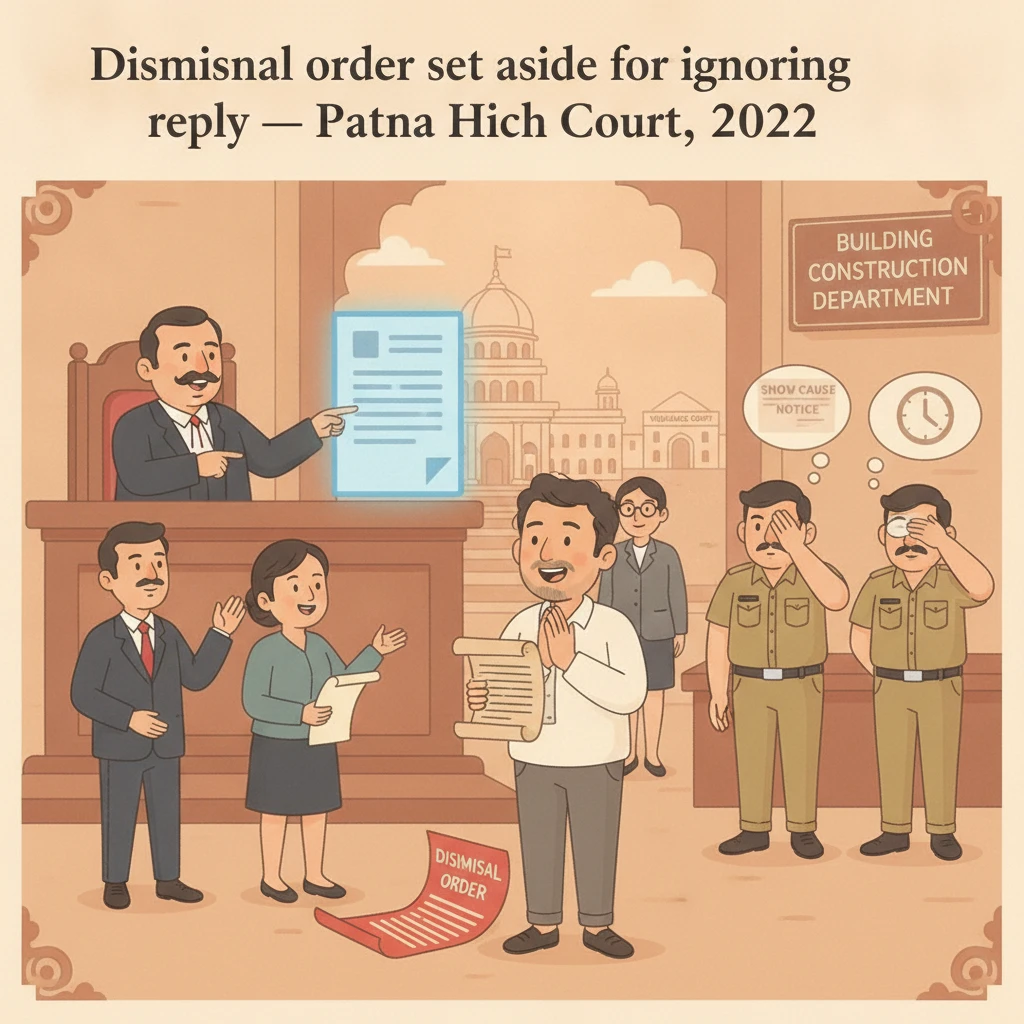
Case Background
The petitioner was working as an Executive Engineer in the Building Construction Department of the Government of Bihar.
On 30 October 2012, he was served with an article of charge. The allegation was that he had demanded and accepted illegal gratification of Rs. 20,000. This was a departmental proceeding, separate from a criminal case mentioned by him as pending before the Special Judge (Vigilance), Patna.
The petitioner submitted his reply to the charge memo on 27 December 2012.
The disciplinary authority was not satisfied with this reply and decided to conduct a regular departmental enquiry.
An inquiry officer was appointed. After conducting the enquiry, the inquiry officer submitted his first report on 3 June 2013. In this report, he clearly held that the charges against the petitioner were not proved.
The disciplinary authority disagreed with this finding. On 22 July 2013, the authority remanded the matter to the same inquiry officer and directed him to commence and conclude the enquiry from what was described as the “defective stage”.
After this remand, the inquiry officer again held a further enquiry and submitted a second report. In this second report also, he came to the conclusion that the charges against the petitioner were not proved.
Despite this second exonerating report, the disciplinary authority again disagreed. A second show cause notice was issued to the petitioner on 28 March 2014, giving him a time limit to respond.
The petitioner submitted his detailed reply to this second show cause notice on 25 April 2014.
On 30 July 2014, the disciplinary authority passed an order dismissing the petitioner from service. This dismissal order, contained in Memo No. 7862 dated 30 July 2014, became the subject of challenge before the Patna High Court in this writ petition.
What the Court Examined and Decided
The writ petition was heard by Hon’ble Mr. Justice P. B. Bajanthri. The petitioner sought several reliefs, the primary one being quashing of the dismissal order dated 30 July 2014.
The petitioner argued that he had been dismissed for a single charge of allegedly demanding and accepting illegal gratification of Rs. 20,000. He pointed out that this charge had not been proved in the departmental enquiry, not once but twice, and yet the disciplinary authority had imposed the extreme punishment of dismissal.
He also contended that the dismissal order had been passed without properly considering his reply to the second show cause notice dated 28 March 2014. According to him, this violated basic principles of natural justice and fair hearing.
The petitioner further stated that a criminal proceeding on the same allegation was still pending before the Special Judge (Vigilance), Patna, but the disciplinary authority had ignored this fact while dismissing him from service.
On the other side, the State defended the dismissal order. The detailed submissions of the State are not reproduced in the judgment, but it is clear that the State relied on the disciplinary authority’s power to disagree with the inquiry officer and to decide the punishment.
The Patna High Court carefully examined the sequence of events. It noted that the inquiry officer, on both occasions, had categorically held that the charges against the petitioner were not proved. Despite this, the disciplinary authority disagreed and moved ahead towards punishment.
The crucial point for the Court was how the disciplinary authority dealt with the petitioner’s reply to the second show cause notice.
The Court perused the dismissal order dated 30 July 2014, particularly paragraphs 7 and 8 of that order. From this reading, the Court found that the petitioner’s explanation to the second show cause notice had not been considered on merits at all. It had been brushed aside simply on the ground that it was belated.
This approach, in the Court’s view, amounted to “total non-application of mind”. If an employee’s livelihood is at stake, the authority cannot ignore his reply on a mere technicality without even considering the contents.
The Court emphasised that the very purpose of issuing a show cause notice is to give the employee an opportunity to defend himself and to place his explanation on record. If the authority does not apply its mind to that explanation, the whole exercise of issuing the show cause notice becomes meaningless.
In plain terms, the Court held that once a second show cause notice was issued and a reply was submitted on 25 April 2014, the disciplinary authority was duty-bound to deal with each of the points raised by the petitioner before deciding on dismissal.
The Court also took note of the fact that, in this case, there were two enquiry reports, both in favour of the petitioner. Even then, the disciplinary authority disagreed and proceeded to dismiss him. This made it even more important that the authority give proper and reasoned consideration to his reply to the second show cause notice.
Finding that this had not been done, the Court set aside the dismissal order dated 30 July 2014.
However, the Court did not straightaway order the petitioner’s reinstatement with all consequential benefits. Instead, it remanded the matter back to the disciplinary authority with specific directions.
The Court directed the disciplinary authority to consider each of the contentions raised by the petitioner in his explanation to the second show cause notice and then pass a fresh, speaking (reasoned) order.
The Court further directed that this entire exercise must be completed within two months from the date of receipt of the High Court’s order.
There was also an important question about how to treat the period between the dismissal (30 July 2014) and the final fresh order that the disciplinary authority would now pass. The Court described this as the “intervening period”.
The Court held that the disciplinary authority must examine how to regulate this intervening period. Specifically, the authority must decide whether the petitioner is to be treated as under deemed suspension or whether he should be taken back on duty, subject to the outcome of the final order.
To guide this decision, the Court referred to the Supreme Court’s judgments in Managing Director, ECIL v. B. Karunakar, (1993) 4 SCC 727, and Chairman-cum-Managing Director, Coal India Limited & Ors. v. Ananta Saha & Ors., (2011) 5 SCC 142, particularly paragraphs 46 to 50 of the latter decision.
The Patna High Court reproduced paragraphs 46 to 50 of the Ananta Saha judgment, which deal with how fresh enquiries should be conducted when earlier punishment is set aside on technical grounds, the need to reinstate and possibly suspend the employee during such fresh enquiry, and the principles regarding back wages.
These Supreme Court decisions clarify that when a punishment is set aside on technical grounds, the employer can hold a fresh enquiry from the stage where the defect occurred, but must reinstate the employee and regulate pay and suspension as per law. The question of back wages is discretionary and depends on the facts of each case.
Relying on these principles, the Patna High Court left it to the disciplinary authority to decide, in accordance with law and the Supreme Court guidelines, how to treat the intervening period and what financial or service benefits, if any, would be due to the petitioner after the final decision.
Finally, with these observations and directions, the writ petition was disposed of.
Why This Judgment Matters
This judgment is important for government employees and others facing departmental proceedings, especially in Bihar.
First, it reinforces that a disciplinary authority cannot ignore an employee’s reply to a show cause notice. Even if the authority thinks the reply is late, it must still apply its mind to the explanations offered when a person’s job and livelihood are at stake.
Second, it shows that when an enquiry officer twice finds charges “not proved”, the disciplinary authority must give detailed reasons if it wants to disagree. It cannot simply override such reports and proceed to dismissal without a careful and reasoned order.
Third, the judgment explains that when a dismissal order is set aside on grounds of procedural unfairness, the employer can reconsider the case, but must follow Supreme Court guidelines, including proper treatment of the intervening period and possible reinstatement or suspension.
For employees, this case highlights the importance of submitting replies to show cause notices and insisting that authorities record their reasons in writing. For departments, it is a reminder that shortcuts in disciplinary procedures can lead to their decisions being struck down by the Patna High Court.
Legal Issues and Answers
Issue: Whether the dismissal of the petitioner from service was valid when his reply to the second show cause notice was not considered and the enquiry officer had twice held the charges as not proved.
Answer: No. The Patna High Court held that there was total non-application of mind in ignoring the petitioner’s explanation, set aside the dismissal order dated 30.07.2014, and directed the disciplinary authority to reconsider the reply and pass a fresh speaking order.
Issue: How should the period between the original dismissal and the fresh decision be treated?
Answer: The Court directed the disciplinary authority to decide whether the petitioner is deemed under suspension or to be taken back on duty, and to regulate the intervening period in light of the Supreme Court decisions in ECIL v. B. Karunakar and Coal India Limited v. Ananta Saha.
Cases Cited by the Court
- Managing Director, ECIL v. B. Karunakar, (1993) 4 SCC 727.
- Chairman-cum-Managing Director, Coal India Limited & Ors. v. Ananta Saha & Ors., (2011) 5 SCC 142.
Case Details
Case Number: Civil Writ Jurisdiction Case No. 21814 of 2014
Case Title: Krishna Kant Kumar v. The State of Bihar & Ors.
Citation: 2022 (2) PLJR 468
Court: High Court of Judicature at Patna
Coram: Hon’ble Mr. Justice P. B. Bajanthri
Date of Judgment: 05.04.2022
Advocates for Petitioner: Dr. Anand Kumar, Advocate; Mr. Sanjay Kumar Ghosarvey, Advocate
Advocate for Respondents: Mr. Sitaram Yadav, GP-16
Nature of the Case: Writ petition (service/disciplinary matter challenging dismissal order)
Impugned Order: Memo No. 7862 dated 30.07.2014 dismissing the petitioner from service as Executive Engineer, Building Construction Department, Govt. of Bihar
Link to Judgment: Click here to view the official Patna High Court judgment
If you found this explanation helpful and wish to stay informed about
how legal developments may affect your rights in Bihar,
you may consider following Samvida Law Associates for more updates.







