
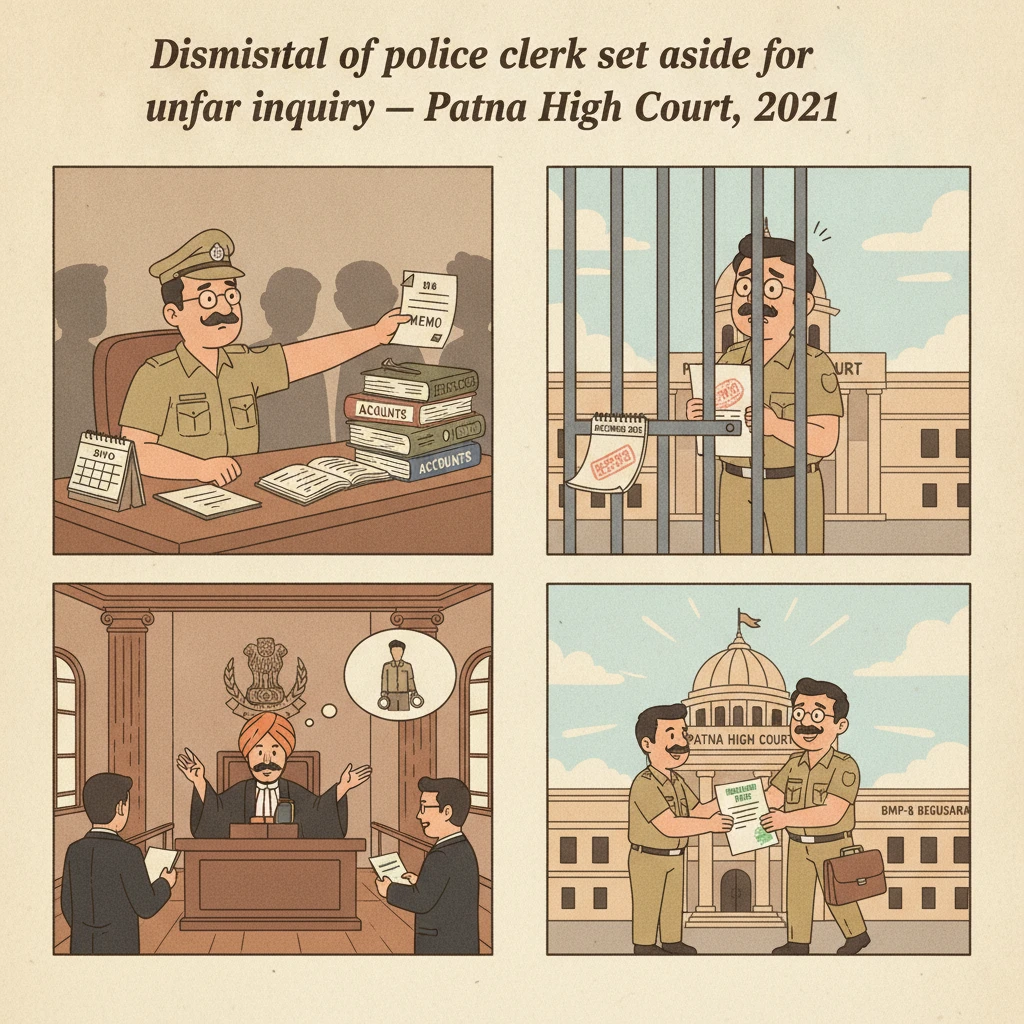
Case Background
The petitioner joined the Bihar Police department as a Clerk on 13.02.1988 in the office of the Superintendent of Police, Darbhanga.
Between 16.02.2006 and 12.02.2007, he was posted as a Clerk in the office of the Superintendent of Police, Muzaffarpur and also worked as an Accountant there till 22.09.2006. On 13.02.2008, he was transferred to Bihar Military Police-8 (BMP-8), Begusarai.
On 01.10.2010, an FIR being Muzaffarpur Town P.S. Case No. 401/2010 was registered against the then Accountant of the office of the Superintendent of Police, Muzaffarpur, Sri Sushil Kumar Choudhary, alleging embezzlement of public money by manipulation in pay bills. Some constables and non-public servants were also made accused. The petitioner was not named in this FIR initially.
On 30.06.2011, the Commandant, BMP-8, Begusarai (Respondent No. 6) issued two memos (Nos. 2681 and 2682) seeking the petitioner’s explanation regarding several accounting lapses. These included non-renewal of a term deposit on maturity, non-submission of compliance reports to objections of the Accountant General, non-disposal of ten matters relating to withholding of pay, making lesser recovery in order No. 1556/08, and drawing cashier allowance of Rs. 300/- per month despite stoppage from January 2010.
The petitioner replied on 29.08.2011. He stated that no loss had been caused to the Government and that he had only followed orders of superior officers. He claimed to have provided a cogent explanation on each point.
Meanwhile, the Additional Director General of Police, BMP, by letter dated 15.06.2011, informed the Commandant about discrepancies in maintenance of accounts. An inspection report of the Transport and Accounts Sections suggested that Head Clerks and Accountants appeared negligent in their work.
Relying on this inspection report, the Commandant issued a memo of charge to the petitioner on 15.09.2011 and sought his explanation. On 11.03.2012, the petitioner was suspended in contemplation of departmental proceedings.
On 20.03.2012, the Deputy Inspector General of Police, Military Police (Northern Division), Muzaffarpur (Respondent No. 5) issued a formal charge-sheet. It repeated the earlier charges and added one new allegation: that the petitioner had been made an accused in Muzaffarpur Town P.S. Case No. 401/2010.
The petitioner was then taken into custody in connection with that criminal case. He remained in custody from March 2012 until he was granted bail by the Patna High Court on 13.12.2012 in Criminal Miscellaneous No. 33395 of 2012. He submitted his joining on 26.12.2012.
What the Court Examined and Decided
Justice Mohit Kumar Shah examined whether the departmental inquiry and dismissal of the petitioner complied with law and principles of natural justice under the Bihar Government Servant (Classification, Control & Appeal) Rules, 2005.
According to the petitioner, the Inquiry Officer proceeded ex parte and concluded the departmental proceeding while he was in judicial custody. The Inquiry Officer submitted his main report on 17.11.2012, holding charges in six paragraphs of the memo proved, even though the petitioner had been unable to participate.
After being released on bail, the petitioner wrote to the Commandant and the Conducting Officer on 02.02.2013. He informed them that he had rejoined on 26.12.2012 and had been relieved to join the office of the Superintendent of Police, Nawada. He clearly expressed his willingness to participate in the departmental proceeding and to cross-examine witnesses.
The record showed that the Conducting Officer then reopened the inquiry and fixed dates. On 27.06.2013 no proceeding took place. On 12.07.2013, the petitioner appeared and submitted his defence.
However, the Inquiry Officer did not revise his earlier ex parte report of 17.11.2012. Instead, he submitted a supplementary report on 25.03.2014. This supplementary report focused only on the additional charge in paragraph 7 of the memo, namely that the petitioner was an accused in Muzaffarpur Town P.S. Case No. 401/2010.
In this supplementary report, the Inquiry Officer treated the seventh charge as proved merely because a charge-sheet had been filed against the petitioner in the criminal case on 23.05.2012. At the same time, he explicitly stated that his findings on the other charges (paragraphs 1 to 6) remained as already given in the ex parte report of 17.11.2012.
During this “reopened” inquiry, only one witness was examined and cross-examined, and even that cross-examination was only partial. The petitioner was not allowed to cross-examine five other witnesses examined earlier during his custody. His detailed defence on the main charges was not factually reconsidered in the supplementary report.
On 26.03.2014, the disciplinary authority (Respondent No. 5) issued a second show cause notice, granting the petitioner only seven days to respond. The notice reached the petitioner on 30.03.2014. Without waiting for his reply, the DIG, Military Police (Northern Division), Muzaffarpur dismissed him from service by memo dated 07.04.2014.
The petitioner appealed to the Inspector General of Police, Bihar Military Police, Bihar, Patna (Respondent No. 4) on 26.06.2014. The appeal was dismissed on 09.12.2014. The appellate order mainly recited the sequence of events and did not seriously address the legal objections or the alleged denial of fair opportunity.
In the writ petition, the petitioner argued that:
- The memo of charge violated Rule 17(3) of the Rules, 2005.
- No Presenting Officer was appointed as required under Rule 17(5)(c).
- The inquiry was conducted behind his back while he was in custody; he was denied the chance to cross-examine witnesses and to properly present his defence.
- The second show cause notice violated Rule 18(3), which mandates at least fifteen days for reply.
- The punishment order and appellate order did not consider his defence and were unreasoned.
The State responded that there was no procedural irregularity. It argued that the petitioner had received multiple notices for explanation before and during the inquiry, but chose not to participate. It contended that the Inquiry Officer rightly proceeded ex parte and later gave him further opportunity. The State also submitted that guidelines for appointment of Presenting Officers were issued only by letter dated 21.07.2017, after this proceeding had concluded.
After going through the record, the Patna High Court made several important findings.
First, the Court noted that the petitioner was undoubtedly in custody from March 2012 to December 2012. The charge-sheet in the departmental proceeding was issued on 20.03.2012 and the Inquiry Officer’s main report was dated 17.11.2012. Thus, the core inquiry and findings on charges 1 to 6 were completed entirely while the petitioner was in custody.
Second, after his release and representation dated 02.02.2013, the reopening of the inquiry was only an “empty formality.” The petitioner was not allowed to cross-examine five key witnesses examined earlier. His defence on the main charges was not reconsidered; instead, the ex parte findings were simply allowed to stand unaltered. The supplementary report of 25.03.2014 only considered charge 7.
Third, the Court held that treating the seventh charge as proved merely because an FIR and charge-sheet existed was unsustainable. Alleging that a government servant’s service is unsatisfactory on the sole basis of a pending criminal case cannot be treated as proved until there is a conviction by the trial court.
Fourth, the Court accepted that no Presenting Officer had been appointed, which violated Rule 17(5)(c) of the Rules, 2005. On this point, the Court referred to the Supreme Court judgments in State of U.P. and others v. Saroj Kr. Sinha, (2010) 2 SCC 772 and Union of India v. Ram Lakhan Sharma, (2018) 7 SCC 670.
Fifth, regarding the second show cause notice, the Court observed that Rule 18(3) requires that a government servant be given fifteen days to file his written representation. In this case, the notice itself granted only seven days, and actual service was on 30.03.2014, leaving even less time before dismissal on 07.04.2014. The Court held that this deprived the petitioner of a real opportunity to reply and therefore vitiated the second show cause notice.
Because the inquiry reports of 17.11.2012 and 25.03.2014 were found to be in clear violation of natural justice and statutory rules, the Court held that they could not stand in law. Once these reports were quashed, the punishment order dated 07.04.2014, which rested entirely on those findings, also had “no legs to stand.”
The Court also found the appellate order dated 09.12.2014 to be perverse. It failed to deal with the petitioner’s specific grounds, showed non-application of mind, and could not survive once the inquiry reports and punishment order were struck down.
Accordingly, the Patna High Court allowed the writ petition. It quashed:
- Inquiry report dated 17.11.2012.
- Supplementary inquiry report dated 25.03.2014.
- Second show cause notice dated 26.03.2014.
- Punishment/dismissal order dated 07.04.2014.
- Appellate order dated 09.12.2014.
The Court remitted the matter to the disciplinary authority with liberty to proceed afresh from the stage of issuance of memo of charges, in accordance with law.
On the question of service consequences, the Court held that the petitioner would be reinstated forthwith as a result of the quashing of the dismissal. However, payment of consequential benefits, including back wages, would depend on the outcome of the fresh disciplinary proceeding.
The Court directed that the fresh proceeding must be completed within six months from the date of receipt or production of a copy of the judgment. If the authority fails to complete it within this time, the petitioner would then become entitled to all consequential benefits including 100% back wages.
The Court also made it clear that the petitioner must cooperate in the fresh proceedings, failing which the disciplinary authority would be free to proceed ex parte.
Why This Judgment Matters
This judgment is significant for government employees in Bihar, particularly police and Bihar Military Police staff, who face departmental action while they are in jail or otherwise unable to attend proceedings.
The Patna High Court has made it clear that:
- Departmental inquiries cannot be concluded behind a person’s back when the authorities know he is in custody.
- After a person is released, a real and effective opportunity must be given to cross-examine witnesses and present a defence; a token reopening is not enough.
- Merely having an FIR and charge-sheet against an employee does not prove misconduct; only a conviction can support such a finding.
- Rules on appointment of Presenting Officers and minimum time for reply to second show cause notices must be strictly followed.
For low-ranking staff who often feel helpless against departmental machinery, this decision reinforces that the law requires fairness at every stage. If authorities ignore these safeguards, courts can step in, set aside the punishment, and order a fresh, proper inquiry.
Legal Issues and Answers
-
Issue: Whether the departmental inquiry and ex parte findings against the petitioner, conducted while he was in custody and without proper opportunity to defend himself, were valid in law.
Answer: No. The Patna High Court held that major parts of the inquiry were held behind the petitioner’s back, he was denied adequate opportunity to cross-examine witnesses and present his defence, and therefore the inquiry reports stood vitiated. -
Issue: Whether non-appointment of a Presenting Officer and failure to grant at least fifteen days’ time for reply to the second show cause notice rendered the proceedings invalid.
Answer: Yes. The Court held that failure to appoint a Presenting Officer violated Rule 17(5)(c) of the Rules, 2005, and grant of less than the mandated fifteen days for reply under Rule 18(3) invalidated the second show cause notice and the consequential punishment. -
Issue: What relief was the petitioner entitled to after the inquiry and punishment orders were quashed.
Answer: The petitioner was entitled to reinstatement. A fresh departmental proceeding could be conducted from the stage of memo of charges. Consequential benefits, including back wages, would depend on the outcome of the fresh inquiry, but if not completed within six months, he would become entitled to 100% back wages and all consequential benefits.
Cases Cited by the Court
- State of U.P. and others v. Saroj Kr. Sinha, (2010) 2 SCC 772.
- Union of India v. Ram Lakhan Sharma, (2018) 7 SCC 670.
Case Details
Case Number: Civil Writ Jurisdiction Case No. 10088 of 2015
Case Title: Dinesh Prasad v. The State of Bihar & Ors.
Citation: 2022 (1) PLJR 332
Court: High Court of Judicature at Patna
Coram: Hon’ble Mr. Justice Mohit Kumar Shah
Date of Judgment: 24.12.2021
Advocates:
For the petitioner: Mr. Prashant Sinha, Advocate.
For the respondents (State): Mr. Kumar Pankaj, AC to SC-5.
Nature of the Case: Writ petition under civil writ jurisdiction challenging dismissal from service, inquiry reports, and appellate order in a departmental proceeding.
Link to Full Judgment: Patna High Court Judgment in CWJC No. 10088 of 2015
If you found this explanation helpful and wish to stay informed about
how legal developments may affect your rights in Bihar,
you may consider following Samvida Law Associates for more updates.







