
Case Background
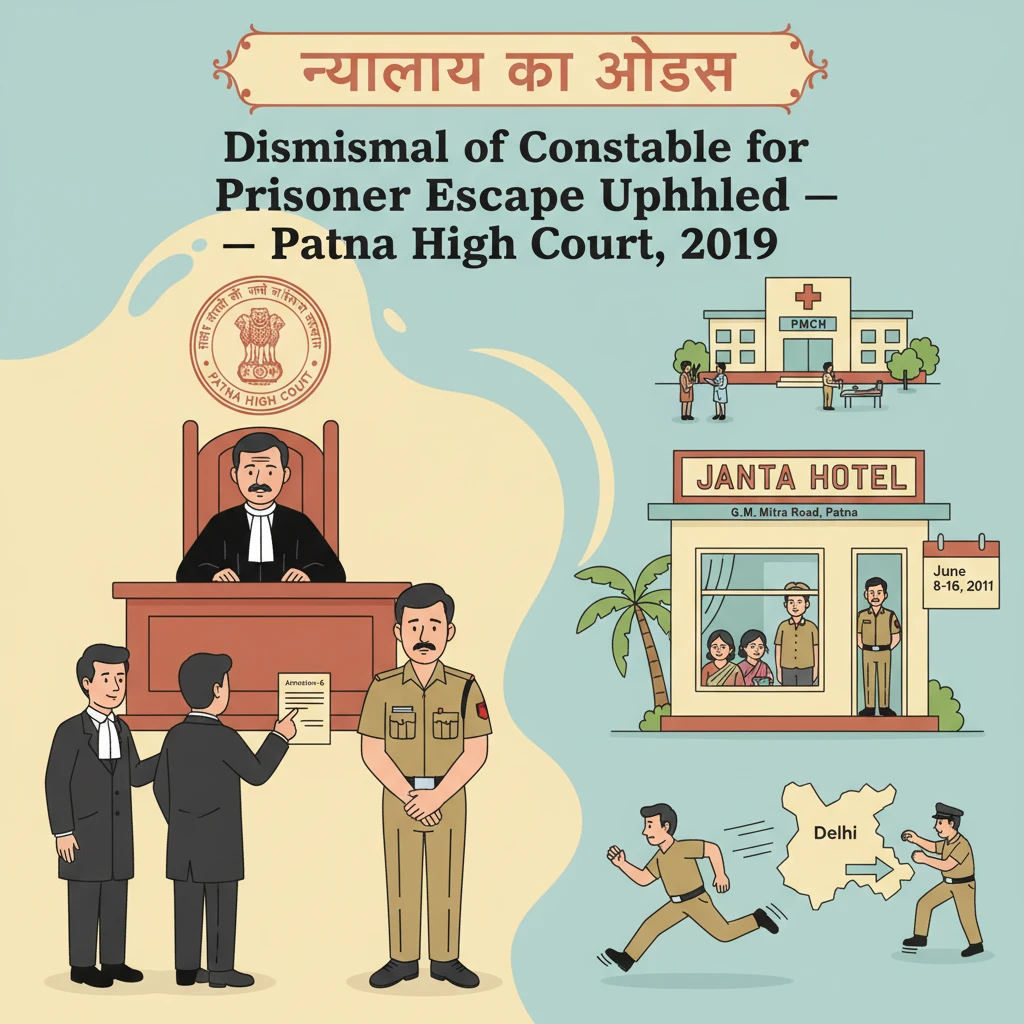
The case arises from a departmental action against a constable who had been entrusted with the custody of an undertrial prisoner. The prisoner was to be taken to Patna Medical College and Hospital for treatment.
According to the record considered by the Patna High Court, the undertrial was taken to the hospital as an outdoor patient. He was not admitted in the hospital.
Instead of returning the prisoner to jail or to proper police custody, he was lodged in Janta Hotel on G.M. Mitra Road, Patna. The enquiry revealed that hotel rooms had been booked in advance and that the mother and wife of the undertrial prisoner were also staying in the same hotel. The bookings were made before the arrival of the prisoner, Amit Mandal.
The prisoner’s stay in the hotel was admitted to be from 8 June 2011 till 16 June 2011. On 16 June 2011, at about 3 p.m., it was alleged that the prisoner absconded and escaped from the hotel.
Importantly, the authorities were informed about this escape only on the next day, i.e. 17 June 2011.
Following this incident, an enquiry was conducted against the constable. A show cause notice was issued to him, and he submitted a written reply. A copy of this reply was filed as Annexure-6 in the writ petition before the Single Judge.
After considering his defence, the disciplinary authority dismissed the constable from service by order dated 12 January 2013. His departmental appeal was rejected by the Deputy Inspector General of Police, Munger Range. He then filed a memorial before the Director General of Police, Bihar, which also failed.
Challenging these orders, the constable approached the Patna High Court in Civil Writ Jurisdiction Case No. 10321 of 2014. The learned Single Judge dismissed the writ petition by judgment dated 13 December 2017, upholding the dismissal from service.
The constable then filed a Letters Patent Appeal (LPA No. 83 of 2018) before a Division Bench of the Patna High Court. The oral judgment dated 23 April 2019, delivered by the Hon’ble Chief Justice and Hon’ble Justice Smt. Anjana Mishra, is the subject of this analysis.
What the Court Examined and Decided
The Division Bench first noted that the challenge in the appeal was to the order of dismissal from service and to the Single Judge’s decision that had refused to interfere with that dismissal.
The Court recounted the core facts which were largely undisputed. The appellant was a constable. He had custody of the undertrial prisoner for taking him to the Patna Medical College and Hospital. After the prisoner received outdoor treatment, he was not admitted. Instead of returning him to proper custody, the constable lodged him in a hotel, where he stayed for eight days along with his family members, whose rooms had been booked in advance.
The key circumstances that the Court underlined were:
First, the prisoner’s stay in the hotel from 8 June 2011 to 16 June 2011 was admitted.
Second, the escape took place on 16 June 2011 at about 3 p.m., but the authorities were informed only on 17 June 2011.
Third, the constable had not informed his superior officers at any stage that the prisoner was being lodged in a hotel instead of being kept in official custody or jail.
The Bench then turned to the defences raised by the appellant in his show cause and before the Court.
The appellant’s main defence was that there was no negligence on his part. He argued that there was no provision for admitting an undertrial prisoner in the hospital once he was only an outdoor patient. Because there was allegedly no accommodation available for returning him immediately, the prisoner was lodged in the hotel as a temporary arrangement. Preparations were, according to him, being made to take the undertrial back.
He further claimed that if he had intended to help the undertrial escape, he could have done so earlier and would not have waited eight days. He also stated that the prisoner had escaped on an earlier occasion and that he had not been warned about this background. From this, he attempted to argue that he could not be blamed for failing to anticipate another escape.
The appellant also tried to rely on an argument of discrimination. He stated that when the prisoner had earlier escaped, the police officer then in charge had not received such a harsh punishment. Therefore, according to him, the penalty of dismissal imposed on him was disproportionate and unwarranted.
Alongside these factual defences, the appellant raised certain procedural objections to the departmental enquiry. He contended that some documents relating to how the communication about the incident was made were not shown to him. Because of this, he argued, the enquiry was vitiated. He also submitted that witnesses were not examined in accordance with the procedure prescribed by law.
Another legal point raised was that negligence should not have been fixed only on him. Relying on paragraph 573 of the Bihar Police Manual, he argued that in cases of escape of a prisoner, higher officials should be proceeded against first when an allegation of negligence is made. According to him, it was wrong to single him out.
Finally, the appellant complained that no Presenting Officer had been appointed in the enquiry. He claimed this put him at a disadvantage and prevented him from properly presenting his case.
The Division Bench carefully considered these submissions but did not accept them.
On the question of negligence, the Court found that the nature of the defence itself showed a key admitted fact: the constable did not inform his superior officers about lodging the undertrial in a hotel. The Court noted the argument that a Havaldar had also accompanied the undertrial and that both were responsible to inform higher authorities. However, the Bench did not agree with this line of defence.
The Court held that an undertrial prisoner was allowed to enjoy accommodation in a hotel room for eight days without the knowledge of higher authorities. This was in violation of the Rules and beyond the competence of the appellant. He was not authorised to detain the prisoner in a hotel or permit such stay.
Given these facts, the Court concluded that negligence had rightly been attributed to the appellant. The Bench also considered the background that the undertrial had earlier escaped and that in this second attempt he escaped with the help of his family members, in circumstances where hotel rooms had been booked in advance. These surrounding facts strengthened the inference that the handling of custody was grossly improper.
In light of this material, the Division Bench saw no reason to come to a different conclusion than the authorities or the learned Single Judge. It also noted that the undertrial was later apprehended from Delhi, but this did not reduce the seriousness of the negligence.
On the claim of procedural violation concerning documents and witness examination, the Bench did not find substance. It emphasised that the appellant’s defence had been categorically considered by the authorities. In the Court’s view, the appellant had been given a full and fair opportunity to present all possible defences.
Regarding the absence of a Presenting Officer, the Court again rejected the appellant’s argument. It observed that the reply submitted by the appellant to the show cause notice itself showed his “excellent way of presentation of facts”. He had even quoted relevant Rules in his reply, indicating that he was fully aware of the legal position. Therefore, the Court held that the mere absence of a Presenting Officer did not prejudice his cause.
On the contention based on paragraph 573 of the Bihar Police Manual and the claim that higher officials should have been hauled up first, the Court did not accept this as a ground to interfere with the punishment imposed on the appellant. The judgment shows that the Bench focused on the appellant’s own role, his failure to inform superiors, and his unauthorised decision to keep the undertrial in a hotel.
The Court also did not accept the argument that the punishment was disproportionate, especially in view of the seriousness of the escape and the prior conduct of the undertrial.
In the end, the Division Bench held that there was no merit in the appeal. It affirmed the dismissal order and the Single Judge’s decision. The Letters Patent Appeal was accordingly dismissed.
Why This Judgment Matters
This judgment is significant for police personnel and others responsible for the custody of undertrial prisoners. It underscores that strict adherence to rules regarding custody and lodging of prisoners is essential.
The Patna High Court made it clear that a constable cannot unilaterally decide to keep an undertrial in a hotel, even for a temporary period, without informing superiors or following prescribed procedures. Keeping a prisoner with family members in a hotel for several days was treated as a serious breach.
The decision also shows that courts will rarely interfere with departmental punishment for such negligence, especially when a prisoner actually escapes. Arguments based on minor procedural lapses in enquiry, or comparison with earlier cases where others may have received lighter punishment, are unlikely to succeed if the core misconduct is admitted or clearly established.
For undertrials, families, and citizens, the judgment highlights how lapses in custody can directly affect public safety and the criminal justice process. For police officers, it is a warning that failure to follow rules, even if claimed to be due to practical difficulties like lack of accommodation, can lead to the extreme penalty of dismissal.
Legal Issues and Answers
- Issue: Whether the constable’s dismissal from service for the escape of an undertrial prisoner, who had been lodged in a hotel without informing superiors, was legally valid.
Answer: Yes. The Patna High Court held that the appellant was negligent, had violated rules by keeping the prisoner in a hotel without authority or intimation, and had been given full opportunity of defence. The dismissal order and the Single Judge’s judgment upholding it were affirmed. - Issue: Whether alleged procedural defects in the departmental enquiry, such as non-supply of certain documents, absence of a Presenting Officer, and alleged improper examination of witnesses, vitiated the proceedings.
Answer: No. The Court found that the appellant’s defence had been fully considered, he had fair opportunity to present his case, and his detailed, rule-based reply showed he was not prejudiced. The enquiry was not vitiated. - Issue: Whether punishment of dismissal was disproportionate, especially when earlier escape of the same undertrial had not attracted such harsh punishment for another officer.
Answer: No. Considering the prolonged hotel stay with family, lack of intimation to superiors, prior escape history of the undertrial, and successful second escape, the Court saw no reason to interfere with the penalty imposed.
Cases Cited by the Court
- The judgment does not record or rely upon any other decided cases. No prior case law is cited.
Case Details
Case Number: Letters Patent Appeal No. 83 of 2018 in Civil Writ Jurisdiction Case No. 10321 of 2014
Case Title: Parmeshwar Paswan v. The State of Bihar & Ors.
Coram: Hon’ble the Chief Justice Amreshwar Pratap Sahi and Hon’ble Justice Smt. Anjana Mishra
Citation: 2019(3) PLJR 275
Date of Judgment: 23-04-2019
Advocates: For the appellant – Mr. Ashok Kumar Chaudhary, Advocate; Mr. Binit Kumar, Advocate; Mr. Ashutosh Ankit, Advocate. For the respondents – Mr. Manish Dhari Singh, Assistant Counsel to Advocate General.
Nature of the Case: Letters Patent Appeal against dismissal of a writ petition challenging departmental dismissal from police service.
Link to the Judgment: https://patnahighcourt.gov.in/viewjudgment/MyM4MyMyMDE4IzEjTg==-Za58WHvqN6U=
If you found this explanation helpful and wish to stay informed about
how legal developments may affect your rights in Bihar,
you may consider following Samvida Law Associates for more updates.







