
Case Background
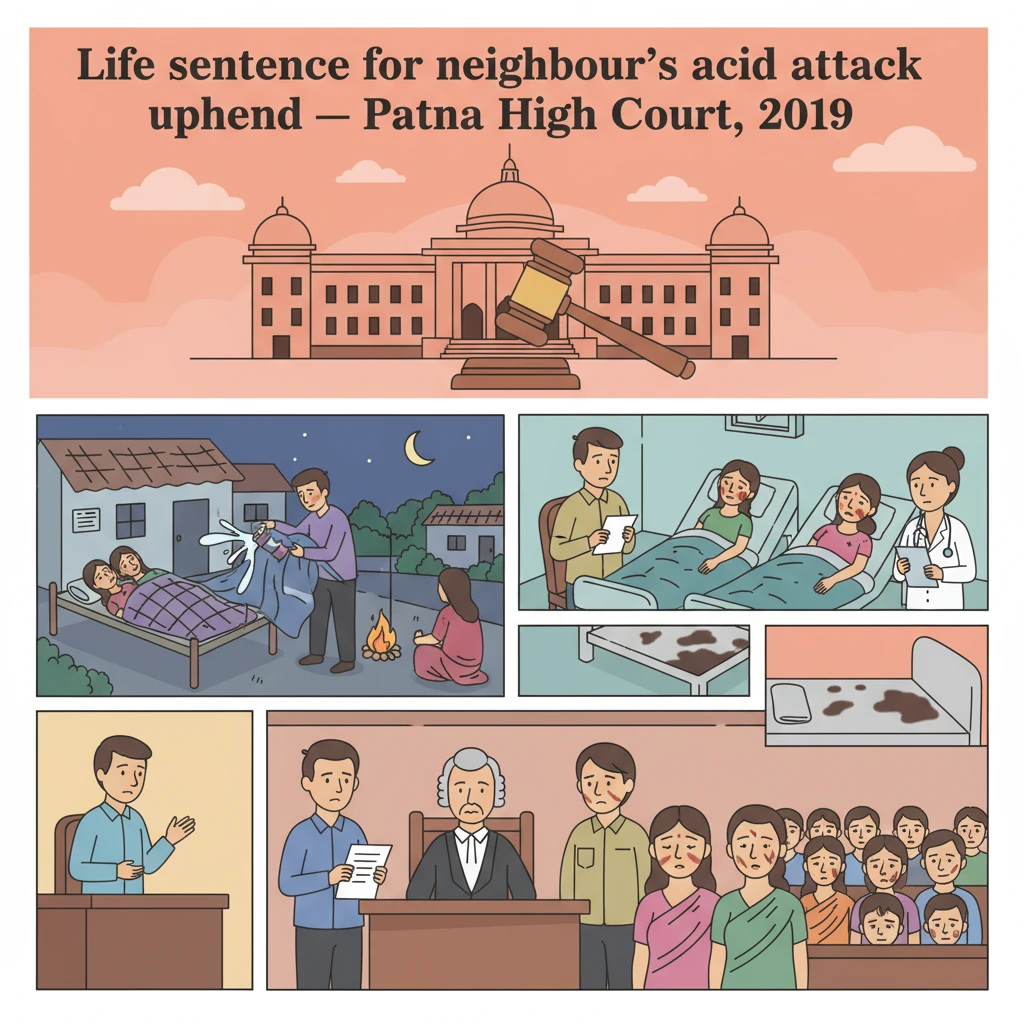
This case arises from a brutal acid attack in village Basganw Parsauni, within Bhairoganj Police Station, West Champaran.
According to the written report (fardbeyan) of the informant, a young woman, the incident started on the evening of 26.01.2011. She and her sister Priyanka were returning home from a village shop around 6:30 PM. Near the house of a washer-man, their neighbour, later the appellant, was standing and began passing lewd and obscene comments at them.
They objected and warned that they would hit him with a slipper if he continued. He became angry and allegedly threatened that he would “deface” her sister so that she would not be able to go to her marital home. After this exchange, the sisters went back to their house.
That night, between 26/27.01.2011, the informant and Priyanka were sleeping on a wooden cot (chowky) in one room. Their elder sister Ranjeeta and their mother were sleeping with the elder sister’s children in another room of the same house.
At about 1:00 AM, while Ranjeeta had stepped out to get her child defecated and was enjoying a bonfire near the door, the appellant allegedly entered the house with three unknown men. They went into the room where the two younger sisters were sleeping, removed the quilt from their faces and poured acid on them.
The informant stated that the faces, bodies, clothes and bedding of both sisters were burnt. They raised alarm. Their family members and villagers rushed in, and both injured sisters were taken first to Bhairoganj railway station and from there to M.J.K. Hospital, Bettiah, where the police recorded the informant’s fardbeyan on 27.01.2011 at about 1:00 PM.
On this basis, Chautarwa (Bhairoganj) P.S. Case No. 12 of 2011 was registered under Sections 448, 324, 326, 307, 509/34 of the Indian Penal Code (IPC) against the appellant, keeping investigation pending against the other unknown persons.
After investigation, the police submitted charge-sheet against the appellant under the same sections. The Magistrate took cognizance and committed the case to the Court of Session. It was tried as Sessions Trial No. 425 of 2011 before the 2nd Additional Sessions Judge, Bagaha, West Champaran.
The trial court framed charges under Sections 448, 326, 307 and 509 IPC. The appellant pleaded not guilty. Eleven prosecution witnesses were examined, including the two victim sisters, their relatives, independent villagers, two doctors and the Investigating Officer (IO). The appellant’s statement was recorded under Section 313 of the Code of Criminal Procedure, where he claimed complete innocence and produced a “handicapped certificate” (Exhibit A) in his defence.
By judgment dated 18.03.2013, the trial court convicted the appellant under Sections 324, 326, 448 and 509 IPC and sentenced him on 21.03.2013 to life imprisonment under Section 326 IPC with a fine of Rs. 50,000/- (and one year further rigorous imprisonment in default), along with separate sentences under the other sections.
Aggrieved, the appellant filed Criminal Appeal (DB) No. 700 of 2013 before the Patna High Court. The Division Bench heard the matter and delivered its oral judgment on 15.01.2019.
What the Court Examined and Decided
The main question before the Patna High Court was whether the prosecution had proved the charges against the appellant beyond all reasonable doubt.
The appellant’s counsel attacked the conviction on several grounds. He argued that only the two sisters (PW-2 Priyanka and PW-3 Nishu) were eyewitnesses and all other important witnesses were not present at the time of the attack. He highlighted differences about lighting in the room, pointing out that the fardbeyan did not mention any lamp, while later in court the informant and her sister said a lamp had been lit.
He stressed that, according to PW-2, it was a dark night at about 1:00 AM and there was no source of light, making identification of the attacker doubtful. He also questioned why Ranjeeta (PW-1), who was at the door near a bonfire, did not stop or chase the intruder if he entered the house. On these and similar points he claimed that the prosecution evidence was unreliable and that the appellant had been falsely implicated.
In the alternative, the defence submitted that if the conviction was to be upheld, the Court should at least reduce the sentence because the appellant had already spent about eight years in custody.
The Additional Public Prosecutor supported the trial court’s findings. He argued that the informant (PW-3) had fully supported the prosecution story, and that Priyanka (PW-2) and Ranjeeta (PW-1) corroborated the main events. The medical evidence of the two doctors matched the version of an acid attack and the severity of injuries. The State contended that minor omissions about a lamp in the fardbeyan could not defeat the case, especially when the accused was a neighbour known to the victims, and had threatened them only hours earlier.
The High Court first examined how many witnesses had actually seen the attack. It noted that several villagers and family members—PW-4 (Satyendra Pandey), PW-5 (Jay Chandra Pandey), PW-6 (Ramakant Tiwary), PW-8 (Nawal Tiwary) and PW-9 (Devanti Devi)—did not witness the pouring of acid.
PW-4 said he came to know of the incident only the next morning from Ranjeeta. But Ranjeeta did not confirm saying this to him, so his version remained uncorroborated hearsay and was not accepted.
PW-5 admitted that he was sleeping at home when the attack happened and only came to the house of the girls on hearing noise. He heard that acid had been poured on the daughters of Nawal Tiwary and that people were saying the appellant had done it. As none of those persons came to court to support this, his evidence also remained hearsay.
PW-6 initially claimed he saw the appellant fleeing after pouring acid while he was returning from defecation. In cross-examination, however, he stated that he was not present at the place of occurrence when the incident took place. The Court therefore treated him only as someone who allegedly saw the appellant running away, not as an eyewitness to the actual pouring of acid.
PW-8, the father of the victims, said he was at Ramnagar Mill with sugarcane and learnt about the attack from his wife over telephone, but PW-9, the mother, did not support that specific claim. She stated she had been sleeping in another room and only came to know of the incident when her daughter told her after the attack. So the Court accepted that PW-9 also was not an eyewitness.
The Bench then turned to the crucial evidence of the informant, PW-3 Nishu Kumari. In court she repeated the story given in the fardbeyan: the evening harassment, the threat to disfigure her sister, and the midnight intrusion with three others, removal of the quilt and pouring of acid on Priyanka, which also splashed onto her.
She described the aftermath: both sisters writhing in pain, relatives and villagers rushing in, and their eventual shifting to hospital via Bhairoganj railway station. She detailed the injuries—Priyanka’s entire face, hands and body badly burnt, and herself suffering burns on hand, neck, forehead and right leg.
The High Court carefully read her cross-examination and found nothing that could shake her presence at the place of occurrence or her version of how the appellant attacked them. It noted that she had faced intense questioning but remained consistent and credible, and that she was herself an injured witness, which lent strong weight to her testimony.
Priyanka (PW-2) also supported the prosecution in line with the fardbeyan and PW-3’s account. She told the court that she and her sister were treated at Bettiah Hospital and that she was still under treatment, blind in both eyes. The trial court had personally observed that her entire face and eyes were defaced with severe burn injuries.
In cross-examination, Priyanka clarified, in response to a court question, that she had not actually seen the appellant pouring the acid, but her sister had seen him. The High Court therefore treated PW-3 as the main eyewitness and PW-2 as an injured witness whose testimony corroborated the occurrence and nature of the attack, though not direct identification.
The Court examined Ranjeeta (PW-1) next. She claimed in chief-examination to be an eyewitness. But from the evidence of PW-2 and PW-3 and her own cross-examination, it became clear that at the exact time of the attack she had gone out to make her child defecate and was enjoying bonfire at the door. She only rushed in when her sisters screamed and saw them already burnt. The High Court concluded that she had not in fact seen the appellant pouring acid and was not an eyewitness, though she supported the circumstances immediately after the incident.
On the medical side, PW-10 Dr. Sri Kant Dubey examined Priyanka. He found second degree burns on the face, both eyes, and left arm and forearm. The injuries caused disfigurement of the face and improper closing of the eyes. He termed them grievous and caused by a corrosive liquid. He proved the injury report (Exhibit 4).
PW-11 Dr. K.M.P. Parvey examined the informant Nishu. He found acid burn injuries on her forehead, left side of face and a small part of her neck. He described these as simple injuries caused by a corrosive substance (acid). He proved the injury report and supplementary report (Exhibits 5 and 5/1). He clarified in cross-examination that it was an acid burn, which could be from sulphuric or any other acid.
The IO, PW-7 Bhagirath Prasad, stated that he found signs of acid—burn marks—on the cot and a “tat” (mat) at the place of occurrence, supporting the version that acid had been poured on the bed where the sisters were sleeping.
The defence tried to show that the appellant was physically handicapped and unable to commit such an act. They produced a handicapped certificate (Exhibit A), and PW-2 remarked in cross-examination that he was handicapped in his hand. However, the IO, in cross-examination, said he had personally examined the appellant and found both hands functioning “swiftly”; he could not be termed handicapped. The trial court also noted, while recording evidence, that though the appellant claimed paralysis, he was standing straight and smartly in the dock. The High Court accepted these observations and rejected the handicap claim.
On the argument about darkness and lack of a light source, the Court accepted that there was some inconsistency about a lamp in the room. But it held this did not help the defence. The appellant was a neighbour whose house stood only three houses away. He had just a few hours earlier threatened to deface Priyanka in front of Nishu.
Given this proximity and prior incident, the Court held that PW-3 was well acquainted with his physical features and could identify him even at night. It emphasised that the appellant had offered no convincing explanation for why the victims’ family would falsely implicate him in such a “heinous and sordid offence”.
Taking the ocular evidence of PW-3, the corroboration from PW-2 and other surrounding witnesses, the medical reports, and the physical evidence of acid burns at the spot, the High Court concluded that the prosecution had proved its case beyond reasonable doubt.
It therefore upheld the conviction and the life sentence under Section 326 IPC, as well as the sentences under Sections 324, 448 and 509 IPC. The Court refused to reduce the sentence, noting that this was a horrifying acid attack which had completely disfigured the victim’s face, rendered her blind in both eyes, and, as per evidence, occurred only 10–15 days before her scheduled marriage.
Finally, the Court noticed that the trial court had not stated whether the various sentences would run concurrently or consecutively. Since the appellant was already awarded life imprisonment under Section 326 IPC, the High Court directed that all other substantive sentences awarded under the allied sections should run concurrently with the life sentence.
The criminal appeal was dismissed.
Why This Judgment Matters
This decision of the Patna High Court is significant for several reasons, especially for victims of acid attacks and sexual harassment.
First, the Court treated the testimony of an injured woman victim as strong and reliable evidence, even when some other family members and villagers were not true eyewitnesses. It shows that if the main victim’s version is consistent, clear and supported by medical evidence, the court can rely on it to uphold a conviction.
Second, the judgment recognises that minor omissions in the initial report, such as not mentioning a lamp, will not by themselves destroy a case when the attacker is a known neighbour and was identified by voice, presence and recent past conduct.
Third, the Court took a firm stand on punishment. It refused to reduce the life sentence, stressing the permanent physical and emotional damage caused by the acid attack: complete disfigurement of face, blindness in both eyes, and the impact on the young woman’s upcoming marriage. This signals that in Bihar, courts will treat such offences with the utmost seriousness.
Fourth, the direction that all other sentences should run concurrently with the life sentence clarifies how multiple punishments in the same case are to be served. This offers guidance for trial courts in similar cases.
Overall, the judgment reinforces that sexual harassment escalating to an acid attack will attract severe consequences, and that attempts to escape liability by claiming false handicap or raising minor inconsistencies will not easily succeed.
Legal Issues and Answers
- Issue: Did the prosecution prove beyond reasonable doubt that the appellant committed the acid attack on the two sisters?
- Answer: Yes. The Court held that the consistent and credible testimony of the injured eyewitness (PW-3), supported by medical evidence, the condition of the scene, and surrounding circumstances, proved the appellant’s guilt under Sections 324, 326, 448 and 509 IPC.
- Issue: Should the life sentence under Section 326 IPC be reduced considering the appellant’s custody period and alleged handicap?
- Answer: No. The Court rejected the handicap claim as unsupported by evidence and held that, given the grievous and life-altering injuries to the victim, there was no ground to reduce the sentence.
- Issue: How should the different sentences under multiple IPC sections operate?
- Answer: The High Court directed that, as the appellant was already sentenced to life imprisonment under Section 326 IPC, the other substantive sentences under allied IPC sections would run concurrently.
Cases Cited by the Court
- The judgment does not mention or rely on any earlier decided case. No prior case law has been cited.
Case Details
Case Number: Criminal Appeal (DB) No. 700 of 2013; arising out of Chautarwa (Bhairoganj) P.S. Case No. 12 of 2011; Sessions Trial No. 425 of 2011
Case Title: Chunnu Chaubey v. The State of Bihar
Citation: 2019 (3) PLJR 320
Coram: Hon’ble Mr. Justice Rakesh Kumar and Hon’ble Mr. Justice Prakash Chandra Jaiswal
Date of Patna High Court Judgment: 15.01.2019
Trial Court: 2nd Additional Sessions Judge, Bagaha, West Champaran
Sections Involved: Sections 324, 326, 448, 509, 307, 34 of the Indian Penal Code (with conviction finally under Sections 324, 326, 448 and 509 IPC)
Advocates: For the Appellant – Mr. Nawal Kishore Singh, Advocate; Mr. Jitendra Nath Tiwary, Advocate; Mr. Sanjeeb Kumar Sanju. For the State – Mr. S.N. Prasad, APP.
Nature of Case: Criminal appeal (Division Bench) against conviction and sentence in a sessions trial relating to an acid attack.
Link to Judgment: View certified judgment of Patna High Court
If you found this explanation helpful and wish to stay informed about
how legal developments may affect your rights in Bihar,
you may consider following Samvida Law Associates for more updates.







