
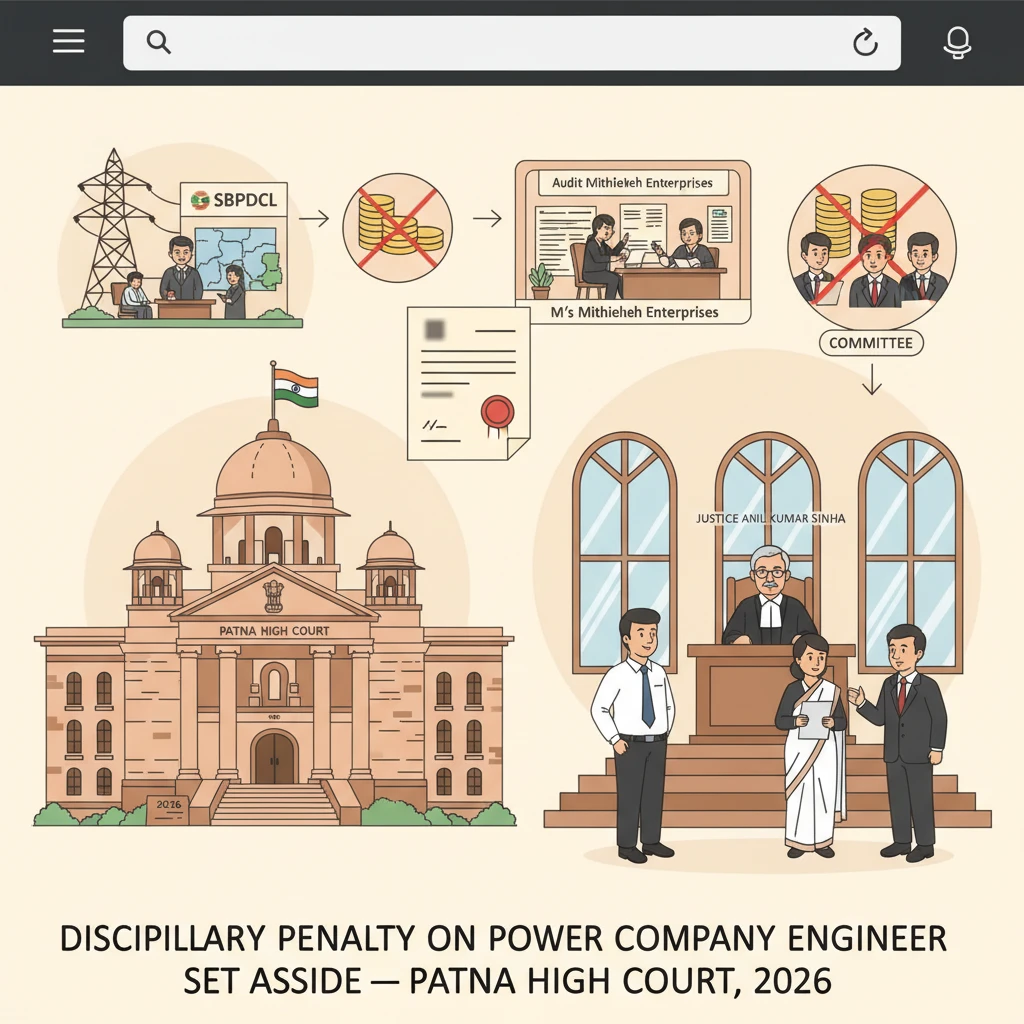
The Court held that the officer who started the enquiry and issued the charge memo had no legal authority to do so.
All related punishment orders were quashed, and the company was directed to refund the deducted amount within one month.
The writ petition was allowed, with no order on costs.
Case Background
The petitioner was appointed as a Junior Electrical Engineer by the erstwhile Bihar State Electricity Board (BSEB) through Notification No. 1097 dated 12.11.1999. He was later promoted to the post of Assistant Electrical Engineer on 17.09.2007.
On 25.10.2012, he was transferred from Electric Supply Sub-Division, Katihar (Urban) to Electric Supply Sub-Division, Rajgir. He joined at Rajgir as Assistant Electrical Engineer.
Meanwhile, with the enactment of the Electricity Act, 2003, the Electricity (Supply) Act, 1948 was repealed and BSEB ceased to exist. Exercising powers under Section 132 of the Electricity Act, 2003, the State Government issued a notification on 30.10.2012 restructuring BSEB into Bihar State Power Holding Company Limited (BSPHCL) and four subsidiary companies, including South Bihar Power Distribution Company Limited (SBPDCL).
Under Section 133 of the Electricity Act, 2003, services of all BSEB employees were initially transferred to BSPHCL on the same terms. Thereafter, they were allocated to subsidiary companies. As Rajgir is a distribution division, the petitioner became an employee of SBPDCL with effect from 01.11.2012.
SBPDCL is governed by a Board of Directors. The Managing Director is the Chief Executive and Administrative Head and became the employer of the petitioner in place of BSEB. Field undertakings are headed by the General Manager-cum-Chief Engineer.
Before the petitioner joined Rajgir, BSEB had issued a tender for appointment of a franchisee for collection of electricity bills. M/s Mithilesh Enterprises was selected as franchisee and Letter of Intent under Memo No. 3281 dated 28.08.2012 was issued by the Electrical Superintending Engineer, Biharsharif.
Under Clause 4 of the Letter of Intent, the Electrical Executive Engineer, Electric Supply Division, Rajgir, was designated as Work Incharge for operation of the contract. Clause 4.5(B) of the agreement between the franchisee and the Electrical Superintending Engineer, Biharsharif, allowed BSEB to authorize any person to inspect, verify and audit the franchisee’s performance, records and accounts.
The contract was for three years. However, during its subsistence, the franchisee defaulted in depositing collections. Scrutiny of accounts for 01.10.2012 to 30.11.2013 brought these irregularities to light and the contract was terminated.
A subsequent audit of accounts for 01.08.2012 to 30.11.2013 showed that the franchisee, during the contract period and even after termination, had collected money from consumers but failed to deposit it, allegedly defalcating more than ₹28,15,898/-.
On 13.01.2014, the Electrical Executive Engineer, Rajgir, constituted a committee to examine relevant records. For the first time, the petitioner was included as a member of this committee. The committee found a short deposit of ₹24,91,848/-. Acting as a committee member, the petitioner forwarded the inspection report to the Electrical Executive Engineer, Rajgir, by letter no. 30 dated 29.01.2014.
What the Court Examined and Decided
On 12.08.2014, the General Manager (HR & Administration), SBPDCL, issued Memo No. 1530 initiating departmental proceedings against the petitioner. It alleged there was reason to believe he was prima facie guilty of gross misconduct and negligence of duty, as per a charge sheet. He was asked to file a written statement within fifteen days. A Chief Engineer, SBPDCL, was appointed as Enquiry Officer.
The enquiry concluded with a report dated 20.11.2014. The report held that, though five charges were framed, no charge of financial embezzlement in collusion with the franchisee was proved. However, the petitioner was held guilty of negligence of duty. A second show cause notice dated 08.01.2015 was then issued by the General Manager (HR & Administration).
The petitioner replied on 09.06.2015, denying all charges. Despite this, the General Manager (HR & Administration) imposed punishment of withholding two annual increments with cumulative effect by order dated 13.05.2016, communicated under Memo No. 665.
The petitioner appealed to the Chairman-cum-Managing Director, BSPHCL, as appellate authority. By order dated 05.02.2017, the appellate authority modified the punishment to withholding one annual increment with non-cumulative effect, vide Resolution No. 267 dated 14.02.2017.
The petitioner then filed a review application on 13.05.2022 before the Chairman-cum-Managing Director, BSPHCL. It was rejected on 14.02.2017 as not maintainable. During pendency of the review, he approached the Patna High Court in CWJC No. 12243 of 2022. That writ was disposed on 30.09.2022 with liberty to challenge the review order by a fresh writ petition.
In the present writ petition (CWJC No. 314 of 2023), the petitioner sought quashing of the initial resolution dated 12.08.2014, the punishment orders of 13.05.2016 and 14.02.2017, and the communication dated 22.09.2022 rejecting review.
His main argument was that the departmental proceedings were initiated by an authority having no jurisdiction. He relied on an Office Order dated 11.03.2015 issued by the General Manager (HR & Administration). That order stated that, based on a Board decision, the General Manager (HR & Administration) of SBPDCL was authorized to exercise powers under the delegation of powers schedule issued by BSPHCL until posting of an Executive Director (HR & Administration) in SBPDCL.
The petitioner pointed out that this delegation came into force only on 11.03.2015, whereas the departmental proceeding against him had been initiated on 12.08.2014. Therefore, on the key date, the General Manager (HR & Administration) was neither appointing authority nor disciplinary authority.
He further referred to the Board of Directors’ resolution of SBPDCL notified via Order No. 164 dated 26.06.2013. By this, powers to award major and minor punishments to officers of the rank of Assistant Engineer/Electrical Engineer and equivalent were shifted from General Manager-cum-Chief Engineer of the concerned area/project to the Managing Director/Executive Director (HR). Thus, the Managing Director (subject to Board’s delegation) was the competent appointing and disciplinary authority.
Relying on Rule 16 of the Bihar Government Servants (Classification, Control and Appeal) Rules, 2005 (2005 Rules), the petitioner contended that only the Government, appointing authority, superior authority, or an authority empowered by general or special order could institute proceedings. The charge memo, second show cause and punishment all came from the General Manager (HR & Administration), without any shown delegation or approval from the Managing Director. Therefore, according to him, the very initiation was illegal.
On merits, he also argued that he had no role in appointing or supervising the franchisee, that the Executive Engineer was designated Work Incharge under the contract, and that he was involved only later as a committee member after the defalcation had already occurred.
The respondents opposed the writ. They argued that proceedings were lawfully initiated by the Managing Director, SBPDCL, via Resolution No. 1529 dated 12.08.2014, and that the General Manager (HR & Administration) acted accordingly. They said the enquiry officer’s report found all five charges proved, and that the petitioner had full opportunity to defend himself. They also highlighted that the appellate authority had already taken a lenient view by modifying the punishment to a single non-cumulative increment stoppage.
They further argued that the petitioner had earlier confined his grievance in CWJC No. 12243 of 2022 only to the review order, and thus the present broader challenge was not maintainable. They also claimed that since he never objected to the competence of the General Manager (HR & Administration) during the enquiry, appeal, or review, he was now estopped from raising this objection at a late stage.
Justice Anil Kumar Sinha examined the central question: was the departmental proceeding initiated by an authority having jurisdiction?
The Court noted that by order dated 26.06.2013, powers to award major and minor punishments to officers of the rank of Assistant Electrical Engineer were vested in the Managing Director/Executive Director (HR). The Office Order dated 11.03.2015 authorized the General Manager (HR & Administration) to exercise powers in the delegation schedule, but it was issued after proceedings against the petitioner had already begun and was only temporary up to appointment of the Executive Director (HR).
Memo No. 1530 dated 12.08.2014 initiating proceedings started from service of the charge memo. The charge memo itself was issued on 11.08.2014 under the signature of the General Manager (HR & Administration). Referring to Rule 16(1) of the 2005 Rules, the Court observed that only the Government, appointing authority, superior authority, or one empowered by Government order can institute a departmental proceeding.
Relying on a prior decision of the Patna High Court in Uday Pratap Singh v. The State of Bihar and Others, 2017 (4) PLJR 195, the Court reiterated that a disciplinary proceeding can only be initiated by a competent authority.
Under Rule 2(f) of the 2005 Rules, the appointing authority includes the authority which appointed the government servant to the service. Under Rule 2(j), the appointing authority is also the disciplinary authority.
In this case, the Court found that the decision to initiate proceedings was taken by the General Manager (HR & Administration). In paragraph 9 of the second supplementary counter affidavit, the respondents themselves admitted that the Managing Director is the disciplinary authority for the petitioner.
The charge memo, second show cause and final punishment order had all been issued by the General Manager (HR & Administration). Though respondents argued that the Enquiry Officer’s appointment order was issued under the Managing Director’s direction, they could not produce any resolution, notification, or order proving that the Managing Director had delegated his disciplinary powers to the General Manager (HR & Administration).
The charge memo did not mention that it was issued under the Managing Director’s direction, nor did it bear any approval of the appointing/disciplinary authority. This, in the Court’s view, showed that the memo was issued without approval of the competent authority.
The Court then referred to Supreme Court decisions in Union of India v. B.V. Gopinath, (2014) 1 SCC 351, State of Tamil Nadu v. Pramod Kumar, (2018) 17 SCC 677, and Sunny Abraham v. Union of India, (2021) 20 SCC 12. These decisions hold that a charge sheet or charge memo not approved by the disciplinary authority is non est in law.
Considering both facts and law, the Court held that initiation of disciplinary proceedings by an authority other than the appointing authority, without any delegation in his favour, was without jurisdiction. No contemporaneous or prior document showed lawful delegation of disciplinary powers to the General Manager (HR & Administration).
The Court rejected the respondents’ argument that the petitioner could not raise this issue later because he had not objected earlier. The Court held that a jurisdictional point goes to the root of the matter and, being a legal point, can be raised at any stage.
Consequently, the Court held that the very initiation of departmental proceedings and all consequential actions were vitiated.
Accordingly, the Patna High Court quashed Resolution No. 1530 dated 12.08.2014 (initiation of proceedings), Resolution No. 664 dated 13.05.2016 (punishment of two increments with cumulative effect), Resolution No. 267 dated 14.02.2017 (modified punishment), and Communication Letter No. 647 dated 22.09.2022 (rejection of review).
The Court directed the respondents to pay the petitioner the entire amount, if any, deducted due to the punishment, within one month from the date of judgment. The writ application was allowed, with no order as to costs.
Why This Judgment Matters
This judgment is significant for employees of public sector utilities and other government-controlled entities in Bihar and elsewhere. It clearly states that departmental proceedings must be started only by the legally competent authority or by someone properly empowered by a formal order.
If a person without such authority issues the charge memo or initiates proceedings, the entire enquiry and punishment can be struck down, even if the employee did not object earlier and even if some charges appear serious.
For employees, this decision shows that they can challenge disciplinary actions where the basic legal requirement of competence and delegation has not been followed. For employers, especially boards and corporations, it is a reminder to strictly follow their own delegation of powers and service rules before starting disciplinary proceedings.
Legal Issues and Answers
-
Issue: Whether the departmental proceeding against the petitioner was validly initiated by a competent authority under the 2005 Rules and the company’s own delegation of powers.
Answer: No. The Patna High Court held that the General Manager (HR & Administration) was not the appointing or disciplinary authority and there was no proved delegation of powers from the Managing Director. The charge memo lacked approval of the competent authority and was thus non est in law. -
Issue: Whether failure of the petitioner to object earlier to the competence of the authority prevented him from raising this jurisdictional issue in the writ petition.
Answer: No. The Court held that questions of jurisdiction go to the root of the matter and, being pure questions of law, can be raised at any stage of proceedings. -
Issue: What is the effect on subsequent punishment orders and review decisions when the initiation of departmental proceedings itself is void for lack of jurisdiction.
Answer: All consequential actions, including punishment orders, appellate modification, and the review rejection, stand vitiated and must be quashed, and the employee is entitled to refund of any amounts deducted under such illegal punishment.
Cases Cited by the Court
- Union of India v. B.V. Gopinath, (2014) 1 SCC 351
- State of Tamil Nadu v. Pramod Kumar, (2018) 17 SCC 677
- Sunny Abraham v. Union of India, (2021) 20 SCC 12
- Hukumchand Shyam Lal v. Union of India, AIR 1976 SC 789
- Manikant Pathak v. The State of Bihar, 1997 (1) PLJR 664 (FB)
- Vijay Kumar Mathur v. SBPDCL, 2023 (2) PLJR 668
- Uday Pratap Singh v. The State of Bihar and Others, 2017 (4) PLJR 195
Case Details
Case Number: Civil Writ Jurisdiction Case No. 314 of 2023
Case Title: Madhurendra Prasad v. Chairman-cum-Managing Director, Bihar State Power (Holding) Co. Ltd. & Others
Court: High Court of Judicature at Patna
Coram: Hon’ble Mr. Justice Anil Kumar Sinha
Date of Judgment: 06.01.2026
Citation: 2026(1) PLJR 553
Nature of the Case: Writ petition (civil) challenging departmental proceedings and punishment imposed by SBPDCL/BSPHCL authorities
Advocates:
- For the Petitioner: Mr. Umesh Prasad Singh, Senior Advocate; Mr. Vaibhava Veer Shanker; Mr. Sameer Sawarn
- For the Respondents: Mr. Dharmeshwar Mishra, Senior Advocate; Mr. Indrajeet Bhushan
Link to Judgment: Click here to access the official Patna High Court judgment
If you found this explanation helpful and wish to stay informed about
how legal developments may affect your rights in Bihar,
you may consider following Samvida Law Associates for more updates.







