

Case Background
The petitioner was a government servant from Aurangabad district. Disciplinary proceedings were started against him under Rule 17 of the Bihar Government Servants (Classification, Control and Appeal) Rules, 2005.
After enquiry, the Enquiry Officer held that the charges against the petitioner were proved. The report went to the disciplinary authority, the Superintendent of Police, Siwan, who is respondent no. 3 in the case.
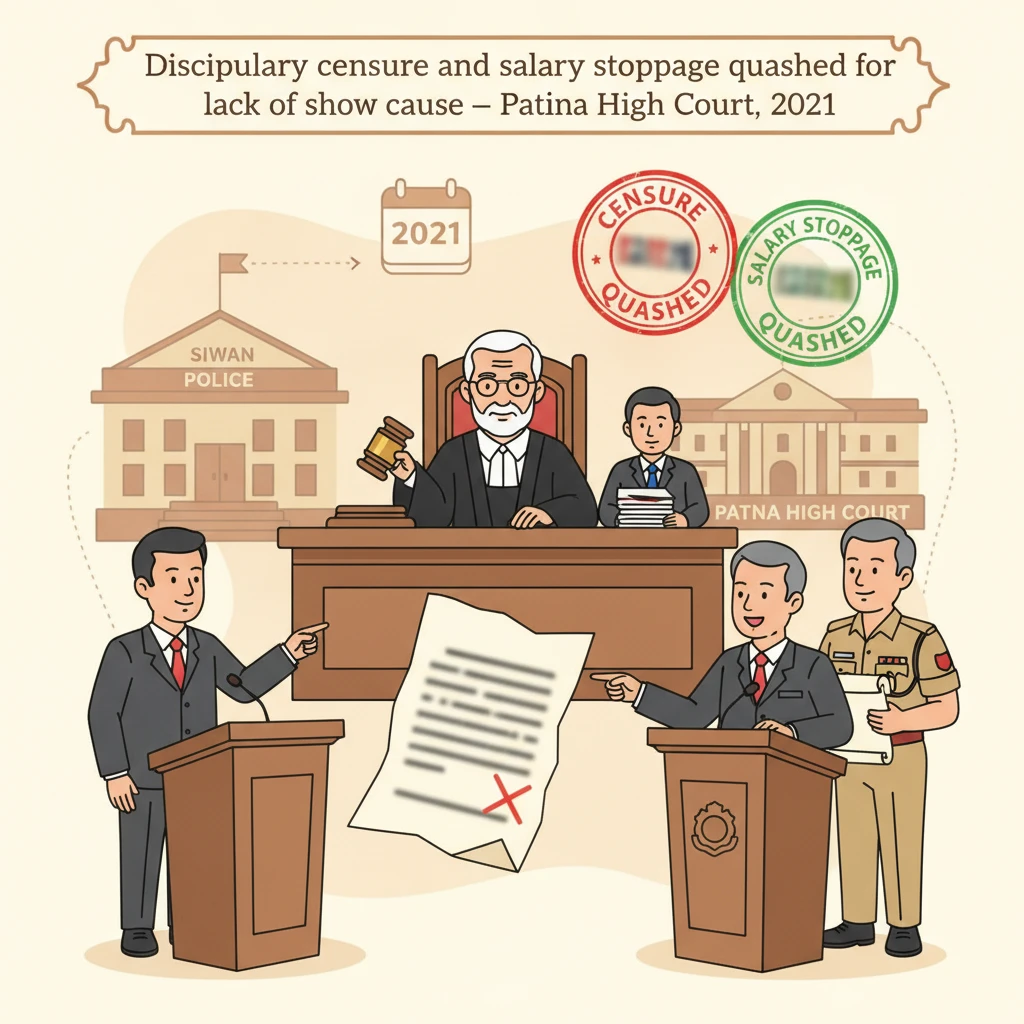
On 25.12.2019, the Superintendent of Police passed an order of punishment. The punishment was one censure, which was to be recorded in the service book. The order also directed that, except subsistence allowance, nothing else would be paid to the petitioner. The order thus withheld his salary for the period of alleged unauthorized absence.
The petitioner attained the age of superannuation on 31.12.2019, just a few days after the punishment order. Instead of filing a departmental appeal, he approached the Patna High Court by way of Civil Writ Jurisdiction Case No. 7770 of 2021.
Through this writ petition, he sought quashing of the punishment order dated 25.12.2019 and prayed for any other reliefs the Court found fit in the facts of his case.
What the Court Examined and Decided
The matter came up before Hon’ble Mr. Justice P. B. Bajanthri. The Court heard learned counsel for the petitioner and the learned counsel representing the State of Bihar and its officers.
The key question before the Patna High Court was whether the punishment order dated 25.12.2019 was passed in accordance with law, particularly the service rules governing departmental enquiries and the Bihar Service Code.
The Court first noted that the petitioner had been proceeded against under Rule 17 of the Bihar Government Servants (Classification, Control and Appeal) Rules, 2005. An enquiry was conducted and the Enquiry Officer concluded that the charges levelled against the petitioner stood proved.
However, the Court carefully examined what happened after the enquiry report was submitted. According to the judgment, once the Enquiry Officer’s report was received, the disciplinary authority directly went ahead and imposed the penalty.
The disciplinary authority did not give the petitioner a copy of the Enquiry Officer’s report. Nor was any show cause notice issued to the petitioner calling upon him to explain why the findings of the Enquiry Officer should not be accepted and why punishment should not be imposed.
This step is crucial in disciplinary matters. After an enquiry, the findings are not automatically final. The delinquent employee must be given a fair chance to read the report and respond to it. Only after considering his reply, if any, can the disciplinary authority lawfully decide on punishment.
In this case, the Court found that this mandatory safeguard was ignored. The authority straightaway imposed two consequences: first, the penalty of censure; and second, withholding of salary for the period treated as unauthorized absence. Because the petitioner was under suspension during a part of this period, the question also arose how that suspension period should be treated under the Bihar Service Code.
The Court then turned to Rule 97 of the Bihar Service Code, which deals with how pay and allowances are to be regulated when a government servant has been dismissed, removed, or suspended and is later reinstated. The rule also addresses how the period of absence from duty is to be treated.
The judgment reproduces Rule 97 in full. Under sub-rule (1), when a government servant who has been dismissed, removed or suspended is reinstated, the competent authority must pass a specific order on two points: first, about pay and allowances for the period of absence from duty; and second, whether that period will count as duty.
Sub-rule (2) says that if the authority finds that the government servant is fully exonerated or that the suspension was wholly unjustified, then he is entitled to full pay and allowances as if he had not been dismissed, removed or suspended.
Sub-rule (3) covers other cases where full exoneration is not found. There, only such proportion of pay and allowances may be granted as the competent authority prescribes. Sub-rule (4) provides that in a case under sub-rule (2), the period of absence shall be treated as duty for all purposes.
Sub-rule (5) deals with cases under sub-rule (3) and states that the period of absence is not to be treated as duty unless the competent authority specifically directs this for any specified purpose, and also allows conversion of that period into leave of any kind due and admissible.
The Court observed that although the disciplinary authority had withheld the petitioner’s salary on the ground of unauthorized absence, the suspension period had not been dealt with in terms of Rule 97. No clear order under Rule 97 was passed to regulate how that period would be treated for pay, allowances, and continuity of service.
Ordinarily, an employee has a statutory remedy of appeal against a punishment order under the service rules. The Court recognized that such remedy existed in this case. However, it also noted two special circumstances.
First, there was a clear violation of the requirement of giving a copy of the Enquiry Officer’s report and a second show cause notice to the petitioner before imposing punishment. This indicated a breach of statutory procedure and principles of natural justice.
Second, the petitioner had already attained the age of superannuation on 31.12.2019, soon after the punishment order. In such a situation, if the Court had sent him back to the appellate authority, it might have caused further delay and hardship, especially when the defect in procedure was evident on the face of the record.
In view of these factors, the Patna High Court chose to directly examine the validity of the punishment order, instead of insisting that the petitioner first pursue the departmental appeal.
After reviewing the material, the Court held that the petitioner had made out a case for interference with the penalty order dated 25.12.2019. The violation of statutory provisions relating to supply of the enquiry report and opportunity to respond was sufficient to set aside the order.
Accordingly, the Court set aside the penalty order dated 25.12.2019, which had imposed censure and denied salary beyond subsistence allowance.
However, the Court did not completely close the matter. Instead, it gave a clear direction to the disciplinary authority on how to proceed further. The authority was instructed to restart the process from the stage where the defect had occurred, that is, from the point after receiving the Enquiry Officer’s report but before imposing punishment.
The disciplinary authority was directed to complete the enquiry proceedings from that corrected stage within a period of two months from the date of receipt of the Court’s order. This means that the authority must now give the petitioner the Enquiry Officer’s report, allow him to submit his explanation, consider it, and then take a fresh decision on whether any punishment is to be imposed.
Further, the competent authority was directed to regulate the suspension period in accordance with Rule 97 of the Bihar Service Code. A specific order under Rule 97 must be passed within three months, deciding how the period of suspension and absence will be treated and what pay and allowances the petitioner will receive for that period.
With these directions, the writ petition was disposed of.
Why This Judgment Matters
This judgment of the Patna High Court is important for government servants facing departmental enquiries, especially in Bihar. It shows that even if charges are held proved by an Enquiry Officer, punishment cannot be imposed behind the back of the employee.
The Court reaffirmed that a copy of the Enquiry Officer’s report must be supplied to the delinquent employee and he must be given an effective chance to respond before any penalty is imposed. If this basic procedural safeguard is violated, the punishment order becomes vulnerable to being set aside.
The judgment also highlights the duty of authorities to pass clear orders under Rule 97 of the Bihar Service Code regarding how suspension and absence periods are to be treated for pay and service benefits. Simply denying salary without invoking Rule 97 in a reasoned way is not proper.
For employees retiring during or soon after departmental proceedings, this case indicates that the High Court may directly intervene when there is an obvious procedural violation, rather than sending them back to the departmental appellate authority.
Legal Issues and Answers
-
Issue: Whether the punishment of censure and denial of salary, imposed after a departmental enquiry under Rule 17 of the Bihar Government Servants (Classification, Control and Appeal) Rules, 2005, was valid when the Enquiry Officer’s report and a second show cause notice were not given to the petitioner.
Answer: No. The Patna High Court held that not providing the Enquiry Officer’s report and second show cause notice amounted to violation of statutory provisions, so the penalty order dated 25.12.2019 was set aside and the matter remitted to the disciplinary authority to proceed from the defective stage. -
Issue: How should the suspension period and related pay of the petitioner be dealt with after setting aside the punishment order.
Answer: The Court directed the competent authority to regulate the suspension period strictly under Rule 97 of the Bihar Service Code and to pass a specific order on this aspect within three months. -
Issue: Whether the Court should insist on the petitioner first filing a departmental appeal despite the existence of such a remedy.
Answer: In the special facts, particularly the clear procedural violation and the petitioner’s superannuation on 31.12.2019, the Court chose to decide the matter itself and not relegate the petitioner to the appellate remedy.
Cases Cited by the Court
- No previous judgments or case law have been cited or relied upon in the text of this decision.
Case Details
Case Number: Civil Writ Jurisdiction Case No. 7770 of 2021
Case Title: Ashok Kumar v. The State of Bihar & Ors.
Coram: Hon’ble Mr. Justice P. B. Bajanthri
Citation: 2022(1) PLJR 534
Advocates:
- For the petitioner: Mr. Mrigank Mauli, Sr. Advocate; Mr. Abhishek Anand, Advocate
- For the respondents: Mr. Suman Kumar Jha, AC to AAG-3
Nature of the case: Writ petition under civil writ jurisdiction challenging a disciplinary punishment order passed by the Superintendent of Police, Siwan.
Link to the judgment: Click here to read the full Patna High Court judgment
If you found this explanation helpful and wish to stay informed about
how legal developments may affect your rights in Bihar,
you may consider following Samvida Law Associates for more updates.







