

Case Background
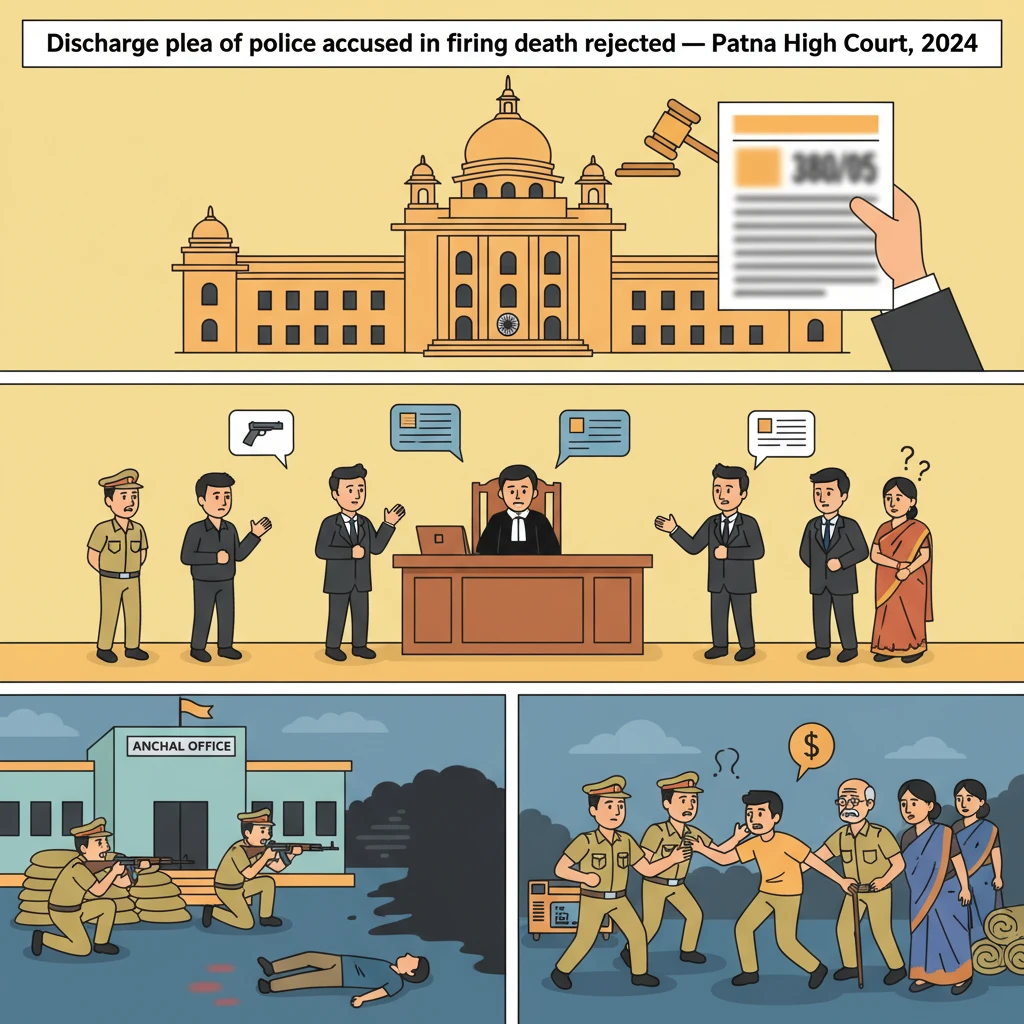
The case arises out of the death of Rajesh Kumar @ Babua Das on 6 April 2000 near the Bihpur Block Office in Bhagalpur district.
On the same night, at about 11:30 p.m., a havildar, Surya Nath Singh, gave a statement that led to registration of Bihupur P.S. Case No. 51 of 2000. He stated that he and four constables, including the present petitioners, were on sentry duty at the Block Office treasury. According to him, some unknown miscreants tried to enter the treasury, fired at the guards, and the police retaliated in self-defence and to protect government property. In that firing, one person, later identified as Rajendra @ Babua Das, died. He claimed the death occurred while protecting the treasury and government arms and ammunition.
Later, Rajesh’s father, Janardan Das, approached the Chief Judicial Magistrate under Section 156(3) Cr.P.C. alleging that his son was murdered by those very police guards. On this complaint, Bihupur P.S. Case No. 68 of 2000 was registered for offences including murder. The police investigated both P.S. Case No. 51 of 2000 and P.S. Case No. 68 of 2000 and, in each, filed a final report stating that the allegations were not substantiated and did not send up the accused for trial.
Before accepting the final report in P.S. Case No. 68 of 2000, the Magistrate notified the complainant. Janardan Das then filed a protest petition. This protest petition was treated as a court complaint and registered as Complaint Case No. 380 of 2005 at Naugachhia.
In this complaint, the father gave a very different story from the police version. He said his house was only about 100 yards from the Anchal (Block) Office, where the accused constables were posted as guards. Rajesh Kumar supplied generators and, because of proximity, had developed friendship with one of the constables. The complainant alleged that the guards and other constables were engaged in “Korean Silk” business with his son. When Rajesh tried to withdraw from their association after realising they were involved in smuggling, relations soured and animosity grew.
According to the complaint, on 6 April 2000, the constables threatened Rajesh. One constable allegedly caught him by the neck and, with the help of the others, forcibly took him to the Anchal Office. Family members and other villagers tried to intervene but were unable to stop them, and they followed to the Block Office. There, on the alleged order of the havildar in charge, a constable opened fire on Rajesh inside or near the treasury room, killing him on the spot.
The complaint further states that local people gathered immediately after the firing, but the guards did not allow anyone to touch the dead body. The body was sent for post-mortem and handed over to the family the next day, 7 April 2000.
The Magistrate examined the complainant and his witnesses on oath during the inquiry under Section 200 Cr.P.C. Being satisfied that there were sufficient grounds to proceed, he took cognizance of offences under Sections 302, 201 and 120B of the Indian Penal Code and Section 27 of the Arms Act against the accused guards and issued process. As the case was exclusively triable by the Court of Session, it was committed and registered as Sessions Trial No. 67 of 2018 before the Additional Sessions Judge, 2nd Court, Naugachhia.
The accused then moved an application under Section 227 Cr.P.C. before the Sessions Court seeking discharge. They said the death was an unavoidable result of police firing while protecting the treasury and their own lives and that they could not be prosecuted without prior sanction under Section 197 Cr.P.C. The Additional Sessions Judge rejected the discharge petition on 17 January 2019.
Aggrieved, the accused–now petitioners–filed Criminal Revision No. 363 of 2019 before the Patna High Court challenging this refusal to discharge them.
What the Court Examined and Decided
The Patna High Court, through Hon’ble Mr. Justice Bibek Chaudhuri, focused on one central question: whether the Sessions Court was wrong in refusing to discharge the petitioners for want of sanction under Section 197 Cr.P.C.
The petitioners’ lawyer argued that they were police constables deployed as guards at the Bihpur Anchal Office treasury. According to them, on the night of 6 April 2000, miscreants, along with the deceased, had attempted to commit theft in the government treasury. The guards fired only in discharge of their official duty to protect government property and their own lives.
On this basis, counsel submitted that the prosecution was bound to obtain previous sanction under Section 197 Cr.P.C. before the Magistrate could take cognizance or commit the case. He heavily relied on the Supreme Court decision in Om Prakash v. State of Jharkhand, (2012) 12 SCC 72, where protection was given to police personnel under a similar notification, and on the Full Bench judgment of the Patna High Court in Sri Ram Rekha Pandey v. State of Bihar, 2016 (3) BLJ 222.
He pointed out that the State of Bihar had issued a notification dated 16 May 1980 under Section 197(3) Cr.P.C., extending sanction protection to members of the police force for acts done while acting or purporting to act in discharge of official duty. The Full Bench in Sri Ram Rekha Pandey had upheld the notification and held that prior sanction is a condition precedent to prosecuting such police officers. Counsel also cited other Supreme Court decisions, including Abdul Wahab Ansari v. State of Bihar, (2000) 8 SCC 500, General Officer Commanding Rashtriya Rifles v. CBI, (2012) 6 SCC 228, and D. Devaraja v. Owais Sabeer Hussain, (2020) 7 SCC 695, to support the proposition that the question of sanction goes to the jurisdiction of the court and can be raised at any stage.
On the other side, the Additional Public Prosecutor relied on Devinder Singh v. State of Punjab through CBI, (2016) 12 SCC 87. In that case, the Supreme Court dealt with an alleged fake encounter where the police claimed they acted in discharge of official duty. The Court held that at the stage of framing charge, the trial court must proceed on the basis of the prosecution version. Only later, after evidence is led, can the court re-examine whether the act had a reasonable nexus with official duty and whether sanction is necessary.
Applying this reasoning, the State argued that, at the stage of considering discharge under Section 227 Cr.P.C., the court was required to look at the prosecution (complainant’s) story and the materials supporting it, not the defence version based on the earlier police case (P.S. Case No. 51 of 2000) and its final report.
The High Court then set out Section 197 Cr.P.C. in detail and referred to the Law Commission’s 41st Report explaining why protection from vexatious prosecution is needed for public servants. It clarified that under Section 197(1), sanction is required only for public servants who are not removable from office except by or with the sanction of the Government. However, by virtue of the State notification dated 16 May 1980 under Section 197(3), the protection was extended to members of the police force in Bihar while acting or purporting to act in discharge of official duty.
The Court accepted that the petitioners are members of the Bihar police force and fall within the protective scope of Section 197 read with the notification. The remaining question, therefore, was whether the act alleged against them was committed while acting or purporting to act in discharge of official duty.
The petitioners relied strongly on the final report in Bihupur P.S. Case No. 51 of 2000 and the havildar’s statement that the death occurred during an exchange of fire with miscreants attempting to loot the treasury. However, the Court compared this with the complaint version in Complaint Case No. 380 of 2005.
The complaint painted a completely different picture. It alleged that the deceased had a business and social relationship with the constables due to proximity. They were said to be jointly involved in Korean silk dealings. When Rajesh tried to withdraw from what he believed to be smuggling activities, animosity arose. On 6 April 2000, the constables allegedly threatened him, forcibly dragged him to the Block Office, and, on the order of the havildar, one constable fired at him, killing him. This, according to the complaint and witnesses examined under Section 200 Cr.P.C., was not a case of fighting miscreants or protecting government property but a murder arising out of a personal dispute linked to business dealings.
At the Section 227 stage, the trial judge’s task is limited: to look at the case record and documents submitted by the prosecution and to see whether there is sufficient ground to proceed. If the materials disclose a prima facie case, the accused cannot be discharged.
The High Court emphasised that at this preliminary stage, the court must primarily consider the prosecution version in the complaint case and the statements of the complainant and his witnesses. The defence story based on the earlier police case and final report is essentially a matter to be tested during trial. It may later be used as defence evidence, but it cannot override the complainant’s version at the threshold.
The Court observed that it “may so happen” that the havildar who lodged P.S. Case No. 51 of 2000 did not narrate the true account of the incident and that a false story may have been created to save the accused. The truth or falsity of that version can only be determined after evidence is led, not at the stage of discharge.
On careful consideration of the complainant’s case and initial evidence, the Court found that, prima facie, the deceased was not killed while the accused were performing official duty. Instead, the materials indicated that the death resulted from animosity which had developed in the course of a private business relationship between the deceased and the accused constables.
Because the alleged act was not, at this stage, shown to be done in discharge of official duty, the requirement of prior sanction under Section 197 Cr.P.C. did not arise. Hence, the Magistrate’s cognizance and the Sessions Court’s proceedings could not be faulted on that ground.
Accordingly, the High Court held that there was no error in the order of the Additional Sessions Judge rejecting the discharge application under Section 227 Cr.P.C. The criminal revision was dismissed on contest, and the impugned order dated 17 January 2019 was affirmed. The records were directed to be sent back to the lower court for continuation of trial.
Why This Judgment Matters
This judgment is important for families alleging that their relatives were killed in police firing but labelled as “encounters” or deaths in official action. The Patna High Court has made clear that, at the early stage, the court must look at the complainant’s story and supporting evidence, not only at the version given by police in their own FIR or final report.
The ruling shows that police officers cannot escape trial simply by saying they were on official duty. If the complaint and initial evidence suggest a private motive, such as personal enmity or business disputes, sanction under Section 197 Cr.P.C. will not block the case at the threshold.
For ordinary citizens, this means that a protest petition and a properly presented complaint, backed by witness statements, can still lead to a full trial even where the police initially close the case and claim self-defence in the name of duty.
Legal Issues and Answers
- Issue: Was prior sanction under Section 197 Cr.P.C. necessary before prosecuting the police constable petitioners for murder and related offences in this case?
Answer: No. On the basis of the complaint and initial evidence, the Court found that the alleged killing did not arise from discharge of official duty but from personal animosity, so sanction was not required at this stage. - Issue: Did the Sessions Court wrongly refuse to discharge the petitioners under Section 227 Cr.P.C. in Sessions Trial No. 67 of 2018?
Answer: No. The Patna High Court held that the Sessions Court correctly relied on the materials in the complaint case and found sufficient ground to proceed, making discharge inappropriate.
Cases Cited by the Court
- Om Prakash & Ors. v. State of Jharkhand & Anr., (2012) 12 SCC 72
- Abdul Wahab Ansari v. State of Bihar, (2000) 8 SCC 500
- General Officer Commanding Rashtriya Rifles v. Central Bureau of Investigation & Anr., (2012) 6 SCC 228
- D. Devaraja v. Owais Sabeer Hussain, (2020) 7 SCC 695
- Devinder Singh & Ors. v. State of Punjab through CBI, (2016) 12 SCC 87
- K. Ch. Prasad v. Smt. Vanalatha Devi & Ors., (1987) 2 SCC 52
- Sri Ram Rekha Pandey v. The State of Bihar & Ors., 2016 (3) BLJ 222 (Full Bench, Patna High Court)
Case Details
Case Number: Criminal Revision No. 363 of 2019 (arising out of Complaint Case No. 380 of 2005, Bhagalpur; Sessions Trial No. 67 of 2018)
Case Title: Dhananjay Kumar Singh & Ors. v. The State of Bihar & Anr.
Coram: Hon’ble Mr. Justice Bibek Chaudhuri
Date of Judgment: 11 January 2024
Citation: 2024(2) PLJR 600
Advocates:
- For the Petitioners (accused police constables): Mr. A.K. Thakur, Advocate; Ms. Vashanavi, Advocate; Mr. Shashank Shekhar, Advocate
- For the Respondents (State and complainant): Mr. Bharat Bhushan, Advocate
Nature of the Case: Criminal revision against an order of the Additional Sessions Judge refusing discharge under Section 227 Cr.P.C. in a sessions trial for offences under Sections 302, 201, 120B IPC and Section 27 of the Arms Act.
Link to Judgment: Full text of Patna High Court judgment
If you found this explanation helpful and wish to stay informed about how legal developments may affect your rights in Bihar, you may consider following Samvida Law Associates for more updates.







