

Case Background
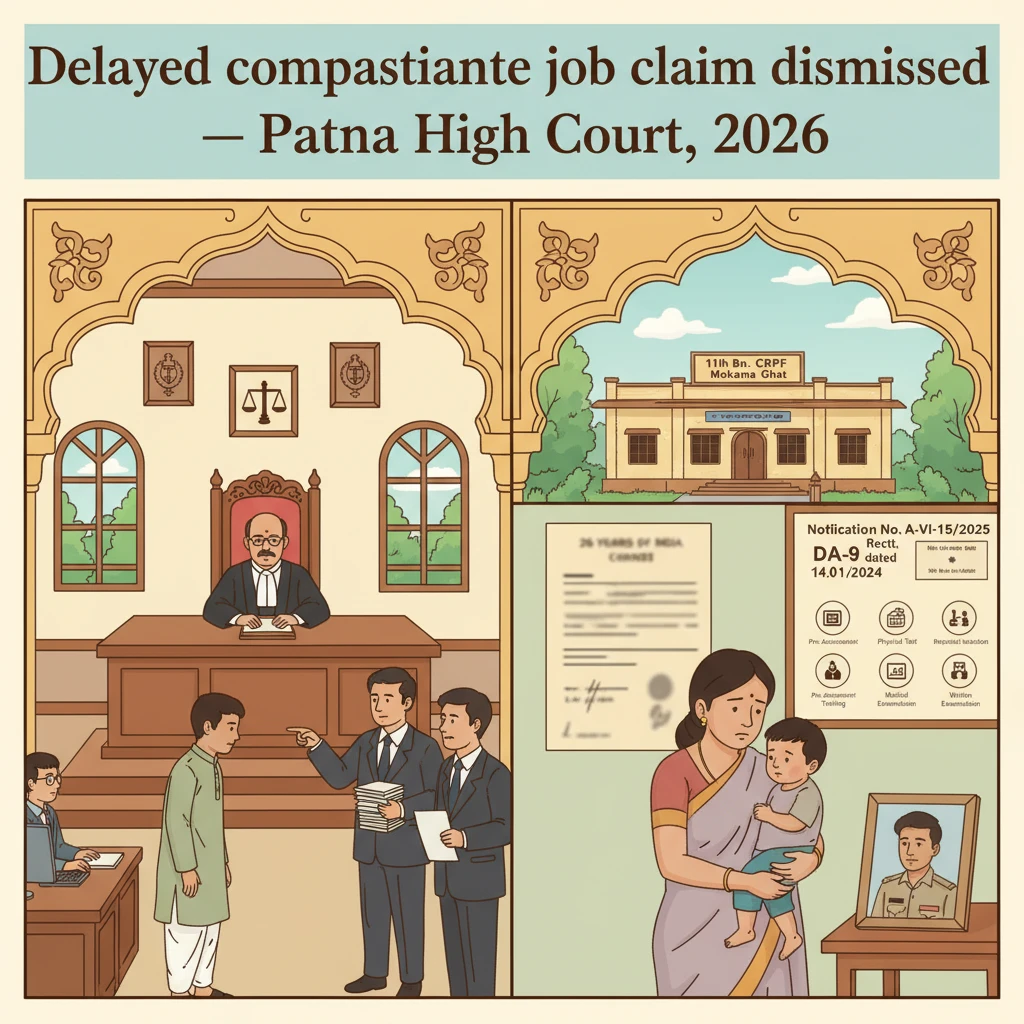
The case was heard by the Patna High Court in Civil Writ Jurisdiction Case No. 4723 of 2026. The petitioner is the son of a Central Reserve Police Force (CRPF) employee who had died while in service.
The petitioner’s father was serving as CT/DVR (No. 930110052) in the 11th Battalion, CRPF, Mokama Ghat, Bihar. He died in harness on 26.04.2005. At that time, the petitioner was only about one and a half years old.
Many years later, after he acquired the required educational qualification and age for a government job, the petitioner approached the CRPF authorities. He claimed to have filed an application before the competent authority seeking appointment on compassionate grounds. However, that original application was not produced before the Court.
According to the petitioner, based on his request, he was called for pre-selection or pre-assessment training for a post in CRPF on compassionate grounds. He attended and completed 15 days of such training.
He further stated that he successfully cleared the pre-assessment training, physical test, medical examination and written examination for the post of CT/Daftry under Notification No. A-VI-15/2025 Rectt. DA-9 dated 14.01.2024.
Despite this, he was not offered appointment. Feeling aggrieved, he approached the Patna High Court through a writ petition seeking directions to the authorities to grant him compassionate appointment.
What the Court Examined and Decided
The writ petition was filed mainly seeking a writ of mandamus. The petitioner requested that the Court direct the Union of India and CRPF authorities to reconsider his claim and grant him appointment on compassionate grounds to any suitable post, particularly the post of CT/Daftry under the 14.01.2024 notification.
The petitioner argued that he had already gone through the selection-related processes. He had completed 15 days of training and had successfully cleared the pre-assessment, physical, medical and written tests. On this basis, he claimed he was eligible and deserved appointment on compassionate grounds.
The Union of India, represented by its counsel, opposed the petition. They focused on the dates and the long delay. They pointed out that the petitioner’s father died on 26.04.2005 and at that time the petitioner was only about one and a half years old.
The Court noted that, according to the respondents, the petitioner had approached the authorities only after about 20 years from the date of death. The respondents, therefore, argued that such a belated claim for compassionate appointment was liable to be rejected on the ground of delay and laches.
After hearing both sides and examining the papers on record, the Court first established the key undisputed facts. It is admitted that the father of the petitioner died in harness on 26.04.2005. It is also admitted that the petitioner was a minor of about one and a half years at that time.
The Court observed that, after attaining majority, the petitioner is said to have submitted an application for compassionate appointment. However, crucially, that application itself was not brought on record before the Court. Only a certificate relating to 15 days’ training was placed on record.
The Court treated this training certificate as the only documentary indication regarding the petitioner’s participation in a process connected to compassionate appointment. The Court held that this by itself was not enough to show that he had any enforceable right to appointment.
The Court then turned to the settled legal position on compassionate appointments. It emphasised that the law is clear that compassionate appointment is not a regular mode of recruitment. Instead, it is a special, exceptional scheme meant to help a family facing sudden financial distress due to the death of a government employee while in service.
The Court explained that the object of compassionate appointment is to relieve “unexpected immediate hardship” faced by the family at the time of the employee’s death. It is intended to provide quick support so that the family can survive the financial shock caused by the loss of the breadwinner.
In this case, the death occurred in 2005. The petitioner was a small child at that time and is making his claim roughly two decades later, after becoming a major and after obtaining qualifications. The Court held that such a late claim cannot be treated as falling within the purpose of compassionate appointment.
To support its view, the Court relied on binding decisions of the Supreme Court of India.
First, the Court cited Jagdish Prasad versus State of Bihar and Another, reported in (1996) 1 SCC 301. In paragraph 3 of that judgment, the Supreme Court had clearly held that the object of compassionate appointment is to relieve unexpected immediate hardship and distress. The Supreme Court further held that when the death occurred long back, and the dependent was a minor at that time, he cannot claim appointment as a matter of right many years later after attaining majority.
The Supreme Court had warned that treating such delayed claims as valid would effectively create “another mode of recruitment” of dependants of deceased government servants, contrary to recruitment rules. The Patna High Court applied this reasoning directly to the petitioner’s case.
Second, the Court referred to Umesh Kumar Nagpal versus State of Haryana and Others, reported in (1994) 4 SCC 138. In paragraph 6 of that decision, the Supreme Court held that compassionate employment cannot be granted after a lapse of a reasonable period. The rules must specify this reasonable period and compassionate employment is not a vested right which can be exercised at any time in the future.
According to the Supreme Court, the purpose is to help the family get over the financial crisis at the time of the death of the sole breadwinner. Compassionate employment cannot be claimed indefinitely after the crisis is over. The Patna High Court used this principle to conclude that the petitioner’s claim, made 20 years after the death, was inconsistent with the very object of the scheme.
Third, the Court relied on Local Administration Department and Another versus M. Selvanayagam @ Kumaravelu, reported in (2011) 13 SCC 42. In paragraph 11 of that judgment, the Supreme Court again underlined that compassionate appointment is meant to provide immediate succour to the bereaved family which may find itself in dire straits.
The Supreme Court cautioned that making appointments many years after the death of the employee, or without properly examining the financial condition of the family, would violate Articles 14 and 16 of the Constitution. Such appointments, granted merely because the claimant is a dependant, were termed “quite bad and illegal”. The Patna High Court reiterated the necessity of keeping this vital aspect in mind.
The Court also noted that it had recently applied the same Supreme Court reasoning in another matter. In C.W.J.C. No. 5750 of 2022 (Janki Ballabh versus The State of Bihar and Ors.), decided on 09.02.2026, the Patna High Court had rejected a similar claim for compassionate appointment on the ground of delay and laches.
Drawing from all these authorities, the Court concluded that the petitioner’s case was squarely covered by the principle that compassionate appointment is meant for immediate relief and cannot be claimed as a deferred benefit decades later.
The Court therefore held that there was no merit in the writ petition. It dismissed the petition and also ordered that any pending applications in the case stood disposed of.
Why This Judgment Matters
This judgment is important for families of government employees, including paramilitary forces like CRPF, who may consider seeking compassionate appointments many years after a death in service.
The Patna High Court has clearly affirmed that compassionate appointment is not a permanent, open-ended right that can be invoked whenever a dependant becomes major or completes education. It must be linked to the immediate financial crisis caused by the death.
The decision also shows that merely being called for training, tests or pre-selection processes does not guarantee a job. Courts will still examine whether the basic requirement of timeliness and genuine immediate hardship is met.
For future cases in Bihar and for central forces posted in the State, this ruling signals that long-delayed claims, even if backed by some departmental steps, are likely to fail if they do not align with the underlying purpose of compassionate appointment schemes.
Legal Issues and Answers
- Issue: Can a dependant claim compassionate appointment in CRPF about 20 years after the employee’s death in harness, based on having undergone training and selection tests?
Answer: No. The Patna High Court held that compassionate appointment is meant to provide immediate relief to the family at the time of the death, and a claim made after such a long delay is barred by delay and laches and contrary to the object of the scheme.
Cases Cited by the Court
- Jagdish Prasad versus State of Bihar and Another, (1996) 1 SCC 301
- Umesh Kumar Nagpal versus State of Haryana and Others, (1994) 4 SCC 138
- Local Administration Department and Another versus M. Selvanayagam @ Kumaravelu, (2011) 13 SCC 42
- C.W.J.C. No. 5750 of 2022, Janki Ballabh versus The State of Bihar and Ors. (Patna High Court, judgment dated 09.02.2026)
Case Details
Case Number: Civil Writ Jurisdiction Case No. 4723 of 2026
Case Title: Aashish Kumar versus Union of India & Ors.
Coram: Hon’ble Mr. Justice Ritesh Kumar
Citation: 2026 (3) PLJR 138
Advocates: Mr. Rajeev Kumar, Advocate for the petitioner; Dr. K. N. Singh, ASG and Mr. R. K. Sharma, CGC for the Union of India
Nature of the Case: Writ petition seeking compassionate appointment in CRPF
Date of Judgment: 30.03.2026
Link to Judgment: https://patnahighcourt.gov.in/viewjudgment/MTUjNDcyMyMyMDI2IzEjTg==-6jxu4–ak1–Xq–ak1–JM=
If you found this explanation helpful and wish to stay informed about
how legal developments may affect your rights in Bihar,
you may consider following Samvida Law Associates for more updates.







