

Case Background
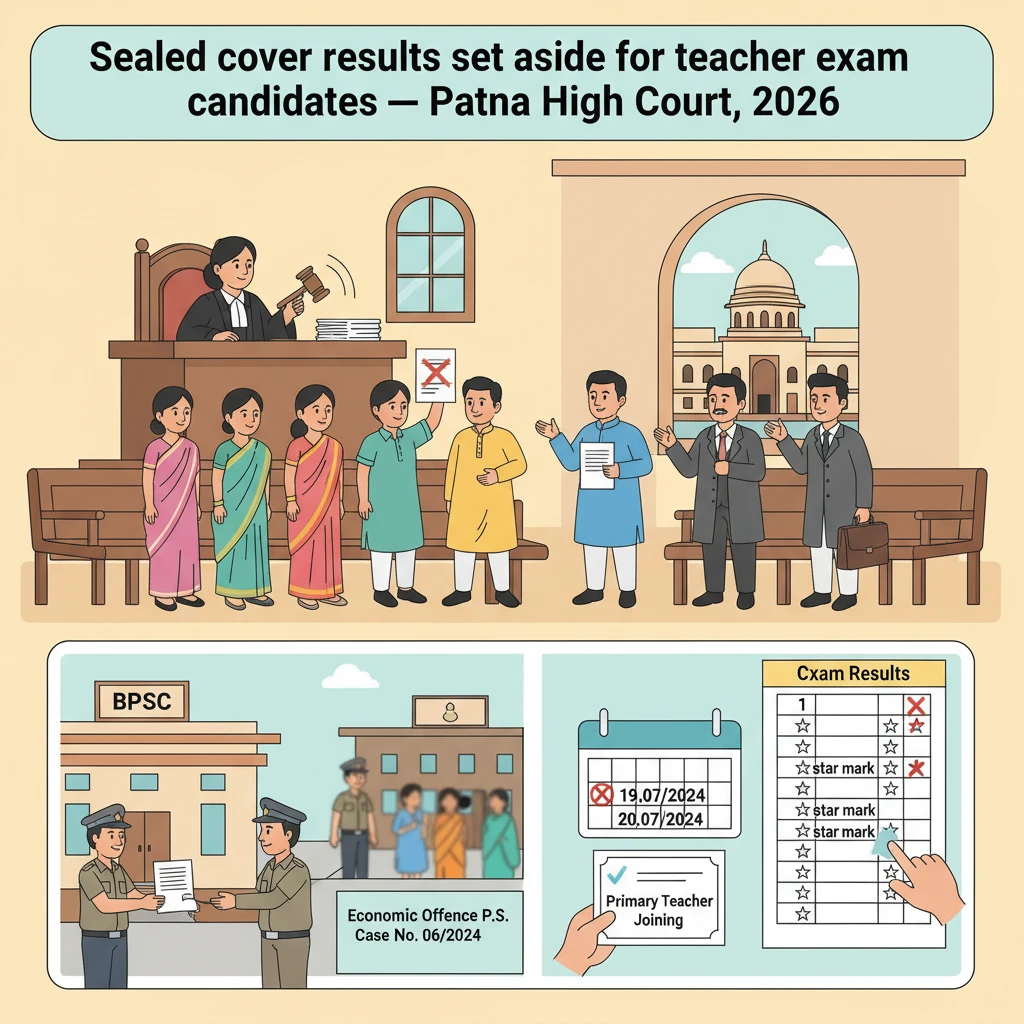
This case concerns nine candidates who appeared in the Bihar Public Service Commission (BPSC) Teacher Recruitment Examination for Elementary and Middle Schools under Advertisement No. 22/2024 dated 07.02.2024.
There had been a serious allegation of question paper leakage in the earlier round of the examination. Because of this, the earlier exam was cancelled and a re-examination, known as TRE-3.0, was conducted between 19.07.2024 and 22.07.2024.
Meanwhile, Economic Offence P.S. Case No. 06 of 2024 was registered in connection with the alleged paper leak. All nine petitioners were named as accused in this FIR. They were arrested during investigation, remanded to judicial custody, and later granted bail by the learned ACJM, Patna, on 02.04.2024.
After getting bail, the petitioners were issued admit cards and they appeared in the re-examination held on 19.07.2024 and 20.07.2024. According to them, they performed well and obtained marks above the cut-off. They relied on their OMR sheets and asserted that the Commission itself had shown them as successful.
On 15.11.2024, BPSC published the list of selected candidates. The petitioners’ names appeared, but with a “star mark” and a remark that their results would be given effect only after disposal of Economic Offence P.S. Case No. 06/2024.
Feeling that this remark blocked their appointment as primary teachers, the petitioners filed Civil Writ Jurisdiction Case No. 839 of 2025 before the Patna High Court on 12.12.2024. They asked the Court to order deletion of the star mark and to direct the authorities to process their joining with all consequential benefits.
What the Court Examined and Decided
The core dispute was whether BPSC and the State could legally keep the petitioners’ results and appointments on hold by invoking the “sealed cover” procedure only because a criminal case was pending against them.
The petitioners argued that they were fully qualified and had cleared the written examination on merit. They said the criminal case did not relate to their performance in the re-exam, and there was no substantive evidence of their guilt. They emphasized that they had already been granted bail.
They claimed that BPSC’s act of putting a star mark against their names in the result dated 15.11.2024 was arbitrary and similar to placing their results in a sealed cover without legal authority. According to them, pendency of an FIR could not, by itself, be a ground to deny appointment in a public job, especially where no charges had been framed by any court on the date the result was declared.
They also alleged violation of Articles 14, 16 and 21 of the Constitution of India, saying they had been treated differently from other similarly situated successful candidates whose appointments were processed.
On the other side, counsel for BPSC and its Examination Controller contended that the writ petition was misconceived. They clarified that BPSC was only a recommending body acting on requisitions from the Education Department.
BPSC explained that, after the question paper leakage, Economic Offences Unit (EOU), Bihar, informed the Commission that many FIR-named accused were also candidates in the re-exam. This included the present petitioners.
Faced with this information, BPSC decided to seek legal opinion. In its meeting on 11.11.2024, the Commission resolved to act according to advice from the Law Department and later from the General Administrative Department (GAD).
GAD, by letter dated 17.01.2025, advised that where an otherwise eligible candidate was facing criminal proceedings and had been charge-sheeted, the result should be kept in sealed cover so that the main selection process was not delayed.
Relying on this advice, BPSC adopted a uniform policy: the results of candidates implicated in the Economic Offence P.S. Case No. 06/2024 were “star marked” and kept in sealed cover till the outcome of the criminal case. BPSC argued this was done in good faith to protect the integrity of the recruitment and not as a final denial of appointment.
The Economic Offence Unit strongly opposed any relief. It highlighted that all nine petitioners were FIR-named accused, specifically identified with separate accused numbers. They had been arrested and later charge-sheeted under Charge Sheet No. 05 of 2025 dated 18.02.2025.
The EOU pointed out that the offences alleged were serious: Sections 420, 467, 468, 471, 120-B, and 34 of the Indian Penal Code, provisions of the Bihar Conduct of Examinations Act, 1981, and Section 66 of the Information Technology Act. The case related to a large-scale organized conspiracy to leak the BPSC Teacher Recruitment Examination (TRE-3) paper.
According to EOU, the investigation revealed an inter-state syndicate engaged in leaking question papers and tutoring candidates in hotels and banquet halls for money. Raids had led to recovery of leaked papers which matched the actual exam papers of 15.03.2024.
On this basis, EOU argued that the petitioners’ involvement in such a serious examination malpractice made them undeserving of equitable relief from the Court.
The State of Bihar submitted that it only acts on BPSC’s recommendations. Since no recommendation had been sent in favour of the petitioners, the State claimed it could not be blamed for withholding their appointments.
The Court then framed two specific issues:
(i) Whether BPSC’s use of the “sealed cover” doctrine to withhold the petitioners’ results and appointments was legally valid when no charges had been framed against them by any court on or before 15.11.2024.
(ii) Whether mere pendency of a criminal case, without any decision on guilt and without directly affecting performance in the exam, could justify denial or deferment of appointment of candidates who had otherwise qualified on merit.
On the first issue, the Court relied on the Supreme Court judgment in Union of India & Others vs. K.V. Jankiraman & Others, (1991) 4 SCC 109. The principle laid down there is that sealed cover procedure can be used only after a charge memo in a departmental proceeding or a charge sheet in a criminal case has been issued. Mere registration of FIR or preliminary investigation is not enough.
Applying this rule, the Court noted that the select list was published on 15.11.2024. The writ petition was filed on 12.12.2024. The charge sheet in Economic Offence P.S. Case No. 06/2024 was filed later, on 18.02.2025.
Therefore, on the crucial date when the petitioners’ results were star marked and withheld, there was no charge sheet or framed charges against them. The matter was only under investigation. Thus, the strict conditions laid down in K.V. Jankiraman for using sealed cover were not satisfied.
The Court held that BPSC’s action, based merely on FIR pendency and administrative instructions, went beyond the permissible legal limits. Sealed cover is an exception to normal declaration of results and must be used sparingly and strictly in line with law. Here, it was used prematurely and was therefore arbitrary and unsustainable.
On the second issue, the Court referred to the Supreme Court decision in Joginder Singh vs. Union Territory of Chandigarh (Civil Appeal No. 10126 of 2014). That case held that mere involvement in a criminal case, without concealment and without adjudication of guilt, cannot by itself disqualify a candidate from appointment.
In the present case, the petitioners had admittedly cleared the exam conducted by BPSC, even after the re-exam. This had not been disputed clearly in BPSC’s counter affidavit.
The only ground for withholding their appointment was that they were accused in the economic offence case. The Court pointed out that they had not been found guilty by any court and the criminal proceedings were still pending. So the presumption of innocence continued in their favour.
The Court emphasized that public employment is governed by Articles 14 and 16. Once a candidate clears all stages of selection, he or she gains a legitimate expectation of appointment, subject to suitability as per law. That expectation cannot be defeated only on the basis of unproven allegations.
The Court acknowledged that the allegations of paper leak were serious. However, seriousness alone could not override settled legal principles. Any decision to deny appointment must be based on conclusive, objective material, not just on FIR pendency.
The Court also noted that BPSC had adopted a blanket approach, treating all FIR-named candidates alike without examining individual roles or the exact stage of proceedings. Such a generalised treatment was held to be unfair and unreasonable.
In conclusion, the Court held that:
• The use of sealed cover by BPSC was illegal because no charge sheet existed on 15.11.2024.
• Mere pendency of the criminal case could not justify indefinite deferment of appointment of the petitioners, who had otherwise qualified on merit.
Allowing the writ petition, the Court issued specific directions. BPSC (Respondent Nos. 3 and 4) was directed to verify from its records whether the petitioners had actually qualified the examination and obtained marks above the cut-off.
If on verification the petitioners were found to be successful, BPSC was ordered to immediately declare their results and forward recommendations to the State. This verification and recommendation exercise was to be completed within four weeks from the date of receipt or production of the Court’s order.
After receiving BPSC’s recommendation, the State respondents were directed to take consequential steps for issuing appointment letters to the petitioners as early as possible, preferably within eight weeks.
The Court also allowed the State to include an express condition in the appointment letters that the appointments would be subject to the final outcome of Economic Offence P.S. Case No. 06/2024. Thus, the rights of both sides were balanced: the petitioners would not lose their jobs merely due to FIR pendency, but the State’s interest was protected if they were later found guilty.
The writ petition was allowed on these terms, with no order as to costs.
Why This Judgment Matters
This judgment is important for thousands of job seekers facing criminal cases based only on FIRs or ongoing investigation.
The Patna High Court made it clear that recruitment agencies like BPSC cannot mechanically hide results or deny appointment only because a candidate is named in an FIR. Until charges are formally framed or guilt is established, candidates are entitled to be treated as innocent.
For teacher recruitment and other public service exams in Bihar, the ruling limits misuse of the “sealed cover” practice. Authorities must follow the Supreme Court’s conditions before resorting to it.
At the same time, the judgment allows the State to protect itself by issuing appointments subject to the final result of pending criminal cases. This balances the rights of candidates and the need to maintain integrity of public employment.
Legal Issues and Answers
- Issue: Can BPSC invoke the sealed cover procedure and withhold results and appointments of candidates only because they are named in an FIR, when no charges have been framed on the date of the result?
Answer: No. The Patna High Court held that sealed cover can be used only after a charge memo or charge sheet is issued. Since the charge sheet in Economic Offence P.S. Case No. 06/2024 was filed on 18.02.2025, much after the result dated 15.11.2024, BPSC’s action was illegal and arbitrary. - Issue: Does mere pendency of a criminal case justify denial or deferment of appointment to candidates who have otherwise qualified on merit in a public examination?
Answer: No. Relying on Joginder Singh, the Court held that involvement in a criminal case without adjudication of guilt and without concealment cannot by itself disqualify a candidate. The petitioners’ appointments could not be stalled merely on the basis of unproven allegations.
Cases Cited by the Court
- Union of India & Others vs. K.V. Jankiraman & Others, (1991) 4 SCC 109
- Joginder Singh vs. Union Territory of Chandigarh, Civil Appeal No. 10126 of 2014
Case Details
Case Number: Civil Writ Jurisdiction Case No. 839 of 2025
Case Title: Monu Kumar & Ors. vs. The State of Bihar & Ors.
Citation: 2026(3) PLJR 207
Court: High Court of Judicature at Patna
Coram: Hon’ble Mr. Justice Alok Kumar Sinha
Date of Judgment: 31.03.2026
Advocates for the Petitioners: Mr. Awadhesh Kumar Mishra, Adv.; Miss Shivani Mishra, Adv.; Mrs. Pragati Singh, Adv.; Mr. Shashank Shekhar, Adv.; Miss Vidhi Shree, Adv.
Advocates for the State of Bihar: Mr. Arvind Ujjwal, SC-4
Advocate for BPSC: Mr. Vikash Kumar, Adv.
Advocates for Economic Offence Unit, Bihar: Mr. Vishwanath Prasad Sinha, Sr. Adv.; Mr. Vijay Anand, Adv.
Respondents: State of Bihar through Additional Chief Secretary, Human Resources Department; Director, Primary Education, Bihar; Chairman, Bihar Public Service Commission; Examination Controller, Bihar Public Service Commission; Additional Director General of Police, Economic Offence Unit, Bihar.
Nature of the Case: Civil writ petition seeking mandamus regarding declaration of result and appointment in teacher recruitment, and challenge to use of sealed cover procedure due to pendency of a criminal case.
Link to Full Judgment: Click here to read the full Patna High Court judgment
If you found this explanation helpful and wish to stay informed about
how legal developments may affect your rights in Bihar,
you may consider following Samvida Law Associates for more updates.







