

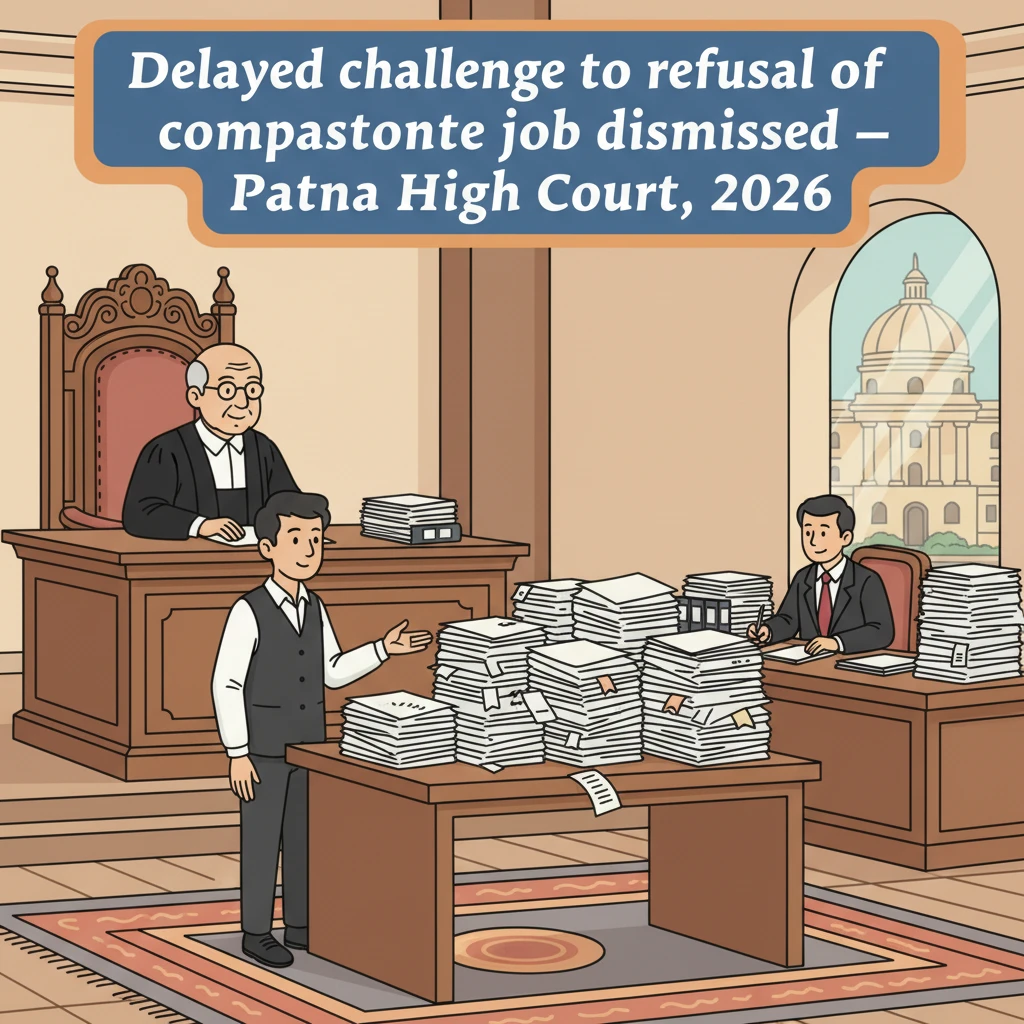
Case Background
The petitioner is the son of a deceased employee of the Central Water Commission posted at Tadong, Gangtok in the State of Sikkim.
His father died in harness on 15.01.2013 while still serving in the Central Water Commission.
Shortly after his father’s death, the petitioner applied for appointment on compassionate grounds. According to the judgment, he submitted this application on 12.02.2013.
The petitioner states that whenever the department called for documents, he promptly supplied them. However, he did not receive any appointment letter or clear written decision for several years.
On 05.12.2017, a legal notice was sent on his behalf by his lawyer to the department seeking information and action on his claim for compassionate appointment.
In response, by letter dated 14.12.2017, the Superintending Engineer of the Central Water Commission replied to the legal notice. This communication is treated as Annexure-5 to the writ petition.
In this letter, the department informed the petitioner that compassionate appointments could only be made against 5% of the available vacant posts. Under this 5% limit, only one post was available and that single post had already been filled by appointing another candidate, one Vimal Sharma, on compassionate grounds.
The department also mentioned that if and when further appointments were to be made, the petitioner would be informed.
The petitioner’s counsel submitted that despite several further representations, including the last one dated 25.05.2023, no fresh decision in his favour was communicated. According to him, he only received oral assurances but no positive written response.
It was in these circumstances that the petitioner filed Civil Writ Jurisdiction Case No. 18505 of 2023 before the Patna High Court seeking a direction to grant him compassionate appointment.
What the Court Examined and Decided
The matter was heard by Hon’ble Mr. Justice Partha Sarthy on 31.03.2026. Counsel for the petitioner, Mr. Sanjay Kumar, assisted by Ms. Rashmi Kumari, addressed the Court. No one appeared on behalf of the respondents.
The Court first noted the basic facts which were not in dispute. The petitioner’s father was an employee of the Central Water Commission at Tadong, Gangtok and died in harness on 15.01.2013. The petitioner applied for compassionate appointment on 12.02.2013.
The Court then looked carefully at the decision taken by the department on the petitioner’s request. It accepted that the petitioner’s application had indeed been considered and that a clear stand had been communicated by the respondents through the letter dated 14.12.2017, written by the Superintending Engineer.
In that letter, the respondents categorically expressed their inability to appoint the petitioner on compassionate grounds. The reason given was that under the policy governing compassionate appointments, only 5% of vacant posts could be filled in this manner. Based on the number of vacancies, this 5% quota worked out to one single post. That one post had already been used to appoint another candidate, Vimal Sharma, on compassionate ground. Therefore, there was no remaining vacancy available for the petitioner under the 5% quota.
The Court treated this letter as the decisive communication rejecting the petitioner’s request for compassionate appointment.
Next, the Court examined the time gap between this rejection and the filing of the writ petition. The judgment records that the letter of refusal was sent to the petitioner through his counsel on 14.12.2017. Yet the petitioner filed the present writ application only in 2023.
The Court highlighted that this delay was significant. It calculated that the writ petition had been filed more than 10 years after the death of the employee and more than 6 years after the respondents clearly communicated their inability to appoint the petitioner on compassionate grounds.
The Court observed that the petitioner had “sat over the matter” during this long period. The judgment notes that the petitioner did not provide any convincing or “good reason” to explain this delay in coming to Court.
To clarify the legal principles involved, the Court referred to two important Supreme Court decisions.
First, it cited the case of Umesh Kumar Nagpal vs. State of Haryana & Ors.; (1994) 4 SCC 138. The High Court summarised the principle laid down there: the purpose of granting compassionate employment is to help the family of a deceased employee to tide over the sudden financial crisis caused by the death of the breadwinner. The object is not to give a family member a job as a right, or to give them the same post held by the deceased employee.
In simple terms, compassionate job schemes are a narrow exception meant only as short-term support in an emergency situation, not as a general form of recruitment or long-delayed promise.
Second, the Court referred to the decision of the Supreme Court in Surjeet Singh Sahni vs. State of U.P. & Ors.; (2022) 15 SCC 536. In that case, the Supreme Court held that merely filing repeated representations does not extend or restart the limitation period for approaching the Court. A person who is aggrieved must come to Court within a reasonable time from the original cause of action. Sending reminders or representations later does not cure earlier delay.
Applying these principles to the facts of the present case, the Patna High Court reasoned that the rejection of the petitioner’s application on 14.12.2017 was the key event. If the petitioner was aggrieved by that decision, he should have approached the Court within a reasonable period thereafter.
However, he waited until December 2023 to file the writ petition. The Court held that this delay remained unexplained and that the law does not permit such stale claims, especially in matters of compassionate appointment which are meant to address immediate hardship.
Even beyond the issue of delay, the Court examined whether there was any illegality in the department’s decision itself. It considered the policy limitation restricting compassionate appointments to 5% of vacant posts and the factual statement that only one post was available under this quota, which had already been filled by appointing Vimal Sharma.
The Court categorically held that it found “no error/illegality” in the reasons given by the respondents in their letter dated 14.12.2017. In other words, the decision to deny appointment to the petitioner due to the full use of the 5% quota was in line with the existing policy and could not be faulted by the Court.
On this basis, the Court concluded that there was no merit in the petitioner’s writ application. It therefore dismissed the writ petition.
The judgment does not record any further directions regarding future consideration of the petitioner’s case or payment of any benefit. The relief sought, namely a direction to appoint the petitioner on compassionate grounds, was effectively declined.
Why This Judgment Matters
This judgment from the Patna High Court is important for families seeking compassionate appointment after the death of a government employee.
First, it underlines that compassionate appointment is not an automatic right. It depends on government policy, including any cap such as the 5% quota on available posts. If the quota is already filled, courts will generally not force the department to create or reserve additional posts.
Second, the judgment stresses that time is crucial in such matters. Compassionate appointment is meant to deal with sudden financial crisis around the time of death. Waiting many years to challenge a refusal weakens the claim. The Court made it clear that just sending repeated representations does not keep a case alive indefinitely.
Third, the ruling shows that courts will examine whether the department has followed the existing policy and whether the refusal letter gives a rational reason. If the reason is within the policy framework and there is no illegality, courts are slow to interfere.
For families of deceased employees, particularly in Bihar and nearby regions who approach the Patna High Court, this case is a reminder to act promptly and to understand the limits of compassionate appointment schemes.
Legal Issues and Answers
- Issue: Whether the petitioner, son of a deceased Central Water Commission employee, was entitled to a direction from the Patna High Court for appointment on compassionate grounds despite the department’s 2017 refusal based on a 5% quota.
Answer: No. The Court held that the claim was barred by unexplained delay and that there was no illegality in the department’s refusal, which correctly applied the 5% quota policy already exhausted by another compassionate appointment. - Issue: Whether repeated representations after the refusal letter could extend the time for approaching the Court.
Answer: No. Relying on the Supreme Court’s decision in Surjeet Singh Sahni, the Court held that filing representations does not extend limitation; a person must approach the Court within a reasonable time from the original refusal. - Issue: What is the purpose and scope of compassionate appointment in service law.
Answer: Referring to Umesh Kumar Nagpal, the Court reiterated that compassionate appointment is only to help the family tide over the sudden crisis caused by the employee’s death and does not confer a right to a job or to the post held by the deceased.
Cases Cited by the Court
- Umesh Kumar Nagpal vs. State of Haryana & Ors.; (1994) 4 SCC 138
- Surjeet Singh Sahni vs. State of U.P. & Ors.; (2022) 15 SCC 536
Case Details
Case Number: Civil Writ Jurisdiction Case No. 18505 of 2023
Case Title: Ranjit Kumar vs. The Union of India & Ors.
Coram: Hon’ble Mr. Justice Partha Sarthy
Citation: 2026 (3) PLJR 205
Advocates: Mr. Sanjay Kumar, Advocate for the petitioner; Ms. Rashmi Kumari, Advocate for the petitioner; None appeared for the respondents
Nature of the Case: Writ petition seeking direction for appointment on compassionate grounds
Date of Judgment: 31.03.2026
Court: High Court of Judicature at Patna
Respondent Authorities: Union of India and officers of the Central Water Commission including Principal Secretary, Under Secretary, Assistant Secretary, Deputy Director, Chief Engineer (HRM), Superintending Engineer, Executive Engineer, and the Departmental Screening/Compassionate Committee
Link to judgement; https://patnahighcourt.gov.in/viewjudgment/NSM5NTMjMjAxOSMxI04=-KwmyHaPt4ZQ=
If you found this explanation helpful and wish to stay informed about
how legal developments may affect your rights in Bihar,
you may consider following Samvida Law Associates for more updates.







