

Case Background
The petitioner is a Joint General Manager in an Ordnance Factory, serving under the Ministry of Defence, Government of India. He had faced departmental proceedings which resulted in a major penalty order dated 30.08.2013. Under that order, his pay was reduced by two stages in the time scale for one year, with non-cumulative effect, by way of withholding two annual increments.
Unhappy with this departmental punishment, the petitioner approached the Central Administrative Tribunal, Patna Bench, by filing Original Application (O.A.) No. 050/00583/2015 along with M.A. 050/00263/2017. During this period, he was serving at Ordnance Factory, Nalanda in Bihar.
While the O.A. remained pending, the petitioner was transferred in July 2016 from Ordnance Factory, Nalanda, to Ordnance Factory, Dehradun in Uttarakhand. The O.A. continued before the Tribunal and was finally decided on 03.01.2019.
By order dated 03.01.2019, passed by Hon’ble Member (Judicial) Shri Jayesh V. Bhairavia and Hon’ble Member (Administrative) Shri Dinesh Sharma, the CAT dismissed the petitioner’s O.A. The Tribunal also effectively upheld the reviewed administrative order of the Central Government dated 28.04.2015, which had confirmed the original major penalty order of 30.08.2013 issued by the Ministry of Defence.
The petitioner then chose to approach the Patna High Court by way of Civil Writ Jurisdiction Case No. 9540 of 2021. In this writ petition, he sought to set aside the CAT’s order dated 03.01.2019, the reviewed order dated 28.04.2015, and the original major penalty order dated 30.08.2013.
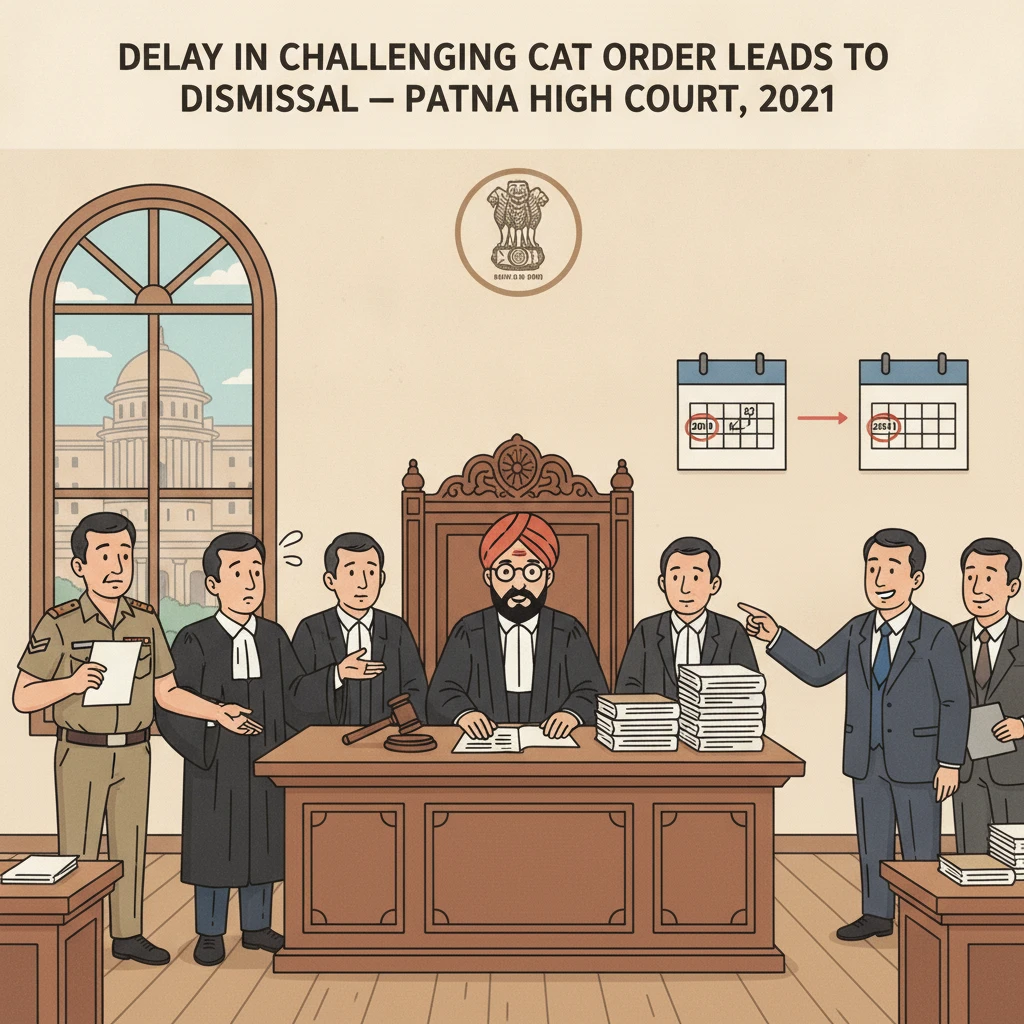
The writ petition, however, was filed only on 27.01.2021 and registered on 29.01.2021, more than two years after the CAT’s decision. This long delay became the central point in the High Court’s decision.
What the Court Examined and Decided
The Bench comprising Hon’ble Mr. Justice Vikash Jain and Hon’ble Mr. Justice Rajesh Kumar Verma heard both sides. The respondent authorities, including the Union of India and senior officers of the Ministry of Defence and Ordnance Factory Board, raised a preliminary objection on limitation and delay.
In paragraph 6 of their counter affidavit, the respondents pointed out that the petitioner had challenged the CAT’s order dated 03.01.2019 only in 2021, after a gap of more than two years. They also stressed that the writ petition did not disclose any facts showing that the disciplinary inquiry was conducted improperly or that there was violation of any law.
Thus, the respondents argued that the petition should be dismissed on the ground of delay and laches alone, without going into the merits of the departmental proceedings or the CAT’s reasoning.
In response, the petitioner relied on paragraph 16 of his rejoinder to explain the delay. He stated that his O.A. before the CAT had remained pending till 02.01.2019 and that in the meantime he had been transferred in July 2016 from Nalanda to Dehradun. According to him, this transfer did not come to the knowledge of his counsel at Patna.
The petitioner further claimed that he had lost his old mobile phone in which his counsel’s contact number was saved. Because of this, he said, he had to purchase a new mobile phone with a different number, which allegedly led to a communication gap between him and his counsel for a long period.
He also mentioned that he and his family members fell ill during the first wave of the COVID-19 pandemic in April 2020. According to his version, he recovered and later came to Patna on 24.01.2021, while travelling to his native village near Barh. At that time, he contacted his counsel, who then informed him about the CAT order and handed over a certified copy.
The petitioner stated that he immediately decided to file a writ petition against the CAT’s order and engaged counsel for this purpose. On this basis, the writ petition was filed belatedly on 27.01.2021 and registered on 29.01.2021. He described these circumstances as “unavoidable” and pleaded that the delay of about two years be “condoned or ignored” because, according to him, there was merit in his case and he was innocent of any intentional delay.
The High Court considered this explanation in detail. The Court was not satisfied with the reasons given. It observed that it was “highly unlikely” that, after being transferred from Ordnance Factory, Nalanda, to Ordnance Factory, Dehradun in July 2016, no communication at all was possible between the petitioner and his counsel for nearly five years.
The Court also noted that the petitioner’s stand about losing his old mobile phone and buying a new one was vague and unsupported. Importantly, the explanation did not mention any specific mobile numbers or dates. This lack of concrete details weakened the credibility of the story.
The Bench emphasised an important principle: a court exercising writ jurisdiction is, in many respects, a court of equity. Such a court comes to the aid of a diligent litigant, not someone who has been careless about pursuing his own case. The Court found that the petitioner had not shown what steps he had taken during these years to contact his counsel or to find out the status of his case pending before the CAT.
The Judges also drew attention to another crucial aspect: the writ petition itself did not contain any material explaining the period of delay. The explanations about transfer, loss of mobile phone, and COVID-19 infection appeared only later in the rejoinder, after the respondents had taken an objection in their counter affidavit. This timing suggested that the explanation was not a genuine contemporaneous reason but a later justification.
In light of these factors, the Court held that there was clear delay and laches on the part of the petitioner, and this delay had not been satisfactorily explained. Because of this, the Bench decided not to go into the detailed merits of the disciplinary proceedings, the reviewed order, or the CAT’s judgment.
Ultimately, the Patna High Court concluded that it was “not inclined to interfere” with the impugned order of the CAT. Consequently, the writ petition was dismissed.
By dismissing the writ petition purely on the ground of delay and laches, the High Court effectively left intact the CAT’s order dated 03.01.2019, the reviewed Central Government order dated 28.04.2015, and the original disciplinary penalty order dated 30.08.2013.
Why This Judgment Matters
This judgment sends a clear message to government employees and other litigants who approach the Patna High Court against orders of the Central Administrative Tribunal or similar bodies. Even if a person believes the punishment or decision is unfair, the challenge must be made within a reasonable time.
The Court underlines that vague and general excuses, such as change of posting, loss of a mobile phone, or unspecified communication gaps with lawyers, will not be enough to justify a long delay. Concrete dates, details, and proof are required for any claim that the delay was beyond the litigant’s control.
The ruling also reminds litigants that they must remain active and alert about their own cases. Simply filing a case and then forgetting about it, without checking with the lawyer or the court for years, can be fatal to their rights.
For employees facing departmental proceedings, this case highlights that once the Tribunal has decided the matter, they should immediately obtain a copy of the order and seek legal advice. Waiting for years before approaching the High Court may close the door on any further challenge, no matter how serious they consider the punishment.
Legal Issues and Answers
-
Issue: Whether the Patna High Court should interfere with the Central Administrative Tribunal’s order upholding a disciplinary penalty when the writ petition was filed more than two years later without a convincing explanation for the delay.
Answer: No. The Court held that there was unexplained delay and laches on the part of the petitioner, rejected the offered explanation as unsatisfactory and vague, and therefore refused to interfere with the CAT’s order.
Cases Cited by the Court
- The judgment does not mention or rely upon any specific earlier case law by name. The Court proceeds on general principles of delay, laches, and diligence in approaching an equity court.
Case Details
Case Number: Civil Writ Jurisdiction Case No. 9540 of 2021
Case Title: Prashant Kumar v. The Union of India & Ors.
Citation: 2022(1) PLJR 72
Court: High Court of Judicature at Patna
Date of Judgment: 02.11.2021
Coram: Hon’ble Mr. Justice Vikash Jain, Hon’ble Mr. Justice Rajesh Kumar Verma
Advocates: Mr. Shambhu Sharan Singh, Advocate for the petitioner; Mr. Raj Kamal, Central Government Counsel (CGC) for the respondents
Respondent Authorities: Union of India; Secretary, Department of Defense Production, Ministry of Defence, Government of India, New Delhi; Director-General and Chairman, Ordnance Factory Board, Kolkata; Chief Vigilance Officer, Department of Defence Production, Ministry of Defence, New Delhi; Chief Vigilance Officer, Ordnance Factory Board, Kolkata; General Manager, Ordnance Factory, Nalanda (F.N), Bihar
Nature of the Case: Writ petition under civil writ jurisdiction challenging a Central Administrative Tribunal order which had upheld a departmental major penalty imposed on a central government employee.
Result: Writ petition dismissed on the ground of delay and laches; no interference with the CAT order or the disciplinary penalty.
Link to Judgment: Click here to read the full judgment of the Patna High Court
If you found this explanation helpful and wish to stay informed about
how legal developments may affect your rights in Bihar,
you may consider following Samvida Law Associates for more updates.







