

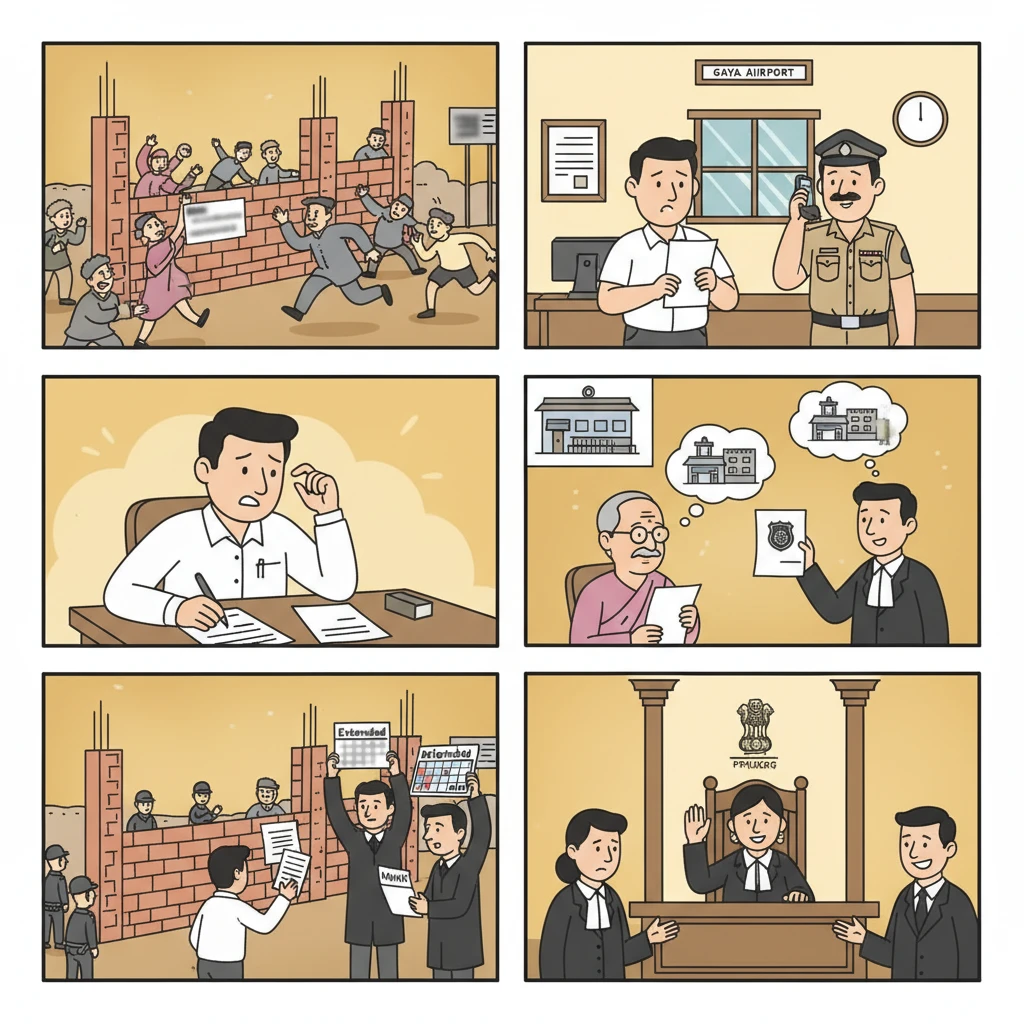
Case Background
The dispute began with a construction contract for a property boundary wall on Airports Authority of India (AAI) land at Gaya Airport, Bihar. Tenders were invited on 07.11.2016 through the e-tendering portal by the Assistant General Manager (Engineering – Civil), AAI, Gaya Airport, acting on behalf of the Chairman, AAI.
The work was estimated to cost Rs. 2,12,07,560 with a completion period of six months, and involved RCC footing, RCC columns, RCC plinth beams, brickwork and related items. The last date for sale of tender documents was 07.11.2016 and the last date for submission of e-bids was 17.12.2016.
The contractor, later the claimant-respondent, submitted his application on 02.12.2016 and was selected for the work after completion of the tender process. A Letter of Appointment was issued on 04.01.2017 for a contract value of Rs. 1,25,77,245/-, which was 40.69% below the estimated cost.
His earnest money deposit of Rs. 4,24,152/- was converted into security deposit, and he was directed to deposit the balance security amount of Rs. 8,33,573/- within ten days, failing which deduction would be made as per the tender conditions. He was also asked to appear on 15.01.2017 before the Assistant General Manager (E-C), Gaya Airport, to sign the agreement.
Contract Agreement No. AAI/GAYA/AGM/Engg(C) 03/2016-17 dated 19.01.2017 was then executed between AAI and the contractor. According to the judgment, there was no dispute over title or possession of the land, and State agencies had demarcated the area to be fenced.
The contractor started construction without hindrance. Being satisfied with his work, AAI cleared the first Running Account (RA) Bill for work done up to 31.03.2017 without dispute.
Trouble began on 02.04.2017, when, as reported by the contractor on 03.04.2017, a mob of around 250 people led by one individual allegedly threatened the site staff and labourers, demanding demolition of the constructed structure within 7-8 days. On 04.04.2017, the contractor lodged an FIR in Bodh Gaya P.S. Case No. 207/17 under Sections 147, 149, 34, 323 and 504 IPC, stating that a mob of about 75-100 persons had created hooliganism and nuisance at the site.
The contractor informed AAI of these incidents, and on 05.04.2017 the Airport Director requested the Senior Superintendent of Police, Gaya, to maintain law and order. On 14.04.2017, and again on 26.04.2017, the contractor wrote to AAI, stating that due to villagers’ agitation the work had come to a complete standstill, that he had suffered approximately Rs. 1,50,000/- loss on establishment and labour, and that there was no possibility of executing the work.
In response, the Airport Director wrote on 05.05.2017 to the Sub-Divisional Officer, Sadar, Gaya, seeking arrangements to restart construction. After a meeting with the District Magistrate, Gaya, a direction dated 15.06.2017 was issued to the SDO, Sadar, to ensure construction by providing police force.
AAI’s case was that while they, along with the local administration, took steps to resume work, the contractor became more interested in closing the contract and securing payment for the work already executed, as reflected in his letters dated 03.06.2017 and 19.06.2017. According to AAI, he did not cooperate in restarting the work.
AAI granted several extensions for completion under Clause 5 of the contract. Starting with letter dated 13.07.2017, the completion date was extended up to 10.08.2017, and then from time to time till 05.11.2018, when it was extended up to 04.12.2018. AAI alleges that despite these extensions, the contractor did not resume the work.
On 06.09.2017, the contractor submitted a representation seeking measurement of work done, preparation of bills, payment, a letter of foreclosure of the contract, compensation, permission to withdraw men, machinery and materials from site, and refund of the security deposit.
What the Court Examined and Decided
The core dispute that eventually reached the Patna High Court was not about who was at fault for stoppage of the work, but whether AAI’s challenge to the arbitral award had been filed within the strict time limits prescribed by law.
After the stoppage of work and exchanges of letters and notices, AAI’s Assistant General Manager (Engg-C) asked the contractor on 11.09.2017 to submit a bill for work done from 01.04.2017 to 03.04.2017, but the contractor did not comply. A joint meeting was held on 05.12.2017, where the contractor assured that he would restart work within a week after mobilising resources, and promised to intimate the date by 12.12.2017.
Instead of resuming work, the contractor served a legal notice dated 11.12.2017. AAI replied on 31.01.2018, denying his claims. Notices were issued to him on 07.02.2018 and 06.03.2018, but he did not respond to these show causes; instead, he sent a demand letter dated 10.03.2018 seeking measurement of remaining work, preparation and payment of the final bill, and compensation for losses. AAI’s lawyer replied on 10.04.2018.
AAI states that the contractor abandoned the work without sufficient cause, and estimated the cost of the leftover work at Rs. 1,96,08,019/-. The contractor sent another demand notice on 30.04.2018. AAI nevertheless processed and paid the second RA Bill on 11.05.2018.
The contractor then sent legal notices dated 21.09.2018/23.10.2018 and 05.01.2019 seeking constitution of a Dispute Resolution Committee (DRC) under Clause 25(i) of the agreement. AAI referred the matter to its Regional Headquarters (RHQ-ER) on 30.11.2018, and a DRC of three members was constituted on 22.12.2018. One member was later replaced on 11.04.2019, and proceedings commenced on 16.05.2019.
Meanwhile, under Clause 3 of the agreement, AAI terminated the contract by letter dated 26.12.2018, citing the contractor’s alleged apathy in completing the work or replying to the show cause notices of February and March 2018.
The DRC heard the matter and directed the contractor to study AAI’s reply and file a rejoinder. On 10.06.2019, the contractor complained that the reply copy was illegible, sought a fresh copy, requested six weeks’ time, and also raised an objection relating to limitation for constituting the DRC. He then moved the Patna High Court in Request Case No. 44/2019 under the Arbitration and Conciliation Act, 1996.
By order dated 27.09.2019, the then Chief Justice of the Patna High Court appointed a sole arbitrator, Hon’ble Mr. Justice V. N. Sinha (Retd.), to adjudicate the disputes. The Arbitrator considered the claims and, on 26.04.2022, passed an award allowing the contractor’s claims and rejecting AAI’s stand.
The contractor subsequently filed an application under Section 33(1)(a) and (b) of the Arbitration and Conciliation Act, 1996 on 30.05.2022, seeking correction and additional adjudication of some claims. This application was rejected by order dated 31.05.2023. The Arbitrator observed that there was no substance in the prayer to adjudicate certain additional claims and publish an additional award, and held that the award dated 26.04.2022 attained finality on 31.05.2023.
AAI then decided to challenge the award under Section 34 of the Act before the Principal District and Sessions Judge, Patna. Arbitration Case No. 18/2024 was filed on 14.03.2024 along with an application to condone delay. The Sheristedar reported a delay of 197 days.
AAI argued before the District Judge that the delay should be attributed to organisational processes: obtaining the Section 33 order, analysing the award, and securing approvals through proper channels. It urged that not every delay shows mala fide or negligence, and that for a large government organisation, the internal decision-making process should be considered a valid cause.
The Principal District Judge rejected these contentions. Applying Section 34(3) of the Arbitration and Conciliation Act, 1996, the court held that an application to set aside an award must be made within three months from the date of disposal of a Section 33 request, with a further maximum grace period of 30 days if sufficient cause is shown, “but not thereafter”. In this case, since the Section 33 application was decided on 31.05.2023, the basic three-month period expired on 31.08.2023, and even with the 30-day extension the last permissible date was 28/30.09.2023. The petition filed on 14.03.2024 was far beyond that outer limit. Hence the case was dismissed as time-barred.
Aggrieved, AAI and the Union of India filed Miscellaneous Appeal No. 449 of 2025 before the Patna High Court, challenging the District Judge’s order dated 07.04.2025.
Before the High Court, counsel for the appellants repeated that they are an organisation and required time to process the matter, and that the court should not treat their delay as reflecting malice or an attempt to stall proceedings. They also submitted that in the case of the State or an organisation like AAI, the institutional nature of decision making at multiple levels should be taken into account when considering condonation of delay.
Justice Rajiv Roy considered these submissions, the record of the case, and the District Judge’s order. The High Court noted the undisputed dates: the arbitral award on 26.04.2022; the rejection of the Section 33 application on 31.05.2023; and the filing of the Section 34 application on 14.03.2024. This showed a delay of about 195–197 days beyond the statutory limit.
The Court then reproduced Section 34(3) of the 1996 Act, emphasising the proviso which permits the court to entertain an application within a further period of thirty days, but “not thereafter”. Interpreting this, the Court held that the statute clearly bars the court from entertaining a Section 34 application after the additional 30-day period.
To reinforce this, the Court relied on two decisions of the Supreme Court. First, in Union of India v. Popular Construction Company, (2001) 8 SCC 470, the Supreme Court held that the words “but not thereafter” in Section 34(3) amount to an express exclusion of Section 5 of the Limitation Act, 1963. Consequently, courts cannot extend the time beyond the additional 30 days. The Supreme Court explained that allowing courts to go beyond the proviso would make the phrase “but not thereafter” meaningless and would undermine the legislative intent to minimise judicial interference in arbitration.
Second, the High Court referred to the recent Supreme Court decision in State of West Bengal v. Rajpath Contractors and Engineers Limited, (2024) 7 SCC 257. There, the Supreme Court clarified that the limitation period under Section 34 is “three months and not ninety days”, with computation governed by Section 12(1) of the Limitation Act. It reiterated that Section 5 of the Limitation Act does not apply to Section 34 petitions because of the wording of the proviso.
On these authorities, the Patna High Court held that once the three months from 31.05.2023 expired on 31.08.2023, the appellants could at best seek condonation for a further thirty days, up to 30.09.2023, by showing sufficient cause. However, filing on 14.03.2024 was clearly outside this outer limit. The explanation that time was lost in internal processing could not override the absolute bar created by the statute.
The Court concluded that the Principal District Judge, Patna was fully justified in holding that the application was time-barred under Section 34(3) and in dismissing Arbitration Case No. 18 of 2024. Finding no error in that “well reasoned order”, the High Court dismissed Miscellaneous Appeal No. 449 of 2025.
Before parting, Justice Rajiv Roy expressed disappointment about the manner in which Gaya International Airport is being managed, particularly in light of its importance to devotees of Gautam Buddha visiting Bodh Gaya. The Court emphasised that airport authorities are duty-bound to respect the sentiments of such visitors and to provide professional services, and called upon the Director, Gaya Airport to look into the matter.
Why This Judgment Matters
This Patna High Court judgment is important for anyone involved in arbitration with government bodies or large organisations. It reinforces that the timelines under Section 34 of the Arbitration and Conciliation Act, 1996 are strict and inflexible.
Once an arbitral award has become final, any challenge must be filed within three months from the date of the award, or from the disposal of a Section 33 application, with at most an additional thirty days if the court is satisfied that there was sufficient cause for delay. After that, the courts simply have no power to entertain the case.
The High Court made it clear that being a government department or statutory corporation does not give any special leeway. Internal file movement, administrative approvals, or institutional delays cannot extend the statutory outer limit. If such organisations do not act within time, the award becomes immediately enforceable.
For contractors and private parties, this means that if they secure an arbitral award and the other side does not challenge it within the prescribed period, they can rely on Section 36 of the Act and proceed to enforce the award as if it were a court decree. For government bodies, the judgment is a reminder to put in place efficient systems for monitoring arbitral awards and deciding on challenges without delay.
Legal Issues and Answers
Issue: Can a court entertain an application under Section 34 of the Arbitration and Conciliation Act, 1996 to set aside an arbitral award when it is filed about six months after expiry of the maximum limitation period of three months plus thirty days?
Answer: No. Relying on Section 34(3) and Supreme Court decisions, the Patna High Court held that courts have no power to entertain such an application beyond the additional thirty-day period; the petition is time-barred.
Issue: Do organisational or governmental decision-making delays constitute a valid ground to extend the Section 34 limitation period beyond the statutory outer limit?
Answer: No. The Court held that while internal processes may explain some delay, they cannot override the clear statutory bar created by the phrase “but not thereafter” in Section 34(3).
Cases Cited by the Court
Union of India v. Popular Construction Company, (2001) 8 SCC 470 – cited to hold that the phrase “but not thereafter” in Section 34(3) excludes the applicability of Section 5 of the Limitation Act and makes the limitation period absolute.
State of West Bengal represented through the Secretary & Ors. v. Rajpath Contractors and Engineers Limited, (2024) 7 SCC 257 – cited for computation of limitation as “three months and not ninety days” and for reiterating that Section 5 of the Limitation Act does not apply to Section 34 petitions.
Case Details
Case Number: Miscellaneous Appeal No. 449 of 2025
Case Title: The Union of India through Assistant General Manager Engineer (Civil), Airports Authority of India, Gaya Airport, Gaya & Ors. v. Brajesh Kumar Sinha
Citation: 2026 (2) PLJR 40
Coram: Hon’ble Mr. Justice Rajiv Roy
Date of Patna High Court Judgment: 11-12-2025
Impugned Order: Judgment dated 07.04.2025 in Arbitration Case No. 18/2024 passed by the learned Principal District and Sessions Judge, Patna
Arbitral Award Dates: Main Award dated 26.04.2022; Application under Section 33 rejected on 31.05.2023
Advocates:
For the Appellants: Dr. Pankaj, Advocate
For the Respondent: Saurabh Bishwambhar, Advocate
Nature of the Case: Miscellaneous appeal against dismissal of an application under Section 34 of the Arbitration and Conciliation Act, 1996, seeking to set aside an arbitral award arising from a construction contract for boundary wall works at Gaya Airport.
Link to Judgment: Click here to read the full Patna High Court judgment
If you found this explanation helpful and wish to stay informed about
how legal developments may affect your rights in Bihar,
you may consider following Samvida Law Associates for more updates.







