
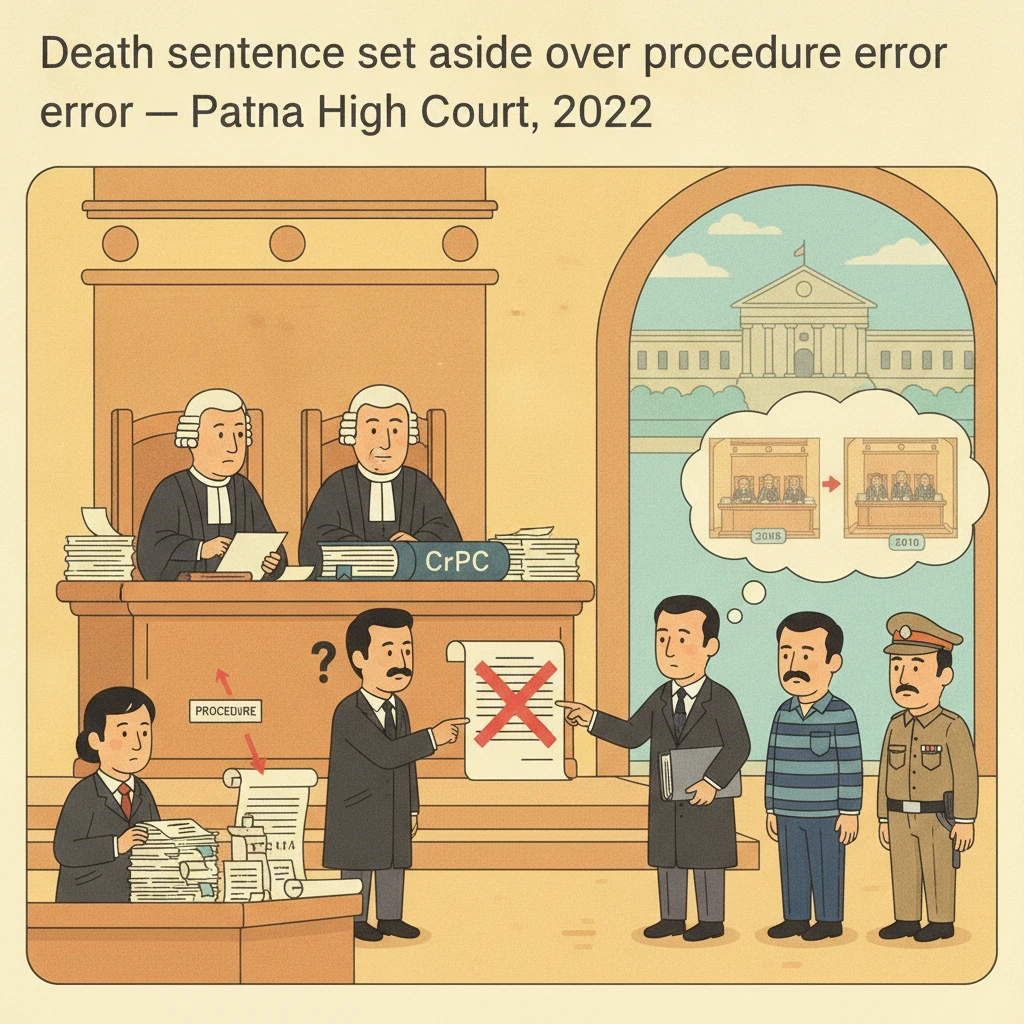
Case Background
The matter reached the Patna High Court as Death Reference No. 3 of 2019 under Section 366 of the Code of Criminal Procedure. The reference arose from Sessions Trial No. 35 of 2016, which in turn came from Ara Town P.S. Case No. 24 of 2015, District Bhojpur.
By judgment dated 17.08.2019, the 3rd Additional Sessions Judge, Ara, Bhojpur convicted one accused, Lamboo Sharma @ Munna Sharma @ Sachidanand Sharma, for the offence under Section 302 of the Indian Penal Code. By order dated 20.08.2019, the trial court sentenced him to death with a fine of Rs. 25,000/-, and in default one more year of imprisonment.
The trial court stated that the main reason for awarding the extreme penalty of death was that the convict had earlier been sentenced to life imprisonment in Sessions Trial Nos. 128 of 2010 and 659 of 2008. On this basis, it treated him as a repeat offender whose previous convictions justified a harsher sentence.
Against the conviction and death sentence, the convict filed Criminal Appeal (DB) No. 1210 of 2019 before the Patna High Court. Along with this appeal, several other connected criminal appeals arising out of the same judgment and order of sentence—Criminal Appeal (DB) Nos. 1150, 1162, 1185, 1246, 1271 and 1290 of 2019—were tagged and heard together with the death reference.
What the Court Examined and Decided
The Division Bench of Hon’ble Mr. Justice Ashwani Kumar Singh and Hon’ble Mr. Justice Arvind Srivastava examined only one central question at this stage: whether the trial court had followed the mandatory legal procedure before using the convict’s previous convictions to justify a death sentence.
The Bench noted in clear terms that while awarding the death sentence in Sessions Trial No. 35 of 2016, the trial court relied on the fact that the accused had been earlier convicted and sentenced to life imprisonment in two earlier sessions trials. However, no evidence on record was taken by the trial court to prove those earlier convictions in the manner required by law.
The High Court pointed out that the Code of Criminal Procedure provides a very specific procedure whenever an accused’s previous conviction is to be used for giving an enhanced punishment or a different kind of punishment in a later case. The relevant provisions are Sections 211(7), 236 and 298 CrPC.
Section 211(7) CrPC says that if the accused has been previously convicted and, because of that, is liable to higher or different punishment for a new offence, then the fact, date and place of the earlier conviction must be clearly stated in the charge. If it is omitted, the court may add it at any time before sentence is passed.
Section 236 CrPC deals with how this previous conviction is then to be handled during trial. It allows the judge, after convicting the accused of the new offence, to take evidence about the alleged previous conviction and record a separate finding. It also has a safeguard: the charge about the previous conviction is not to be read, the accused is not to be asked to plead to it, and the prosecution is not to refer to it at all, until after the accused has first been found guilty of the new offence. This is to ensure the trial on the fresh offence is not prejudiced by knowledge of the past record.
Section 298 CrPC then explains how a previous conviction or acquittal can be proved. It may be done by a certified extract of the sentence or order from the court records, or by a certificate from the jail in which the punishment was undergone, or by production of the warrant of commitment, along with evidence that the person in those documents is the same person now before the court.
Justice Arvind Srivastava, writing the main opinion, observed that none of these procedural requirements were followed by the trial court. The trial court had not framed a charge mentioning the previous convictions of the accused under Section 211(7) CrPC. Nor did it take any evidence under Section 236 read with Section 298 CrPC to formally prove those earlier convictions and the identity of the accused as that same person.
Because of this failure, the High Court held that the trial court could not legally use the past convictions for the purpose of enhancing the punishment to the level of a death sentence. The Bench emphasised that when the law requires previous convictions to be proved in a particular way, courts must follow that procedure strictly, especially in matters involving capital punishment where the right to life under Article 21 of the Constitution is at stake.
Justice Ashwani Kumar Singh wrote a concurring opinion, fully agreeing with Justice Arvind Srivastava and providing additional reasoning. He began by referring to Section 54 of the Indian Evidence Act, which generally makes evidence of bad character irrelevant in criminal trials, except in reply to evidence of good character, and with two limited explanations. One of those explanations is that a previous conviction is relevant as evidence of bad character.
But, he noted, Section 54 does not override other provisions of law that specifically make evidence of previous conviction admissible, such as Sections 211(7), 236, 248(3) and 298 CrPC. These provisions allow previous convictions to be relied upon, but only after following the safeguards built into the procedure.
The concurring opinion explained that a person’s criminal antecedents cannot be used to decide guilt for a new charge. They become relevant only at the stage of sentencing, and only when they have been properly charged and proved, particularly where the law allows increased punishment for repeat offenders.
Justice Ashwani Kumar Singh discussed several judgments from different High Courts to underline this point:
He referred to a decision in Prakash v. State of M.P., where enhanced sentence based on a previous conviction was set aside because the earlier conviction had not formed part of the charge under Section 211(7) CrPC, even though the accused had admitted it.
He also mentioned Bhagwangiri v. State, Raju v. Emperor, and Teka Ahir v. Emperor, which stressed that evidence of a previous conviction must not be brought before the court until after the accused has been convicted of the subsequent offence, and that introducing such evidence earlier is illegal and prejudicial.
Further, he cited State of Kerala v. Jayanandan @ Jayan and Amra Ram v. State of Rajasthan to highlight that previous convictions must be proved strictly in the manner set out in Section 298 CrPC. Voluntary statements or mere mention in the charge-sheet are not enough; official records and proper proof of identity are required.
From all these authorities, the Bench concluded that if the fact of previous conviction is not mentioned in the charge at any stage, it cannot later be used for enhancing punishment. If it is omitted initially, it may still be added before passing sentence, but in this case even that was not done.
On these facts, the High Court answered the key question in the negative: the death sentence awarded to the convict Lamboo Sharma could not be confirmed because the mandatory procedural steps relating to previous convictions had not been followed. Therefore, substantial justice demanded that the sentence be set aside and the matter remitted to the trial court.
Accordingly, the High Court set aside the order of sentence dated 20.08.2019 insofar as it related to the convict Lamboo Sharma. Death Reference No. 3 of 2019 was not confirmed.
The Bench remitted the reference along with the entire record of Sessions Trial No. 35 of 2016 back to the trial court with a direction to pass a fresh order of sentence in respect of Lamboo Sharma strictly in accordance with the prescribed procedure under Sections 211(7) and 236 CrPC. It clarified that the trial court would be at liberty to frame a separate charge of previous conviction and, if such charge is framed and contested, to take evidence under Section 298 CrPC before deciding on any enhanced punishment.
The Court also directed that all the connected criminal appeals be listed after the fresh orders are passed by the trial court, indicating that the final outcome for the other appellants and for the convict’s sentence would depend on those future proceedings.
Why This Judgment Matters
This decision of the Patna High Court has practical importance for accused persons, lawyers and trial courts, especially in Bihar.
First, it makes clear that even if an accused is a repeat offender with prior serious convictions, a trial court cannot jump straight to the harshest punishment without proving those earlier convictions in the legally prescribed way. The record must show a proper charge, an opportunity to contest, and formal proof through court or jail documents.
Second, it underlines that sentencing is not a mechanical exercise. When deciding whether a person should live or die, the courts must strictly follow the due process laid down by law. Any short-cut—even in the name of public safety—will not be accepted by the High Court.
Third, the judgment protects accused persons from being prejudged purely on their past record while the new case is being tried. The law separates the trial of the new offence from the consideration of previous convictions to ensure a fair hearing.
For families of accused and for victims, this ruling explains that procedure is not a mere technicality. It is a safeguard under Article 21 of the Constitution. A death sentence can stand only if every legal step is properly followed.
Legal Issues and Answers
-
Issue: Can a death sentence be based on previous convictions when those earlier convictions were neither included in the charge under Section 211(7) CrPC nor proved as required by Sections 236 and 298 CrPC?
Answer: No. The Patna High Court held that without framing and proving the charge of previous conviction in the prescribed manner, those convictions cannot be used to enhance punishment. The death sentence was therefore set aside and the matter remitted for fresh sentencing. -
Issue: What should a trial court do if it wants to rely on an accused’s past convictions for imposing a higher sentence?
Answer: The trial court must state the fact, date and place of previous convictions in the charge under Section 211(7) CrPC, try and convict the accused on the new offence, then read the charge of previous conviction, take evidence under Section 298 CrPC if the conviction is denied, record a finding under Section 236 CrPC, and only then consider enhanced punishment.
Cases Cited by the Court
- Mahomed Hanif and another v. Emperor [(1942) 44 BOM L.R. 456; (1942) AIR (B215)]
- Prakash v. State of M.P. [1983 J.L.J. 448 MP: (MANU/MP/0286/1982)]
- Bhagwangiri v. State [MANU/RH/0070/1955]
- Raju v. Emperor [AIR (1927) L.A.H. 774]
- Teka Ahir v. Emperor [AIR (1920) Patna 351]
- Mohanlal Shamji Soni v. Union of India and Another [1991 Supp (1) SCC 271]
- State of Kerala v. Jayanandan @ Jayan [2017 CRI.L.J 2218]
- Amra Ram v. State of Rajasthan [1991 (1) Crimes 711 (RAJ)]
Case Details
Case Number: Death Reference No. 3 of 2019 with Criminal Appeal (DB) Nos. 1150, 1162, 1185, 1210, 1246, 1271 and 1290 of 2019
Case Title: The State of Bihar v. Lamboo Sharma @ Munna Sharma @ Sachidanand Sharma; and connected appeals by Shyam Vinay Sharma, Rinku Yadav, Md. Naim Miya @ Naim Miya, Md. Chand Miya @ Chand Miyan, Anshu Kumar and Akhilesh Upadhyay @ Musa
Citation: 2022(2) PLJR 45
Coram: Hon’ble Mr. Justice Ashwani Kumar Singh and Hon’ble Mr. Justice Arvind Srivastava
Judgment Date: 23.03.2022
Advocates:
In Death Reference No. 3 of 2019 – For the petitioner (State): Not specified in the text; For the respondent (convict): Mr. Pratik Mishra, Amicus Curiae; Mr. Vikram Deo Singh and Mr. Sada Nand Roy, Advocates.
In Criminal Appeal (DB) No. 1150 of 2019 – For the appellant: Mr. Prabhat Kumar Singh, Advocate; For the respondent (State): Dr. Mayanand Jha, APP.
In Criminal Appeal (DB) No. 1162 of 2019 – For the appellant: Mr. Manoj Kumar, Advocate; For the respondent (State): Mr. Ajay Mishra, APP.
In Criminal Appeal (DB) No. 1185 of 2019 – For the appellant: Mr. Surendra Singh, Sr. Advocate with Mr. Ravindra Kumar, Advocate; For the respondent (State): Mr. Dilip Kumar Sinha, APP.
In Criminal Appeal (DB) No. 1210 of 2019 – For the appellant: Mr. Vikram Deo Singh and Mr. Sada Nand Roy, Advocates; For the respondent (State): Mr. Abhimanyu Sharma, APP.
In Criminal Appeal (DB) No. 1246 of 2019 – For the appellant: Mr. Surendra Singh, Sr. Advocate with Mr. Ravindra Kumar, Advocate; For the respondent (State): Mr. Ajay Mishra, APP.
In Criminal Appeal (DB) No. 1271 of 2019 – For the appellant: Mr. Ravindra Kumar, Advocate; For the respondent (State): Mr. Ajay Mishra, APP.
In Criminal Appeal (DB) No. 1290 of 2019 – For the appellant: Mr. Ravindra Kumar, Advocate; For the respondent (State): Mr. Ajay Mishra, APP.
Nature of the Case: Reference for confirmation of death sentence under Section 366 CrPC; connected criminal appeals against judgment of conviction dated 17.08.2019 and order of sentence dated 20.08.2019 in Sessions Trial No. 35 of 2016 (Ara Town P.S. Case No. 24 of 2015).
Link to the Judgment: Click here to view the official Patna High Court judgment
If you found this explanation helpful and wish to stay informed about
how legal developments may affect your rights in Bihar,
you may consider following Samvida Law Associates for more updates.







