
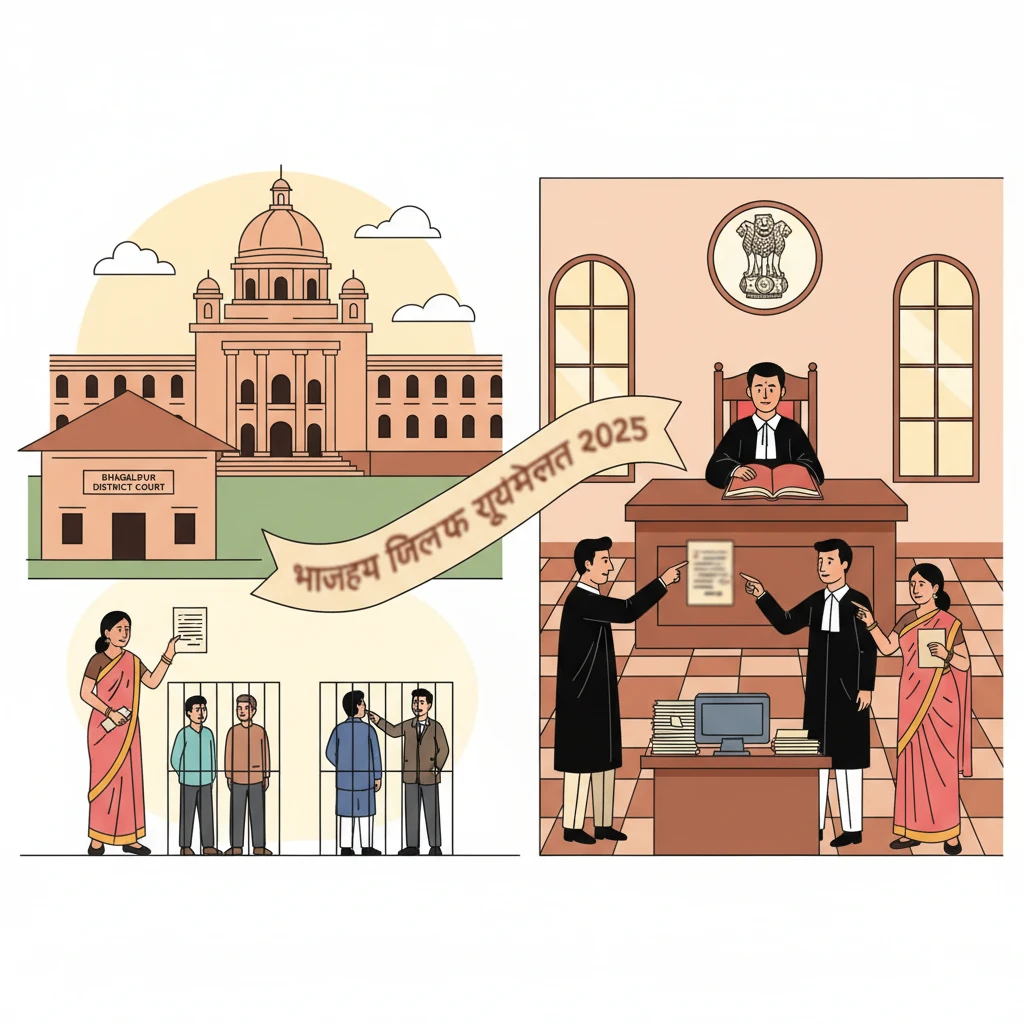
Case Background
This case arises from a criminal complaint filed by a woman alleging cruelty and dowry-related offences by her husband and in-laws.
The victim, Suman Devi, wife of respondent no. 3, lodged Criminal Complaint Case No. 85 of 2006 at Bhagalpur. She named four accused persons, including opposite party no. 2, Mahendra Jha, and opposite party no. 3, Nandan Kishore Jha.
After cognizance, charges were framed under Sections 323, 498A and 406 read with Section 34 of the Indian Penal Code and Sections 3 and 4 (referred to as Section ¾) of the Dowry Prohibition Act against all four accused.
Following trial, the learned S.D.J.M., Naugachia, convicted opposite party nos. 2 and 3 under these provisions and sentenced them accordingly. The remaining two accused were acquitted of all charges.
Opposite party nos. 2 and 3 challenged their conviction by filing Criminal Appeal No. 77 of 2014 before the Sessions Court, Bhagalpur. The Additional District and Sessions Judge-I, Naugachia, allowed the appeal on 07.12.2016 and set aside the conviction and sentence, resulting in their acquittal.
Aggrieved by this appellate acquittal, the complainant-victim approached the Patna High Court. She initially filed Special Leave Application (S.L.A.) No. 11 of 2017 on 09.02.2017. By order dated 02.11.2017, the High Court granted special leave to file a criminal appeal against the acquittal.
On the basis of that leave, Criminal Appeal (U/S) No. 1 of 2018 was filed. However, during its pendency, the victim requested that the criminal appeal be converted into a criminal revision. On 20.02.2019, this request was allowed, and the matter was registered as Criminal Revision No. 383 of 2019.
When the criminal revision came up for hearing, the State and the opposite parties raised a preliminary objection that the revision itself was not maintainable in law. This objection led to the present judgment dated 04.04.2025 by the Patna High Court.
What the Court Examined and Decided
The central question before the Patna High Court was not about guilt or innocence in the dowry and cruelty allegations. Instead, the Court focused on a technical but very important point: what is the correct legal remedy available to a victim when an appellate court acquits the accused?
The Court framed the issue in simple terms: against an appellate judgment of acquittal, was it proper for the victim to file a criminal revision, or should she have pursued a criminal appeal?
To answer this, the Court carefully examined the scheme of the Code of Criminal Procedure, 1973 (Cr.P.C.), especially Sections 372, 378, and 401, and key Supreme Court decisions.
Right of appeal in case of acquittal
The Court first referred to Section 378 Cr.P.C., which deals with appeals in case of acquittal. Sub-sections (1), (2) and (3) cover police cases where the State or Central Government directs the Public Prosecutor to file an appeal, subject to leave of the High Court.
Most relevant to this case was Section 378(4). It states that if an order of acquittal is passed in any case instituted upon complaint, the complainant can file an appeal in the High Court, but only if the High Court grants special leave. There is also a time limit for applying for such special leave under Section 378(5).
The Court then turned to Section 372 Cr.P.C., which contains a general rule that no appeal lies from any judgment or order of a criminal court except as provided by the Code or other law. Earlier, victims had no independent statutory right to appeal, except where they were “complainants” under Section 378(4).
In 2009, a significant change came through the insertion of a proviso to Section 372. This proviso gave a specific and independent right to a “victim” to prefer an appeal against:
- an order acquitting the accused, or
- an order convicting the accused for a lesser offence, or
- an order imposing inadequate compensation.
This appeal lies to the court where an appeal against conviction from that court would ordinarily lie.
The Court noted that this proviso did not impose any condition of obtaining leave or special leave, unlike Section 378(3) and (4).
Supreme Court decisions relied upon
The Patna High Court then discussed the Supreme Court’s three-judge bench judgment in Mallikarjun Kodagali v. State of Karnataka, (2019) 2 SCC 752.
In that case, the victim of an assault case filed an appeal under the proviso to Section 372 against an acquittal. The High Court dismissed it as not maintainable, saying the proviso came into force after the incident. A subsequent appeal under Section 378(4) was also rejected on the ground that the case was not a complaint case.
The Supreme Court examined Sections 372 and 378 in detail and allowed the victim’s appeal. It held that a victim, as defined in Section 2(wa) Cr.P.C., is entitled to file an appeal under the proviso to Section 372 without seeking leave or special leave. The Court emphasised that this right must be given a “realistic, liberal, progressive and beneficial” interpretation in favour of victims.
The Patna High Court also took note of the minority view in Mallikarjun Kodagali, which had favoured reading the victim’s right of appeal together with Section 378(3) and (4), keeping in mind the strengthened presumption of innocence after acquittal. However, the majority view was binding.
The Court then referred to the later Supreme Court judgment in Joseph Stephen v. Santhanasamy, (2022) 13 SCC 115. There, an accused convicted under certain sections of the IPC was acquitted by the first appellate court on all charges, and the victim filed a criminal revision before the High Court. The High Court, in revisional jurisdiction, set aside the acquittal and restored the conviction.
The Supreme Court considered three questions, including whether a revision is maintainable when the victim has a statutory right of appeal under Section 372, and whether the High Court can treat a revision as an appeal.
On this issue, the Supreme Court pointed to Section 401(4) Cr.P.C., which clearly states that if an appeal lies and no appeal is brought, no proceeding by way of revision shall be entertained at the instance of the party who could have appealed.
The Supreme Court held that after the 2009 amendment, a victim has a statutory right of appeal against an order of acquittal under the proviso to Section 372. Therefore, no revision can be entertained at the instance of a victim where this appeal remedy exists and has not been availed.
At the same time, the Supreme Court also clarified that while a complainant in a complaint case needs special leave to appeal under Section 378(4), the victim’s right under the proviso to Section 372 is an “absolute right” and does not require leave or special leave.
The Supreme Court further explained Section 401(5), which allows the High Court, in appropriate cases, to treat a revision as an appeal if it is satisfied that the revision was filed under an erroneous belief that no appeal lay, and if it is necessary in the interests of justice. It held that the High Court must pass a judicial order when converting a revision into an appeal.
The Patna High Court also referred to a Jharkhand High Court decision in Renu Mishra v. State of Jharkhand and Anr. (Criminal Revision No. 520 of 2019, decided on 18.04.2024), where a revision against an appellate acquittal was dismissed as not maintainable, following Joseph Stephen, with liberty to the victim to take appropriate steps.
Application to the present case
Having set out the law, the Patna High Court returned to the facts before it.
It noted that the case began as a complaint case instituted by the victim herself, leading to conviction by the S.D.J.M. and subsequent acquittal by the appellate court in Criminal Appeal No. 77 of 2014.
The victim then came to the High Court. She initially filed S.L.A. No. 11 of 2017, which was allowed, and on that basis Criminal Appeal (U/S) No. 1 of 2018 was filed. Later, on her own prayer, this appeal was converted into Criminal Revision No. 383 of 2019.
The Court held that, in view of the law declared in Mallikarjun Kodagali and Joseph Stephen, the victim had a clear remedy to file a criminal appeal under the proviso to Section 372 Cr.P.C. without any need for leave or special leave. The proviso applies equally to victims in police cases and complaint cases; it does not discriminate between them.
Because an appeal lay under the proviso to Section 372 and could have been pursued directly, the filing and continuation of a criminal revision was barred by Section 401(4) Cr.P.C. Thus, strictly speaking, the present criminal revision was not maintainable.
However, the Court recognised that Section 401(5) gives the High Court power to treat a revision as an appeal in appropriate cases, where the revision was filed under an erroneous belief and the interests of justice demand such conversion.
Relying on the approach adopted by the Supreme Court in Joseph Stephen, the Patna High Court concluded that instead of dismissing the matter as a non-maintainable revision and forcing the victim to start the process afresh, it would be proper to convert the criminal revision back into a criminal appeal and hear it on merits.
Final order
In the conclusion, the Court held that the present Criminal Revision No. 383 of 2019 is hit by Section 401(4) Cr.P.C. because an appeal remedy under the proviso to Section 372 Cr.P.C. was available to the victim.
Exercising its power under Section 401(5), the Court ordered that the criminal revision petition be converted into a criminal appeal. The office was directed to make necessary corrections in the record and list the appeal before the appropriate Bench, with the permission of the Hon’ble the Chief Justice.
Importantly, the Court did not decide on the guilt or innocence of the opposite parties. It only settled the procedural route: the matter will now proceed as a criminal appeal against the acquittal, to be decided on its own merits in due course.
Why This Judgment Matters
This judgment is significant for victims of crime, especially women in dowry and cruelty cases, who want to challenge an acquittal.
The Patna High Court firmly applied the Supreme Court rulings that a victim has a direct statutory right to appeal an acquittal under the proviso to Section 372 Cr.P.C. This right is “absolute” and does not require prior permission from the High Court.
The Court also clarified a very practical point. If an appeal lies and the victim or complainant instead files a revision, the High Court cannot entertain that revision because of Section 401(4) Cr.P.C. However, to avoid injustice and delay, the High Court may convert such a mistaken revision into an appeal under Section 401(5), if it finds it was filed under an erroneous belief.
For lay readers, this means: if you are recognised as a “victim” under Cr.P.C. and an appellate court has acquitted the accused, your main remedy is to file a criminal appeal under the proviso to Section 372, not a criminal revision. But if you mistakenly file a revision, the High Court can, in proper cases, convert it into an appeal instead of dismissing it outright.
Legal Issues and Answers
- Issue: Whether a victim can maintain a criminal revision against an appellate judgment of acquittal when a statutory remedy of appeal exists under the proviso to Section 372 Cr.P.C.
Answer: No. In view of Section 401(4) Cr.P.C., when an appeal lies and has not been filed, a revision by the party who could have appealed is not maintainable. However, the High Court may convert such a revision into an appeal under Section 401(5) Cr.P.C. - Issue: Whether a victim requires leave or special leave of the High Court to file an appeal against acquittal under the proviso to Section 372 Cr.P.C.
Answer: No. Following Mallikarjun Kodagali and Joseph Stephen, the victim’s right of appeal under the proviso to Section 372 Cr.P.C. is absolute and does not require leave or special leave, unlike an appeal by a complainant under Section 378(4) Cr.P.C. - Issue: Whether the present criminal revision arising from a complaint case challenging appellate acquittal should be dismissed as non-maintainable or converted into an appeal.
Answer: The revision is hit by Section 401(4) Cr.P.C., but in exercise of powers under Section 401(5) Cr.P.C. and in the interests of justice, it is converted into a criminal appeal to be heard on merits.
Cases Cited by the Court
- Mallikarjun Kodagali v. State of Karnataka, (2019) 2 SCC 752
- Joseph Stephen v. Santhanasamy, (2022) 13 SCC 115
- Renu Mishra v. State of Jharkhand and Anr., Criminal Revision No. 520 of 2019, decided on 18.04.2024 (Jharkhand High Court)
Case Details
Case Number: Criminal Revision No. 383 of 2019 (now directed to be treated as Criminal Appeal (U/S) No. 1 of 2018)
Case Title: Smt. Suman Devi v. The State of Bihar & Ors.
Originating Case: Criminal Complaint Case No. 85 of 2006, District Bhagalpur; arising out of P.S. Case No. 85 of 2006, Thana Bhagalpur (Complaint Case)
Impugned Order: Judgment dated 07.12.2016 passed by the Additional District and Sessions Judge-I, Naugachia in Criminal Appeal No. 77 of 2014
Trial Court Judgment: Judgment of conviction and order of sentence dated 06.06.2014 by the S.D.J.M., Naugachia, convicting opposite party nos. 2 and 3 under Sections 323, 498A, 406/34 IPC and Sections 3 and 4 of the Dowry Prohibition Act
Coram: Hon’ble Mr. Justice Jitendra Kumar
Citation: 2025 (2) PLJR 723
Advocates:
- For the Petitioner (victim/complainant): Mr. Rajesh Kumar, Advocate
- For the State: Mr. Abhay Kumar, APP
- For Opposite Party Nos. 2 & 3: Mr. Ajay Kumar Thakur, Advocate; Mr. Saroj Kumar, Advocate
Nature of the Case: Criminal revision arising out of a criminal appeal against conviction (complaint case), challenging the appellate acquittal; decided on maintainability and converted into a criminal appeal under Section 372 Cr.P.C. read with Section 401(5) Cr.P.C.
Date of Patna High Court Judgment: 04.04.2025 (CAV judgment; CAV date 24.03.2025)
Link to Judgment: https://patnahighcourt.gov.in/viewjudgment/NyMzODMjMjAxOSMxI04=-16eEsZ4–ak1–g8A=
If you found this explanation helpful and wish to stay informed about
how legal developments may affect your rights in Bihar,
you may consider following Samvida Law Associates for more updates.







