
Case Background
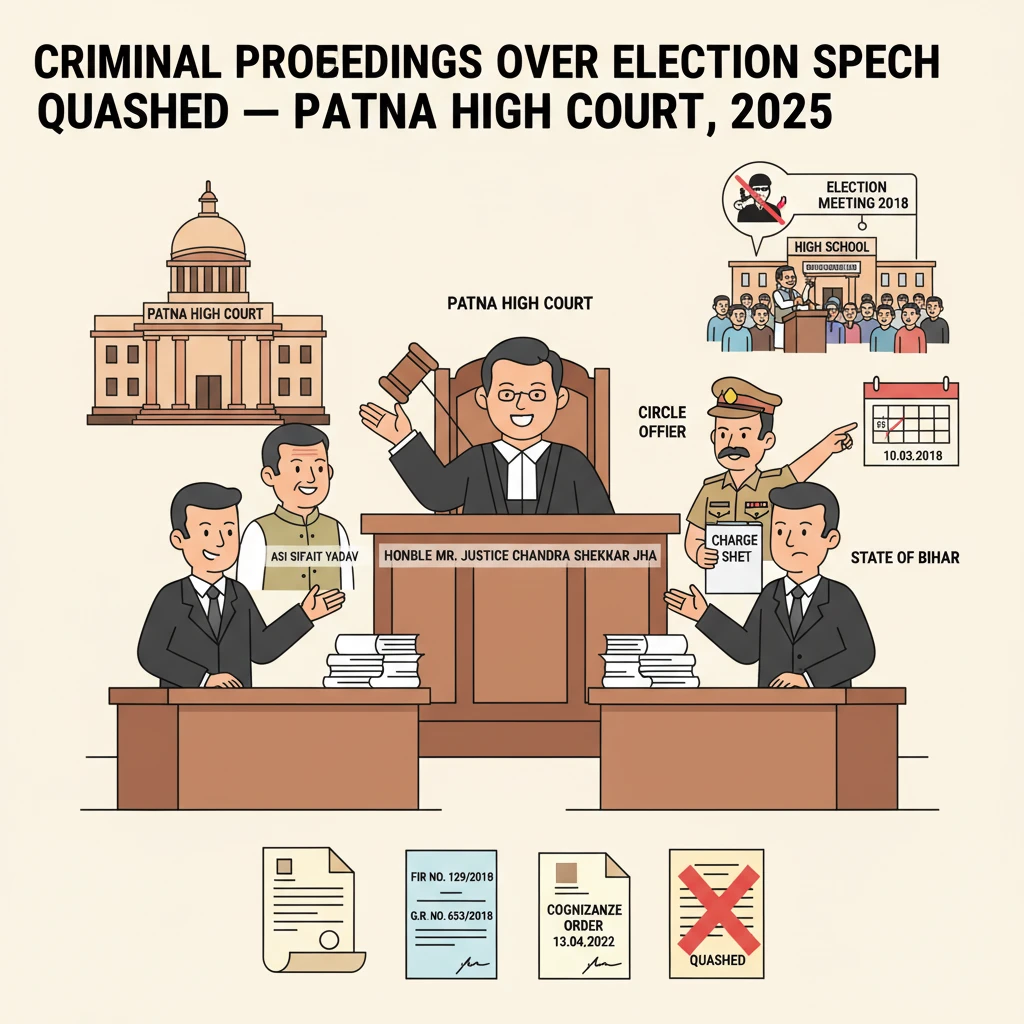
The case arose from an election meeting held on 09.03.2018 at the campus of High School, Narpatganj, in District Araria, Bihar.
At that time, the petitioner was the State President of a political party. He addressed a public gathering during the election period. The Model Code of Conduct was in force.
The Circle Officer, Narpatganj, District Araria, submitted a written information dated 10.03.2018 to the Officer-in-Charge of Narpatganj Police Station. In this written information, the Circle Officer alleged that the petitioner had delivered a provoking public speech in violation of the Model Code of Conduct.
According to the written information, while criticising the rival candidate of another political party, the petitioner stated that if that rival candidate, named in the report, won the election, Araria would become the centre or base of “ISIS”. On this basis, it was alleged that the petitioner had given a hate or provocative speech.
On receipt of this written information, Narpatganj P.S. Case No. 129 of 2018 was registered on 10.03.2018 under Section 153A of the Indian Penal Code and Section 125 of the Representation of People Act, 1951.
The Investigating Officer later submitted charge-sheet no. 574/2021 dated 31.10.2021 against the petitioner. Based on this, the Chief Judicial Magistrate, Araria, took cognizance on 13.04.2022 for the offences under Section 153 of the IPC and Section 125 of the Representation of People Act, and issued summons to the petitioner. The case was then transferred to the Special Court for MP/MLA (A.C.J.M.-I), Araria for trial.
The petitioner approached the Patna High Court under Section 482 of the Code of Criminal Procedure, seeking quashing of the cognizance order and all criminal proceedings arising out of Narpatganj P.S. Case No. 129 of 2018 / G.R. No. 653 of 2018.
What the Court Examined and Decided
The Patna High Court, presided over by Hon’ble Mr. Justice Chandra Shekhar Jha, heard the application under Section 482 Cr.P.C. The petitioner was represented by counsel, and the State was represented by the learned A.P.P. Despite several opportunities from 22.03.2023 onwards, the State did not file a counter affidavit. Therefore, the Court proceeded to decide the matter based on the materials available on record.
The petitioner’s counsel argued that the case was lodged due to political motives. It was pointed out that at the relevant time the petitioner was the State President of his party and was later serving as Minister of State for Home Affairs, Government of India. He was allegedly implicated with oblique and ulterior political motive.
The main legal arguments advanced were:
First, the written information did not mention any religion, caste, community or language. The speech, as recorded, only said that if the rival candidate won, Araria would become a base of ISIS. According to the petitioner, ISIS is a militant outfit and not a reference to any particular religion. On this foundation, it was argued that the ingredients of Section 153 IPC and Section 125 of the Representation of People Act were not made out.
Second, it was argued that no illegal act was done by the petitioner. The allegation did not disclose any illegal act that could be described as “malignantly” or “wantonly” giving provocation as required under Section 153 IPC.
Third, the petitioner’s counsel submitted that the complaint was not made by the rival candidate himself, but through the Circle Officer, allegedly in connivance with political rivals. It was therefore suggested that the case was mala fide.
Fourth, it was also submitted that cognizance was barred by limitation, although the judgment ultimately focuses more on the lack of ingredients of the offences than on limitation.
The petitioner relied on the principles laid down by the Supreme Court in State of Haryana v. Bhajan Lal and also on a judgment of the Patna High Court in Navjot Singh Sidhu v. State of Bihar, reported in 2023 SCC OnLine Pat 6186.
The Court first reproduced the text of Section 153 IPC and Section 125 of the Representation of People Act, 1951. Section 153 IPC punishes “wantonly giving provocation with intent to cause riot”, by doing something illegal and giving provocation that could lead to rioting. Section 125 of the Representation of People Act punishes promoting or attempting to promote, in connection with an election, enmity or hatred between different classes of citizens of India on grounds of religion, race, caste, community or language.
To understand the scope of Section 153 IPC, the Court discussed the meaning of the words “malignantly” and “wantonly”. Referring to Kahanji (1893) 18 Bom 758 and Bromage v. Prosser (1825) 4 B & C 247, the Court explained that “malignantly” implies a kind of general malice — an unlawful act done intentionally without just cause or excuse, often with extreme malevolence.
The Court then relied on the 10th Edition of Black’s Law Dictionary to interpret “wantonly” as reckless, heedless, malicious conduct, characterised by extreme recklessness and disregard for the rights or safety of others, or for consequences. Wanton acts are those done in such a manner that a person of ordinary intelligence, with normal concern for others, would not commit them unless wholly indifferent to the probable harmful effects.
The Court also cited a prior Patna High Court decision in Kori v. State [AIR 1952 Pat 138]. In that case, it was held that if the act itself is not illegal, then however wanton, undesirable or deplorable it may be, no offence under Section 153 IPC can be made out. The example given was: if killing a cow is not made an offence by law, then even killing a cow in the open, though deplorable, would not be an “illegal act” for the purpose of Section 153 IPC.
From these authorities, the Court concluded that, to attract Section 153 IPC, there must be an illegal act done malignantly or wantonly, giving provocation likely to cause rioting.
Turning to the facts of the present case, the Court closely examined the written information of 10.03.2018. The only statement attributed to the petitioner was that if the rival candidate of a particular party won, Araria would become a base of ISIS.
The Court noted that the written information did not claim that the petitioner made any reference to religion, caste, community or language. It further observed that ISIS is a militant outfit and, as recorded in the judgment, “having no connection with any religion”. The Court held that there was no harm caused to any religious sentiment of any particular community on the face of the written information.
The Court then held that no illegal act was attributed to the petitioner. Merely expressing an apprehension that, if a certain candidate won, Araria could become a base of a militant outfit, could not by itself be treated as an act that was “malignant” or “wanton” under Section 153 IPC. Therefore, the basic ingredient of an “illegal act” under this section was missing.
With respect to Section 125 of the Representation of People Act, the Court found that the written information did not state that the petitioner was promoting or attempting to promote enmity or hatred between different classes of citizens on the grounds of religion, race, caste, community or language. The record was silent about any such divisive content. Thus, the essential elements required for an offence under Section 125 were not present.
The Court also examined the cognizance order of the Chief Judicial Magistrate dated 13.04.2022. It found that the order simply recorded that there was “sufficient material” to draw a prima facie inference, without explaining how the ingredients of the offences under Section 153 IPC and Section 125 R.P. Act were satisfied.
Relying on the Supreme Court’s decision in Pepsi Food Ltd. v. Special Judicial Magistrate [(1998) 5 SCC 749], the Court emphasised that summoning an accused in a criminal case is a serious matter and the Magistrate must apply his mind to the facts and applicable law. The order must reflect such application of mind and cannot be mechanical. The Magistrate cannot act as a mere post office.
The Court also referred to paragraph 102 of the judgment in State of Haryana v. Bhajan Lal [(1992) Supp (1) SCC 335], which lists illustrative categories where the High Court can exercise its inherent powers to quash criminal proceedings, including where the allegations in the FIR, even if taken at face value, do not prima facie constitute any offence; or where the allegations are so absurd and inherently improbable that no prudent person could conclude that there is sufficient ground for proceeding; or where the proceeding is mala fide.
After considering the legal position and the case records, the Patna High Court held that the written information that formed the basis of Narpatganj P.S. Case No. 129 of 2018 did not prima facie constitute any offence under Section 153 IPC or Section 125 of the Representation of People Act. The cognizance order did not explain how a prima facie case was made out and appeared to be passed mechanically.
Accordingly, the Court quashed and set aside the cognizance order dated 13.04.2022 passed by the Chief Judicial Magistrate, Araria, in G.R. No. 653 of 2018 arising out of Narpatganj P.S. Case No. 129 of 2018, so far as it related to the petitioner. All consequential proceedings against the petitioner were also set aside. The criminal miscellaneous application under Section 482 Cr.P.C. was allowed.
Why This Judgment Matters
This judgment is important for people involved in political speech during elections, especially in Bihar. It shows that not every harsh or critical political statement can be turned into a criminal case.
The Patna High Court made it clear that, for offences like Section 153 IPC or Section 125 of the Representation of People Act, certain strict conditions must be met. There must be an illegal act combined with malicious or reckless intent in the case of Section 153, and there must be promotion of enmity on specific grounds such as religion, caste, community, race or language in the case of Section 125.
Simply making a political prediction or expressing fear about future consequences, without targeting a particular religion, caste or community, is not enough to attract these serious criminal provisions.
The judgment also sends a message to Magistrates that they must carefully examine the complaint and materials before issuing summons. Orders that do not explain why a prima facie case exists can be struck down as mechanical.
For ordinary citizens and political workers, this ruling offers some protection against misuse of criminal law to silence political speech that, while sharp, does not actually promote communal hatred or riot.
Legal Issues and Answers
- Issue: Whether the allegations in the written information and FIR disclosed any prima facie offence under Section 153 of the IPC and Section 125 of the Representation of People Act against the petitioner for his election speech.
Answer: The Patna High Court held that the written information did not disclose any illegal act, nor any promotion of enmity on grounds of religion, caste, community, race or language, and therefore no prima facie offence under these sections was made out. - Issue: Whether the cognizance order dated 13.04.2022 passed by the Chief Judicial Magistrate, Araria, could stand in law when it did not discuss how the ingredients of the offences were satisfied.
Answer: The Court held that the cognizance order was mechanical and non-speaking on the crucial aspects, and thus liable to be quashed under Section 482 Cr.P.C. - Issue: Whether the High Court could exercise its inherent powers under Section 482 Cr.P.C. to quash the criminal proceedings in light of the principles laid down in Bhajan Lal and Pepsi Food Ltd. cases.
Answer: Yes. The Court applied the illustrative categories from Bhajan Lal and the requirement of judicial application of mind from Pepsi Food Ltd., and concluded that continuing the proceedings would be an abuse of process, warranting quashing.
Cases Cited by the Court
- Pepsi Food Ltd. v. Special Judicial Magistrate [(1998) 5 SCC 749]
- State of Haryana and Ors. v. Bhajan Lal and Ors [(1992) Supp (1) SCC 335]
- Kahanji (1893) 18 Bom 758
- Bromage v. Prosser [(1825) 4 B & C 247]
- Kori v. State [AIR 1952 Pat 138]
- Navjot Singh Sidhu v. State of Bihar, 2023 SCC OnLine Pat 6186 (relied on by petitioner)
Case Details
Case Number: Criminal Miscellaneous No. 17279 of 2023 (arising out of Narpatganj P.S. Case No. 129 of 2018; G.R. No. 653 of 2018)
Case Title: Nityanand Roy @ Nityanand Rai v. State of Bihar
Citation: 2025(3) PLJR 200
Coram: Hon’ble Mr. Justice Chandra Shekhar Jha
Advocates:
For the Petitioner: Mr. Naresh Dikshit, Advocate; Mr. Brij Bihari Tiwary, Advocate
For the State (Opposite Party): Mr. Jharkhandi Upadhyay, A.P.P.
Nature of the Case: Application under Section 482 of the Code of Criminal Procedure for quashing of cognizance order and criminal proceedings arising from an FIR relating to alleged hate speech and violation of election law.
Date of Cognizance Order Challenged: 13.04.2022
Date of Patna High Court Judgment: 17.06.2025 (C.A.V.; CAV date 13.05.2025)
Police Station Case Details: Narpatganj P.S. Case No. 129 of 2018, District Araria, registered on 10.03.2018 under Section 153A IPC and Section 125 Representation of People Act, 1951.
Link to judgement ; https://patnahighcourt.gov.in/viewjudgment/NiMxNzI3OSMyMDIzIzEjTg==-wDxk10mAXV4=
If you found this explanation helpful and wish to stay informed about
how legal developments may affect your rights in Bihar,
you may consider following Samvida Law Associates for more updates.







