

Case Background
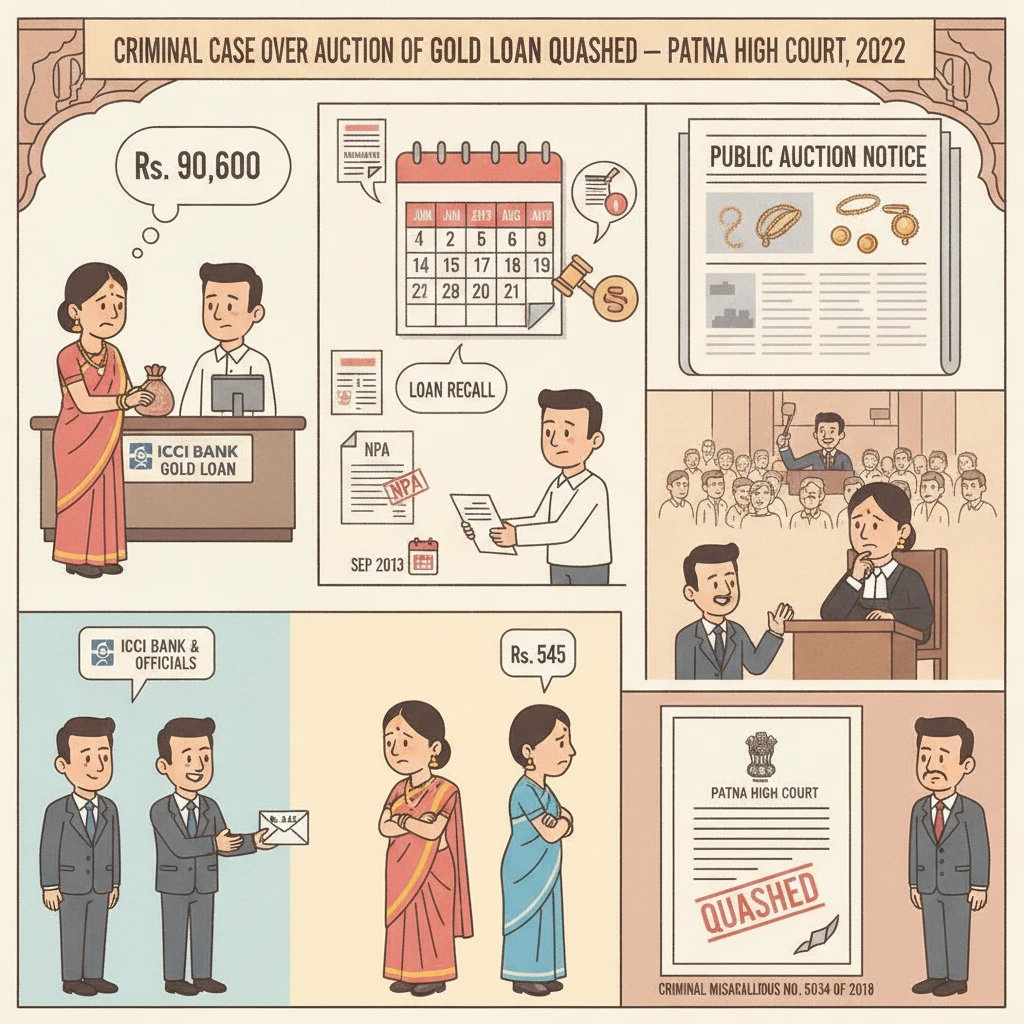
The dispute started with a gold loan taken by the complainant from ICICI Bank. She pledged her jewellery and received a loan of Rs. 90,600/-. According to the record, the bank valued the jewellery at Rs. 90,683/-. The loan amount was credited to her account on 30 November 2012.
The loan agreement fixed 30 May 2013 as the maturity date by which the complainant had to repay the loan and redeem the pledged ornaments. The Patna High Court noted that, after this date, the complainant did not pay the loan amount.
The bank then started recovery steps. It issued a demand notice on 15 June 2013, followed by a Loan Recall Notice on 4 July 2013, and another notice dated 25 July 2013 for enforcement of security. All these notices called upon the complainant to clear the outstanding dues and warned her about possible auction of the pledged gold in case of non-payment.
Despite these notices, there was no repayment. The loan account was treated as a Non-Performing Asset (NPA) in July 2013. On 4 August 2013, the complainant applied to the bank seeking time till September 2013 to pay the dues. Even after this request, the dues were not cleared.
The bank then proceeded to auction. It published an auction notice in two local newspapers on 13 August 2013. A physical auction took place on 24 August 2013. On 30 August 2013, the complainant’s pledged gold ornaments were sold to a purchaser for Rs. 1,00,632/-. The bank adjusted this sum against the outstanding loan and interest.
After adjusting the loan amount and interest for the period from 30 November 2012 to 30 September 2013, a balance of Rs. 545/- remained. On 30 September 2013, the bank issued a demand draft of Rs. 545/- in favour of the complainant and sent it to her. She returned the draft.
Several months later, on 26 February 2014, the complainant filed a criminal complaint before the Chief Judicial Magistrate, Patna. She alleged criminal acts by ICICI Bank and some of its officers in connection with the valuation and auction of the pledged gold.
The Judicial Magistrate, Patna, after enquiry, passed an order dated 25 June 2016 taking cognizance against the bank and its officers for offences under Sections 409, 420 and 120B of the Indian Penal Code. Aggrieved, the bank and its officers filed Criminal Revision No. 542 of 2016 before the Additional Sessions Judge X, Patna.
On 15 November 2017, the Additional Sessions Judge dismissed the revision and upheld the Magistrate’s order, holding there was no illegality in taking cognizance. The bank and its officers then moved the Patna High Court under Section 482 of the Code of Criminal Procedure, 1973, seeking quashing of both orders.
What the Court Examined and Decided
Before the Patna High Court, the petitioners were ICICI Bank and three of its officials: the Zonal Head Retail, the Regional Head (Gold Loan), and the Branch Manager of the Fraser Road branch, Patna. They argued that they were made accused only after the bank started lawful steps to recover the unpaid gold loan and auctioned the pledged ornaments.
Their primary contention was that the complaint and the materials on record did not make out any criminal offence, even if taken at face value. They stressed that:
• there was no allegation that any of them had deceived the complainant by false or misleading representation, or by any fraudulent inducement; and
• there was no dishonest use of the sale proceeds from the gold ornaments.
On this basis, they argued that the essential ingredients of cheating and criminal breach of trust under Sections 420 and 409 IPC were missing, and therefore, a criminal case could not be sustained.
The petitioners’ second major point was that the dispute was purely civil in nature, arising entirely from a loan agreement. They submitted that recovery steps taken in terms of the agreement, including auction of pledged security after multiple notices, could at best give rise to a civil claim but not a criminal prosecution.
To support this, they relied on the Supreme Court decision in Indian Oil Corporation vs. NEPC India Ltd., (2006) 6 SCC 736. In that case, the Supreme Court cautioned that efforts to settle civil disputes and claims by applying pressure through criminal prosecution should be deprecated and discouraged.
They also relied on G. Sagar Suri vs. State of U.P., (2000) 2 SCC 636, where the Supreme Court emphasised that courts must see whether an essentially civil dispute has been given a cloak of criminal offence and that criminal proceedings are not a shortcut for other remedies.
The third argument was about mala fide intention. The petitioners highlighted that the loan was sanctioned on 30 November 2012 and the auction held on 24 August 2013. Till the date of auction, there had been no complaint regarding valuation of jewellery or demand of bribe. The complaint was lodged only on 26 February 2014, about eight months after auction, suggesting that it was filed only to harass the bank officials for having proceeded with recovery.
Fourth, the petitioners attacked the Magistrate’s order taking cognizance as mechanical and passed without proper application of judicial mind, and described the revisional order as cryptic and non-speaking.
They further relied on the decision of the Supreme Court in State of Haryana vs. Bhajan Lal, 1992 Supp (1) SCC 335. In that case, the Court laid down illustrative categories where High Courts can exercise inherent powers under Section 482 Cr.P.C. to quash criminal proceedings. The petitioners argued that the present case fell particularly under Category (7), i.e., where criminal proceedings are maliciously instituted with an ulterior motive for wreaking vengeance.
On the other hand, despite several opportunities, no one appeared before the High Court for the complainant. The learned Additional Public Prosecutor for the State opposed the quashing but mainly supported the impugned orders without adding much beyond that.
The Patna High Court carefully examined the gold loan agreement, the complaint petition, and the related documents such as notices and auction records placed on the record. The Court observed that the dispute clearly arose from a private gold loan agreement. The borrower had defaulted in repayment, and the bank had taken steps to realise its outstanding dues strictly in terms of the agreed conditions.
The Court noted that the gold ornaments were pledged on 30 November 2012 against a loan of Rs. 90,600/-, with maturity on 30 May 2013. The complainant admittedly made no payment after maturity. The bank then sent a demand notice on 15 June 2013, a Loan Recall Notice on 4 July 2013, and a Notice dated 25 July 2013 for enforcement of security.
The complaint itself, especially paragraph 9, showed that the complainant had received these notices but still did not clear the dues. A public notice for auction was then published on 13 August 2013 in the Financial Express. The auction occurred on 24 August 2013. The pledged gold was sold for Rs. 1,00,632/-. After adjusting the outstanding loan and interest, the bank sent the remaining Rs. 545/- by demand draft on 1 January 2014, which the complainant returned on 18 February 2014.
On these facts, the Patna High Court concluded that the case was not one of criminal breach of trust. The Court held that there was no allegation or material to show that the bank officials had disposed of the pledged jewellery in violation of any legal direction. On the contrary, all actions appeared to have been taken in accordance with the loan agreement’s terms and after clear notice to the borrower.
The Court specifically found that the money realised from the auction had not been dishonestly used by the accused persons. Instead, it had been properly adjusted towards the outstanding loan, and the small excess amount was returned to the borrower through a demand draft. As a result, the accusation did not even prima facie constitute the offence of criminal breach of trust.
The Court then turned to the legality of the Magistrate’s order. Referring to the Supreme Court’s decision in Pepsi Food Ltd. v. Special Judicial Magistrate, AIR 1998 SC 128, the Patna High Court recalled that summoning an accused is a serious matter and a Magistrate must apply his mind to the facts and law. The order must show that such application of mind has occurred.
Similarly, relying on Zandu Pharmaceutical Works Ltd. v. Md. Sharaful Haque, AIR 2005 SC 9, the Court noted that if the allegations in the complaint do not constitute the offence for which cognizance is taken, the High Court can quash the proceedings under Section 482 Cr.P.C.
The Court also quoted Inder Mohan Goswami v. State of Uttaranchal, (2007) 12 SCC 1, where the Supreme Court stated that inherent powers under Section 482 Cr.P.C. exist to do real and substantial justice and to prevent abuse of the court’s process, to be exercised sparingly but effectively when needed.
After reviewing the legal position and the factual matrix, the Patna High Court found that continuation of the criminal proceedings against the bank and its officers would amount to abuse of the process of the court. It characterised the impugned orders as reflecting non-application of judicial mind to the civil nature of the dispute and the absence of criminal ingredients.
Accordingly, the Court exercised its inherent powers under Section 482 Cr.P.C. It quashed the Magistrate’s order dated 25 June 2016 taking cognizance for offences under Sections 409, 420, and 120B IPC in Complaint Case No. 25388(C) of 2014. It also quashed the revisional order dated 15 November 2017 passed in Criminal Revision No. 542 of 2016 by the Additional Sessions Judge X, Patna.
With these findings, the application filed by the bank and its officials was allowed. The criminal proceedings against them came to an end.
Why This Judgment Matters
This Patna High Court decision is important for borrowers and banks alike. It makes clear that when a borrower takes a gold loan and fails to repay despite repeated notices, the bank’s act of auctioning the pledged ornaments, in line with the loan agreement, does not by itself amount to a criminal offence.
For borrowers, the judgment is a reminder that if they disagree with the valuation of jewellery or the bank’s enforcement steps, their remedy is usually civil – through consumer forums or civil courts – not by filing criminal cases alleging cheating or breach of trust without clear criminal conduct.
For banks and financial institutions, the ruling affirms that where they follow the agreed procedure, issue proper notices, and account for the sale proceeds, criminal complaints filed later as a pressure tactic can be challenged and quashed under Section 482 Cr.P.C.
The judgment also reinforces that Magistrates must carefully examine complaints before taking cognizance. They must ensure that the basic ingredients of alleged offences are present and that essentially civil disputes are not allowed to be turned into criminal prosecutions.
Legal Issues and Answers
Issue: Did the allegations in the complaint, taken at face value, disclose offences of criminal breach of trust, cheating, and criminal conspiracy against the bank and its officers in relation to the auction of pledged gold?
Answer: No. The Patna High Court held that the bank acted as per the loan agreement and notices, there was no dishonest misappropriation or deception, and therefore no prima facie offence under Sections 409, 420, or 120B IPC was made out.
Issue: Should the High Court exercise its inherent powers under Section 482 Cr.P.C. to quash the criminal proceedings in this loan-related dispute?
Answer: Yes. The Court held that continuation of the proceedings would be an abuse of the process of the court in a matter that was essentially a private, civil dispute arising from a gold loan agreement.
Issue: Were the Magistrate’s and the Revisional Court’s orders taking and affirming cognizance sustainable in law?
Answer: No. The High Court found the orders to be products of non-application of judicial mind to the civil nature of the dispute and the absence of criminal ingredients, and therefore quashed both orders.
Cases Cited by the Court
- Indian Oil Corporation vs. NEPC India Ltd., (2006) 6 Supreme Court Cases 736
- G. Sagar Suri vs. State of U.P. & Ors., (2000) 2 Supreme Court Cases 636
- State of Haryana vs. Bhajan Lal, 1992 (Supplementary) 1 Supreme Court Cases 335
- Pepsi Food Ltd. and others vs. Special Judicial Magistrate and others, AIR 1998 Supreme Court 128
- Zandu Pharmaceutical Works Ltd. and others vs. Md. Sharaful Haque and others, AIR 2005 Supreme Court 9
- Inder Mohan Goswami vs. State of Uttaranchal, (2007) 12 Supreme Court Cases 1
Case Details
Case Number: Criminal Miscellaneous No. 5034 of 2018 (arising out of Complaint Case No. 25388(C) of 2014, District Patna)
Case Title: ICICI Bank & Ors. vs. State of Bihar & Anr.
Coram: Hon’ble Mr. Justice Prabhat Kumar Singh
Citation: 2022 (3) PLJR 33
Advocates:
For the petitioners: Mr. Rana Vikram Singh, Advocate; Mr. Dayanand Singh, Advocate
For the State: Mr. Aditya Narayan Singh 1, APP
Advocate for the complainant/opposite party no. 2: Not recorded as present in the judgment.
Nature of the Case: Petition under Section 482 of the Code of Criminal Procedure, 1973, seeking quashing of the Magistrate’s cognizance order and the revisional court’s order in a complaint alleging offences under Sections 409, 420, and 120B of the Indian Penal Code in relation to a gold loan.
Date of High Court Judgment: 19 May 2022
Link to Judgment: Patna High Court Judgment – CR. MISC. No. 5034 of 2018
If you found this explanation helpful and wish to stay informed about
how legal developments may affect your rights in Bihar,
you may consider following Samvida Law Associates for more updates.







