

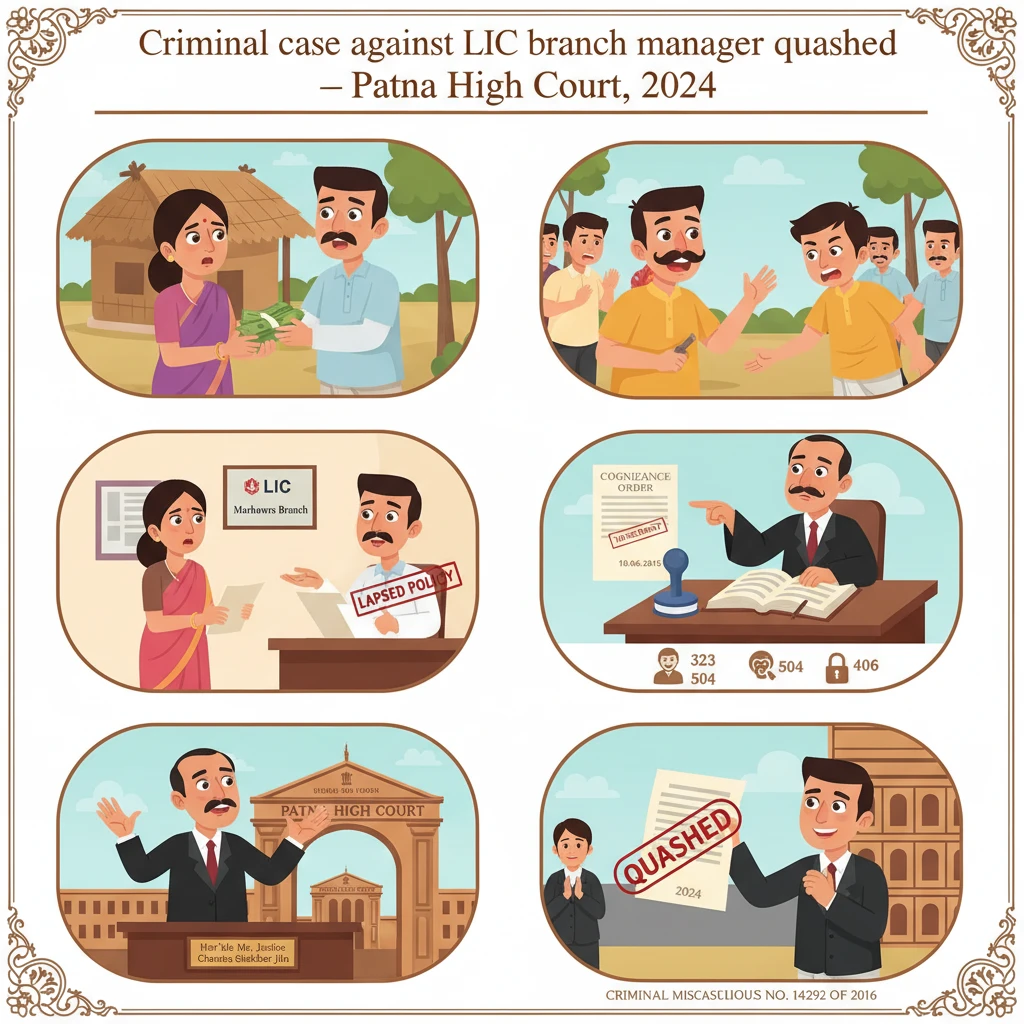
Case Background
The dispute started when the complainant and her husband purchased a Life Insurance Corporation of India (LIC) policy, bearing No. 537138740. They bought this policy through an LIC agent named Kameshwar Ram.
According to the complaint, the complainant’s husband used to give Rs. 10,000 per year to the LIC agent for depositing in the policy. Later, they allegedly handed over a lump sum of Rs. 23,060 to the same agent for deposit with LIC.
The complainant said that this amount of Rs. 23,060 was never deposited in the LIC policy. When she and her husband demanded their money back, the agent allegedly refused and even snatched her belongings. When she went to his residence with some villagers, he again refused to return the amount.
The complainant then contacted the Branch Manager of LIC, Marhawra Branch, Chapra, who is the petitioner in this case. She informed him about the alleged cheating by the agent. As per the complaint, the Branch Manager did not cooperate and told her that the policy had lapsed.
On these allegations, the complainant filed Complaint Case No. 709/2015 in the court of the Judicial Magistrate, Chapra. The Magistrate took cognizance on 10.06.2015 in Tr. No. 980/2015 for offences under Sections 323, 504 and 406 of the Indian Penal Code (IPC) against the LIC Branch Manager.
Feeling aggrieved, the Branch Manager approached the Patna High Court through Criminal Miscellaneous No. 14292 of 2016, seeking quashing of the cognizance order and the criminal proceedings against him.
What the Court Examined and Decided
The matter came before the Patna High Court, presided over by Hon’ble Mr. Justice Chandra Shekhar Jha. The Court heard arguments from both sides.
On behalf of the petitioner, it was argued that he had been dragged into the case only because he was the Branch Manager of LIC, Marhawra Branch, Chapra. The defence stressed that all the real allegations related to the conduct of the LIC agent, Kameshwar Ram, and not to the Branch Manager.
The petitioner’s counsel pointed out that, according to the complaint itself, the entire transaction of money took place between the complainant’s husband and the agent. The complaint alleged that Rs. 23,060 was handed over to the agent to deposit in Policy No. 537138740, but the agent did not deposit it and refused to return it.
They submitted that there was no allegation that the Branch Manager had himself taken any money from the complainant or her husband. There was also no claim that he had abused or assaulted the complainant.
The only allegation against the Branch Manager, as highlighted by the defence, was that when the complainant approached him, he told her that no such amount was deposited in the branch and that the policy had lapsed. This, according to the petitioner, could not amount to criminal offences under Sections 323 (voluntarily causing hurt), 504 (insult with intent to provoke breach of peace) or 406 (criminal breach of trust) of the IPC.
The petitioner’s side also argued that criminal law does not recognise “vicarious liability” in such circumstances. In simple words, just because the Branch Manager is the superior officer of an LIC agent, he cannot automatically be held criminally liable for the agent’s independent acts unless there are specific allegations showing his own involvement in the offence.
Therefore, the petitioner asked the High Court to use its power to quash the proceedings, as no prima facie (on the face of it) case was made out against him.
On the other hand, the learned Additional Public Prosecutor (APP) opposed the application. The APP argued that as Branch Manager, the petitioner was responsible for monitoring the activities of the LIC agent, Kameshwar Ram. On that basis, it was suggested that the proceedings against him should continue.
To decide whether the case should be quashed, the Court referred to the well-known Supreme Court judgment in State of Haryana and Others vs. Bhajan Lal and Others, reported in 1992 Supp (1) Supreme Court Cases 335.
The High Court reproduced paragraph 102 of the Bhajan Lal judgment. In that paragraph, the Supreme Court had laid down different categories of cases where the High Court can exercise its powers under Article 226 of the Constitution or Section 482 of the Code of Criminal Procedure to quash criminal proceedings. These are meant to prevent misuse of the court process and to secure justice.
The Court focused on guidelines 1, 5 and 7 from Bhajan Lal:
First, where, even if all the allegations in the complaint are accepted as true, they do not prima facie constitute any offence or make out a case against the accused.
Second, where the allegations are so absurd or inherently improbable that no sensible person could conclude that there is enough ground to proceed against the accused.
Third, where the criminal proceeding is clearly malicious or driven by bad faith, intended to harass the accused due to personal grudge.
Applying these tests, the Patna High Court carefully examined the complaint and the sworn statement (SA) of the complainant on oath.
The Court noted that all specific allegations of wrongful receipt of money, non-deposit of policy amount, refusal to return money and snatching of belongings were directed against the LIC agent, Kameshwar Ram.
As far as the Branch Manager was concerned, the complaint only said that when the complainant approached him, he did not extend cooperation and informed her that no amount had been deposited in that LIC branch and that the policy had lapsed.
The Court found that there was no allegation that the Branch Manager had ever taken any money, or misused any money, or had any agreement with the complainant to receive or deposit money. There was also no claim that he had abused, threatened, or assaulted her.
Therefore, even if all statements in the complaint were accepted as true, they did not, in the Court’s view, make out offences under Sections 323, 504 or 406 of the IPC against the Branch Manager.
In particular, for criminal breach of trust under Section 406, there must be an allegation that the accused was entrusted with property or dominion over it, and then dishonestly misused it. The complaint did not state that any money was entrusted to the Branch Manager personally. The money, by the complainant’s own version, had been handed over to the agent.
Similarly, for an offence under Section 323, there should be an allegation of causing hurt, and for Section 504, there should be intentional insult likely to provoke breach of peace. The complaint was silent on any such conduct by the Branch Manager.
On these facts, the High Court held that the implication of the petitioner appeared to be only because he was the manager of the LIC branch, and that there is no concept of vicarious liability in such criminal proceedings in the absence of specific allegations.
Taking guidance from guideline numbers 1, 5 and 7 in Bhajan Lal, the Court concluded that continuing the criminal case against the Branch Manager would be an abuse of the process of the court.
Accordingly, the Court quashed and set aside the order dated 10.06.2015 by which the Judicial Magistrate, 1st Class, Chapra had taken cognizance against the petitioner in Tr. No. 980/2015 arising out of Complaint Case No. 709/2015.
The High Court allowed the criminal miscellaneous application. It also directed that the trial court records, if any, be returned to the learned trial court along with a copy of the judgment.
Why This Judgment Matters
This judgment is significant for people dealing with insurance agents, bank agents or other intermediaries. Many times, when an agent cheats a customer, there is a temptation to drag every senior officer into a criminal case out of frustration and anger.
The Patna High Court has made it clear that a Branch Manager or senior officer cannot be made an accused in a criminal case unless there are clear and specific allegations showing his or her own criminal act.
Simply holding a supervisory position or being responsible to “monitor” an agent’s work is not enough for criminal liability. Courts will look for direct involvement, such as taking money, giving false assurances, or participating in the cheating.
For complainants, this means that when they file a criminal case, they need to clearly state who took the money, who made which promises, and who committed which wrongful act. General statements that “officers are responsible” will not support a criminal case against those officers.
For officials and managers, the judgment offers protection from being unnecessarily drawn into criminal cases where there is no specific allegation of wrongdoing against them.
Legal Issues and Answers
- Issue: Whether the complaint and statement on oath disclosed any prima facie criminal offence under Sections 323, 504 and 406 IPC against the LIC Branch Manager, so as to justify the Magistrate’s cognizance order dated 10.06.2015.
Answer: No. The Patna High Court held that the complaint only alleged that the Branch Manager informed the complainant that no amount had been deposited and that the policy had lapsed. There were no specific allegations of assault, insult, or criminal breach of trust by him. Hence, no prima facie case was made out against him. - Issue: Can the Branch Manager be held criminally liable merely because he was supervising the LIC agent who allegedly misappropriated the complainant’s money?
Answer: No. The Court held that there is no concept of vicarious liability in such criminal proceedings against the manager in the absence of clear allegations indicating his own involvement. His implication only as Branch Manager was insufficient, and proceedings against him were quashed by applying the principles laid down in Bhajan Lal’s case.
Cases Cited by the Court
- State of Haryana and Others vs. Bhajan Lal and Others, 1992 Supp (1) Supreme Court Cases 335.
Case Details
Case Number: Criminal Miscellaneous No. 14292 of 2016; arising out of Complaint Case No. 709/2015, Tr. No. 980/2015.
Case Title: Rajiv Kumar Sinha vs. State of Bihar & Anr.
Coram: Hon’ble Mr. Justice Chandra Shekhar Jha.
Citation: 2024 (2) PLJR 806.
Advocates: For the petitioner: Mr. Prashant Sinha, Advocate; Mr. Kunal Kumar, Advocate. For the State/Opposite Party: Mrs. Rina Sinha, APP.
Nature of the Case: Criminal miscellaneous application seeking quashing of cognizance order in a complaint case under Sections 323, 504 and 406 of the Indian Penal Code.
Date of Judgment: 27.03.2024.
Court: High Court of Judicature at Patna.
Link to Judgment: Click here to read the full judgment of the Patna High Court
If you found this explanation helpful and wish to stay informed about how legal developments may affect your rights in Bihar, you may consider following Samvida Law Associates for more updates.







