

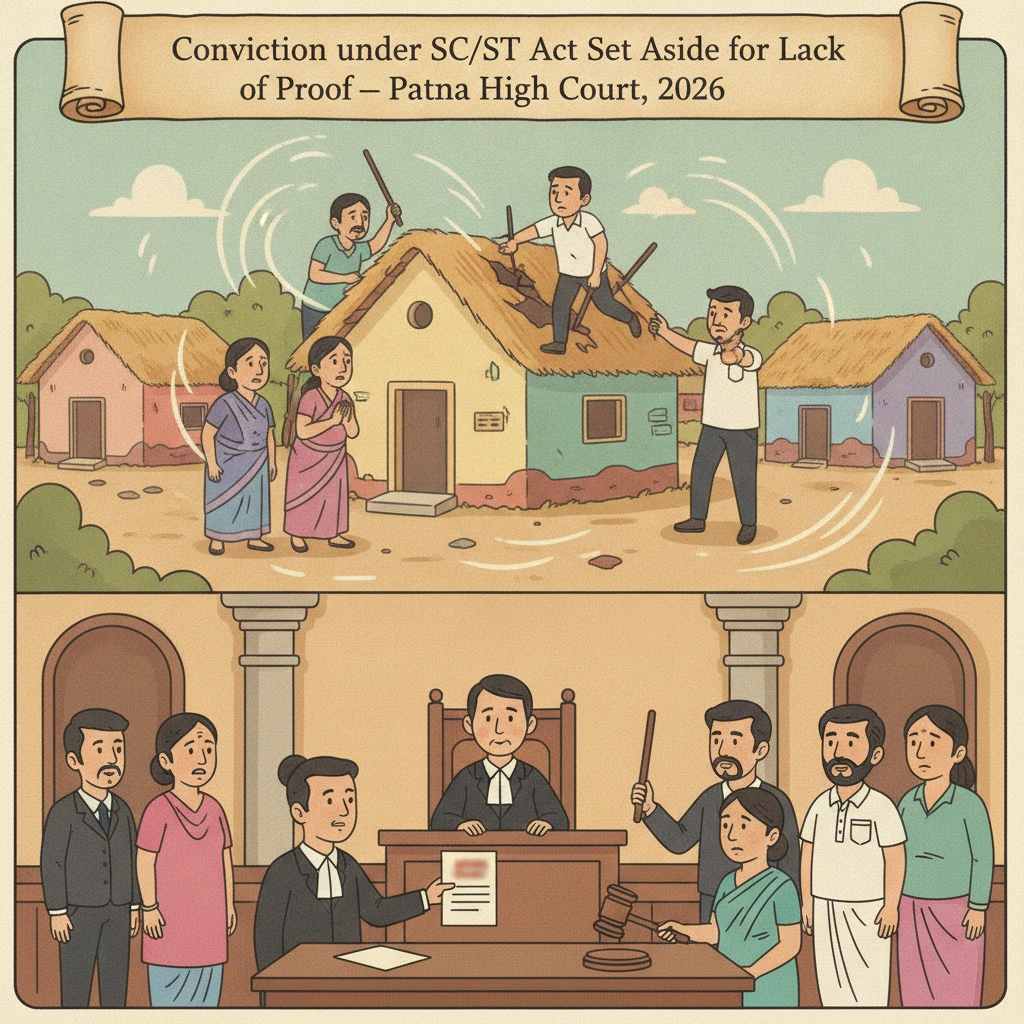
Case Background
The case arises from an FIR registered as S.C./S.T. P.S. Case No. 08 of 2010 in the district of Gaya. The police case was later tried as Sessions Trial No. 208 of 2015 before the Exclusive Special Court, Special Judge (S.C./S.T. (POA) Act), Gaya.
According to the prosecution, on 01.03.2010 at about 5 PM, the informant, a woman belonging to a Scheduled Caste, was at her residence. It was alleged that two of the accused, later arrayed as Appellant Nos. 2 and 3, tried to enter her house. When she protested, they allegedly abused her using caste-based slurs.
The FIR further stated that all the accused-appellants then came armed with lathi and danda, destroyed the roof of the informant’s house, abused her and her family members with caste-based slurs, and assaulted the informant and her daughter-in-law.
On the basis of this FIR, investigation was conducted and charge-sheet was submitted. The case was committed to the Court of Session and tried by the Special Judge under the Indian Penal Code and the Scheduled Castes and Scheduled Tribes (Prevention of Atrocities) Act.
By judgment of conviction and order of sentence dated 07.09.2016, the trial court convicted all six accused-appellants under Section 427 of the Indian Penal Code and Section 3(1)(x)(xi) of the Scheduled Castes and Scheduled Tribes (Prevention of Atrocities) Act.
They were sentenced to simple imprisonment for one year under Section 427 IPC. Under Section 3(1)(x)(xi) of the SC/ST (POA) Act, they were sentenced to simple imprisonment for three years with a fine of Rs. 10,000/- each, with a further six months’ simple imprisonment in case of default of payment of fine.
Aggrieved by this conviction and sentence, the six convicts filed Criminal Appeal (SJ) No. 866 of 2016 before the Patna High Court.
What the Court Examined and Decided
The appeal was heard by Hon’ble Mr. Justice Prabhat Kumar Singh. The appellants were represented by counsel, and the State was represented by the learned Additional Public Prosecutor. Despite valid service of notice, no one appeared on behalf of the informant (Respondent No. 2).
The High Court examined the evidence led before the trial court. The prosecution had examined four witnesses. All four were close relatives of the informant.
P.W. 1 was Gaya Chaudhary, husband of the informant. The Court noted that his deposition was general and omnibus in nature, without specific attribution of overt acts to particular accused.
P.W. 2 was Sikandar Chaudhary, brother of P.W. 1 and brother-in-law (dewar) of the informant. The Court observed that his testimony suffered from exaggeration and material improvements over the version given in the FIR.
P.W. 3 was Kiran Devi, daughter-in-law of the informant and an alleged injured witness. The judgment records that her testimony showed improvements regarding the weapons allegedly carried by the accused persons.
P.W. 4 was Munki Devi, the informant herself, who supported the prosecution case as stated in the FIR.
On the defence side, two witnesses were examined: D.W. 1 Kalawati Devi and D.W. 2 Rajan Chaudhary.
Arguments by the Appellants
Counsel for the appellants attacked the conviction on several grounds based on the trial record.
First, it was argued that neither the Investigating Officer nor the doctor had been examined by the prosecution. According to the appellants, non-examination of the Investigating Officer caused serious prejudice because the defence could not properly challenge the prosecution witnesses on their earlier statements or the investigation findings. It also meant the place and manner of occurrence could not be properly proved.
In the absence of examination of the doctor and production of injury report, the appellants contended that the allegations of assault on the informant and her daughter-in-law could not be substantiated.
Second, the defence highlighted that all prosecution witnesses were members of the informant’s family and therefore highly interested. It was argued that their testimony, suffering from exaggerations and material improvements over the FIR, was unreliable, doubtful and untrustworthy.
Third, counsel pointed to a delay of seven days in lodging the FIR and argued that there was no explanation for this inordinate delay.
Fourth, it was contended that no independent witness was produced, even though the incident was alleged to have occurred at 5 PM during the festival season, when people would normally be around.
Fifth, the appellants argued that as per the FIR, the alleged incident took place inside the informant’s house. Therefore, according to them, the prosecution failed to prove that any intentional caste-based insult took place “within public view”, which is an essential ingredient of Section 3(1)(x)(xi) of the SC/ST (POA) Act as it then stood.
On these grounds, the appellants submitted that the prosecution failed to prove the case beyond reasonable doubt and that the trial court had wrongly convicted them while ignoring material contradictions in the evidence.
Response of the State
The learned Additional Public Prosecutor, representing the State, supported the trial court’s judgment. He argued that the evidence on record clearly pointed to the guilt of the appellants, that the prosecution had proved their involvement, and that the charges under Section 427 IPC and Section 3(1)(x)(xi) of the SC/ST (POA) Act had been established beyond reasonable doubt. Therefore, according to the State, the conviction required no interference.
High Court’s Assessment of the Evidence
After considering the rival submissions and perusing the evidence and records, the Patna High Court made several important findings.
First, the Court noted that all prosecution witnesses were close relatives of the informant and thus highly interested witnesses. Their testimony was found to contain material improvements over the FIR version. This made their evidence unreliable, doubtful and untrustworthy in the Court’s view.
Second, the Court considered the allegation that the incident occurred at 5 PM during a festival season. Despite this, there was no independent eye witness produced to support the prosecution story or to show that the incident took place within public view.
The Court treated this as significant because, for a conviction under the SC/ST (POA) Act provisions cited (Section 3(1)(x)(xi)), an intentional insult or intimidation by caste-based abuse must occur in public view. The absence of independent witnesses in these circumstances meant, in the Court’s view, that an essential ingredient of the offence under the Act was missing.
Third, the Court took serious note of the non-examination of the Investigating Officer. It held that this caused great prejudice to the defence because the defence was deprived of documentary evidence and could not confront the witnesses with their earlier statements to explain material discrepancies. The defence was also unable to contradict them effectively under Section 145 of the Evidence Act.
Fourth, the Court observed that neither the doctor was examined nor any injury report was produced to back up the allegation of assault on the informant and her daughter-in-law.
Fifth, the evidence in the case also revealed admitted prior enmity and land dispute between the parties. In such a background, the Court considered that the possibility of false implication could not be ruled out.
Standard of Proof in Criminal Cases
The Patna High Court reiterated settled principles of criminal law. It stressed that in criminal cases, where life and liberty of the accused are at stake, a strict standard of proof is required. It is not enough that the prosecution story “may be true”.
The Court noted that the case must be proved beyond reasonable doubt. Conviction cannot be based only on probabilities. The burden always lies on the prosecution to establish the guilt of the accused. Unless the evidence leads the Court to the conclusion that the prosecution story “must be true”, the accused is entitled to benefit of doubt.
Applying this standard to the facts, the Court held that the prosecution had “miserably failed” to prove the guilt of the appellants beyond reasonable doubt.
Final Decision
In light of the above findings, the Court concluded that the appellants were entitled to benefit of doubt. It therefore set aside the judgment of conviction and order of sentence dated 07.09.2016 passed by the Exclusive Special Court, Special Judge (S.C./S.T. (POA) Act), Gaya in Sessions Trial No. 208 of 2015 arising out of S.C./S.T. P.S. Case No. 08 of 2010, so far as these six appellants were concerned.
The Court discharged the appellants from the liability of their bail bonds in connection with the case. Consequently, the criminal appeal was allowed and any interlocutory applications in it were disposed of.
Why This Judgment Matters
This Patna High Court judgment is important for both victims and accused in cases under the SC/ST (Prevention of Atrocities) Act and related criminal offences.
First, it underlines that courts will insist on strong, reliable evidence before confirming a conviction, especially where all key witnesses are close relatives and there is admitted previous enmity. Interested testimony with material improvements over the FIR will be treated with caution.
Second, the judgment highlights the importance of examining the Investigating Officer and medical witnesses. When they are not produced, the defence loses important tools to test the prosecution case. Such gaps can create reasonable doubt and may result in acquittal.
Third, in cases of alleged caste-based insults, the Court reiterates that the prosecution must show that the insult was made within “public view” to attract certain provisions of the SC/ST (POA) Act. Allegations of abuse inside a house, with no independent witness, may not be enough.
Finally, the judgment reassures that the criminal justice system must work on the standard of proof beyond reasonable doubt, not on suspicion or probabilities. This benefits all citizens by promoting fair trials and careful scrutiny of criminal charges.
Legal Issues and Answers
- Issue: Whether the prosecution had proved beyond reasonable doubt that the appellants committed mischief under Section 427 IPC and caste-based offences under Section 3(1)(x)(xi) of the SC/ST (POA) Act.
Answer: No. The Patna High Court held that the evidence was unreliable, key witnesses were interested and had made material improvements, essential ingredients of the SC/ST Act (public view) were not proved, and crucial witnesses like the Investigating Officer and doctor were not examined. Therefore, the prosecution failed to prove the case beyond reasonable doubt and the appellants were entitled to benefit of doubt.
Cases Cited by the Court
- No prior judgments are expressly cited or relied upon in the text of this decision.
Case Details
Case Number: Criminal Appeal (SJ) No. 866 of 2016; arising out of S.C./S.T. P.S. Case No. 08 of 2010; Sessions Trial No. 208 of 2015
Case Title: Binni Singh & Ors. v. The State of Bihar & Anr.
Citation: 2026 (3) PLJR 548
Coram: Hon’ble Mr. Justice Prabhat Kumar Singh
Date of Patna High Court Judgment: 06.05.2026
Trial Court: Exclusive Special Court, Special Judge (S.C./S.T. (POA) Act), Gaya
Offences Alleged: Section 427 of the Indian Penal Code; Section 3(1)(x)(xi) of the Scheduled Castes and Scheduled Tribes (Prevention of Atrocities) Act
Result in Appeal: Conviction and sentence set aside; appellants acquitted by giving benefit of doubt; bail bond liabilities discharged; appeal allowed.
Advocates: For the Appellants: Mr. Anil Kumar Saxena, Advocate. For the State: Mr. Sadanand Paswan, Additional Public Prosecutor. No appearance on behalf of the informant/Respondent No. 2 despite valid service of notice.
Nature of the Case: Criminal appeal (single judge) against judgment of conviction and order of sentence passed by Special Judge under SC/ST (POA) Act.
Link to Judgment: Click here to view the official Patna High Court judgment
If you found this explanation helpful and wish to stay informed about how legal developments may affect your rights in Bihar, you may consider following Samvida Law Associates for more updates.







