

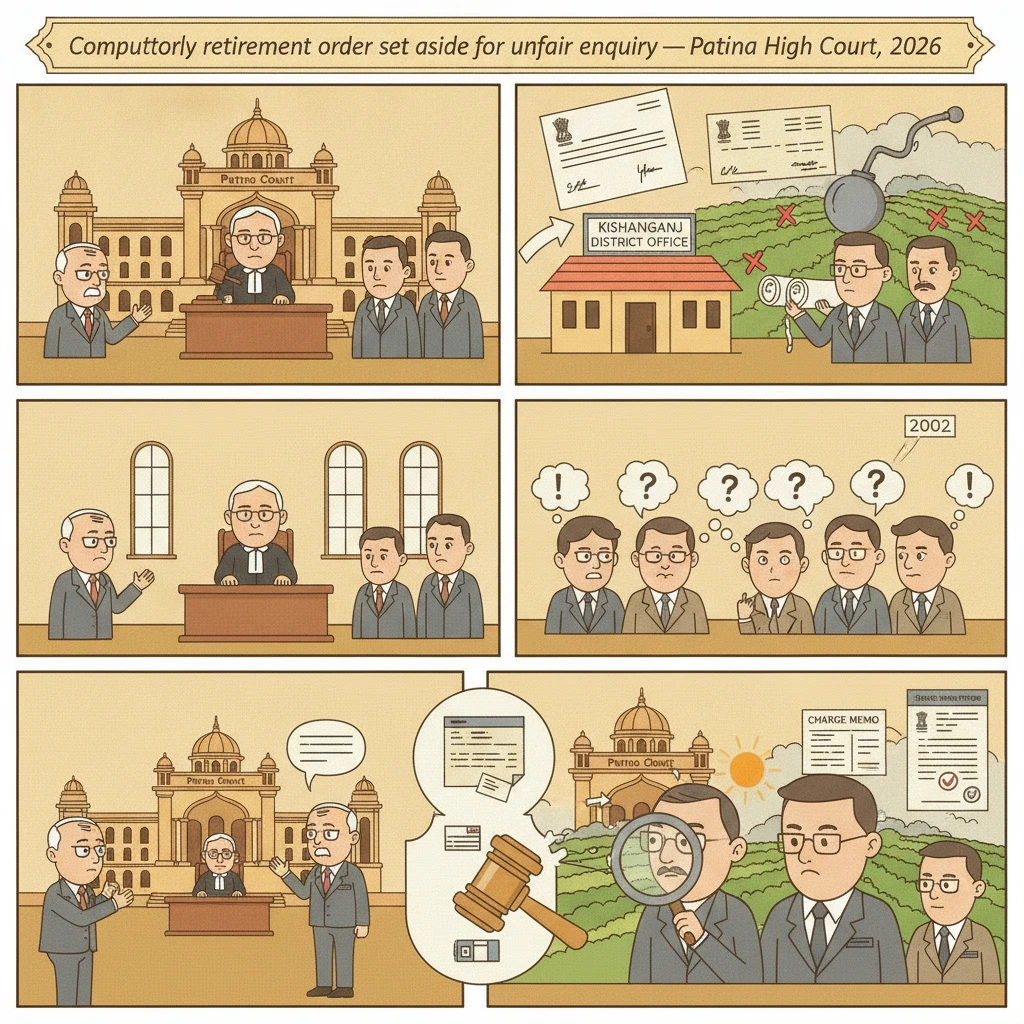
Case Background
This case arose from the State Government’s Industrial Promotion Policy, 1995. Under this policy, the Revenue and Land Reforms Department authorised all District Magistrates, through Letter No.1697 dated 22.11.1995, to allot up to 5 acres of government land in each district for setting up industrial units.
On the basis of this circular, 44 persons were settled with a total of 182.07 acres of government land in Kishanganj district for tea plantation. Later the Government decided that these lands had been wrongly leased for 90 years and that such leases should be cancelled. By Letter No.6 dated 07.01.2002, the District Magistrate, Kishanganj was directed to cancel the leases and take back possession.
At the relevant time, the petitioner was posted as Land Reforms Deputy Collector (L.R.D.C.) in Kishanganj. The Government decided to initiate departmental proceedings against all Additional Collectors, Sub-Divisional Officers, L.R.D.Cs and Circle Officers who had been posted in Kishanganj during the relevant period.
By Letter No.63 dated 05.01.2006, the Commissioner, Purnea Division sent a list of 10 officials, including the petitioner, to the Commissioner-cum-Secretary, Revenue and Land Reforms Department for such action. Thereafter, by Letter No.218(6) dated 11.02.2006, a decision was taken to initiate departmental proceedings against these ten officials.
A memo of charge was served on the petitioner by the Personnel and Administrative Reforms Department. Certain charges were levelled and his explanation was sought. On 11.08.2006, the petitioner submitted his reply. He stated that he had only forwarded records placed before him by the Circle Officers, Pothia and Thakurganj, and that he had not suppressed any facts or sent any wrong report.
Despite this reply, the State proceeded with a full departmental enquiry. By Memo No.10670 dated 29.10.2009, the Commissioner, Purnea Division was appointed as the Conducting Officer (Enquiry Officer). The memo itself noted that the Hon’ble Chief Minister had approved the proposal to initiate departmental proceedings. By Memo No.906 dated 25.11.2009, the District Magistrate, Kishanganj appointed the Additional Collector, Kishanganj as Presenting Officer.
The Conducting Officer fixed dates for enquiry. The petitioner appeared and requested copies of documents mentioned in the list of enclosures with the charge memo, on which the charges were based. On 27.11.2009, the Conducting Officer ordered the Presenting Officer to make these records available and fixed 16.12.2009 as the next date.
When the records were not produced on 16.12.2009, the matter was adjourned, and finally 13.02.2010 was fixed. On 13.02.2010, according to the petitioner, he appeared but the Presenting Officer did not. In the Presenting Officer’s absence, the Conducting Officer directed him to produce evidence in support of the charges, but did not fix a further date.
Later, the petitioner suddenly came to know that the Enquiry Officer had already submitted his report on 06.03.2010. The documents he had requested were never given to him, and he was not allowed to verify or contest them.
After more than three years, Letter No.16640 dated 22.10.2013 was issued by the Joint Secretary, General Administration Department, enclosing a second show cause notice and a copy of the enquiry report. Only then did the petitioner learn that all five charges had been held proved against him.
He submitted his reply to the second show cause on 06.11.2013, again denying the charges. He specifically stated that despite the Conducting Officer’s earlier order, the documents had never been supplied to him. He also requested copies of the Presenting Officer’s written submissions and the documents relied upon so that he could give a detailed defence.
Ignoring these requests, the Disciplinary Authority, by Memo No.9554 dated 14.07.2014, ordered that the petitioner be compulsorily retired from service as punishment under Rule 14(ix) of the Bihar Government Servants (Classification, Control and Appeal) Rules, 2005.
The petitioner initially filed the writ petition to challenge the second show cause notice and enquiry report. Later, by allowing I.A. No.5549 of 2014, the Court treated his challenge to the final punishment order as part of the same writ petition and also included his prayer for reinstatement with consequential benefits.
What the Court Examined and Decided
Justice Ritesh Kumar of the Patna High Court heard both sides. The core complaint was that the departmental enquiry had violated the Bihar Government Servants (Classification, Control and Appeal) Rules, 2005 (Bihar C.C.A. Rules, 2005) and the principles of natural justice.
The petitioner argued that along with the charge memo he was not given any list of witnesses or the documents that the department wanted to rely upon. He pointed out that Rule 17 of the Bihar C.C.A. Rules, 2005 clearly requires both. He emphasised that he had repeatedly asked for the documents during the enquiry and that the Enquiry Officer himself had ordered the Presenting Officer to supply them on 27.11.2009, but this was never done.
According to the petitioner, no witness was examined during enquiry, he was never allowed to cross-examine anyone, and he was not given any chance to produce defence witnesses or supporting documents. Yet the Enquiry Officer treated the documents as if they were proved and held all charges to be established behind his back.
The petitioner also questioned whether the charge memo was issued by a competent authority, referring to decisions of the Supreme Court in Union of India v. B.V. Gopinath and Sunny Abraham v. Union of India, which stress that the disciplinary authority must independently approve the charge memorandum. He further relied on Supreme Court judgments such as Roop Singh Negi v. Punjab National Bank (on the need for evidence in departmental enquiries) and Lucknow Kshetriya Gramin Bank v. Rajendra Singh (on parity in punishment).
He brought to the Court’s notice that similarly placed officers, against whom recommendations had been made by the same Letter dated 05.01.2006, had already been granted relief by the Patna High Court. In particular, orders in C.W.J.C. No.15658 of 2016 (Dr. Fateh Faiyaz v. State of Bihar & Ors.) and C.W.J.C. No.10098 of 2014 (Raghunandan Jha v. State of Bihar & Ors.) had quashed punishments imposed in connection with the same set of allegations, and the State’s Letters Patent Appeals against those orders had been dismissed.
The State, on the other hand, argued that the enquiry had been lawfully conducted, that the petitioner had participated without raising objections, and that he had not shown any real prejudice caused by alleged non-supply of documents. Relying on a 2013 Patna High Court decision in Om Prakash Sah v. State of Bihar, the State submitted that unless serious prejudice is demonstrated, minor procedural lapses do not vitiate a departmental proceeding.
After considering the records, the Court first examined whether the basic procedural safeguards under the Bihar C.C.A. Rules, 2005 were followed.
The Court found that while some documents were mentioned in the charge memo, no list of witnesses was supplied to the petitioner. Rule 17(3) specifically requires that when charges are framed, both a list of documents and a list of witnesses should be given to the delinquent officer. Not giving the list of witnesses was therefore, in the Court’s words, “in complete contravention” of Rule 17(3).
The Court further noted that in the actual enquiry no documents were supplied to the petitioner and no witnesses were examined at all. This was held to be in violation of Rule 17(4), which contemplates that witnesses will be examined and documents proved in the presence of the delinquent officer.
Because no witnesses were examined, the petitioner could not cross-examine them, which violated Rule 17(14). He was also denied an opportunity to produce defence witnesses and documents to prove his innocence, as required by the same rule. In simple terms, the enquiry was based on unproved papers and no oral evidence, with the petitioner remaining largely in the dark.
On the question of whether the charge memo needed prior approval of the appointing authority or Chief Minister, the Court referred to a Division Bench judgment in Rajiv Sinha v. Union of India, reported in 2017 (4) PLJR 271. In that case, the Division Bench had held that even if a charge sheet was not approved at the initial stage, once the final order of punishment was approved by the competent authority (there, the Finance Minister), the entire proceedings would be deemed to be approved, and the delinquent could not later challenge initiation of the enquiry.
Justice Ritesh Kumar noted that Rajiv Sinha had already considered the Supreme Court ruling in B.V. Gopinath and that Civil Appeals arising out of Rajiv Sinha were pending before the Supreme Court. Therefore, instead of deciding that contentious issue in this case, the Court expressly left the question of competence of the authority issuing the charge memo “open, to be decided in an appropriate proceeding”.
The Court then compared the present matter with earlier decisions concerning other officers prosecuted on the basis of the same recommendation dated 05.01.2006. In Dr. Fateh Faiyaz’s case, a Co-ordinate Bench had found the proceeding to be an “extreme case of abuse of executive power”, unsustainable both on procedure and on merits, especially when higher decision-makers had been left untouched. The writ petition there had been allowed with all consequential benefits, and the State’s L.P.A. No.1619 of 2017 was dismissed on 20.03.2018.
Similarly, in Raghunandan Jha’s case, another Co-ordinate Bench had quashed the punishment order on the basis of these earlier favourable judgments for co-delinquents. The State’s appeal in L.P.A. No.245 of 2018 was dismissed on 22.01.2019.
In contrast, the State’s reliance on Om Prakash Sah was found inapplicable because in that case, the delinquent had not raised any serious procedural objection during the enquiry or in his replies. Here, by clear findings, the petitioner had been asking for documents from the very beginning and had been contesting the non-supply and procedural lapses.
On this overall assessment, the Court concluded that the departmental proceedings against the petitioner had been conducted in “complete violation” of the Bihar C.C.A. Rules, 2005 as well as basic principles of natural justice. The petitioner had not been given a fair chance to know the evidence against him, to cross-examine witnesses, or to produce his own defence.
Accordingly, the Court held that the punishment order contained in Memo No.9554 dated 14.07.2014, by which the petitioner had been compulsorily retired, was unsustainable in law and deserved to be set aside.
Given that the petitioner had filed the writ petition in 2013 and had since retired during its pendency, the Court directed that he be treated as reinstated with all consequential benefits up to his actual date of retirement. This includes all service-related benefits and post-retiral benefits that he would have received if the punishment order had never been passed.
The authorities were directed to complete the entire exercise of recalculating and granting these benefits within four months from receipt or production of the Court’s order. The Court further ordered that if this time limit was not complied with, the petitioner would be entitled to interest at 6% per annum from the date of filing of the writ petition until actual payment.
Why This Judgment Matters
This judgment of the Patna High Court is significant for government servants facing departmental enquiries in Bihar. It shows that if enquiry officers and departments ignore the basic rules meant to ensure a fair hearing, courts can and will strike down even major punishments like compulsory retirement.
Here, a senior officer was removed from active service and forced into compulsory retirement without being given the documents used against him and without any witness being examined. The Court recognised that such a process is not just a minor technical lapse but a fundamental denial of natural justice.
The ruling also strengthens the position of officers who were part of the same group proceedings, arising from the 05.01.2006 recommendation, many of whom have already obtained similar relief from the Patna High Court. It confirms that the State cannot selectively uphold flawed enquiries against some officers while others are exonerated on the same facts and procedure.
Practically, the judgment means that departments must strictly follow Rule 17 of the Bihar C.C.A. Rules, 2005: they must supply charge, list of witnesses, and documents, allow cross-examination, and give a real chance to present a defence. Otherwise, even after years, the courts may undo the punishment and order back wages and retirement benefits, with interest if there is delay in compliance.
Legal Issues and Answers
-
Issue: Whether the departmental enquiry against the petitioner was conducted in accordance with the Bihar C.C.A. Rules, 2005 and principles of natural justice.
Answer: No. The Court held that the enquiry violated Rule 17(3), 17(4) and 17(14) as no list of witnesses or documents was supplied, no witnesses were examined, and the petitioner was denied cross-examination and opportunity to lead defence evidence. -
Issue: Whether the punishment of compulsory retirement imposed by Memo No.9554 dated 14.07.2014 could stand on the basis of such an enquiry.
Answer: No. Since the proceedings were vitiated by serious procedural defects and denial of natural justice, the punishment order was quashed and the petitioner was granted reinstatement for all service and post-retiral benefits up to his retirement, with interest if there was delay in payment. -
Issue: Whether the Court would decide the question of competence of the authority issuing the charge memo in light of B.V. Gopinath and related case law.
Answer: Not in this case. The Court noted the Division Bench judgment in Rajiv Sinha and the pending Civil Appeals before the Supreme Court and therefore left this legal question open to be decided in an appropriate proceeding.
Cases Cited by the Court
- Union of India v. B.V. Gopinath, (2014) 1 SCC 351.
- Sunny Abraham v. Union of India, (2021) 20 SCC 12.
- Roop Singh Negi v. Punjab National Bank, (2009) 2 SCC 570.
- Lucknow Kshetriya Gramin Bank v. Rajendra Singh, (2013) 12 SCC 372.
- Rajiv Sinha v. Union of India, 2017 (4) PLJR 271 (Division Bench, Patna High Court).
- Om Prakash Sah v. State of Bihar, 2013 (3) PLJR 775.
- C.W.J.C. No.15658 of 2016, Dr. Fateh Faiyaz v. State of Bihar & Ors., judgment dated 25.07.2017, Patna High Court (and L.P.A. No.1619 of 2017, judgment dated 20.03.2018).
- C.W.J.C. No.10098 of 2014, Raghunandan Jha v. State of Bihar & Ors., order dated 20.11.2017, Patna High Court (and L.P.A. No.245 of 2018, order dated 22.01.2019).
- The Court also referred to B.C. Chaturvedi v. Union of India & Ors., (1995) 6 SCC 749, as noticed in Om Prakash Sah.
Case Details
Case Number: Civil Writ Jurisdiction Case No.25072 of 2013
Case Title: Ramesh Mishra v. The State of Bihar & Ors.
Citation: 2026(3) PLJR 607
CORAM: Hon’ble Mr. Justice Ritesh Kumar
Date of Judgment: 27.04.2026
Advocates:
- For the Petitioner: Mr. Bindhyachal Singh, Senior Advocate; Mr. Aakash Kumar, Advocate.
- For the State: Mr. Prabhakar Jha, G.P.27; Mr. Shankar Kumar Thakur, Advocate; Mr. Mukund Mohan Jha, A.C. to G.P.27.
Nature of the Case: Writ petition (civil) challenging departmental enquiry, second show cause notice, and punishment of compulsory retirement, with prayer for reinstatement and consequential service and post-retiral benefits.
Link to Judgment: Full text of Patna High Court judgment
If you found this explanation helpful and wish to stay informed about
how legal developments may affect your rights in Bihar,
you may consider following Samvida Law Associates for more updates.







