

Case Background
The case began with a written report by an Assistant Sub-Inspector (ASI) of Malaypur Police Station, Jamui, named Kamlesh Kumar Singh. On 20.08.2018, at about 14:30 hours, he was on patrol duty with his team when he received a mobile phone message.
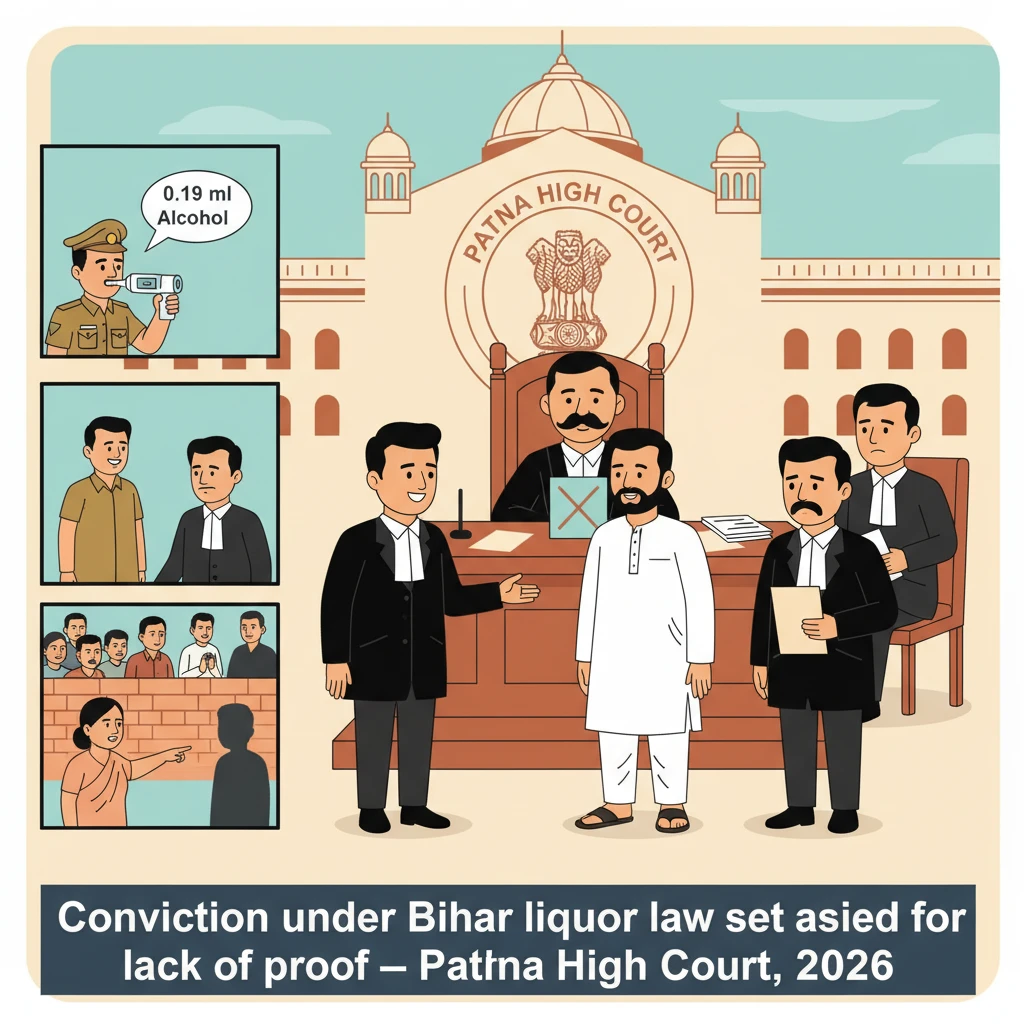
According to this information, the appellant was in an inebriated condition and creating nuisance in the locality. Acting on this information, the police reached the spot and checked his condition through a breath analyser machine.
The breath analyser allegedly showed that he had consumed 0.19 ml alcohol. Based on the ASI’s written report, Malaypur P.S. Case No. 60 of 2018 was registered for offences under Section 290 of the Indian Penal Code (IPC) and Section 37(b) of the Bihar Prohibition and Excise Act, 2016.
After investigation, the learned trial court took cognizance on 28.02.2019 under Section 290 IPC and Section 37(b) of the Bihar Prohibition and Excise Act, 2016. Charges were framed on 04.05.2019 for these sections, and were explained to the accused, who pleaded not guilty and claimed to be tried.
During trial, the prosecution examined six witnesses, all of whom were police personnel. The defence examined one witness, the mother of the accused. After evaluating the evidence, the 1st Additional District & Sessions Judge-cum-Special Judge, Excise, Jamui, in Trial No. 217 of 2018 convicted the appellant under Section 37(b) of the Bihar Prohibition and Excise Act, 2016.
The trial court sentenced him to pay a fine of Rs. 50,000/-. In default of payment of fine, he was to undergo imprisonment for three months. The judgment recorded that the appellant had already undergone three months in custody prior to conviction and directed that this period be adjusted.
Aggrieved by this judgment of conviction and order of sentence dated 30.06.2021, the appellant filed Criminal Appeal (SJ) No. 3340 of 2021 before the Patna High Court. The appeal came up before Hon’ble Mr. Justice Ansul @ Anshul Raj, who delivered the oral judgment on 27.01.2026.
What the Court Examined and Decided
The Patna High Court closely examined the evidence recorded by the trial court and the arguments advanced by both sides. The central question was whether the prosecution had proved, beyond reasonable doubt, that the appellant had consumed alcohol in violation of the Bihar Prohibition and Excise Act, 2016.
Six prosecution witnesses were examined during trial:
PW-1 Baliram Yadav, PW-2 Alok Kumar, PW-3 Chitranjan Kumar and PW-4 Ram Prakash Kumar were constables posted at Malaypur Police Station. They supported the prosecution story in a similar manner, namely that the appellant was found in intoxicated condition and that the police followed the information received.
PW-5 Kamlesh Kumar Singh, ASI, Malaypur Police Station, was the informant of the case. He had lodged the written report which formed the basis of registration of the Malaypur P.S. Case No. 60 of 2018. PW-6 Arun Rai, Sub-Inspector at Malaypur Police Station, also supported the prosecution case.
On the defence side, DW-1 Gorki Devi, the mother of the appellant, stated that her son had been falsely implicated due to a previous dispute with one person named Shiv Ji Singh. Her testimony was aimed at suggesting a motive for false implication.
In addition to oral testimony, the prosecution produced documentary exhibits. These included signatures on the breath analysis report (Exhibit-1), signatures on the written application (Exhibit-2), signature of the then Station House Officer on the written application (Exhibit-2/1), handwriting and signature of the formal First Information Report by then SHO Amit Kumar (Exhibit-3), and handwriting and signature of the arrest memo prepared by S.A.N.I. Kamlesh Kumar Singh (Exhibit-4).
After prosecution evidence, the trial court examined the accused under Section 313 of the Code of Criminal Procedure. The appellant completely denied the allegations and all the evidence that had surfaced during the trial, asserting his innocence.
The trial court, however, accepted the prosecution version and convicted the appellant under Section 37(b) of the Bihar Prohibition and Excise Act, 2016, imposing the fine of Rs. 50,000/- with default imprisonment of three months. The period of custody already undergone prior to conviction was to be adjusted against the default sentence.
On appeal, the High Court reassessed whether the conviction could be sustained on the basis of the evidence on record. A key part of this reassessment related to how the alleged consumption of alcohol had been proved.
The High Court noted that the entire case rested on the breath analyser reading which allegedly showed that the appellant had consumed 0.19 ml alcohol. However, the actual breath analyser machine was not produced in court. There was no material on record to show that the machine used was in proper working condition or had the capacity to give a correct and reliable report.
Further, the Court underlined that no blood test of the accused had been conducted. In cases of alleged alcohol consumption under a strict prohibition law, a blood test is an important piece of objective evidence. The absence of any such test was described by the Court as a “major flaw”.
The Court also observed that the procedure for search and seizure was not followed. The judgment records that the procedure for search and seizure, as required by law, was not complied with. This failure created serious doubt about the fairness and reliability of the investigation.
Another important aspect highlighted by the Court was the lack of independent witnesses. All six prosecution witnesses were police officials posted at the same station. There was no member of the public examined to support the allegation that the appellant was in an inebriated condition and creating nuisance.
In criminal law, especially in cases where independent witnesses are available or could be available, Courts often expect the prosecution to bring such witnesses to strengthen credibility. Here, the complete absence of independent witnesses further weakened the prosecution case.
Considering these deficiencies together, the Patna High Court held that the prosecution had failed to establish the guilt of the appellant beyond reasonable doubt. The combination of factors—the absence of an independent witness, non-production of the breath analyser machine, lack of proof that the machine was reliable, no blood test, and non-compliance with search and seizure procedure—created serious doubt about the prosecution story.
Because of these serious doubts, the Court concluded that the appellant “deserves to be acquitted of the charges levelled against him.” The appeal was therefore allowed.
The High Court expressly quashed and set aside the judgment of conviction and order of sentence dated 30.06.2021 passed by the trial court in Trial No. 217 of 2018 arising out of Malaypur P.S. Case No. 60 of 2018. It recorded that the appellant is acquitted from the charges.
Since the appellant was already on bail during the pendency of the appeal, the Court discharged him from all liabilities of bail bonds and sureties. The Court also directed that any fine deposited by the appellant be returned to him immediately.
Finally, the High Court directed its office to send back the trial court records along with a copy of the judgment to the trial court forthwith, completing the appellate process.
Why This Judgment Matters
This judgment is significant for cases under the Bihar Prohibition and Excise Act, 2016. It shows that even under a strict prohibition regime, a person cannot be convicted unless the prosecution proves its case with reliable and lawful evidence.
The Patna High Court stressed that breath analyser readings alone, without proper demonstration of reliability and without supporting evidence like a blood test, are not enough. The Court also highlighted that legal procedures for search and seizure must be followed.
For ordinary citizens, especially in Bihar where prohibition laws are actively enforced, this decision shows that police evidence must still stand the test of fairness and legality. For lawyers and trial courts, it underlines the need for independent witnesses, proper scientific testing, and strict adherence to procedure before recording a conviction.
Legal Issues and Answers
-
Issue: Whether the conviction of the appellant under Section 37(b) of the Bihar Prohibition and Excise Act, 2016 could be sustained on the basis of the prosecution evidence, mainly a breath analyser reading and official witness testimony.
Answer: No. The Patna High Court held that the prosecution failed to prove the charge beyond reasonable doubt as there was no independent witness, the breath analyser machine was not produced or shown to be reliable, no blood test of the accused was conducted, and the procedure for search and seizure was not followed. Consequently, the conviction and sentence were set aside and the appellant was acquitted.
Cases Cited by the Court
- The judgment does not record any prior case law being cited or relied upon by the Court.
Case Details
Case Number: Criminal Appeal (SJ) No. 3340 of 2021, arising out of Malaypur P.S. Case No. 60 of 2018; Trial No. 217 of 2018
Case Title: Aneesh Manjhi vs. The State of Bihar
Citation: 2026(2) PLJR 251
Court: High Court of Judicature at Patna
Coram: Hon’ble Mr. Justice Ansul @ Anshul Raj
Date of High Court Judgment: 27.01.2026
Trial Court Judgment and Sentence: Judgment of conviction and order of sentence dated 30.06.2021 passed by 1st Additional District & Sessions Judge-cum-Special Judge, Excise, Jamui, convicting the appellant under Section 37(b) of the Bihar Prohibition and Excise Act, 2016 and sentencing him to a fine of Rs. 50,000/- with three months’ imprisonment in default, with adjustment of three months already undergone.
Nature of the Case: Criminal appeal (single judge) against conviction and sentence under the Bihar Prohibition and Excise Act, 2016 and Section 290 IPC.
Offences Alleged: Section 290 IPC; Section 37(b), Bihar Prohibition and Excise Act, 2016.
Final Outcome in Appeal: Appeal allowed; conviction and sentence quashed and set aside; appellant acquitted; bail bonds discharged; fine, if deposited, to be returned.
Advocates:
For the appellant: Mr. Prabhat Kumar Singh, Advocate.
For the State (respondent): Mr. Satyanarayan Singh, APP.
Link to Judgment: Patna High Court Judgment in Cr. App (SJ) No. 3340 of 2021
If you found this explanation helpful and wish to stay informed about how legal developments may affect your rights in Bihar, you may consider following Samvida Law Associates for more updates.







