

Case Background
This case arose from an incident said to have taken place on 07.05.1993 at about 10:00 AM in village Bilap, Police Station Bihta, District Patna.
According to the prosecution, the informant Dhirendra Kumar (P.W.7) and his father Ramadhar Sharma were returning home after working in their sugarcane field. When they reached near the house of the present appellant, they allegedly saw the appellant with a pistol and another accused, Awadhesh Singh, with a gun.
The informant claimed that Awadhesh Singh abused his father and ordered the appellant to kill him for allegedly cutting the ridge of the field. On this order, the appellant allegedly fired from his pistol on the back of Ramadhar Sharma, who fell to the ground. Immediately thereafter, Awadhesh Singh allegedly fired from his gun and injured the informant on his left palm.
The villagers were said to have rushed to the place on hearing the alarm. The injured father was taken first to Dariyapur on a cot and then by jeep to the Referral Hospital, Bihta, where the doctor declared him dead. The dead body was brought to Bihta Police Station, where the informant’s oral statement (fardbeyan) was recorded at 11:10 AM on 07.05.1993 by A.S.I. Ram Pravesh Singh (P.W.9).
On this basis, Bihta P.S. Case No. 81 of 1993 was registered under Sections 302 and 307/34 of the Indian Penal Code and Section 27 of the Arms Act. P.W.9 himself started investigation.
After investigation, police submitted charge-sheet against the appellant and Awadhesh Singh under Sections 302 and 307/34 IPC and Section 27 Arms Act in the court of A.C.J.M., Danapur. Cognizance was taken, documents were supplied under Section 207 Cr.P.C., and the case was committed to the Court of Session on 07.10.1993.
The Sessions Judge transferred the matter to the 7th Additional Sessions Judge, Patna. Charges under Section 302 IPC and Section 27 Arms Act were framed against the appellant, and under Sections 302/34, 307 IPC and Section 27 Arms Act against Awadhesh Singh. Both denied the charges and claimed trial.
The trial court examined nine prosecution witnesses, including three claimed eye-witnesses (P.W.1, P.W.2, P.W.7), the informant’s brother (P.W.3), a relative (P.W.4), two doctors (P.W.5 and P.W.6), and two investigating officers (P.W.8 and P.W.9). On 27.09.1995, the 7th Additional Sessions Judge convicted the appellant under Section 302 IPC and Section 27 Arms Act and sentenced him to life imprisonment and five years’ rigorous imprisonment respectively by order dated 28.09.1995.
The co-accused Awadhesh Singh was also convicted and sentenced, but his separate appeal later abated due to his death. The appellant alone pursued Criminal Appeal (DB) No. 358 of 1995 before the Patna High Court.
What the Court Examined and Decided
The Division Bench of the Patna High Court (Hon’ble Mr. Justice Ashwani Kumar Singh and Hon’ble Mr. Justice Rajeev Ranjan Prasad) carefully scrutinised the evidence to see whether the prosecution had proved the case beyond reasonable doubt.
The Court started with the medical evidence regarding the time of death. The post-mortem was conducted by Dr. Basuki Nath Gupta (P.W.5) at the Sub-Divisional Hospital, Danapur. The body was received at 04:30 PM on 07.05.1993 and the examination began at 05:00 PM the same day.
The doctor found sixteen lacerated entry wounds on the left back of the chest below the scapula, with inverted margins and blackening, consistent with firearm injury from close range. Sixteen pellets were extracted from the left lung. He opined that death was due to haemorrhage and shock caused by firearm injuries and that time since death was “within 36 hours”.
In cross-examination, he admitted essential facts about rigor mortis: it starts 3–6 hours after death, takes about 12 hours to spread over the whole body, and persists for another 12 hours. He specifically stated that rigor mortis in this case was in its last stage at the time of post-mortem and that “in no case the death would have been caused within 12 hours”.
The incident, according to the FIR and eye-witnesses, occurred at 10:00 AM on 07.05.1993, and post-mortem commenced at 05:00 PM the same day, a gap of about 7 hours. The Court considered a standard medical text, “Modi’s Medical Jurisprudence and Toxicology”, which notes that in India rigor mortis generally sets in 1–2 hours after death and is fully developed in about 12 hours, lasting 18–48 hours depending on climate.
On this basis, the Bench held that while rigor mortis alone cannot fix the exact time of death with mathematical precision, it was difficult to accept that rigor mortis would be in all four limbs, and in its last stage, only 7 hours after the alleged time of death. This created a strong probability that the death had occurred earlier than 10:00 AM.
Next, the Court examined whether the so-called eye-witnesses really saw the occurrence.
P.W.1 Raj Deo Ram claimed at trial that he was removing garbage in a lane, saw the deceased and informant returning from the field, and saw the appellant fire at the deceased on the order of Awadhesh Singh, followed by a shot by Awadhesh Singh injuring the informant. He further claimed he tied a gamchha on the back wound and helped carry the deceased to hospital.
However, the second Investigating Officer, Asrar Ahmad (P.W.8), contradicted this version in detail. He testified that during investigation P.W.1 had not stated that he saw the appellant firing at the deceased or that he saw both accused armed with pistol and gun abusing and threatening the deceased. According to P.W.8, P.W.1 had only said that he saw the deceased keep a spade at Kundan Kumar’s door, heard the sound of firing, and later saw the deceased already lying on the ground and the informant injured. P.W.1 had also told the I.O. that he wrapped the gamchha around the belly of the deceased, not on the back below the shoulder as deposed later in court.
This suggested to the High Court that P.W.1 did not actually see the firing itself, and that he had “developed” his story during the trial to match the informant’s version.
Similarly, P.W.2 Kundan Kumar told the trial court that he was going to a shop to buy tea leaves and sugar, heard hulla, saw both accused abusing the deceased, and saw the appellant firing on the deceased’s back and Awadhesh Singh firing at the informant.
But P.W.8 again contradicted him, stating that in his police statement P.W.2 had not said he was going to Anil Sharma’s shop or that he saw the accused with weapons or heard Awadhesh ordering to kill. According to the I.O., P.W.2 had said that the deceased had taken his spade to the sugarcane field, was returning with his son, stopped at P.W.2’s door to return the spade, and at that time the informant came running and said the appellant had fired. When the father and son proceeded ahead, P.W.2 heard two more shots and then saw the deceased lying on the ground and the informant injured. He had not claimed to see any firing or any weapon at that stage.
P.W.8 also testified that in his police statement, P.W.2 had said that gamchha was tied around the belly of the deceased to take him to hospital, not the back below the shoulder. This once again showed that P.W.2’s trial version was a substantial improvement over his original statement and that he too had not actually witnessed the firing.
P.W.3 Jitendra Kumar, the informant’s brother, was a hearsay witness. He claimed he learned about the details of the firing from his brother while travelling in the jeep with the injured father. P.W.8 said that even P.W.3’s earlier statement to police was different: he had then said that his father and brother were returning from the field, his father had stopped at Kundan Kumar’s door to return the spade, his brother heard a shot, told his father, and when they both moved ahead, three rounds were fired, one hitting the father in the abdomen and another hitting the informant. This version did not match the trial narrative of shots at the back and hand, and reinforced the Court’s doubt about the prosecution’s consistency.
The High Court then turned to the injured informant P.W.7. He had asserted that Awadhesh Singh’s gunshot injured his left palm. Since an injured eye-witness normally carries high credibility, the Bench closely examined the medical evidence regarding his injuries.
Dr. Pradeep Kumar (P.W.6), Medical Officer in charge of the Referral Hospital, Bihta, examined the informant at 12:05 PM on 07.05.1993. He found two injuries: a 1” x ¼” lacerated wound between the left thumb and index finger, and a 2” x 1” swelling on the back of the left elbow. In cross-examination he stated both injuries were simple, caused by a hard and blunt substance, not by firearm. He specifically admitted that injuries Nos. 1 and 2 “were not caused by firearm” and that firearm injuries would generally show charring or blackening at the margins.
This clear medical statement directly contradicted the prosecution’s claim that the informant was shot by a gun. The Court observed that while a court can sometimes differ from a doctor’s opinion based on reliable eye-witness testimony, it cannot reject the doctor’s objective findings—like the nature of wounds—without any challenge or contrary medical evidence. Here, the prosecution never questioned or rebutted the doctor’s conclusion.
The Court also noted a serious timing mismatch. P.W.6 said the informant’s injuries were within six hours old at 12:05 PM, suggesting they were inflicted sometime after 06:05 AM that day. But as per P.W.5’s rigor mortis findings, the deceased could not have died within 12 hours of the post-mortem at 05:00 PM—meaning death must have occurred before 05:00 AM. This created at least a six-hour gap between the likely time of death and the time when the informant’s injuries were caused, despite the prosecution’s assertion that both occurred during the same firing incident.
The Bench then looked at motive and place of occurrence. The alleged motive was that the deceased had cut the ridge of Awadhesh Singh’s field. But P.W.2 himself described the boundaries of the deceased’s field: North – Kalash Deo Singh; South – Deo Prasad Pathak; East – Narsingh; West – Deen Bandhu Pathak. The field of Awadhesh Singh was nowhere adjacent. P.W.8 further deposed that on visiting the sugarcane field he came to know there had been no quarrel there and that Awadhesh Singh had no adjoining land. This seriously weakened the suggested motive.
On the place of occurrence, both Investigating Officers admitted that no empty cartridges, bullets, pellets, wads, blood or blood-stained earth were found at the alleged spot. P.W.9, who first went there, accepted that no one showed him the exact place where the deceased was shot or where he fell. P.W.8 said he did not find uprooted grass or fresh soil, and in any case such observations were not recorded in the case diary. No blood-stained lungi, ganji, or gamchha allegedly drenched with blood were seized or produced in court.
In light of these discrepancies, the High Court concluded that it had not been positively established that the incident took place at the spot or in the manner claimed by the prosecution.
Summarising, the Bench observed that the death may well have occurred earlier, possibly at a different place and in a different manner, at the hands of unknown persons. Due to admitted disputes between the families, the appellant and Awadhesh Singh could have been falsely implicated.
Given such serious doubts about time of death, genuineness of eye-witness accounts, nature and timing of injuries, absence of physical evidence at the scene, and shaky motive, the Court held that the prosecution had failed to prove its case beyond reasonable doubt. The appellant was therefore entitled to benefit of doubt.
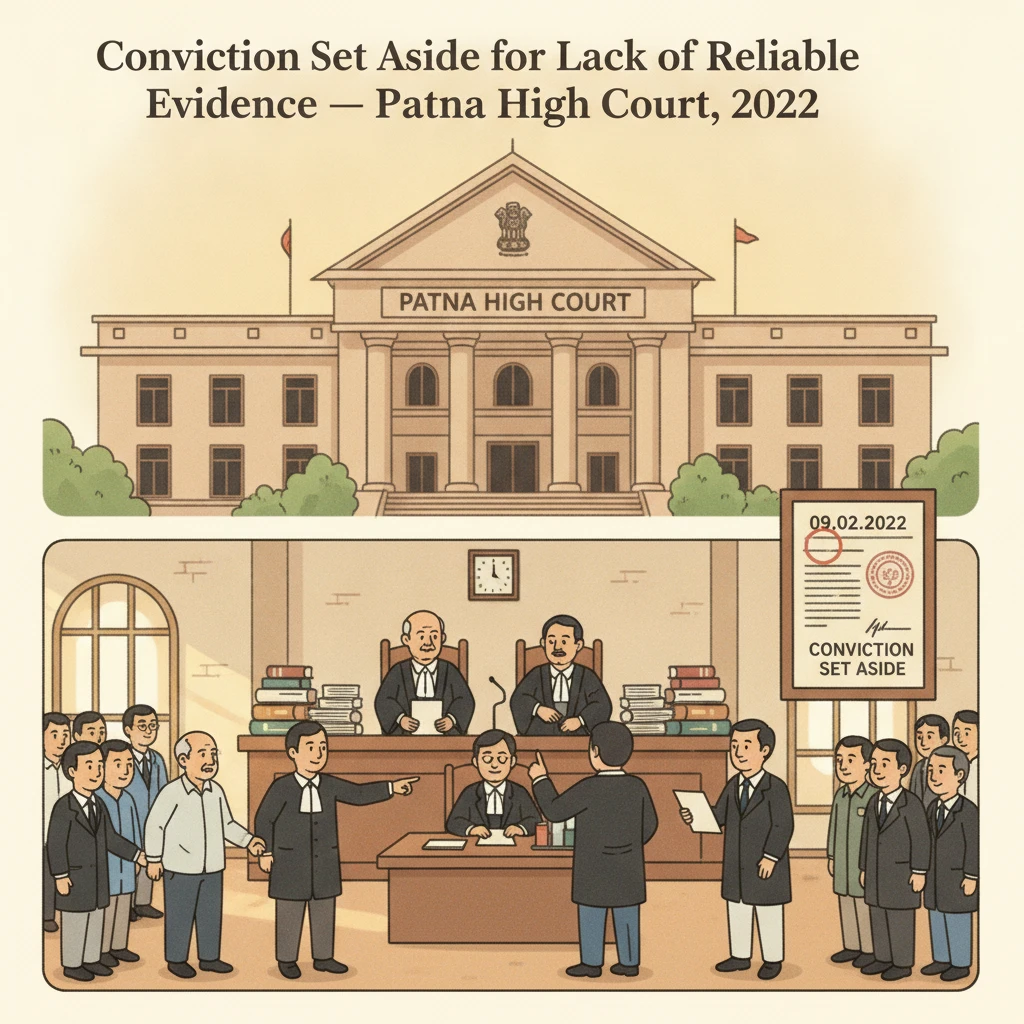
The Court allowed the appeal, set aside the conviction and sentences passed by the trial court on 27.09.1995 and 28.09.1995, and discharged the appellant from his bail bonds, as he was already on bail.
Why This Judgment Matters
This decision shows how closely the Patna High Court looks at evidence in serious cases like murder. Even when a lower court has given a life sentence, the High Court will interfere if the proof is weak or doubtful.
For villagers and ordinary people, it underlines that criminal cases cannot be decided only on statements. The court checks whether medical reports, site inspection, and earlier police statements match the story told at trial. If witnesses change their versions or if doctors’ reports do not support the claim, the court may refuse to uphold a conviction.
The judgment also highlights that benefit of doubt is a real protection in law. If there is a serious doubt about when or how a death happened, and whether the accused was involved at all, the accused cannot be kept in jail for life only on suspicion or village enmity.
Legal Issues and Answers
Issue: Did the prosecution prove beyond reasonable doubt that the appellant shot and killed the deceased as alleged in the FIR?
Answer: No. The Court found major contradictions in eye-witness accounts, mismatch between medical and ocular evidence, doubtful motive and place of occurrence, and absence of supporting physical evidence. The appellant was given benefit of doubt and acquitted.
Issue: Could the injured informant’s testimony alone sustain the conviction despite medical evidence suggesting his injuries were not caused by firearm and were not contemporaneous with the death?
Answer: No. The unchallenged medical opinion that the informant’s injuries were simple, caused by hard and blunt substance and not by firearm, and were inflicted within six hours, conflicted with the overall prosecution case and reduced the reliability of his version.
Cases Cited by the Court
- The judgment does not mention or rely on any specific earlier case-law by name or citation. It only refers generally to medical textbooks (Modi’s Medical Jurisprudence and Toxicology) and settled legal principles.
Case Details
Case Number: Criminal Appeal (DB) No. 358 of 1995
Case Title: Manglesh Singh @ Jata Singh v. The State of Bihar
Court: High Court of Judicature at Patna
Coram: Hon’ble Mr. Justice Ashwani Kumar Singh and Hon’ble Mr. Justice Rajeev Ranjan Prasad
Date of Judgment: 09.02.2022
Citation: 2022 (1) PLJR 817
Advocates:
- For the Appellant: Mr. Sudhanshu Kumar Lall, Advocate; Mr. Dhananjay Kumar, Advocate
- For the State: Mr. Dilip Kumar Sinha, APP
- For the Informant: Mr. Manoj Kumar Singh, Advocate
Nature of Case: Criminal appeal (Division Bench) against conviction and sentence under Section 302 IPC and Section 27 of the Arms Act arising out of Sessions Trial No. 742 of 1993.
Result: Appeal allowed; conviction and sentence set aside; appellant discharged from bail bonds.
Link to judgement; https://patnahighcourt.gov.in/viewjudgment/NSMzNTgjMTk5NSMxI04=-nB3G6G–ak1–hbng=
If you found this explanation helpful and wish to stay informed about how legal developments may affect your rights in Bihar, you may consider following Samvida Law Associates for more updates.







