

Case Background
This criminal appeal arose from a judgment dated 16.12.2004 passed by the Additional District and Sessions Judge 1st, West Champaran, Bettiah, functioning as Special Court under the Scheduled Castes and Scheduled Tribes (Prevention of Atrocities) Act, in Trial No. 22 of 1995.
The trial court had convicted appellant no. 2 for the offence punishable under Section 323 of the Indian Penal Code (IPC) and sentenced him to undergo rigorous imprisonment for three months. The case stemmed from a complaint case, numbered 6000 of 1992, filed by the complainant, Sheo Chand Baitha.
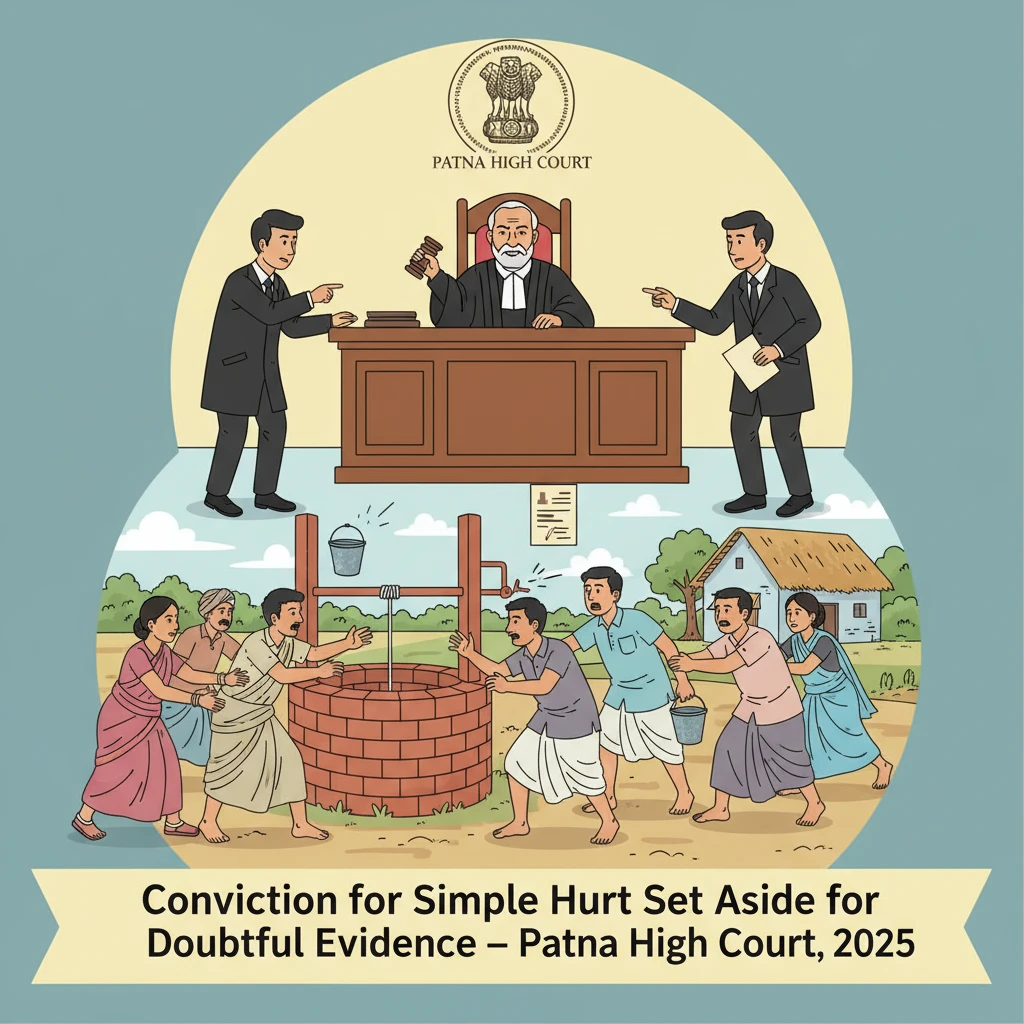
According to the complaint, on 19.07.1992 at about 11:00 AM, the complainant put his bucket into a well near his house in Khora village to draw water. Co-accused Dhuri Sah (appellant no. 1 before the High Court, since deceased) had already lowered his own bucket into the same well. Dhuri Sah allegedly started abusing the complainant by calling out his caste and saying that his religion had been defiled as the complainant had put his bucket into the well while he was drawing water.
On hearing the shouts, appellant no. 2 arrived at the spot. When the complainant asked Dhuri Sah to speak respectfully, both accused allegedly pushed and slapped him, causing him to fall on the ground. Appellant no. 2 was further alleged to have forcibly snatched the complainant’s bucket, said to be worth Rs. 75. Neighbours then intervened and, as per the complaint, “saved the complainant’s life”.
On this basis, Complaint Case No. 6000 of 1992 was registered under Sections 323 and 379 IPC and Section 3(10) of the Scheduled Castes and Scheduled Tribes (Prevention of Atrocities) Act. The trial court took cognizance and on 16.09.1993 framed charges against the accused persons under the same provisions.
The complainant and four other prosecution witnesses were examined. No documentary evidence was produced by the prosecution. The defence examined four witnesses and produced Exhibits A to A/3, which were signatures of the advocate on the complaint petition. In their statements under Section 313 of the Code of Criminal Procedure (Cr.P.C.), the accused took the plea of total denial.
During the pendency of this appeal, the Superintendent of Police, West Champaran, informed the Patna High Court through a report dated 12.11.2025 that appellant no. 1, Dhuri Sah, had died. Consequently, the appeal stood abated as against him. The Court therefore considered the case only in respect of appellant no. 2.
What the Court Examined and Decided
The Patna High Court, through Hon’ble Mr. Justice Alok Kumar Pandey, heard the submissions of the learned Amicus Curiae for appellant no. 2 and the learned Additional Public Prosecutor for the State.
The core question framed by the Court was whether the offence under Section 323 IPC was made out against appellant no. 2 in the light of the evidence and circumstances on record.
The Amicus Curiae attacked the trial court judgment on several grounds. She argued that there were material contradictions in the statements of the prosecution witnesses and that the trial court had failed to appreciate the defence evidence. She also pointed out that:
- There was an unexplained delay of 10 days in filing the complaint.
- The complainant could not prove the exact place of occurrence by mentioning its boundary or khata-khesra details.
- Most of the prosecution witnesses (PWs 1, 3, and 5) were “chance witnesses” whose stated presence on the spot was doubtful.
- The complaint was allegedly filed to counter an earlier case lodged by the wife of appellant no. 2 against one Virendra Kuwar, with whom the complainant was said to be closely associated.
The State, on the other hand, argued that the complainant (PW-4) and the other witnesses had supported the prosecution case and that the trial court’s conviction under Section 323 IPC was justified and required no interference.
The High Court carefully examined the testimonies of all the prosecution witnesses, the defence witnesses, and the documents brought on record.
The Court first assessed the evidence of the complainant (PW-4), who was the star witness. In response to court questions, he admitted that he had filed the complaint 10 days after the alleged occurrence but gave no explanation for this delay. He also failed to state the boundary or khata-khesra of the place of occurrence. The Court noted that in criminal cases, the prosecution must clearly establish where the incident took place. Since the complainant himself could not prove the boundary of the place of occurrence, the Court found that the prosecution failed on this basic point and that the authenticity of the complaint itself became doubtful.
The High Court then scrutinised the other prosecution witnesses, especially focusing on whether they were genuine eyewitnesses or mere “chance witnesses”.
PW-2 (Bhola Raut) said that appellant no. 2 had given two to three blows to the complainant. The Court found his version of the manner of occurrence inconsistent with the complaint petition. In his evidence he vaguely stated that he was coming from one side while three other witnesses—Harihar, Tulsi, and Motilal—were coming from another side, a statement which directly conflicted with PW-3’s testimony.
PW-3 (Tulsi Mahto), a resident of Mehadiya whose house was about one mile away from the place of occurrence, claimed that he had gone to the house of co-accused Dhuri Yadav to take medicine and saw the incident. The Court considered him a chance witness. In cross-examination, he admitted that he did not know the name of the medicine and had no purchase receipt. He also stated that he went to the spot alone after hearing commotion, which was inconsistent with PW-2’s claim that several persons were coming together. For these reasons, the Court held that his evidence was not trustworthy.
PW-5 (Motilal Yadav), from another village, said he was returning from the house of one Gena Mistiri and saw the occurrence. The Court again treated him as a chance witness. In cross-examination, he admitted that he could not say how many slaps were given and could not indicate the specific boundary of the place of occurrence. He also admitted that he did not ask anyone about the incident after witnessing it. The Court felt that if he had truly seen such an occurrence, his natural conduct would be to talk to others about it. His behaviour thus suggested that he had not actually witnessed the event, making his presence at the scene doubtful.
PW-1 (Harihar Mahto) claimed that he was working in his field and saw the occurrence. The Court noted that he did not disclose what work he was doing or how the place of occurrence was visible from where he was working. He said the accused assaulted the complainant with fists, but his account of the assault differed from other witnesses. There was also a mismatch between the complaint, which said that the bucket was forcibly snatched in the presence of nearby witnesses, and his testimony, which failed to mention the presence of any other witnesses when the bucket was taken. The Court concluded that his statement regarding the manner of occurrence was inconsistent with the complaint petition and lacked credibility.
To guide its approach to “chance witnesses”, the High Court relied on Supreme Court precedents. It quoted from Rajesh Yadav v. State of Uttar Pradesh (Criminal Appeal Nos. 339–340 of 2014) where a chance witness is described as someone who happens to be at the scene by chance and not as a matter of course, whose testimony may require greater scrutiny. It also cited Jarnail Singh v. State of Punjab, (2009) 9 SCC 719, wherein the Supreme Court held that the evidence of a chance witness must be cautiously examined and that if his presence at the scene is doubtful, his deposition should be discarded.
Applying these principles, the Patna High Court held that PWs 1, 3 and 5 were all chance witnesses whose presence at the scene was not satisfactorily explained and whose testimonies suffered from serious inconsistencies. Hence, their evidence did not inspire confidence and was liable to be discarded.
The Court next considered the defence case. The defence examined four witnesses (DWs 1 to 4) and produced Exhibits A, A/1, A/2 and A/3. From this material, the Court found it “crystal clear” that the wife of appellant no. 2 had earlier filed Mehadiya P.S. Case No. 110 of 1992 against one Virendra Kuwar and others. The complainant in the present case was associated with Virendra Kuwar. The High Court accepted the defence suggestion that the present complaint had been filed in retaliation, at the behest of Virendra Kuwar, to put pressure on appellant no. 2 and others and to overcome the earlier case.
The Court also stressed that the complainant himself had admitted that his complaint was lodged after 10 days of the alleged occurrence and that he had not explained this delay. The combination of unexplained delay, failure to prove the exact place of occurrence, reliance on chance witnesses, and contradictions in the prosecution evidence led the Court to hold that the prosecution story was “very much doubtful”.
In criminal law, the prosecution must prove its case beyond reasonable doubt. If there are serious doubts about the incident or identity of the assailant, the benefit of doubt must go to the accused. The Court held that in this case, the prosecution had failed to discharge its burden.
Consequently, the Patna High Court held that the trial court had erred both in law and in its appreciation of the evidence. The conviction and sentence of appellant no. 2 under Section 323 IPC were set aside. The appeal was allowed. Since appellant no. 2 was already on bail, he was discharged from the liabilities of his bail bond.
Why This Judgment Matters
This judgment is important because it shows how carefully criminal courts must evaluate evidence before upholding a conviction, even for a relatively minor offence like simple hurt under Section 323 IPC.
For villagers and ordinary citizens, the ruling illustrates that:
- A complaint filed after delay must explain why it was late, otherwise the Court may treat it with suspicion.
- The exact place of an alleged incident must be clearly proved; vague references are not enough.
- People who claim to have just happened to be present (chance witnesses) must give a believable reason for being there. If their stories do not match or their conduct seems unnatural, their evidence can be rejected.
- If there is evidence that a criminal case was filed only to counter or pressurise someone because of an earlier case, the Court will take that seriously and can give the accused the benefit of doubt.
In short, the judgment reinforces the principle that no person should be punished unless the prosecution case is strong, consistent and free from major doubts. It also confirms that the Patna High Court will interfere with trial court decisions where evidence has not been properly appreciated.
Legal Issues and Answers
Issue: Whether, on the evidence available, the offence under Section 323 IPC was proved against appellant no. 2 beyond reasonable doubt.
Answer: No. The Patna High Court held that the prosecution failed to establish the incident and the role of appellant no. 2 with certainty, due to unexplained delay in filing the complaint, failure to prove the place of occurrence, reliance on unreliable chance witnesses, and contradictions in their testimonies. The conviction and sentence were therefore set aside and the appeal allowed.
Cases Cited by the Court
Rajesh Yadav v. State of Uttar Pradesh, Criminal Appeal Nos. 339–340 of 2014 – cited for the definition and treatment of a “chance witness”.
Jarnail Singh v. State of Punjab, (2009) 9 SCC 719 – cited for the principle that evidence of a chance witness must be closely scrutinised and may be discarded if his presence at the scene is doubtful.
The judgment in Jarnail Singh itself refers to earlier Supreme Court authorities such as Satbir v. Surat Singh, Harjinder Singh v. State of Gujarat, Acharaparambath Pradeepan v. State of Kerala, Sarvesh Narain Shukla v. Daroga Singh and Shankarlal v. State of Rajasthan, which are also reproduced in the Patna High Court judgment in support of the same principle.
Case Details
Case Number: Criminal Appeal (SJ) No. 99 of 2005
Trial Reference: Trial No. 22 of 1995 arising out of Complaint Case No. 6000 of 1992
Case Title: Dhuri Sah and another v. The State of Bihar
Coram: Hon’ble Mr. Justice Alok Kumar Pandey
Citation: 2026 (2) PLJR 48
Date of Patna High Court Judgment: 06.12.2025
Advocates:
- Mrs. Sushmita Mishra, Amicus Curiae for the appellants
- Mrs. Anita Kumari Singh, Additional Public Prosecutor for the State
Nature of the Case: Criminal appeal (single judge) against conviction and sentence under Section 323 IPC passed by the Special Court under the Scheduled Castes and Scheduled Tribes (Prevention of Atrocities) Act.
Final Outcome: Conviction and sentence of appellant no. 2 under Section 323 IPC set aside; appeal allowed; appellant no. 2 discharged from bail bond liabilities. Appeal abated as against appellant no. 1 due to his death.
Link to Judgment: Patna High Court Judgment – Criminal Appeal (SJ) No. 99 of 2005
If you found this explanation helpful and wish to stay informed about
how legal developments may affect your rights in Bihar,
you may consider following Samvida Law Associates for more updates.







