

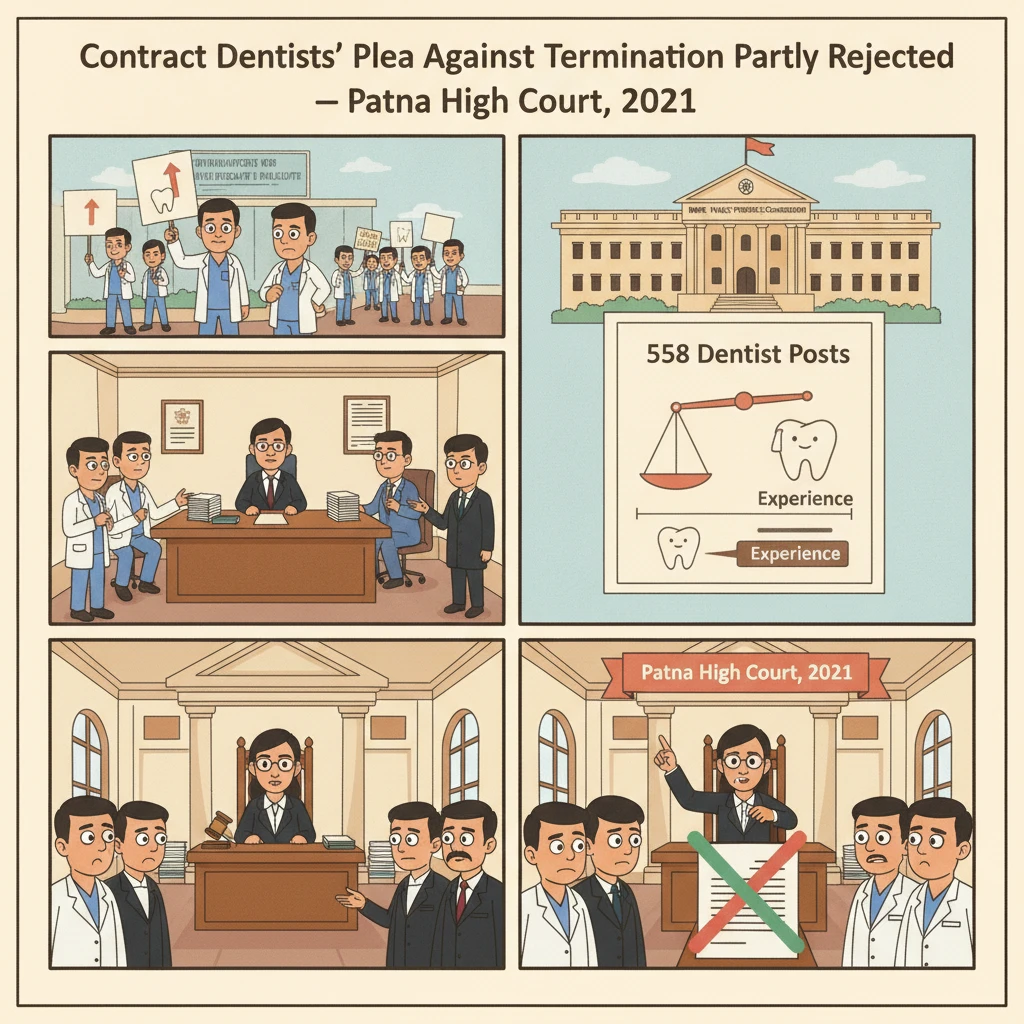
Case Background
This case arises from two writ petitions: Civil Writ Jurisdiction Case No. 7282 of 2020 filed by 30 contractual dentists working across Bihar, and Civil Writ Jurisdiction Case No. 10738 of 2020 filed by one contractual dentist from Muzaffarpur.
All the petitioners were qualified dentists, registered under the Dentists Act, 1948. They had been engaged by the State of Bihar on a contractual basis pursuant to various advertisements. Initially, they were taken on daily wages and allowed to work two days in a week. In 2011, their remuneration was revised to Rs. 30,000 per month.
Over time, these contractual dentists began demanding regularization of their services. To press this demand, they went on strike. This led to a meeting on 10.03.2015 between representatives of the dentists and the Principal Secretary, Health Department. The minutes of this meeting recorded two key points: first, that the department would obtain legal opinion from the Advocate General on the proposal for regularization and then send a proposal to the State Government; and second, that no penal action would be taken against the striking dentists.
Before this meeting, the Bihar Dentist Service Rules, 2014, framed under the proviso to Article 309 of the Constitution, had already been notified on 14.10.2014. These rules governed regular recruitment to the dentist cadre in the State.
On 25.03.2015, the Bihar Public Service Commission issued an advertisement inviting applications for 558 basic grade dentist posts. The selection process, as per the advertisement, allotted 25 out of 100 marks as weightage for work experience to dentists already working in Government hospitals, clearly favouring contractual dentists like the petitioners.
The Principal Secretary, Health Department, then addressed a letter dated 31.03.2015 to representatives of contractual doctors and dentists. This communication indicated that, after completion of the selection process by the Commission, if some doctors/dentists with requisite qualifications and long contractual service were not selected, the department would frame a policy, in accordance with law, to consider their appointment through regularization.
The selection process under the 25.03.2015 advertisement was completed. All contractual dentists in Bihar were selected for regular appointment, except 73, which included the petitioners. Despite many regular appointments, the remaining contractual dentists, including those who had not been selected, were allowed to continue for some time.
On 25.02.2020, the Health Department issued Memo No. 256, deciding to terminate all contractual appointments of dentists, since regular appointments had been made under the 2014 Rules. This order triggered the present writ petitions, where the petitioners challenged the termination and sought protection of their services.
What the Court Examined and Decided
The core grievance of the petitioners was that the State Government had gone back on its promises to contractual dentists. They relied heavily on three sets of assurances:
First, the 10.03.2015 meeting minutes, where it was resolved that the Health Department would obtain legal opinion from the Advocate General on regularization and then send a proposal to the Government. According to the petitioners, this created a legitimate expectation that their services would be regularized.
Second, the letter dated 31.03.2015 from the Principal Secretary to representatives of contractual doctors/dentists. This letter stated that if, after the Public Service Commission’s selection, some contractual doctors/dentists did not get selected, the Government would, on the basis of legal opinion, frame a policy for their regularization in accordance with law.
Third, an assurance alleged to have been given by the Health Minister on the floor of the Bihar Legislative Assembly. According to the petitioners, the Minister stated that the cases of those 73 dentists who could not be recommended by the Commission due to low merit would be considered for regularization after appointing those recommended by the Commission.
The petitioners contended that these assurances created a binding promise, and that the subsequent order dated 25.02.2020 terminating their contracts was contrary to that promise. They argued that the State was bound by principles such as promissory estoppel and could not resile from the commitments made.
They also relied on a General Administration Department resolution dated 17.09.2018 (Memo No. 12534). This resolution recorded the State’s decision to accept a committee’s recommendation on contractual employees. The committee had noted that many contractual workers may fail in regular recruitment examinations or interviews. It recommended that, if posts remained vacant even after regular appointments, instead of making fresh contractual appointments, those contractual workers who had failed in regular selection could be adjusted on contract against the vacant posts. The petitioners argued that this policy supported continuation of existing contractual dentists until retirement age or end of scheme, or at least until all posts were filled.
Additionally, in the Muzaffarpur petitioner’s case (C.W.J.C. No. 10738 of 2020), it was pointed out that the Civil Surgeon-cum-Chief Medical Officer, by letter dated 15.02.2021, had informed the Health Department that one dentist post at Primary Health Centre, Mushahri, remained vacant due to non-appointment of a regular dentist, and therefore the petitioner’s services were being used on a contractual basis. Counsel argued that, as the post was still vacant, terminating her contract would serve no public purpose and would be against public interest.
On the other side, the State argued that contractual employees simply have no legal right to hold posts once regular appointments are made in accordance with statutory rules. It was emphasised that regular appointments of dentists had been made on the basis of Bihar Public Service Commission recommendations under the Bihar Dentist Service Rules, 2014. Since the petitioners had been given due weightage for experience and yet failed to secure selection, they could not insist on continuing in service or claim regularization.
The Court first clarified the basic legal position: a contractual employee has no right to continue after the contract period ends or once the post is filled on a regular basis through a lawful selection process. On this principle, dentists working on contract against posts which had already been filled up regularly could not demand as of right that their contractual engagement be continued.
The petitioners’ reliance on the Supreme Court decision in Surya Narayan Yadav v. Bihar State Electricity Board, (1985) 3 SCC 38, was carefully examined. In that case, the Electricity Board had repeatedly represented to its ex-cadre trainee employees that they would be permanently absorbed without examination and confirmed after probation. Relying on those representations, some trainees did not seek employment elsewhere. The Supreme Court held that the Board was bound to honour those assurances.
The Patna High Court held that the facts here were different. In the dentists’ case, there was no categorical assurance that their services would be regularized. The assurance was limited: that the process of appointment would be completed after legal opinion from the Advocate General. The Advocate General’s opinion, when given, indicated that most dentists were likely to qualify in the regular recruitment process and that, in case some failed, the Government could consider suitable steps for their regularization in accordance with law. Later communication dated 31.03.2015 merely showed an intention to frame a policy; it was not a clear promise of regularization.
The Court also considered the plea of promissory estoppel, based on the Supreme Court judgment in State of Jharkhand v. Brahmputra Metallics Ltd., Ranchi, and the judgment in Monnet Ispat and Energy Ltd. v. Union of India, (2012) 11 SCC 1, referred to therein. The Court noted that promissory estoppel requires a definite promise, and the other party must have acted to its prejudice based on that promise. Further, a promise contrary to law cannot be enforced; public authorities cannot be compelled under promissory estoppel to act against statutory provisions.
Here, the Patna High Court found that:
There was no clear and unequivocal promise that the petitioners’ services would be regularized. The communications only spoke about considering regularization and framing a policy “in accordance with law”.
The petitioners had not pleaded or shown that they changed their position or suffered prejudice relying on any specific promise.
Any promise that contradicted the Bihar Dentist Service Rules, 2014 could not be enforced, as regular appointments had to follow the statutory recruitment process through the Commission.
The Court also observed that the selection process had been designed to significantly favour contractual dentists: out of 100 marks, 25 marks were reserved for work experience in Government hospitals. Despite 558 posts being advertised and such high weightage, the petitioners still failed to secure positions in the merit list. This further weakened their claim to any right of regularization or continued engagement.
At the same time, the Court noted some important facts in favour of the petitioners. The State itself admitted, through instructions to the Government Advocate, that there were 571 sanctioned dentist posts in Bihar, out of which 525 were occupied by regular dentists, leaving 46 posts vacant. The department had already obtained roster clearance from the General Administration Department for these vacancies. The Court was also told that some contractual dentists were still being allowed to continue.
The Court took note of the 31.03.2015 communication and the 17.09.2018 General Administration Department resolution, both showing a policy inclination towards allowing unsuccessful but qualified contractual workers to continue on contract where posts remained vacant, instead of recruiting fresh contractual staff.
However, the Court was careful about the limits of judicial power. It held that, in exercise of judicial review, it could not direct the State to engage any particular person on contract. Nevertheless, in public interest, considering that the petitioners had been serving as dentists on contract for long periods and that posts remained vacant, the State should consider engaging them on contract against those vacant posts.
Accordingly, while upholding the general legal position that contractual dentists cannot claim any right to regularization or continuation once posts are filled regularly, the Court directed the Additional Chief Secretary, Health Department, Government of Bihar, to take a final decision on engaging the petitioners and similarly situated persons on contractual basis against vacant dentist posts, with a clear condition that such engagement would terminate once regular appointments are made.
The Court further clarified that no undertaking from the petitioners was required regarding non-claim of continuation after regular appointments. In its view, a contractual engagement automatically ends on expiry of the contract period or on regular appointment to the post as per the rules. Therefore, the legal framework already ensured that the petitioners could not insist on continuation after regular recruitment.
The Additional Chief Secretary was directed to take this decision within one month from the date of receipt or production of the Court’s order. With these directions and observations, both writ petitions were disposed of.
Why This Judgment Matters
This judgment is significant for contractual health professionals in Bihar, especially those working as dentists. It clearly states that contractual engagement does not give a right to a permanent post or to continuation after regular recruitment under statutory rules. Promises or political assurances cannot override recruitment rules framed under Article 309 of the Constitution.
At the same time, the Patna High Court recognised the practical reality: many posts for dentists in government hospitals remain vacant, and contractual dentists have been serving for years. The Court did not force the Government to appoint them, but strongly indicated that, in public interest, the State should use their services on contract against vacant posts until regular appointments are made.
For contract workers generally, the judgment shows that internal government communications about “considering” regularization or “framing a policy” are not the same as a legal promise. Unless the State issues a clear and lawful policy or rule, courts will be reluctant to treat such communications as binding.
For the State, the judgment underlines the need for clarity and consistency. Once a department talks about framing a policy for contractual employees and later does not act on it, it creates confusion and litigation. The Court’s direction to the Additional Chief Secretary to take a clear decision within one month pushes the administration towards finality and transparency.
Legal Issues and Answers
Issue: Do contractual dentists have a legal right to continue in service or to be regularized after regular appointments are made under the Bihar Dentist Service Rules, 2014?
Answer: No. The Court held that contractual employees have no right to hold the post after expiry of the contract period or after posts are filled through regular selection under statutory rules, and no clear promise of regularization had been made to the petitioners.
Issue: Can the State of Bihar be compelled, on the basis of promissory estoppel or earlier assurances, to regularize or permanently absorb contractual dentists who failed in the regular recruitment process?
Answer: No. The Court held that there was no categorical promise of regularization; the communications only showed an intention to frame policy “in accordance with law”, and any promise contrary to statutory rules cannot be enforced through promissory estoppel.
Issue: What relief, if any, can be granted to long-serving contractual dentists when vacancies still exist?
Answer: While not directing appointments, the Court directed the Additional Chief Secretary, Health Department, to consider engaging the petitioners and similarly situated contractual dentists on contract against vacant posts, clearly stipulating that such contracts would end once regular appointments are made, and to take this decision within one month.
Cases Cited by the Court
- Surya Narayan Yadav v. Bihar State Electricity Board and Others, (1985) 3 SCC 38 – held distinguishable on facts.
- State of Jharkhand and Others v. Brahmputra Metallics Ltd., Ranchi and Others, Civil Appeal Nos. 3860/3862 of 2020; 2020 SCC Online SC 968 – referred to on promissory estoppel but found inapplicable on facts.
- Monnet Ispat and Energy Ltd. v. Union of India and Others, (2012) 11 SCC 1 – cited for the principle that promissory estoppel cannot compel action contrary to law.
- Najma v. Government of NCT of Delhi, W.P. (C) No. 8956 of 2020, decision dated 22.07.2021 (Delhi High Court) – relied upon by petitioners; the Court distinguished the present case.
Case Details
Case Number: Civil Writ Jurisdiction Case No. 7282 of 2020 with Civil Writ Jurisdiction Case No. 10738 of 2020
Case Title: Dr. Vikash Kumar & Ors. v. The State of Bihar & Ors.; with Dr. Shahina Shaukat v. The State of Bihar & Ors.
Citation: 2022 (1) PLJR 891
Court: High Court of Judicature at Patna
Coram: Hon’ble Mr. Justice Chakradhari Sharan Singh
Date of Judgment: 08-10-2021
Advocates:
- For the petitioners in C.W.J.C. No. 7282 of 2020: Mr. P.K. Shahi, Senior Advocate; Mr. Vikas Kumar.
- For the respondents in C.W.J.C. No. 7282 of 2020: Mr. Ajay Behari Sinha, GA 8; Mr. Kishore Kumar Sinha; Mr. Shashi Shekhar.
- For the petitioner in C.W.J.C. No. 10738 of 2020: Mrs. Nivedita Nirvikar, Senior Advocate; Mr. Zainul Abedin; Mr. Shailesh Kumar.
- For the respondents in C.W.J.C. No. 10738 of 2020: Mr. Nagendra Prasad Yadav, SC 23; Mr. Kishore Kumar Sinha.
Nature of the Case: Writ petitions (civil) challenging termination of contractual appointments of dentists and seeking continuation/regularization.
Link to Full Judgment: Patna High Court Judgment – CWJC No. 7282 of 2020 with CWJC No. 10738 of 2020
If you found this explanation helpful and wish to stay informed about
how legal developments may affect your rights in Bihar,
you may consider following Samvida Law Associates for more updates.







