

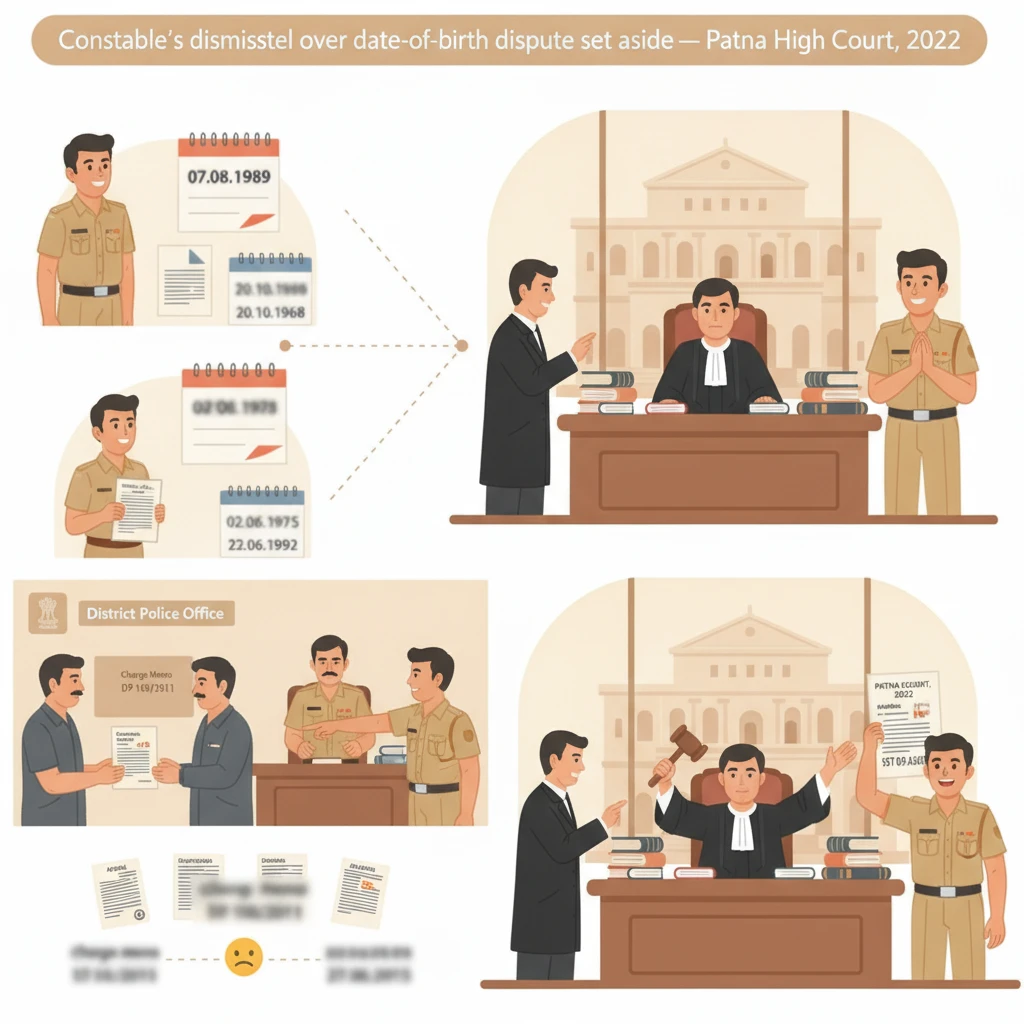
Case Background
The petitioner was first appointed as a Home Guard on 07.08.1989. For that appointment, his date of birth was recorded as 20.10.1968.
Later, a public advertisement was issued on 10.02.2004 inviting applications for the post of Constable. The petitioner applied as a candidate. Selection to this post was based on matriculation (10th pass) qualification.
The petitioner was selected on 09.05.2008. His documents were verified on 04.07.2008 for final appointment. At that stage, no objection was recorded and his documents were cleared.
However, before a formal appointment order could be issued, an FIR was lodged on 18.07.2008. The allegation was that the petitioner had furnished two different dates of birth – 20.10.1968 and 02.06.1975 – on the basis of his transfer certificate and matriculation certificate.
The record shows that the petitioner passed his matriculation examination on 25.11.1992 while he was already working as a Home Guard. His matriculation certificate recorded his date of birth as 02.06.1975, which differed from the date of birth in the Home Guard records.
Some similarly situated persons had already approached the Patna High Court in relation to rectification of date of birth. Their cases were disposed of by the Court (referred to as Annexure-6). The petitioner also approached the Court, and his petition was disposed of (Annexure-7) with a direction to submit a detailed representation. It was to be considered in light of the earlier decision.
After these developments, the petitioner was appointed as Constable on 14.04.2011.
On the basis of an Investigating Officer’s report in the criminal case, the disciplinary authority placed the petitioner under suspension on 04.11.2011. On the departmental side, a charge memo was issued on 13.11.2011. The petitioner submitted his reply on 25.01.2012.
The disciplinary authority was not satisfied with his explanation and decided to hold a departmental (domestic) enquiry. The enquiry concluded on 11.07.2013, holding that the charge against the petitioner was proved.
Based on the Enquiry Officer’s report dated 11.07.2013, a second show cause notice was issued on 05.08.2013. Thereafter, by Memo No. 5405 dated 13.09.2013, the disciplinary authority dismissed the petitioner from service in Departmental Proceeding No. 108/2011. It was directed that he would get only subsistence allowance for the suspension period and that the suspension period would be adjusted against half earned leave.
The petitioner filed an appeal, but the appellate authority (Respondent No. 4) dismissed it by Memo No. 1391 dated 27.06.2014, affirming the order of dismissal. A memorial filed thereafter was also rejected on 23.06.2015.
Meanwhile, in the criminal case arising from the FIR dated 18.07.2008, the petitioner was acquitted on 04.11.2015. The Court in the criminal case held that the prosecution had failed to prove the charges.
Aggrieved by the departmental dismissal and rejection of his appeals, the petitioner approached the Patna High Court in Civil Writ Jurisdiction Case No. 17398 of 2014.
What the Court Examined and Decided
The petitioner’s main prayer before the Patna High Court was to set aside the dismissal order dated 30.09.2013, the appellate order dated 27.06.2014, and to direct his reinstatement with all consequential monetary benefits.
On behalf of the petitioner, it was pointed out that the qualification for appointment as Home Guard was only Class 8. At that time, he had given his date of birth as 20.10.1968, and he was appointed on 07.08.1989.
He later passed matriculation on 25.11.1992. In the Home Guard records, his date of birth continued as 20.10.1968. But for the purpose of Constable recruitment, the relevant document was the matriculation certificate, which showed his date of birth as 02.06.1975.
Thus, there was a variation between the date of birth in the Home Guard record and the matriculation record. The petitioner’s stand was that for Constable recruitment, the date of birth in matriculation should be treated as final.
The petitioner argued that the enquiry did not establish that he had deliberately misled the authorities by giving two dates of birth. He relied on a policy decision of the State, issued by Respondent No. 2 on 15.01.2000, dealing with correction of date of birth in service records. He claimed that he had made a representation under this policy, but it was rejected.
According to the petitioner, the main charge was that he had furnished two dates of birth and had not written his name in the application as recorded in the matriculation certificate. He claimed that the omission of his full name in the application form was inadvertent.
He also highlighted that he had been acquitted in the criminal case on 04.11.2015, showing that the allegation of giving false information was not proved even on the criminal side.
Very importantly, the petitioner pointed out that three crucial documents – the transfer certificate, the matriculation certificate, and his application form for the Constable post – were not listed as relied-on documents in the charge memo. Without these documents being specifically included and examined, it would be impossible to fairly decide whether he had actually furnished two dates of birth or written an incorrect name.
On this basis, he argued that the entire departmental process, from initiation of enquiry to rejection of his memorial, was vitiated and liable to be set aside.
The State opposed the petition. The State’s counsel argued that the petitioner had misled the authorities by giving two dates of birth, 20.10.1968 and 02.06.1975, and by mentioning a name in the application form which did not match the name in the matriculation certificate. They maintained that the Enquiry Officer’s report and the orders of the disciplinary and appellate authorities were proper and required no interference.
After hearing both sides, the Court narrowed the key question: had the department proved that the petitioner misled the authorities about his date of birth and name?
The Court identified three crucial documents for answering this question: the transfer certificate (date of birth 20.10.1968), the matriculation certificate (date of birth 02.06.1975 and name Vijay Kumar or Vijay Kumar Singh), and the application form for the Constable post (where the petitioner mentioned his name differently from the matriculation, and gave date of birth as 20.10.1970 instead of 02.06.1975).
The Court noted that these crucial documents were not specifically cited in the list of documents attached to the charge memo, as seen from Annexure-13. Instead, the listed documents were mainly official reports and police records, and some witnesses were named.
The Court recorded that the respondents themselves argued that the three documents were part of document no. 1, but the author of document no. 1 had not been examined or cross-examined in the enquiry.
The Court also observed that, if the exact date of birth was in dispute, the authors of the transfer certificate and matriculation certificate should have been examined to identify which date of birth was correct. Further, State policy dated 15.01.2000 (issued by Respondent No. 2) required that the date of birth in matriculation (02.06.1975) be taken as final.
The Court emphasised that from the very beginning, the authorities failed to cite and rely upon the relevant documents necessary to prove that the petitioner had misled them on date of birth and name.
On the criminal side, the same issue had been examined in the FIR registered on 18.07.2008. The petitioner’s acquittal on 04.11.2015 clearly showed, in the Court’s words, that the prosecution had failed to prove the charges there as well.
The Court further noted that before the appointment order was issued on 14.04.2011, the petitioner’s documents were checked on 04.07.2008 and no objection was raised at that time. This showed that the verification process itself had lapses on the part of the selecting authority.
The Court held that the disciplinary authority, the appellate authority, and the authority rejecting the memorial had not appreciated the matter properly. They failed to consider the transfer certificate, the matriculation certificate, and the Constable application form in the enquiry proceedings. They also did not examine the author of the key report dated 02.11.2011 (document no. 1).
At the same time, the Court did not completely absolve the petitioner. It recorded that in his application form, the petitioner had indeed written his date of birth as 20.10.1970 even though his matriculation certificate showed 02.06.1975, and he had also given his name in a manner contrary to the matriculation record.
The Court noted that the petitioner’s application should ideally have been rejected at the threshold or at the stage of document verification, and that there were lapses on the part of the selecting authority in not doing so. Nevertheless, whether the petitioner had intentionally misled the authorities needed to be proved in a lawful enquiry, which had not been done.
Because of these procedural defects, the Court set aside the dismissal and related orders on what it called “technical ground”. It directed that the petitioner be reinstated to the post of Constable.
However, the Court refused to grant back wages for the period between the dismissal date (13.09.2013) and his reinstatement. It gave a clear reason: it was undisputed that the petitioner had mentioned a wrong date of birth (20.10.1970) and incorrect name in his application form, even though his matriculation record showed 02.06.1975 and the correct name.
The Court also considered whether it should send the case back for a fresh enquiry. Because the dispute dated back to 2008 and the case did not involve misappropriation of government money, the Court felt that ordering a fresh enquiry would not be appropriate.
Instead, it ordered the respondent authorities to reinstate the petitioner within two months from receipt of the order. It also directed them to extend all service benefits such as increments, re-fixation of pay, seniority, and pensionary benefits (if applicable) at par with his immediate junior appointed with effect from 14.04.2011, up to the present. Only the monetary benefits for the intervening period from 13.09.2013 till reinstatement were denied.
Accordingly, the writ petition was allowed.
Why This Judgment Matters
This judgment is important for government employees and candidates facing departmental action over alleged false information in application forms, especially about date of birth and name.
The Patna High Court has made it clear that if the State wants to punish an employee for giving wrong details, it must strictly prove the charge through a fair enquiry. All crucial documents must be cited and produced, and the authors of key documents should be examined and cross-examined.
At the same time, the Court has also signalled that candidates must be careful and honest while filling forms. Here, the petitioner was denied back wages because he had mentioned a different date of birth and incorrect name in his application, even though his dismissal was set aside.
For similarly placed persons, this decision shows that defective departmental enquiries can be challenged successfully. But they should not expect full back wages if their own conduct is not fully clean, even when the Court grants reinstatement.
Legal Issues and Answers
-
Issue: Whether the departmental enquiry properly proved that the petitioner misled the authorities by giving different dates of birth and an incorrect name for Constable recruitment.
Answer: No. The enquiry was held to be defective because crucial documents (transfer certificate, matriculation certificate, application form) were not properly cited or proved, and key witnesses were not examined. -
Issue: Whether the dismissal order, appellate order, and rejection of memorial could stand in such circumstances.
Answer: No. All these orders were set aside on technical grounds, and the petitioner was directed to be reinstated as Constable. -
Issue: Whether the petitioner was entitled to monetary benefits for the period between his dismissal and reinstatement.
Answer: No. The Court denied back wages for that period because the petitioner had admittedly given an incorrect date of birth and name in his Constable application form.
Cases Cited by the Court
- The judgment does not refer to or rely on any specific reported case law. It does, however, refer to an earlier decision of the Patna High Court (Annexure-6) and a policy decision of the State dated 15.01.2000.
Case Details
Case Number: Civil Writ Jurisdiction Case No. 17398 of 2014
Case Title: Vijay Kumar @ Vijay Kumar Singh v. The State of Bihar and Others
Citation: 2022 (2) PLJR 86
Court: High Court of Judicature at Patna
Coram: Hon’ble Mr. Justice P. B. Bajanthri
Date of Judgment: 08.03.2022
Advocates:
For the Petitioner: Mr. Arun Kumar
For the State: Mr. Ashok Kumar Dubey (AC to AAG-11)
Nature of the Case: Writ petition under civil writ jurisdiction challenging dismissal from service and seeking reinstatement with consequential benefits.
Link to the Judgment: Click here to read the full Patna High Court judgment
If you found this explanation helpful and wish to stay informed about
how legal developments may affect your rights in Bihar,
you may consider following Samvida Law Associates for more updates.







