

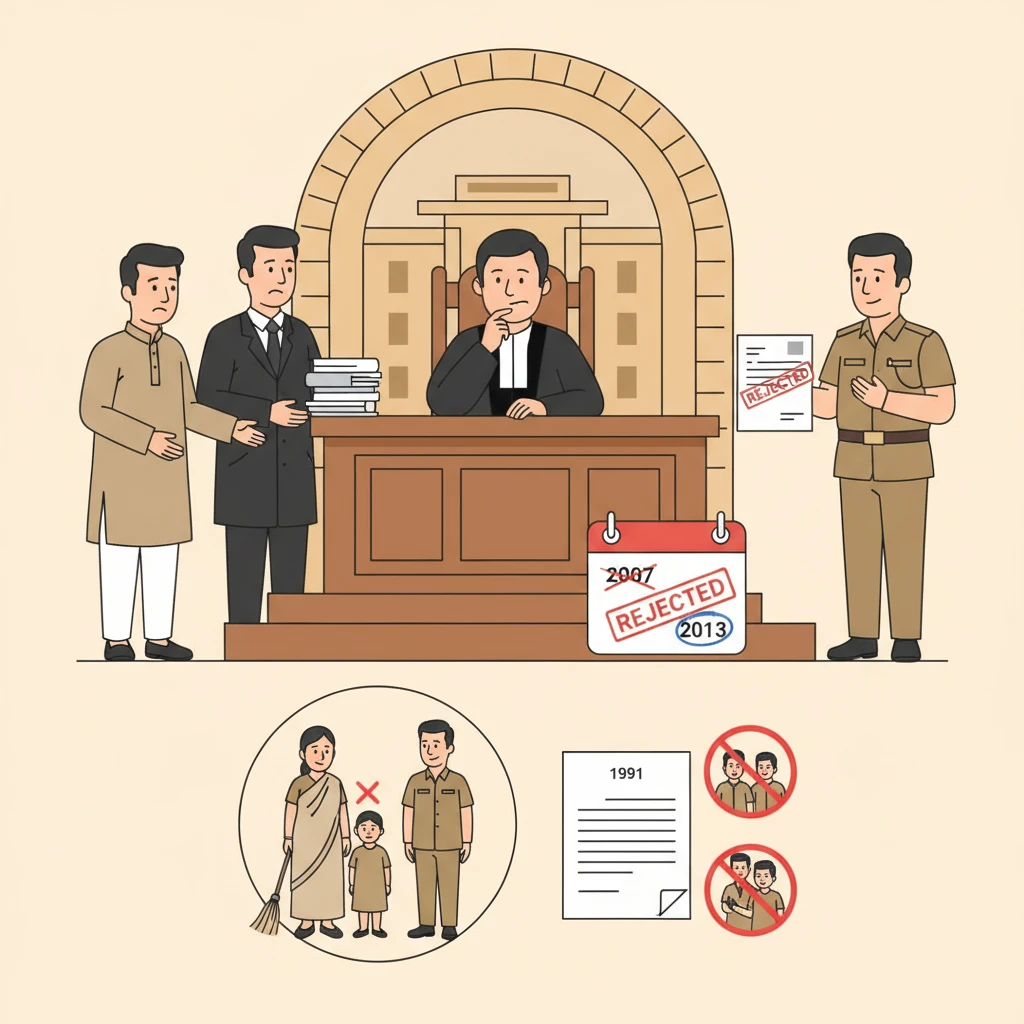
Case Background
The petitioner is the son of a woman who worked as a 4th grade sweeper in Bhagalpur Municipal Corporation. She died in harness on 30.12.2006 due to illness, after serving to the satisfaction of the authorities.
According to the petitioner, he applied in 2007 to Bhagalpur Municipal Corporation for compassionate employment, seeking a government job in place of his deceased mother. He claimed that despite this application, no job was given to him.
Finding no relief from the authorities, the petitioner filed Civil Writ Jurisdiction Case No. 18242 of 2015 before the Patna High Court. He requested the Court to direct the respondents to provide him compassionate appointment on the basis of his mother’s death while in service.
What the Court Examined and Decided
The writ petition came up before Hon’ble Mr. Justice Mohit Kumar Shah. The main question was whether the petitioner had any right to be appointed on compassionate grounds after his mother’s death, given the facts and the applicable policy.
The Municipal Corporation, Bhagalpur, through its counsel, opposed the claim. The Court recorded the stand of the Corporation as reflected in its counter affidavit.
First, the Corporation disputed the petitioner’s claim about the timing of his application. While the petitioner stated that he had applied in 2007, the Municipal Corporation produced its version that the petitioner had in fact made an application only on 16.11.2013. This later date was significant because there was a limitation period for applying under the compassionate appointment scheme.
Second, the Corporation pointed out that the petitioner’s father was already working as an employee of Bhagalpur Municipal Corporation. On this basis, the Corporation argued that the petitioner was not eligible for compassionate appointment under the applicable government policy.
The Corporation relied on a circular dated 05.10.1991. As per that circular, if any member of the family of the deceased employee is already employed in government service, the dependents are barred from claiming compassionate employment. The objective is that compassionate appointment is meant for families with no earning member, facing immediate financial crisis after the death of the employee.
The Corporation further informed the Court that the petitioner’s claim had been placed before the Compassionate Employment Committee. In its meeting held on 05.01.2015, the Committee rejected the petitioner’s claim on the ground that his application had been filed after the expiry of the prescribed period of limitation. This rejection order of the Committee had not been challenged separately by the petitioner.
The Corporation also referred to another aspect of the same circular dated 05.10.1991. It stated that where both husband and wife are government employees, and one of them dies, compassionate appointment cannot be granted to the dependents. In this case, both the petitioner’s father and mother were employees of the Municipal Corporation, Bhagalpur. Therefore, on the death of the mother, the dependents, including the petitioner, could not claim any right to compassionate appointment under this policy.
After hearing both sides and examining the materials on record, the Court framed its reasoning on two main grounds: the policy restriction and the time delay.
On the first ground, the Court noted that the policy of the Bhagalpur Municipal Corporation, following the circular dated 05.10.1991, clearly provided that if both parents are government employees and one of them dies, the dependents cannot be granted compassionate employment. In the present case, it was not in dispute that both parents of the petitioner were or had been government employees with the Municipal Corporation, and that only the mother had died.
In such a situation, the Court held that the petitioner could not claim compassionate employment. The existence of the father as a serving government employee meant that the family already had an earning member and therefore did not fall within the class of cases that the compassionate appointment policy intended to benefit.
On the second ground, the Court stressed the delay and the underlying object of the compassionate appointment scheme. The Court observed that 17 years had passed since the death of the petitioner’s mother in 2006. Granting compassionate appointment after such a long gap would go against the very purpose of the scheme.
The Court explained that the object of compassionate employment is to help a family tide over the immediate financial crisis that arises on the death of the sole breadwinner. The benefit is intended to be quick and urgent, not something that can be claimed indefinitely long after the crisis period has passed. When an appointment is sought after many years, the link between the death and any ongoing immediate crisis becomes too weak.
The Court referred to the judgment of the Hon’ble Supreme Court in Umesh Kumar Nagpal v. State of Haryana and Others, reported in (1994) 4 SCC 138. In that decision, the Apex Court has clearly laid down that compassionate appointment is not a matter of inheritance or a regular mode of recruitment, but an exception created to provide immediate financial relief to the family of a deceased government servant facing sudden hardship.
Following this principle, the Patna High Court emphasized that allowing compassionate recruitment after 17 years would be contrary to the spirit of the scheme as explained by the Supreme Court. The passage of such a long time strongly suggested that the immediate hardship, if any, had already been addressed by other means and that the claim now appeared more like a request for regular employment rather than emergency support.
Putting these two central factors together, the Court concluded that the petitioner’s case did not merit any consideration. The policy itself barred compassionate appointment where both parents are government employees and one dies. In addition, the long lapse of 17 years further made the claim untenable under the settled legal position on compassionate employment.
Accordingly, the Court held that there was no merit in the writ petition. The petition was dismissed, and no directions were given to the respondents to provide any job to the petitioner.
Why This Judgment Matters
This judgment is important for families of government and municipal employees in Bihar and similar jurisdictions. It makes clear that compassionate appointment is not an automatic right available to every dependent after the death of a government servant.
Where one parent is already in government service, particularly when both parents are or were government employees, the family may not qualify for compassionate appointment. The existence of an employed family member is treated as a sign that the family is not in the kind of acute financial distress that the scheme is meant to address.
The judgment also shows that courts will not support claims for compassionate jobs that are brought many years after the death of the employee. Delayed claims, filed long after the immediate crisis is over, are likely to be rejected because they defeat the object of the scheme.
For dependents considering such applications, this decision underscores the need to act within the time limits laid down in the relevant policy and to understand that the benefit is meant only for extraordinary financial hardship immediately following the death of the employee.
Legal Issues and Answers
- Issue: Whether the petitioner, whose deceased mother was a municipal employee and whose father is also employed in the same Municipal Corporation, is entitled to compassionate appointment many years after the mother’s death.
Answer: No. The Patna High Court held that the applicable policy bars compassionate appointment where both parents are government employees and one dies, and that after 17 years the very object of compassionate employment—to provide immediate relief from financial crisis—would be violated.
Cases Cited by the Court
- Umesh Kumar Nagpal v. State of Haryana and Others, (1994) 4 SCC 138.
Case Details
Case Number: Civil Writ Jurisdiction Case No. 18242 of 2015
Case Title: Binod Hari v. The State of Bihar and Others
Citation: 2024 (1) PLJR 399
Coram: Hon’ble Mr. Justice Mohit Kumar Shah
Date of Judgment: 05.10.2023
Advocates:
For the petitioner: Mr. Saroj Kumar Sharma, Advocate
For the State of Bihar: Mr. Nilotpal Sharma, AC to GP-21
For Bhagalpur Nagar Nigam: Mr. Manish Kumar, Advocate
Nature of the Case: Writ petition seeking compassionate appointment
Link to Judgment: Click here to read the full judgment of the Patna High Court
If you found this explanation helpful and wish to stay informed about
how legal developments may affect your rights in Bihar,
you may consider following Samvida Law Associates for more updates.







