

Case Background
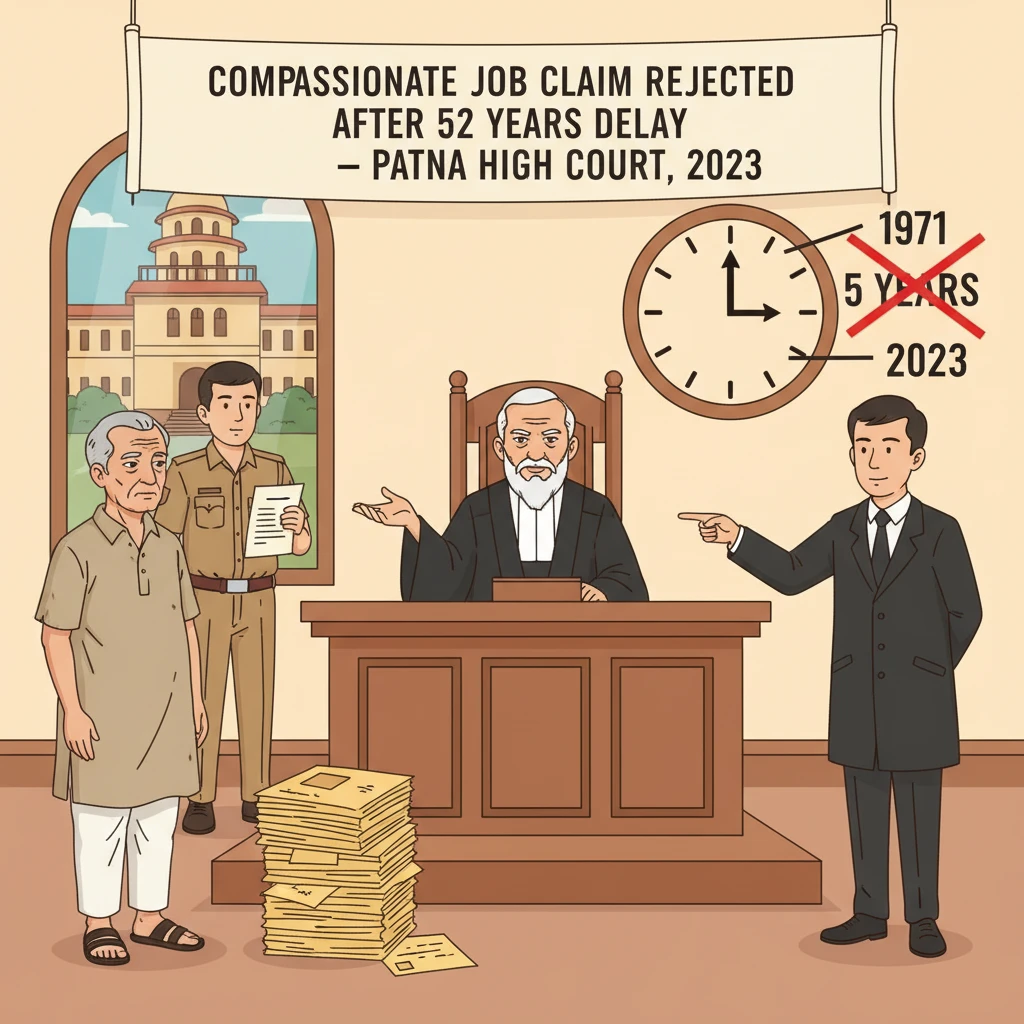
The petitioner is the son of a government employee who worked as a Dafadar under Bangaon Police Station in Saharsa district. His father died in harness on 17.05.1971, while still in government service.
At that time, the petitioner was a minor. Because of his age, he was not considered for compassionate appointment immediately after his father’s death.
Many years passed. According to the pleadings noted by the Patna High Court, the petitioner later applied for compassionate appointment on 11.05.2011 and again on 24.07.2013. In these applications, he sought appointment on the post of Dafadar under Bangaon Police Station in Saharsa district.
By the time he filed the present writ petition in 2015, the petitioner claimed that respondent no. 7 had wrongly been appointed on the post of Dafadar. He asked the Court to direct the authorities to appoint him instead.
The writ petition was registered as Civil Writ Jurisdiction Case No. 18313 of 2015 before the Patna High Court. It came up before Hon’ble Mr. Justice Mohit Kumar Shah, who delivered an oral judgment on 05.10.2023.
What the Court Examined and Decided
The main relief sought by the petitioner was a writ of mandamus commanding the State authorities to appoint him as Dafadar under Bangaon Police Station, Saharsa. He wanted the Court to hold that he was entitled to this compassionate appointment and that respondent no. 7 had been wrongly appointed.
At the very outset of the hearing, the State’s counsel pointed to two crucial facts. First, the petitioner’s father had died on 17.05.1971, about 52 years before the Court’s decision. Second, at the time of his father’s death, the petitioner was a minor. Because of this, he had not been considered for compassionate appointment at that time.
The Court then carefully examined the pleadings in the writ petition. From page 7 of the petition, the Court noted that the petitioner had applied for compassionate appointment on two dates: 11.05.2011 and 24.07.2013. These dates were important because the rules governing compassionate appointment prescribed a limitation period of five years from the date of death of the concerned employee.
By that standard, any request for compassionate appointment in this case should have been made within five years of 17.05.1971. Instead, the petitioner applied after around forty years, in 2011 and 2013.
The State’s counsel also drew the Court’s attention to the petitioner’s age. According to the affidavit filed in the case, the petitioner was 53 years old when the writ petition was filed in 2015. The Court inferred that by the time of the judgment in 2023, he would be around 61 years old. This meant that he had already reached the age of superannuation, or retirement, which again made the relief of compassionate employment practically impossible.
After considering these facts, the Court turned to the basic purpose of compassionate appointment schemes. It emphasized that such schemes exist to provide immediate relief to the dependents of a deceased government employee who suddenly lose their breadwinner and face financial hardship.
The Court observed that when an employee dies in harness, the primary idea behind compassionate appointment is to give quick support to the family so that they can survive the sudden financial crisis. It is not meant to act as a reserved or hereditary job that can be claimed decades later by a dependent.
On this point, the Court relied on the judgment of the Hon’ble Supreme Court in Umesh Kumar Nagpal v. State of Haryana and Ors., reported in (1994) 4 SCC 138. In that case, the Supreme Court had clearly laid down that compassionate appointment is meant only to relieve the family’s immediate financial difficulties and cannot be treated as an alternative mode of regular recruitment for dependents long after the death.
Applying this principle, the Patna High Court found that the petitioner’s claim came far too late. His father had died in 1971, and he applied only in 2011 and 2013, after about forty years. If the Court were to direct compassionate appointment after such a huge delay, it would, in the Court’s words, “result in violation of the very object of the Compassionate Employment Scheme.”
The Court held that the petitioner’s claim did not fit the object and purpose of compassionate appointment because the element of “immediate succor” was entirely missing. The scheme is designed to help families who are in distress due to the sudden death of their sole breadwinner, not to grant employment decades later when circumstances have completely changed.
The Court added another important aspect. If applications made after many years were entertained, then the existing vacancies would already have been filled through regular recruitment processes. Moreover, such delayed claims could create unfairness for other families who genuinely needed immediate relief when their breadwinner died.
The Court stressed that “what is material for consideration is the time when the relief is to be granted to a family in distress and not to reserving a job for one of the dependents.” In other words, the timing of the request is central in compassionate appointment cases.
Combining all these points, the Court reached a clear conclusion. First, the petitioner’s applications for compassionate appointment in 2011 and 2013 were filed long after the expiry of the five‑year limitation period prescribed in the rules. Second, more than 52 years had passed since the death of his father by the time the Court decided the case. Third, the petitioner had already crossed the age of superannuation and could not practically be given a job.
For these reasons, the Court held that the petitioner’s claim for compassionate employment had no merit. It refused to interfere with the appointment already made to the post of Dafadar and declined to issue any direction for his appointment.
In the concluding paragraph of the judgment, the Court stated that it did not find any merit in the writ petition. Accordingly, the writ petition stood dismissed.
Why This Judgment Matters
This judgment is significant for families of deceased government employees and for lawyers handling compassionate appointment matters in Bihar.
First, it reinforces that compassionate appointment is an emergency relief measure, not a right that can be exercised at any time in life. Claims made after a long delay, especially beyond the limitation period in the rules, are unlikely to succeed.
Second, the decision underlines that courts will look closely at both timing and age. If a dependent seeks compassionate appointment many years after the death and has already reached or is close to the age of retirement, the Court will treat such claims as outside the scope of the scheme.
Third, by relying on the Supreme Court decision in Umesh Kumar Nagpal, the Patna High Court has again reminded that government jobs cannot be treated as hereditary property. They cannot be “reserved” for dependents to claim decades later.
For ordinary readers, this means that if a government employee dies in service, the family should, where eligible, apply for compassionate appointment without delay and within the time limit given in the rules. Waiting for many years weakens the case and may lead to outright rejection, as happened here.
Legal Issues and Answers
- Issue: Whether the petitioner, whose father died in harness in 1971, could claim compassionate appointment to the post of Dafadar in 2011/2013 and seek displacement of the existing appointee through a writ petition filed in 2015.
Answer: No. The Patna High Court held that the applications were filed far beyond the five‑year limitation period, the petitioner had already reached the age of superannuation, and granting compassionate appointment after about 52 years would defeat the very object of the Compassionate Employment Scheme. The writ petition was dismissed.
Cases Cited by the Court
- Umesh Kumar Nagpal v. State of Haryana and Ors., (1994) 4 SCC 138.
Case Details
Case Number: Civil Writ Jurisdiction Case No. 18313 of 2015
Case Title: Ramanand Singh v. The State of Bihar and Others
Court: High Court of Judicature at Patna
Coram: Hon’ble Mr. Justice Mohit Kumar Shah
Date of Judgment: 05.10.2023
Citation: 2024 (1) PLJR 415
Advocates:
- For the petitioner: Mr. Pravin Kumar Sinha, Advocate
- For the respondents: Smt. Namrata Mishra, Government Advocate 13
Nature of the Case: Writ petition (Civil) seeking mandamus for appointment on compassionate grounds to the post of Dafadar and challenge to the appointment of another person on that post.
Link to Judgment: Click here to read the full judgment of the Patna High Court
If you found this explanation helpful and wish to stay informed about how legal developments may affect your rights in Bihar, you may consider following Samvida Law Associates for more updates.







