

Case Background
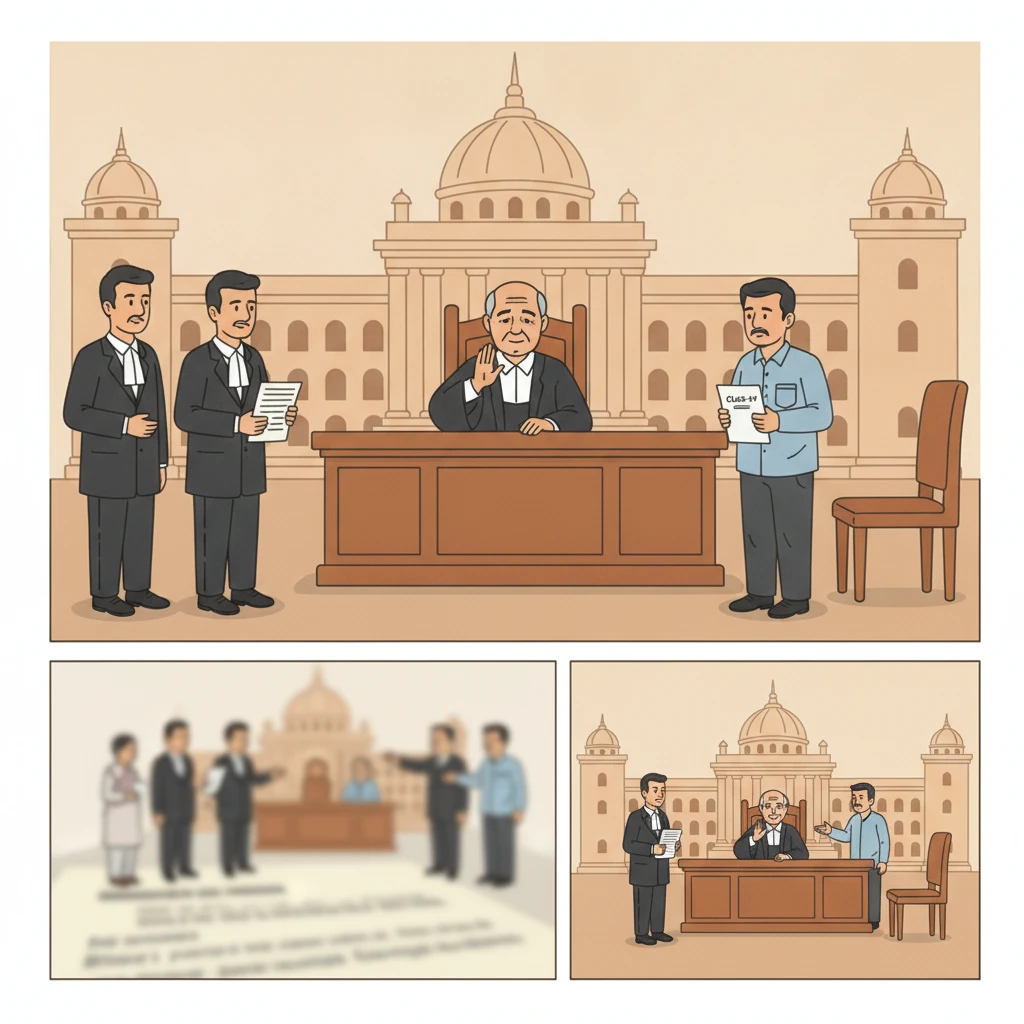
The petitioner was appointed on a Class-IV post in the Bihar Public Service Commission (BPSC) on compassionate grounds. Compassionate appointment is given to a dependent of a deceased employee to provide immediate financial support to the family.
After this appointment, the petitioner wanted to be placed on a higher post, namely a Class-III post. He claimed that at the time of his selection as a Class-IV employee, four clear vacancies of Class-III posts were available.
He filed a writ petition before the Patna High Court in Civil Writ Jurisdiction Case No. 9975 of 2021. In this petition, he asked the Court to direct the respondents to consider his appointment or adjustment on a Class-III post, to post him on any suitable Class-III vacancy, and to grant him all consequential monetary benefits.
The petitioner also requested the Court to direct the respondents to consider his representation in the light of an earlier order in C.W.J.C. No. 7320 of 1990 dated 01.04.1991, along with his educational qualifications and the alleged vacancies existing at that time.
What the Court Examined and Decided
The matter was heard by Hon’ble Mr. Justice P. B. Bajanthri on 08.03.2022. The central question before the Patna High Court was narrow and clearly stated: whether the petitioner, who had already been appointed on a Class-IV post on compassionate grounds, was entitled to be “switched over” to a Class-III post.
The Court noted that the petitioner wanted the Court to issue a writ of mandamus directing the BPSC and its officers to appoint or adjust him in a Class-III post, and to treat him like other “similarly situated” employees who, according to him, were allowed to move from Class-IV to Class-III posts.
To decide whether such a writ could be issued, the Court first examined what is required for mandamus. It explained that for a writ of mandamus to be granted, two basic ingredients must be present:
First, the petitioner must show that he has a legal or statutory right to the relief he is asking for. Second, he must show that he has made a demand for this relief before the competent authority and that such demand has not been properly addressed.
The Court found that the petitioner failed on the first and most important requirement. Nowhere had he shown that any law, rule, or statutory provision gave him a right to be appointed on a Class-III post instead of the Class-IV post he was already holding.
The Court recorded that the petitioner “has not pointed out any provision of law that he is entitled to Class-III post only.” In other words, even though he had educational qualifications and even though he argued that vacancies existed, there was no rule shown to the Court that required the authorities to give him a higher post.
On the other side, the petitioner’s main argument was based on alleged discrimination. His counsel argued that in “identical circumstances” certain other persons, whose names were mentioned in his representation, had been allowed by the authorities to shift from Class-IV to Class-III posts. Because they were given this benefit, he claimed, he too should be given the same opportunity. The claim was that denying him this benefit amounted to discrimination.
The Court examined this contention carefully. It emphasized that, in the absence of any statutory provision that allows compassionate appointees on Class-IV posts to be shifted as a matter of right to Class-III posts, the petitioner could not base his claim solely on what might have been done in other cases.
The Court relied on consistent principles laid down by the Hon’ble Supreme Court of India. It stressed that even if some people in the past were granted such a benefit in violation of law, that itself does not create a right in favour of others to demand the same illegal benefit. Courts cannot direct authorities to repeat an illegality merely for the sake of equal treatment.
The Patna High Court referred specifically to two recent judgments of the Supreme Court to underline this point:
First, the Court cited R. Muthukumar and Others vs. Chairman and Managing Director TANGEDCO and Others, reported in 2022 SCC Online SC 151, decided on 07.02.2022. Second, it referred to Karnataka Rural Infrastructure Development Limited vs. T.P. Nataraja and Others, reported in 2021 SCC Online SC 767.
Both these decisions reiterate that an illegality cannot be perpetuated under the cover of equality or non-discrimination. If one person obtained an illegal benefit, another person cannot insist on the same illegal act being repeated in his favour.
Applying this principle, the Court held that even assuming that some other employees had been wrongly allowed to move from Class-IV to Class-III posts, that would not give the petitioner any legal right to demand a similar switch. Since no law was shown permitting such movement as a right, and since alleged past irregularities could not be used to demand equal illegality, the ground of discrimination had no merit.
On this basis, the Court concluded that the petitioner had failed to establish a legal or statutory right to be appointed or adjusted on a Class-III post. Without such a right, no writ of mandamus could be issued in his favour.
The Court, therefore, held that the writ petition was liable to be dismissed. It expressly stated that the petitioner is “not entitled on the point of discrimination among the employees” in the absence of any statutory provision for such switching over.
After announcing that the petition was dismissed, a further submission was made by the petitioner’s counsel. He argued that Class-III posts were available and that the petitioner should be accommodated in any one of the existing vacancies.
The Court dealt with this additional plea briefly but firmly. It observed that the petitioner had never challenged his initial appointment to the Class-IV post. He had not claimed that he accepted that appointment under protest, nor did he question its validity so as to seek a higher post instead.
Because of this, the Court held that the relief now sought—placement on a Class-III post only because vacancies existed—could not be entertained. In the absence of any challenge to the initial compassionate appointment on a Class-IV post, there was no legal basis to ask the Court to adjust him in a Class-III vacancy.
As a result, the Patna High Court dismissed the writ petition in its entirety. No further directions were issued to the BPSC or its officers regarding the petitioner’s post or benefits.
Why This Judgment Matters
This judgment is important for families of government employees who receive compassionate appointments, especially in Bihar. Many such appointees feel that, because of their education or the availability of higher posts, they should be shifted from Class-IV to Class-III posts after appointment.
The Patna High Court makes it clear that such a change is not a matter of right. Unless there is a specific law or rule that gives a compassionate appointee the right to a higher post, the Court will not order it through a writ of mandamus.
The decision also reinforces a broader principle: a person cannot claim a benefit simply because someone else may have received it illegally. Wrong decisions made in earlier cases do not become a standard, and they do not bind the authorities or the Court to repeat the same mistake.
For employees and their families, this means that expectations for compassionate appointments must be grounded in the actual rules, not in what may have happened in other individual cases. It also signals to departments and commissions that they cannot justify irregular appointments by pointing to past practices.
Legal Issues and Answers
Issue: Does a person appointed on a Class-IV post on compassionate grounds have a legal right to be switched over to a Class-III post, especially when other employees have allegedly been given such benefit?
Answer: No. The Patna High Court held that in the absence of any statutory provision granting such a right, and since illegality committed in other cases cannot be repeated on grounds of equality, the petitioner is not entitled to be switched to a Class-III post. The writ petition was dismissed.
Issue: Can availability of Class-III vacancies by itself justify directing the authorities to adjust a Class-IV compassionate appointee against such vacancies?
Answer: No. The Court held that since the petitioner did not challenge his initial Class-IV appointment or accept it under protest, and did not show any legal right to a Class-III post, mere existence of vacancies could not justify the relief sought.
Cases Cited by the Court
- R. Muthukumar and Others vs. Chairman and Managing Director TANGEDCO and Others, 2022 SCC Online SC 151 (decided on 07.02.2022).
- Karnataka Rural Infrastructure Development Limited vs. T.P. Nataraja and Others, 2021 SCC Online SC 767.
Case Details
Case Number: Civil Writ Jurisdiction Case No. 9975 of 2021
Case Title: Parwez Alam vs. The Bihar Public Service Commission and Others
Citation: 2022 (2) PLJR 494
Court: High Court of Judicature at Patna
Coram: Hon’ble Mr. Justice P. B. Bajanthri
Date of Judgment: 08.03.2022
Advocates for the Petitioner: Mr. Satish Chandra Jha 3, Advocate
Advocates for the Respondents (Bihar Public Service Commission and its officers): Mr. Sanjay Pandey, Advocate; Mr. Zaki Haider, Advocate
Respondents: Bihar Public Service Commission through its Chairman, the Chairman BPSC, the Secretary BPSC, the Under Secretary BPSC, and the Section Officer BPSC, all at Patna
Nature of the Case: Writ petition (civil) seeking mandamus for appointment/adjustment from Class-IV to Class-III post on compassionate appointment and related benefits
Link to Judgment: View full judgment on Patna High Court website
If you found this explanation helpful and wish to stay informed about how legal developments may affect your rights in Bihar, you may consider following Samvida Law Associates for more updates.







