

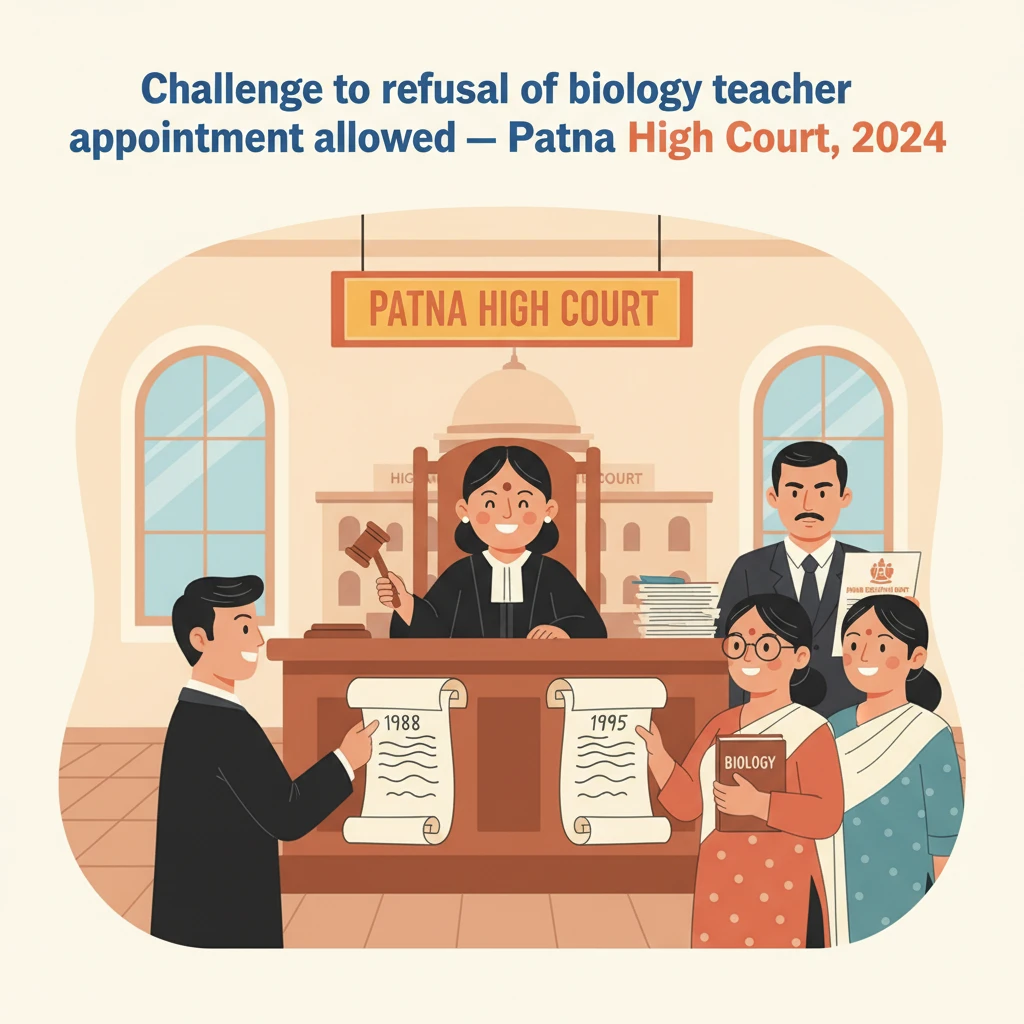
Case Background
This case relates to very old recruitment processes for biology and mathematics teachers in nationalised secondary schools and project schools in Bihar.
In 1988, the Vidyalaya Sewa Board (predecessor of the Bihar Staff Selection Commission) issued Advertisement No. 1/88 for appointment of subject teachers. Candidates in eight subjects were selected and appointed.
However, for different reasons, the selected candidates in biology and mathematics were not appointed for almost five years by the Education Department. During this period, the State introduced a new reservation policy for teachers.
In 1995, to adjust to the changed reservation policy, another Advertisement No. 1/95 was issued in continuation of Advertisement No. 1/88. On 8.10.1998 and 21.5.1999, the Vidyalaya Sewa Board recommended 1056 biology and 552 mathematics candidates.
Teachers in other subjects were appointed. But biology and mathematics teachers were again left out. Appointment letters were not issued up to the year 2000.
The petitioner, a recommended biology candidate placed at serial number 710 in the merit list (Roll No. 1379), along with other similarly placed candidates, approached the Patna High Court in several writ petitions (including CWJC No. 2994/2000, 7732/2000, 8926/2000, 9259/2000, 12625/2000, 3920/2001, 752/2001 and 3773/2001). On 15.2.2001, a Single Judge allowed these writs and directed the State to calculate up-to-date vacancies and make appointments within three months (reported in 2001 (2) PLJR 110).
The State filed multiple Letters Patent Appeals (LPA Nos. 439, 445, 446, 447, 1347, 1354, 1360 and 1435 of 2001). On 16.12.2004, the Division Bench dismissed the appeals and directed compliance with the Single Judge’s order.
The State then approached the Supreme Court in SLP (Civil) Nos. 6369–6376 of 2005. While these were pending, Bihar introduced the Panchayat Teachers Appointment Rules, 2006 and transferred all vacant posts to Panchayati Raj institutions. More than 3000 biology teacher posts were advertised under the new rules.
The State argued before the Supreme Court that, because of the new 2006 Rules, appointments could not be made under the old process. The Supreme Court rejected this stand. On 28.08.2012, it dismissed the SLPs and directed appointment of the recommended candidates, noting the long delay.
Even after the Supreme Court’s order, the Education Department did not issue appointments. Contempt petitions were filed in 2012 before the Patna High Court.
To comply with court directions, the State framed “The Bihar Nationalized Secondary School Teacher’s Special Appointment Rule, 2013”. Under this, 329 posts for biology and 312 for mathematics were created as a dying cadre for a one-time appointment confined to candidates of Advertisements 1/88 and 1/95.
The petitioner’s grievance arose because, despite many biology posts remaining vacant due to non-joining or non-availability of reserved category candidates, he was not appointed. His representation was rejected by memo no. 84 dated 20.03.2018, leading to the present writ petition (CWJC No. 4108 of 2019).
What the Court Examined and Decided
The core dispute before the Patna High Court was whether the Education Department could refuse to fill vacant biology teacher posts from the remaining panel candidates, on the ground that the posts belonged to reserved categories and could not be de-reserved without three consecutive years of advertisement under the Bihar Reservation Act, 1991/1992.
The petitioner argued that the special appointment rules of 2013 were framed specifically to implement earlier court orders and to appoint biology and mathematics teachers recommended under Advertisements 1/88 and 1/95. These rules created a one-time, dying cadre: once the special appointees retired or died, the posts would vanish.
He submitted that the State had wrongly limited biology posts to 329 and mathematics posts to 312 by carving out 30% of vacancies for promotion of Class III employees under 1983 Rules, even though later rules of 1997 and 2004 had abolished that 30% quota. The High Court, in contempt proceedings, had not accepted the State’s vacancy calculations and permitted fresh calculation.
Regarding appointments actually made, the petitioner pointed out a long and staggered process:
First, in 2013, 329 biology candidates were issued appointment letters under memo no. 438 dated 22.06.2013, but only 226 joined. One hundred three seats remained vacant due to non-availability or non-appearance of reserved category candidates.
Second, in 2016, further biology appointments were made—80 candidates were appointed through memo nos. 27 dated 05.01.2016, 458 dated 29.02.2016 and 849 dated 18.04.2016. Sixty seats again remained vacant for want of SC, ST and BC-I candidates.
Third, after the High Court’s order dated 28.09.2016, which directed that the 30% quota carved out for Class III employees should be made available (since no appointment was being made against those posts), the State recalculated biology vacancies at 407 and notified them through memo no. 128 dated 21.08.2017.
Pursuant to this, between 22.08.2017 and 28.08.2017, appointment letters were issued to 300 biology candidates only, because reserved category candidates (SC, ST and BC-I) were not available in the remaining merit list. As a result, 107 posts reserved for SC/ST/BC-I remained unfilled due to non-availability of eligible candidates, and 28 posts remained vacant due to non-joining.
Thus, the petitioner claimed that 135 special biology posts remained vacant. In total, as per his supplementary affidavit, 270 biology seats were vacant considering all rounds, and the authorities had already given three opportunities for counselling to reserved category candidates without success.
The petitioner relied on Section 4(6) of the Bihar Reservation of Vacancies in Posts and Services (for SC, ST and other Backward Classes) Act, 1991. He argued that when reserved candidates are unavailable, the vacancies can be exchanged or filled by general category candidates. Since the Special Rules allow only a one-time appointment and bar any fresh advertisement, leaving the posts vacant permanently defeats the purpose of the Court’s earlier directions and the Special Rules.
He therefore sought a direction to appoint him and other remaining panel candidates against these vacant biology posts and to quash memo no. 84 dated 20.03.2018, by which the Principal Secretary had refused de-reservation on the ground that posts could be de-reserved only after advertisement for three consecutive years.
The State, in a detailed counter affidavit, took the stand that in the biology subject, 789 vacancies had been calculated as per High Court directions. All 50% open category vacancies and the vacancies earmarked for backward classes had been fully filled by candidates within the “zone of merit”.
The State pointed out that the petitioner belongs to the BC category and his serial number in the merit list is 710, whereas appointments in BC category were made only up to serial number 619. Therefore, his merit position did not fall within the zone of appointment for his category, and he could not claim appointment as of right.
Regarding unfilled reserved category seats, the State argued that de-reservation under the Bihar Reservation Act, 1992 requires publication of advertisements for three consecutive recruitment years. Only after such cycle, and continued non-availability of reserved category candidates, can vacancies be de-reserved.
The State also emphasised that, after the Niyojan Niyamawali, 2006, regular scale assistant teacher posts ceased to exist and were converted into fixed pay posts, so new posts had to be created under the Special Appointment Rules, 2013 and later 2017. These special posts were dying posts with one-time appointments; they would cease to exist on the retirement or death of the appointees. Therefore, according to the State, it was not possible to advertise the posts for three consecutive years, and consequently there could be no question of de-reservation. On this reasoning, the Principal Secretary rejected de-reservation by memo no. 84 dated 20.03.2018.
Justice Anjani Kumar Sharan considered the arguments and the record. In paragraph 15, the Court first recorded that it was an admitted fact that the vacancies in question were already lying vacant because SC/ST and BC-I candidates were not available and that this recruitment was a one-time process under the Special Appointment Rules, 2013 and 2017. It was also admitted that 135 posts were vacant due to non-availability of reserved category candidates and non-joining of some candidates.
The Court then examined the legal position under the Bihar Reservation Act, 1992. The Act provides that if reserved vacancies cannot be filled due to non-availability of candidates, they must be advertised for three consecutive years. Only after three unsuccessful recruitment attempts can those reserved posts be de-reserved and treated as backlog.
However, in this case, the Court noted that the Special Appointment Rules mandated a one-time measure and prohibited further advertisement. Because of this special nature of the recruitment, it was impossible to follow the three-year advertisement requirement literally.
Therefore, the Court held that the Principal Secretary’s memo no. 84 dated 20.03.2018, which rejected de-reservation solely for want of three advertisements, was not in accordance with law. The insistence on a procedure that could not be complied with in a one-time dying cadre appointment was legally unsustainable.
Without itself ordering direct appointment of the petitioner, the Court set aside memo no. 84 and directed a fresh decision. The petitioner was given four weeks to file a detailed representation before the Principal Secretary/Additional Chief Secretary, Education Department, along with a copy of the judgment.
The Principal Secretary/Additional Chief Secretary (respondent no. 3) was directed to hear the petitioner or his counsel personally and pass an appropriate order within eight weeks from the date of filing of the representation.
The Court added that if the representation was not decided within the stipulated period, respondent no. 3 would be held personally liable for non-compliance of the Court’s order.
With these directions and observations, the writ application was allowed.
Why This Judgment Matters
This judgment is important for many candidates who were recommended decades ago for government teaching posts but never appointed because of administrative delays and later changes in recruitment rules.
The Patna High Court held that when the Government itself creates a special one-time recruitment scheme through Special Appointment Rules, it cannot hide behind normal reservation procedures that are impossible to apply in that framework.
Where reserved posts remain vacant again and again because no eligible candidates come forward and further advertisement is barred, the Government must reconsider its stand instead of permanently locking out remaining panel candidates.
The ruling also sends a signal that authorities must obey earlier court directions in letter and spirit. Failure to take a reasoned, lawful decision can lead to their orders being quashed and personal accountability for delay in compliance.
Legal Issues and Answers
- Issue: Whether the Education Department could refuse to de-reserve unfilled reserved category biology teacher posts under the Special Appointment Rules, 2013 and 2017 by insisting on three consecutive advertisements under the Bihar Reservation Act, 1991/1992.
Answer: No. The Court held that, in a one-time special recruitment where further advertisement is not permissible, memo no. 84 dated 20.03.2018 rejecting de-reservation on this ground was not in accordance with law and therefore had to be quashed. - Issue: What relief should be granted to the petitioner, a recommended biology teacher who had not been appointed despite vacant posts?
Answer: The Court did not order direct appointment but directed the petitioner to file a detailed representation. The Principal Secretary/Additional Chief Secretary must personally hear him and take an appropriate decision within eight weeks, failing which personal liability for non-compliance would arise.
Cases Cited by the Court
- The judgment refers to and relies on the earlier Patna High Court decision reported in 2001 (2) PLJR 110, by which writ petitions of similarly situated biology and mathematics candidates were allowed and directions for appointment were issued.
- The Court also notes dismissal of the State’s appeals in LPAs decided on 16.12.2004 and dismissal of SLP (Civil) Nos. 6369–6376 of 2005 by the Supreme Court on 28.08.2012, though specific Supreme Court citation numbers are not provided in the text.
Case Details
Case Number: Civil Writ Jurisdiction Case No. 4108 of 2019
Case Title: Anil Kumar v. The State of Bihar and Ors.
Citation: 2024 (2) PLJR 673
Court: High Court of Judicature at Patna
Coram: Hon’ble Mr. Justice Anjani Kumar Sharan
Date of Judgment: 19.03.2024
Advocates:
- For the Petitioner: Mr. Amit Srivastava, Senior Advocate; Mr. Girish Pandey, Advocate; Mr. Rakesh Kumar, Advocate
- For the State/Respondents: Mr. Subhash Chandra Mishra, Standing Counsel 16
Nature of the Case: Writ petition (civil) seeking mandamus for appointment as biology teacher under special appointment rules and for quashing memo no. 84 dated 20.03.2018 refusing de-reservation of reserved category vacancies.
Link to Judgment: Click here to access the official Patna High Court judgment
If you found this explanation helpful and wish to stay informed about
how legal developments may affect your rights in Bihar,
you may consider following Samvida Law Associates for more updates.







