

Case Background
The dispute arises from a matrimonial case pending before the Family Court, Kaimur at Bhabhua. The husband filed Matrimonial Case No. 11 of 2016 under Section 13(1A) of the Hindu Marriage Act, seeking dissolution of marriage.
During the pendency of this matrimonial case, the Family Court granted interim maintenance of Rs. 11,000 per month in favour of the wife, who is the opposite party in that case. This interim maintenance order continued while evidence in the divorce case was being recorded.
On 06.03.2021, the wife filed an application before the Family Court seeking enhancement of the interim maintenance amount from Rs. 11,000 to Rs. 45,000 per month. According to the wife, the husband is a Senior Manager in his organisation and earns Rs. 1,50,000 per month, and therefore the interim maintenance should be increased. She also stated that she had filed a petition under Section 9 of the Hindu Marriage Act for restitution of conjugal rights and wanted to stay with her husband, but the husband instead pursued dissolution of marriage.
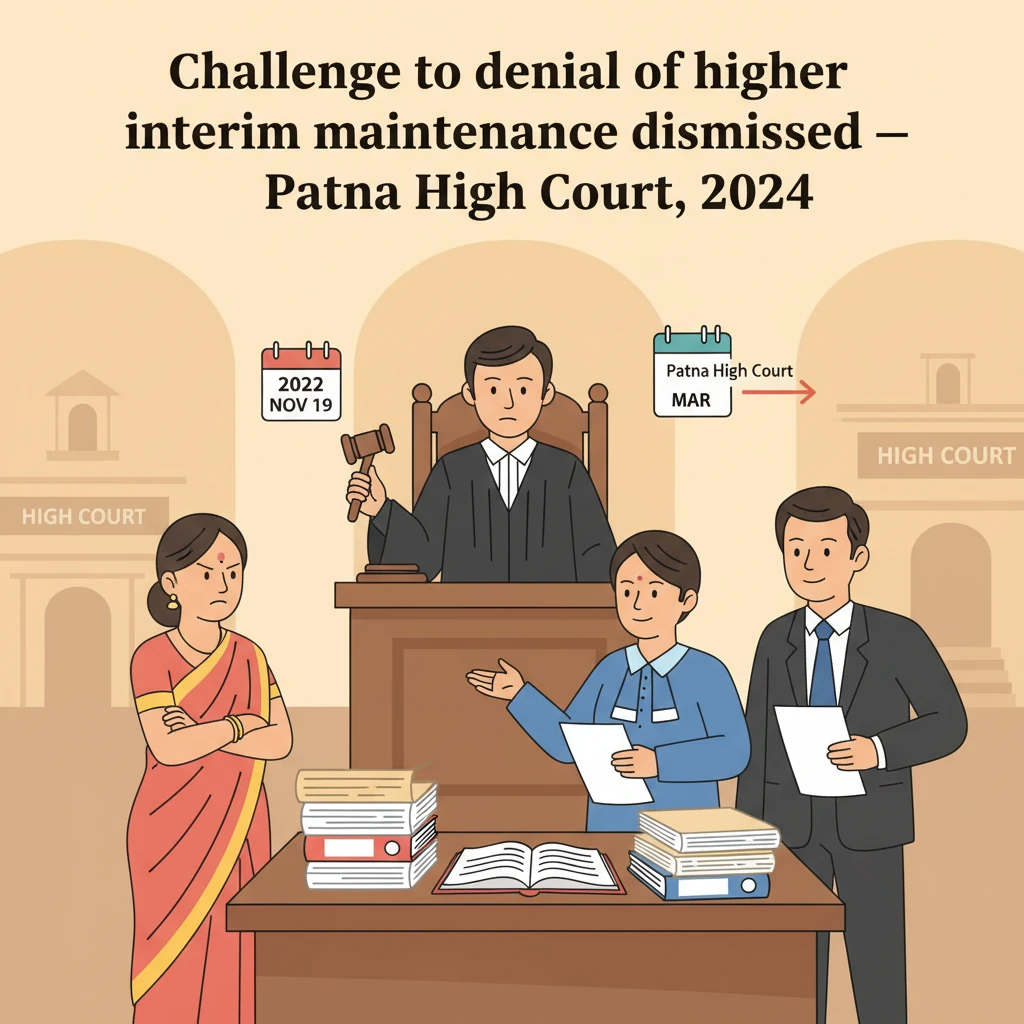
The Family Court took more than a year to decide the enhancement application. By order dated 19.11.2022, the Principal Judge, Family Court, Kaimur at Bhabhua rejected the wife’s application for enhancement of interim maintenance. The court recorded that evidence of both sides in the matrimonial case had already been closed, and the matter was fixed for final arguments, and in such a situation it was not proper to pass an order for enhancement of interim maintenance.
Aggrieved, the wife approached the Patna High Court by filing Civil Miscellaneous Jurisdiction No. 170 of 2023 under Section 227 of the Constitution of India. She asked the High Court to set aside the Family Court’s order and to direct consideration of her enhancement petition on merits.
What the Court Examined and Decided
The Patna High Court, through Hon’ble Mr. Justice Arun Kumar Jha, heard the matter at the admission stage itself and decided to dispose of the petition without issuing further notices or calling for a detailed hearing.
Counsel for the wife argued that the Family Court had acted improperly by dismissing her enhancement application only because the case had reached the stage of final arguments. According to her, the court should have decided the application on its merits.
She pointed out that the husband had taken eight months to file his rejoinder to the enhancement application. Despite this delay, instead of deciding on the wife’s claim for a higher amount, the Family Court rejected her application by simply stating that the case was ready for final arguments.
The wife’s counsel further submitted that the husband is a Senior Manager and has an income of Rs. 1,50,000 per month. In her view, this financial position should have been considered by the Family Court while deciding whether the interim maintenance ought to be increased from Rs. 11,000 to Rs. 45,000 per month. She also highlighted that she had moved a petition under Section 9 of the Hindu Marriage Act, expressing her desire to continue living with her husband, whereas the husband had filed for divorce, showing his lack of interest in reconciliation.
On these grounds, her prayer before the Patna High Court was that the Family Court’s order dated 19.11.2022 be set aside and that a direction be issued to the trial court to decide the enhancement application on merits.
On the other side, counsel for the husband opposed the petition. He submitted that the husband’s case for dissolution of marriage had already reached a very advanced stage. Evidence of both parties had been closed, and the case was coming up for final arguments.
The husband’s counsel pointed out that interim maintenance had already been granted to the wife in the same matrimonial case. According to him, there was no separate maintenance case filed by the wife. Any concern about maintenance, including its quantum, could appropriately be addressed in the final order of the matrimonial case itself.
He therefore defended the Family Court’s approach. In his submission, once the case was at its “fag end”, it was correct for the court to refuse to reopen the question of interim maintenance and instead concentrate on delivering a final decision. He argued that there was no reason for the High Court to interfere with such an order.
After hearing both sides, the Patna High Court examined the facts and circumstances. The Court noted that some aspects were very clear on the record.
First, the Court observed that the wife had not filed any independent case for maintenance against the husband. The interim maintenance of Rs. 11,000 per month had been granted to her only in the husband’s matrimonial case for divorce. This was significant because the pending case before the Family Court was essentially the husband’s divorce petition, not a stand-alone maintenance proceeding initiated by the wife.
Second, the Court took note of the Family Court’s finding that the evidence of both parties had already been closed and that the matter had been coming up for final arguments. This meant that the case was almost ready for a final judgment on the divorce petition and any connected issues.
In this context, the High Court also recorded its impression that the wife did not appear to be interested in the final disposal of the matrimonial case “for reasons best known to her.” This remark reflects the Court’s view that the application for enhancement of interim maintenance seemed to work against speedy conclusion of the main case.
The High Court emphasised that in such a situation the primary concern of the Family Court should be to dispose of the main matrimonial case. In the Court’s opinion, the Family Court had rightly focused on ensuring final disposal rather than entertaining another round of litigation on interim maintenance, particularly when evidence was already closed.
Regarding the wife’s grievance about delay in disposal of her enhancement application and the eight-month period taken by the husband to file a rejoinder, the High Court acknowledged that the trial court is duty-bound to consider all relevant facts at the time of passing the final order. However, the Court made it clear that such delay cannot be treated as a “condition precedent” for disposal of the matrimonial case itself. In other words, the final hearing of the divorce case cannot be held up merely because of issues surrounding the interim maintenance application.
On the question of jurisdiction, the High Court held that it did not find any error in the approach adopted by the Family Court while passing the impugned order. Since the Family Court had exercised its discretion keeping in view the advanced stage of the matrimonial case and the need for speedy disposal, the High Court found no reason to interfere under its supervisory powers under Section 227 of the Constitution.
Consequently, the High Court affirmed the order dated 19.11.2022 passed by the Principal Judge, Family Court, Kaimur at Bhabhua, rejecting the wife’s application for enhancement of interim maintenance. The civil miscellaneous petition filed by the wife was dismissed.
At the same time, the Patna High Court issued a clear direction to the Family Court. It directed that, since evidence of both parties had already been closed, the Family Court should take up Matrimonial Case No. 11 of 2016 for final disposal at the earliest and preferably within a period of three months. This direction aims to ensure that both parties get a final decision without further delay, and that issues such as maintenance can be comprehensively dealt with in the final judgment.
Why This Judgment Matters
This decision of the Patna High Court is important for spouses involved in long-running matrimonial disputes where interim maintenance is already in place and the case has reached an advanced stage.
The judgment shows that when the divorce case is almost ready for final hearing, the court may decline to reopen or substantially modify interim arrangements. Instead, it may prefer to decide everything finally, including maintenance, in the final judgment.
For litigants, this means that repeated attempts to change interim maintenance late in the case may not succeed, especially when evidence is closed and the court is focused on concluding the matter. The judgment also stresses that delays in deciding interim applications cannot be used as a ground to further delay the main case.
At the same time, the direction to complete the trial within a time frame protects both parties. It ensures that the spouse receiving interim maintenance is not left waiting indefinitely, and that the paying spouse also gets clarity on his or her obligations through a final order.
Legal Issues and Answers
- Issue: Whether the High Court should interfere with the Family Court’s refusal to enhance interim maintenance when the matrimonial case is at the stage of final arguments after closure of evidence.
Answer: No. The Patna High Court held that the Family Court rightly prioritised final disposal of the matrimonial case and, finding no jurisdictional error, affirmed the order refusing enhancement of interim maintenance. - Issue: Whether delay in disposal of an application for enhancement of interim maintenance can be treated as a barrier to concluding the main matrimonial case.
Answer: No. The Court held that while such delay can be considered at the time of final orders, it cannot be made a condition precedent for disposal of the matrimonial case.
Cases Cited by the Court
- No prior judgments or case law have been cited or relied upon in the text of this judgment.
Case Details
Case Number: Civil Miscellaneous Jurisdiction No. 170 of 2023
Case Title: Pinki Kumari v. Rajiv Kumar
Court: High Court of Judicature at Patna
Coram: Hon’ble Mr. Justice Arun Kumar Jha
Date of Judgment: 20.08.2024
Citation: 2024(4) PLJR 624
Advocates:
- For the Petitioner (wife): Mr. Baban Kumar, Advocate
- For the Respondent (husband): Mrs. Vagisha Pragya Vacaknavi, Advocate; Ms. Ankita Roy, Advocate; Mr. Ashutosh Kr. Pandey, Advocate
Nature of the Case: Petition under Section 227 of the Constitution of India challenging a Family Court order refusing enhancement of interim maintenance in a pending matrimonial case under Section 13(1A) of the Hindu Marriage Act.
Impugned Order: Order dated 19.11.2022 of the Principal Judge, Family Court, Kaimur at Bhabhua in Matrimonial Case No. 11 of 2016, rejecting the wife’s application dated 06.03.2021 for enhancement of interim maintenance from Rs. 11,000 to Rs. 45,000 per month.
Link to the Judgment: Click here to read the full judgment of the Patna High Court
If you found this explanation helpful and wish to stay informed about how legal developments may affect your rights in Bihar, you may consider following Samvida Law Associates for more updates.







