

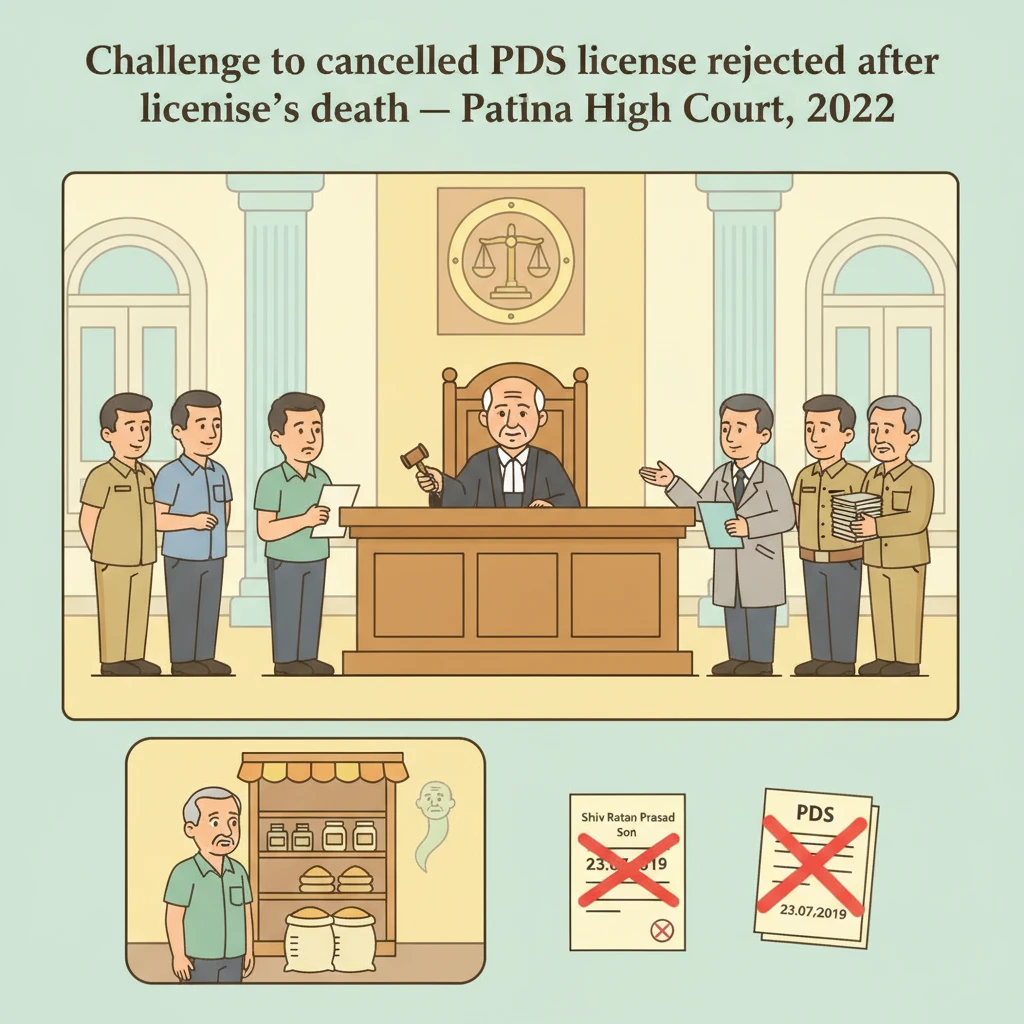
Case Background
The petitioner’s father, Shiv Ratan Prasad, had a licence to run a Public Distribution System (PDS) shop under the Bihar Targeted Public Distribution System (BTPDS) (Control) Order, 2016.
The licensing authority cancelled this PDS licence by an order dated 31.08.2017. Against this cancellation order, the licensee filed an appeal before the Collector, Jehanabad. This appeal was registered as Appeal Case No. 16/DM of 2018.
The appeal was filed in light of an earlier observation made by the Patna High Court in an order dated 10.04.2018 passed in CWJC No. 13801 of 2017. Eventually, the Collector, acting as the appellate authority, dismissed the appeal on 23.07.2019 and upheld the cancellation of the licence.
After the appellate order, no further challenge was made by the original licensee. Later, the licensee, Shiv Ratan Prasad, died on 27.03.2020.
Almost one year after his death, his son (the present petitioner) filed this writ application before the Patna High Court. Through this writ case, he sought quashing of both the original cancellation order dated 31.08.2017 and the appellate order dated 23.07.2019.
What the Court Examined and Decided
The Division Bench of the Patna High Court, comprising Hon’ble Mr Justice Chakradhari Sharan Singh and Hon’ble Mr Justice Madhuresh Prasad, heard the matter through video conferencing because of COVID-19 restrictions.
The Court first recorded that learned counsel for the petitioner and for the State had been heard.
The main relief sought by the petitioner was to set aside the cancellation of his late father’s PDS licence and the dismissal of the appeal by the Collector. The petitioner wanted these orders quashed even though the original licensee was no longer alive.
The petitioner’s counsel argued that the cancellation order of the licensing authority was per se illegal. According to him, the licensee had not been given any opportunity of hearing before the licence was cancelled. On this basis, it was claimed that the order violated the principles of natural justice.
He further submitted that the appellate authority, i.e., the Collector, Jehanabad, failed to properly examine the relevant issues raised before it in Appeal Case No. 16/DM of 2018.
The Court then posed a specific question to the petitioner’s counsel: whether the cause of action to challenge the cancellation of the licence still survived after the death of the original licensee.
In response, the petitioner’s counsel argued that the orders of the licensing authority and the appellate authority were per se illegal. Therefore, according to him, even after the death of the licensee, the petitioner could maintain this writ application.
He stated that the petitioner wanted to get the earlier orders set aside so that he could take benefit of Rule 9 of the BTPDS (Control) Order, 2016. This rule, as mentioned in the judgment, provides for grant of licence on compassionate basis.
Thus, the petitioner’s stand was that if the earlier cancellation was removed as illegal, he could claim a fresh licence on compassionate grounds under Rule 9.
The Court examined this line of reasoning and rejected it.
First, the Bench considered whether the son of the deceased licensee could question the correctness of the cancellation after the death of the original licence holder. The Court clearly held that he could not. In its considered opinion, the cause of action did not survive after the death of the original licensee.
This meant that any right to challenge the orders belonged to the licensee himself and ended when he passed away. Once he did not pursue any further remedy during his lifetime after the appeal was dismissed, his legal challenge came to an end.
Second, the Court examined the actual cancellation order passed by the licensing authority. It noted that the order dealt in detail with the materials available on record before cancelling the licence.
The Court also found that the licensee had been given an opportunity to submit his explanation and that he had in fact submitted it. Therefore, the Court held that there was no breach of the principles of natural justice.
The Bench specifically recorded that the plea that the cancellation order had been passed in violation of the principles of natural justice was “not sustainable at all”.
Third, the Court noted that the appellate order of the Collector also discussed the points taken by the original licensee. In other words, the appellate authority did consider the grounds raised in appeal before dismissing it.
Taking these findings together, the Court concluded that the writ application had “no merit for more than one reasons”. The primary reasons were: the cause of action did not survive after the death of the original licensee, and the orders of the licensing and appellate authorities did not suffer from any legal infirmity or violation of natural justice.
The Court also did not accept the argument that the alleged illegality of the orders allowed the son to continue the challenge just to secure a compassionate licence under Rule 9 of the BTPDS (Control) Order, 2016. The judgment makes it clear that such an indirect attempt to revive a dead cause of action could not be entertained.
Finally, after setting out its reasoning, the Bench held that the writ application deserved to be dismissed and accordingly dismissed it.
Why This Judgment Matters
This judgment is important for PDS shop licensees and their families in Bihar.
First, it makes clear that a challenge to cancellation of a PDS licence is personal to the licensee. If the licensee dies and has not pursued further remedies during his lifetime, his legal right to challenge the cancellation does not automatically pass to his heirs.
Second, the decision shows that the Patna High Court will look closely at whether the licensing and appellate authorities gave adequate opportunity of hearing and considered the materials on record. If they have done so, the Court will be slow to interfere.
Third, the judgment sends a message that heirs cannot use a writ petition to reopen old disputes with the sole aim of getting a new licence on compassionate grounds. The route of compassionate appointment or licence, even if available under rules like Rule 9 of the BTPDS (Control) Order, 2016, cannot be built on an already concluded and unchallenged cancellation order.
For families of licence holders, this case underlines the need to act promptly and within the lifetime of the original licence holder if they want to contest any adverse order.
Legal Issues and Answers
- Issue: Can the son of a deceased PDS licensee maintain a writ petition to challenge the cancellation of the licence and the dismissal of the statutory appeal, in order to seek benefit of compassionate licensing under Rule 9 of the BTPDS (Control) Order, 2016?
Answer: No. The Patna High Court held that the cause of action to question the cancellation of the licence did not survive after the death of the original licensee, and therefore the son could not maintain the writ petition for this purpose. - Issue: Were the cancellation order of the licensing authority and the appellate order of the Collector passed in violation of the principles of natural justice due to lack of hearing?
Answer: No. The Court found that the licensing authority had considered materials on record and had given the licensee an opportunity to submit his explanation, which he did. The appellate order also dealt with the grounds raised. Hence, the allegation of violation of natural justice was rejected.
Cases Cited by the Court
- The judgment records that the appeal before the Collector was filed in the light of an observation made by the Patna High Court in the order dated 10.04.2018 passed in CWJC No. 13801 of 2017. However, no specific earlier case law is cited or relied upon in the reasoning of this judgment.
Case Details
Case Number: Civil Writ Jurisdiction Case No. 3911 of 2021
Case Title: Rajiv Kumar v. The State of Bihar & Ors.
Citation: 2022(1) PLJR 350
Court: High Court of Judicature at Patna
Coram: Hon’ble Mr Justice Chakradhari Sharan Singh and Hon’ble Mr Justice Madhuresh Prasad
Date of Judgment: 24-01-2022
Advocates for Petitioner: Mr S. K. Lal, Mr Pritish Kumar Lal, Advocates
Advocate for Respondents (State): Mr AC to SC IV
Nature of the Case: Writ petition under civil writ jurisdiction challenging cancellation of PDS licence and dismissal of statutory appeal.
Link to the Judgment: Click here to view the official Patna High Court judgment
If you found this explanation helpful and wish to stay informed about how legal developments may affect your rights in Bihar, you may consider following Samvida Law Associates for more updates.







