

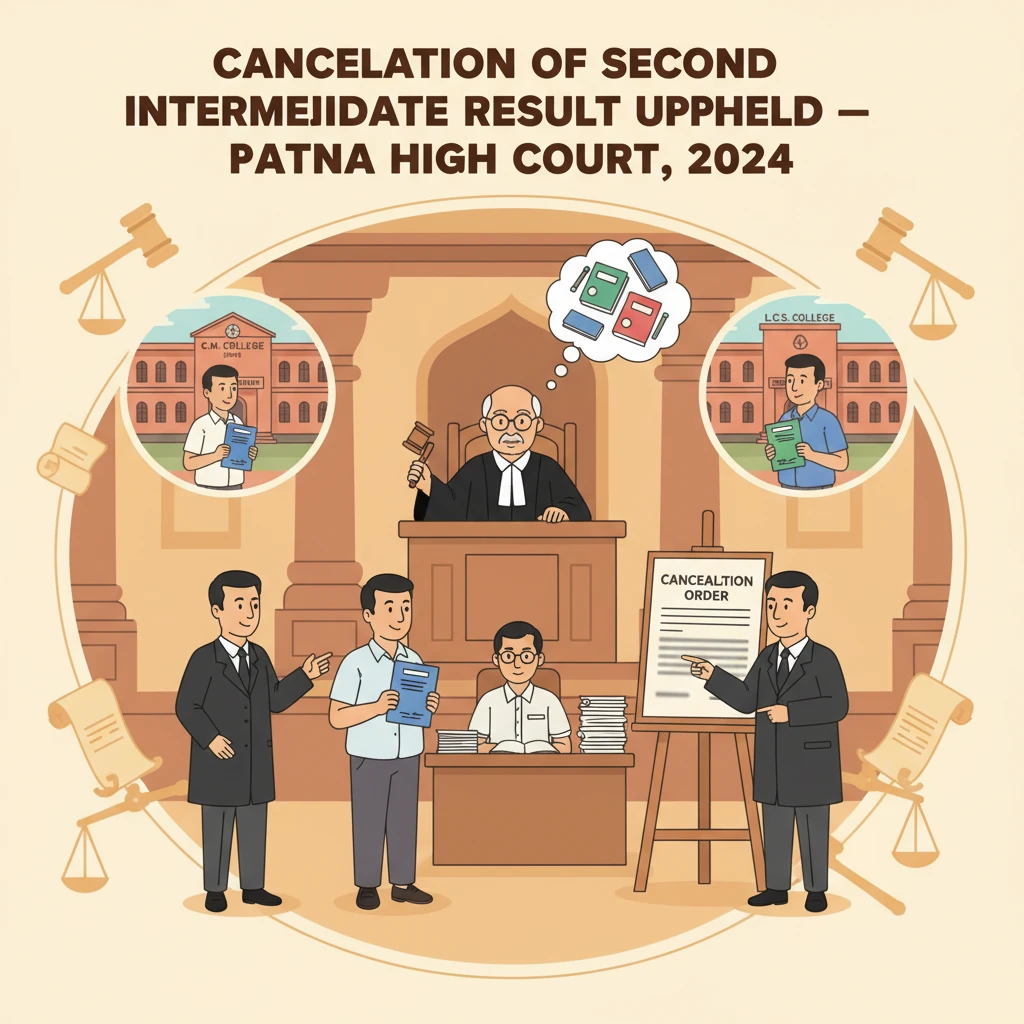
Case Background
The petitioner passed his matriculation examination in 1999.
After matriculation, he took admission in C.M. College, Darbhanga, in the Intermediate of Arts course for the session 1999–2001. He appeared in the Intermediate Arts examination in 2001 and passed with second division. On the strength of this Intermediate Arts result, he also took admission in a three-year graduation (B.A.) course in 2001 itself.
Later, in 2002, he again got himself enlisted with the Bihar Intermediate Education Council, this time in the Intermediate of Science course from L.C.S. College, Darbhanga. He appeared in the Intermediate Science Examination, 2004, as a regular student and passed with first division.
Years later, on 26.04.2013, the Bihar School Examination Board published a notice in the Hindi newspaper “Dainik Jagran”. The notice stated that the petitioner’s Intermediate Science certificate obtained in 2004 stood cancelled. The ground mentioned was that he had also appeared in the Intermediate examination in 2001 in a different stream (Arts) and passed with second division, and therefore appearing again in Intermediate in another stream was not in accordance with the Rules and Regulations.
The petitioner challenged this newspaper notice in CWJC No. 9556 of 2013. A Single Judge of the Patna High Court, by order dated 26.07.2017, examined the statutory provisions and held that the petitioner could not have been allowed admission in the Intermediate Science course after having already passed Intermediate Arts within three years. The Court held that second enlistment was not permissible under the Rules and that a person cannot be allowed to continue with two Intermediate certificates. On that reasoning, the writ petition was dismissed.
Aggrieved, the petitioner filed L.P.A. No. 1122 of 2017 before a Division Bench. By order dated 29.11.2019, the Division Bench set aside the Single Judge’s order. However, it did not straightaway restore the certificate. Instead, it modified the Board’s notice dated 26.04.2013 and treated it as a show-cause notice to the petitioner.
The Division Bench directed the petitioner to submit his reply to the Secretary of the Board within four weeks, giving his mobile number and postal address. The Secretary was directed to fix a date of hearing, inform the petitioner by post and SMS, grant him personal hearing, and thereafter pass a speaking order in accordance with law, after considering his reply.
Pursuant to these directions, the Bihar School Examination Board heard the petitioner, granted him opportunity to file his show-cause reply, and then passed Office Order Memo No. BSEB (SS) 173/LS/17-DAR/EX/4288/D-20 dated 21.02.2020. By this order, the Board cancelled the petitioner’s Intermediate Science Examination, 2004 result relating to Roll Code 5109 and Roll No. 10069.
Challenging this fresh speaking order, the petitioner filed the present writ petition, Civil Writ Jurisdiction Case No. 8494 of 2020, before the Patna High Court.
What the Court Examined and Decided
Justice Anil Kumar Sinha heard the matter. The central question before the Patna High Court was whether the Bihar School Examination Board had correctly applied the Bihar Intermediate Education Council (Establishment of Colleges and Conduct of Examination) Rules, 1994, in cancelling the petitioner’s 2004 Intermediate Science result, after giving him hearing as directed in the earlier LPA.
The petitioner’s senior counsel argued that the Secretary of the Bihar School Examination Board had misinterpreted the 1994 Rules. She stressed that the cancellation happened more than fifteen years after the result was issued, and this was unfair to the petitioner who had acted with bona fide intention.
According to the petitioner’s counsel, there was no fraud, concealment, or change in date of birth or identity. The Board itself had accepted his registration form for Intermediate Science and allowed him to appear in the 2004 examination. On this basis, she contended that the petitioner should not be punished for any alleged procedural irregularity committed by the authorities at that time.
The petitioner’s counsel particularly relied on Rule 12(10) of the 1994 Rules. She stated that this provision says that “enlistment shall be valid for examinations of three consecutive years only”. Her interpretation was that since the petitioner was initially enlisted/registered in 1999 through C.M. College, Darbhanga, that enlistment was valid only up to three consecutive years from 1999. She argued that in 2002, after completion of those three years from the first enlistment, the petitioner could validly get himself admitted in Intermediate Science and receive a fresh registration, which he did through L.C.S. College, Darbhanga, and later passed the 2004 exam.
She thus maintained that the second registration did not violate the Rules, and that there was no mala fide on the petitioner’s part. Therefore, according to her, the cancellation of his Intermediate Science result after such a long gap was illegal and should be set aside.
On the other side, counsel for the Bihar School Examination Board defended the impugned office order. He submitted that the order was passed strictly in compliance with the Division Bench’s directions in L.P.A. No. 1122 of 2017.
He pointed out that the petitioner was given full opportunity to submit his show-cause reply and also an opportunity for personal hearing, as mandated by the Division Bench. Therefore, there was no breach of natural justice.
On the interpretation of the Rules, the Board’s counsel relied on Rule 12(1) of the 1994 Rules. He submitted that this provision states that all students admitted to Intermediate courses are required to enlist themselves with the Council and that such enlistment is valid for examinations of three consecutive years only.
According to the Board, the petitioner first enlisted in 1999 as an Intermediate Arts student from C.M. College, Darbhanga. That enlistment covered the academic sessions 1999–2001, 2000–2002 and 2001–2003. Thus, when he again enlisted afresh in 2002 as an Intermediate Science student from L.C.S. College, Darbhanga, the earlier enlistment was still valid up to 2003.
The Board argued that in view of this specific rule, the petitioner was not entitled to a fresh enlistment in 2002 while his earlier enlistment remained valid. The Board also noted that the petitioner, after passing Intermediate Arts in 2001, had already taken admission in a three-year B.A. course, and yet he sought to pursue Intermediate Science as a regular student during the same period.
After hearing both sides and examining the materials, including the impugned order, the Court framed the factual position clearly. The Court noted that:
First, after passing matriculation in 1999, the petitioner enlisted with the Bihar Intermediate Education Council as an Intermediate Arts student from C.M. College, Darbhanga, and passed the Intermediate Arts examination in 2001.
Second, after passing Intermediate Arts, he took admission in a three-year graduation degree course in 2001 itself.
Third, as recorded in the impugned order, the petitioner again got himself enlisted in 2002 with the Bihar Intermediate Education Council as an Intermediate Science student from L.C.S. College, Darbhanga.
Fourth, during the same sessions in which he studied Intermediate Science, he also appeared as a regular student in B.A. Part I and Part II examinations, alongside appearing in the Intermediate Science Examination, 2004.
Based on these facts and the interpretation of the Rules, the Court reached a clear conclusion. Justice Anil Kumar Sinha held that the petitioner could not have pursued the Bachelor of Arts course as a regular student and, at the same time, the Intermediate Science course as a regular student simultaneously.
The Court accepted the finding of the Secretary, Bihar School Examination Board, that such simultaneous pursuit of two regular courses at different levels was not permissible under the scheme of the 1994 Rules and the enlistment system.
The Court did not accept the petitioner’s argument that the second enlistment was permissible merely because three years had passed from the date of first enlistment. Instead, by highlighting that the first enlistment remained valid for three years and that the petitioner was already in a graduation course, the Court signalled that the Rules did not contemplate maintaining two different regular courses with overlapping enrolments.
In paragraph 13 of the judgment, the Court concluded that the Bihar School Examination Board had “rightly cancelled” the petitioner’s Intermediate Science Examination result of 2004, after granting “due opportunity” to him as directed in the earlier LPA.
Therefore, in the final analysis, the High Court found no illegality in the Board’s speaking order dated 21.02.2020. The writ petition was dismissed, and the cancellation of the 2004 Intermediate Science result remained in force. No order as to costs was passed.
Why This Judgment Matters
This judgment is significant for students and educational authorities in Bihar, especially those dealing with the Bihar School Examination Board and the Bihar Intermediate Education Council.
First, it reinforces that a student cannot simultaneously pursue two regular courses at different levels, such as Intermediate and graduation, under the same examination system. Even if a student manages to register and appear in examinations, the Board is empowered to cancel such results if they violate the Rules.
Second, the case demonstrates that earlier directions of the Patna High Court, especially in an appeal like L.P.A. No. 1122 of 2017, must be followed carefully. The Board complied by issuing a reasoned speaking order after giving the petitioner a full hearing. Once that is done, the Court will ordinarily not interfere unless clear illegality is shown.
Third, for students who consider taking admission in a second Intermediate course after already passing one stream and moving to graduation, the decision sends a clear warning. The Rules on enlistment and validity of registration are strict. A second registration during the currency of the first enlistment, or while pursuing a higher course as a regular student, may be treated as invalid, and the later result can be cancelled even after several years.
Finally, the judgment underlines that bona fide intention or absence of fraud is not enough if the basic eligibility or procedural rules of the examination system are not satisfied. Compliance with the 1994 Rules and the structure laid down by the Council is essential.
Legal Issues and Answers
Issue: Whether the Bihar School Examination Board could cancel the petitioner’s 2004 Intermediate Science result on the ground that he had already passed Intermediate Arts in 2001 and was simultaneously pursuing B.A. as a regular student.
Answer: Yes. The Patna High Court held that, in view of the 1994 Rules and the factual finding that the petitioner was pursuing B.A. and Intermediate Science simultaneously as a regular student, the Board rightly cancelled the 2004 Intermediate Science result after giving due opportunity of hearing.
Issue: Whether the petitioner’s second enlistment in 2002 for Intermediate Science was permissible under Rule 12 of the 1994 Rules.
Answer: The Court accepted the Board’s stand that the earlier enlistment of 1999 remained valid for three consecutive years and that a fresh enlistment in 2002, during the validity of the first enlistment, coupled with simultaneous graduation studies, was not permissible.
Cases Cited by the Court
- The judgment itself refers to earlier proceedings between the same parties: CWJC No. 9556 of 2013 (Single Judge order dated 26.07.2017) and L.P.A. No. 1122 of 2017 (Division Bench order dated 29.11.2019). No other external case law has been cited or relied upon in the text provided.
Case Details
Case Number: Civil Writ Jurisdiction Case No. 8494 of 2020
Case Title: Uday Shankar Yadav v. State of Bihar & Others
Citation: 2024 (1) PLJR 760
Court: High Court of Judicature at Patna
Coram: Hon’ble Mr. Justice Anil Kumar Sinha
Date of Judgment: 16.01.2024
Parties: Petitioner – Uday Shankar Yadav; Respondents – State of Bihar through Principal Secretary, Education Department; Principal Secretary, Education Department; Director, Primary Education; Bihar School Examination Board through its Secretary; Chairman, Bihar School Examination Board; Secretary, Bihar School Examination Board; District Magistrate, Darbhanga; District Education Officer, Darbhanga; District Programme Officer (Establishment – Education), Darbhanga; Block Development Officer, Hanuman Nagar; Block Education Officer, Hanuman Nagar; Mukhiya-cum-Chairman, Panchayat Teacher-Employment Committee, Gram Panchayat Raj Neyam Chhatauna; Panchayat Secretary-cum-Secretary, Panchayat Teacher-Employment Committee, Gram Panchayat Raj Neyam Chhatauna.
Advocates: For the petitioner – Ms. Nivedita Nirvikar, Senior Advocate, assisted by Mr. Mrityunjay Kumar. For the State of Bihar – Mr. Jitendra Kumar Roy, Standing Counsel 13. For the Bihar School Examination Board – Mr. Girijesh Kumar.
Nature of the Case: Writ petition under civil writ jurisdiction challenging the order of the Bihar School Examination Board cancelling the petitioner’s Intermediate Science Examination, 2004 result.
Impugned Order: Office Order Memo No. BSEB (SS) 173/LS/17-DAR/EX/4288/D-20 dated 21.02.2020 issued by the Secretary, Bihar School Examination Board, Patna, cancelling the petitioner’s Intermediate Science Examination, 2004 result (Roll Code 5109, Roll No. 10069).
link to judgement; https://patnahighcourt.gov.in/viewjudgment/MTUjODQ5NCMyMDIwIzEjTg==-ktjhPXtbd6U=
If you found this explanation helpful and wish to stay informed about how legal developments may affect your rights in Bihar, you may consider following Samvida Law Associates for more updates.







