

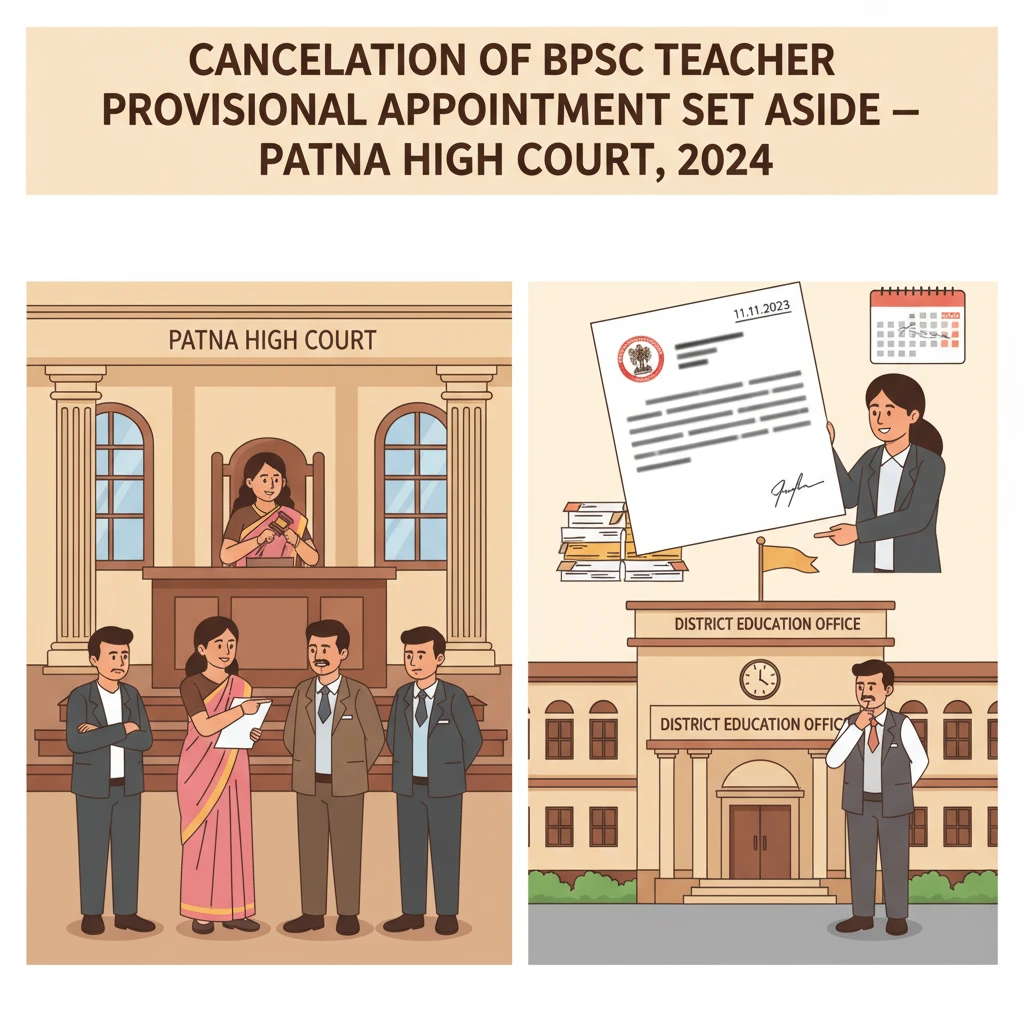
Case Background
The case arose from the large-scale teacher recruitment conducted by the Bihar Public Service Commission (B.P.S.C.) under Advertisement No. 26 of 2023. The petitioner applied under the Extremely Backward Class (EBC) category for appointment as a school teacher in Primary, Secondary and Higher Secondary schools.
She participated in the competitive examination conducted by B.P.S.C. and was declared successful. After counselling and verification of documents, a provisional appointment letter dated 02.11.2023 was issued in her favour. This letter was issued under Rule 9(i) of the Bihar State School Teacher (Appointment, Transfer, Disciplinary Proceedings and Service Conditions) Rules, 2023 (Rules, 2023).
On 11.11.2023, the Education Department issued a press communique. It warned the teachers selected through B.P.S.C. that they should not form any unions or associations or get letter pads printed in the association’s name. The communication stated that if they did so, their provisional appointment letters would be cancelled.
On the same day, the District Education Officer, Madhubani, acting through the District Education Officer’s establishment, issued Memo No. 3826 dated 11.11.2023 to the petitioner. This was a show cause notice referring to the press communique. It alleged that after being selected and issued a provisional appointment letter, the petitioner formed an association named “Madhyamik Evam Uchchatar Madhyamik BPSC Adhyapak Sangh”.
The notice further alleged that, as State President of this association, the petitioner had submitted a letter to the Director, Secondary Education, Bihar, Patna, raising a question mark over the functioning of the Department and the Government with an intention to defeat the ambitious policies of the Government. She was asked to explain within twenty-four hours why her provisional appointment should not be cancelled.
Within the same day, 11.11.2023, the petitioner replied to the show cause notice. She denied forming any association or submitting any application or memorandum to the Director, Secondary Education. She asserted that she was not the State President of any association and alleged that some unknown person had used her name on a letter pad to give such an application.
Despite this reply, by Memo No. 3836 dated 13.11.2023, the District Education Officer, Madhubani cancelled her provisional appointment letter. The officer held that by forming an association and writing a letter on its letter pad, the petitioner had violated the Bihar Government Servant’s Conduct Rules, 1976 (Rules, 1976) read with Rule 17(vii) of the Rules, 2023.
Aggrieved by this cancellation, the petitioner filed the present writ petition before the Patna High Court under its civil writ jurisdiction, seeking quashing of the order dated 13.11.2023 and consequential relief.
What the Court Examined and Decided
The matter was heard by Hon’ble Mr. Justice Anil Kumar Sinha. The Court carefully considered the provisional appointment letter, the show cause notice, the impugned cancellation order, the counter affidavits of the State, and the applicable statutory rules.
The petitioner’s counsel argued that the cancellation order was arbitrary, unreasonable and against constitutional principles. According to the petitioner, she had only been given a provisional appointment letter. As per Rule 10 of the Rules, 2023, the probation period for a teacher starts only from the date of joining in the school. Since she had not yet been given posting or allowed to join, the Bihar Service Condition rules and the Bihar Government Servant’s Conduct Rules, 1976 could not be applied to her.
The petitioner’s side emphasized that the provisional appointment letter is not an actual appointment letter. Until a formal appointment letter is issued by the Department and the teacher joins and starts work, service condition rules and conduct rules do not bind her. Her counsel also submitted that forming an association is not illegal by itself. Even if Rules, 1976 were assumed to be applicable, Rule 7 of those Rules would not apply in her case because that rule only restrains government servants from joining associations whose objects or activities are prejudicial to the sovereignty and integrity of India, public order or morality.
The petitioner’s counsel contended that the alleged letter dated 08.11.2023 placed on record by the State in a second counter affidavit (Annexure R/1) could not be said, by any stretch of imagination, to be prejudicial to India’s sovereignty and integrity, public order or morality. Hence, even on the State’s own version, the conduct rules did not justify the drastic step of cancelling her provisional appointment.
On the other hand, the State’s counsel argued that once the petitioner accepted the provisional appointment letter, she became a government servant. Therefore, Rules, 1976 read with Rules, 2023 applied to her. They asserted that she had written a letter dated 08.11.2023 to the Director, Secondary Education on the letter pad of “Madhyamik Evam Uchchatar Madhyamik BPSC Adhyapak Sangh” as its State President, raising four issues concerning selected teachers.
The State argued that, even before joining, she was putting pressure on Government officers to accept her demands. The counter affidavit stated that Government officials had spoken to her on the telephone, and she had confirmed that she had formed the “Sangh” and was its State President. The State alleged that by denying formation of the association and authorship of the letter in her reply to the show cause, the petitioner had not approached the Court with clean hands. They maintained that the District Education Officer had rightly cancelled her provisional appointment letter after considering her explanation.
The Court first closely examined the impugned order itself. The order recorded a finding that after receiving her provisional appointment letter on 02.11.2023, the petitioner formed the association within a week on 08.11.2023 and started issuing statements. The authority noted that she did this even before any school was allotted, before submitting joining, and before starting teaching.
The impugned order further observed that probation begins only after submission of joining, and only thereafter salary is paid. Since the petitioner had not submitted her joining and her probation had not started, the order concluded that the Bihar Government Servant (Classification, Control and Appeal) Rules, 2005 (Rules, 2005) did not apply. However, in the same breath, the authority held that by forming an association and writing to the Government on its letter pad, she had violated Rule 17(vii) of the Rules, 2023, which makes Rules, 1976 applicable to school teachers and bars associations that could exert pressure on the Government.
The High Court found this reasoning internally inconsistent. On the one hand, the officer admitted that Rules, 2005 could not apply because the petitioner had not joined. On the other hand, the officer still treated her as a person bound by the conduct rules through Rule 17(vii) of the Rules, 2023, and cancelled her provisional appointment for alleged violation of those conduct rules.
The Court then turned to the terms of the provisional appointment letter and the Rules, 2023. The letter dated 02.11.2023, issued under Rule 9(i) of the Rules, 2023, carried specific conditions. Clause (2) clearly stated that it could not be treated as an appointment letter, and that a formal appointment letter would be issued only after verification of certificates and completion of other formalities by the Department.
Clause (4) provided that salary would be payable from the date of joining in the school. Clause (5) stated that the probation period would begin after submission of joining and that, after successful completion of probation, the teacher’s services would be confirmed.
Rule 9(i) of the Rules, 2023 imposes a duty on the appointing authority to verify educational and training qualifications, experience certificates, and other documents before issuing an appointment letter. It permits issuance of a provisional appointment letter only in the interest of work, with verification to be completed within a time frame fixed by the Department. Rule 10(i) provides that the probation period for directly recruited school teachers will be two years from the date of “contribution”, i.e., the date of joining and actual service.
On a combined reading of these provisions, the Court held that the provisional appointment letter was intended solely to facilitate verification and did not itself amount to an appointment. At best, it reflected the Government’s intention to appoint the petitioner as a teacher subject to further steps. It was “a stage short of the appointment letter.” Therefore, the argument that she became a government servant immediately upon receiving the provisional letter was rejected.
The Court also examined the definition of “government servant” under Rules, 1976. It includes “any person appointed to serve in connection with the affairs of the State, in respect of whom the Governor of Bihar is empowered to make Rules under Article 309 of the Constitution of India…” The Court emphasized that, as per this definition, a person can be considered a government servant only when serving in connection with the affairs of the Government.
Rule 10 of the Rules, 2023, which speaks of probation from the date of “contribution”, also indicates that a teacher’s service status begins when he or she joins and starts rendering services. On this basis, the Court concluded that merely issuing an appointment letter does not make a person a government servant; joining and actual service are necessary. In the present case, even an appointment letter had not been issued, no school had been allotted, and the petitioner had not started teaching. Therefore, she could not be called a government servant and Rule 7 of Rules, 1976 did not apply to her.
The Court then addressed the wider issue of forming associations. It agreed with the petitioner’s argument that forming an association is not, by itself, illegal. The right to form associations or unions is guaranteed under Article 19(1)(c) of the Constitution of India. The Court reiterated the settled legal position that fundamental rights like the right to form associations or unions, freedom of speech and expression, right to assemble peacefully without arms, right to move freely throughout India and right to carry on any occupation, trade or business cannot be placed under discretionary control of executive authorities. State officials cannot have the power to grant or withhold permission to exercise such rights at their discretion; otherwise, the guaranteed freedoms would stand abridged or abrogated.
The Court noted that Article 19(1)(c) is subject to reasonable restrictions under Article 19(4), which permits restrictions in the interest of public order, morality, and the sovereignty and integrity of India. Rule 7 of Rules, 1976 mirrors this constitutional limitation by prohibiting government servants from joining or remaining members of associations whose objects or activities are prejudicial to those interests.
However, the Court pointed out that, in the present case, the State had not alleged that the objects or activities of the association supposedly formed by the petitioner were prejudicial to the sovereignty and integrity of India, public order or morality. Even if it were assumed that she had indeed formed an association before becoming a government servant, and that she did so to “put pressure upon Government officials”, that by itself did not make her actions violative of Rule 7 of Rules, 1976. Without any allegation that the association’s aims threatened sovereignty, integrity, public order or morality, the conduct rules could not be invoked to justify cancellation of her provisional appointment.
Thus, on both factual and legal grounds, the Court held that the impugned cancellation order was arbitrary, unreasonable, whimsical and passed in colourable exercise of power. Consequently, the writ petition was allowed. Memo No. 3836 dated 13.11.2023, cancelling the provisional appointment, was set aside.
The Court further directed the District Education Officer, Madhubani (respondent no. 6) to issue a formal appointment letter to the petitioner and allot her a school within one month from the date of receipt or production of a copy of the judgment. No order as to costs was made.
Why This Judgment Matters
This judgment is important for thousands of candidates selected as teachers through B.P.S.C. recruitment in Bihar. Many of them receive provisional appointment letters and wait for final posting and joining.
The Patna High Court has clarified that a provisional appointment letter issued under Rule 9(i) of the Rules, 2023 does not make a person a government servant. Service conduct rules cannot be used against such candidates unless a formal appointment letter is issued and they actually join service.
The decision also reinforces the constitutional right to form associations or unions under Article 19(1)(c). Authorities cannot threaten cancellation of selection merely because candidates or prospective employees form or join associations, unless there is some concrete allegation that the association’s activities are prejudicial to sovereignty, integrity, public order or morality.
For aspiring teachers and other government job seekers, the ruling gives some protection against arbitrary cancellation of provisional selection on vague charges of “forming associations” or “pressurizing the Government”. For departments, it is a reminder that their powers must be exercised reasonably and in compliance with constitutional freedoms.
Legal Issues and Answers
Issue: Does receiving a provisional appointment letter under the Bihar State School Teacher Rules, 2023 make a selected candidate a “government servant” so that the Bihar Government Servant’s Conduct Rules, 1976 automatically apply?
Answer: No. The Court held that a provisional appointment letter is not an appointment letter. A person becomes a government servant only after issuance of a formal appointment letter, joining, and rendering service. Since the petitioner had not joined, Rule 7 of Rules, 1976 did not apply to her.
Issue: Can a provisional teacher’s appointment be cancelled merely for forming an association or allegedly writing to the Government through that association, without any allegation of threat to sovereignty, integrity, public order or morality?
Answer: No. The Court held that forming an association is not per se illegal and is protected by Article 19(1)(c). In absence of any allegation that the association’s objects or activities were prejudicial to sovereignty, integrity, public order or morality, cancellation of the provisional appointment on this ground was arbitrary and unsustainable.
Issue: Was the District Education Officer justified in cancelling the petitioner’s provisional appointment letter by invoking Rule 17(vii) of Rules, 2023 and the conduct rules?
Answer: No. The Court found the reasoning in the cancellation order self-contradictory and held that the order was arbitrary, unreasonable, whimsical and passed in colourable exercise of power. The cancellation order was quashed and a direction was issued to appoint and post the petitioner within one month.
Cases Cited by the Court
- No previous case law has been expressly cited or relied upon in the text of this judgment. The Court’s reasoning is based on constitutional provisions and the relevant Bihar rules.
Case Details
Case Number: Civil Writ Jurisdiction Case No. 17010 of 2023
Case Title: Babita Kumari v. The State of Bihar & Ors.
Coram: Hon’ble Mr. Justice Anil Kumar Sinha
Citation: 2024 (1) PLJR 808
Advocates:
- For the Petitioner: Mr. Shashi Bhushan Kumar
- For the Respondents: Kumari Amrita, Government Pleader 3; Mr. Naresh Dixit, Advocate
Nature of the Case: Writ petition under civil writ jurisdiction challenging cancellation of provisional appointment of a B.P.S.C.-selected school teacher.
Date of Judgment: 01.02.2024
Link to Judgment: Click here to read the full Patna High Court judgment
If you found this explanation helpful and wish to stay informed about
how legal developments may affect your rights in Bihar,
you may consider following Samvida Law Associates for more updates.







