

Case Background
The petitioner is a bus operator from Darbhanga–Madhubani area. He owns buses bearing registration numbers BR-06PB-9099 and BR-06PB-9095.
He applied to the Regional Transport Authority, Darbhanga, for special permits and renewal of licence for these buses. On 15.05.2023, he submitted his application.
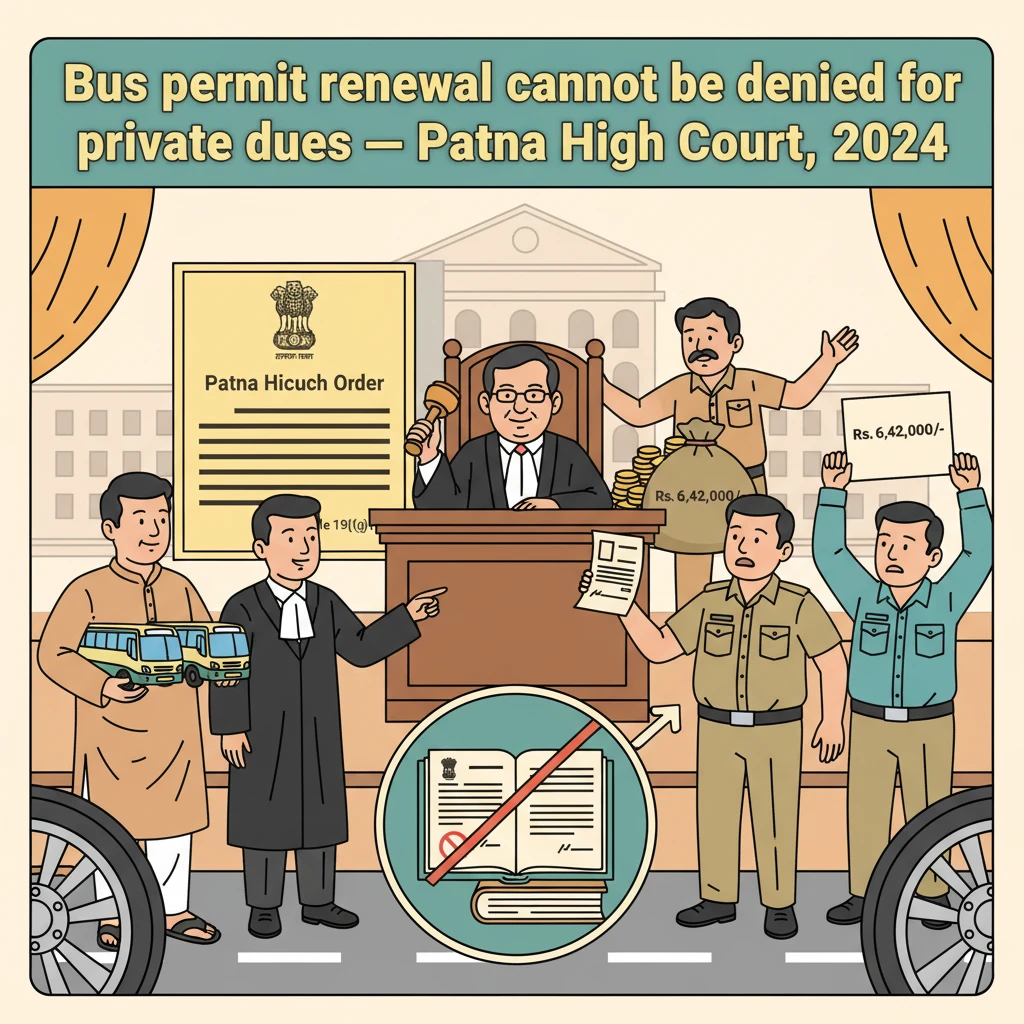
On 09.06.2023, the Regional Transport Authority (RTA), Darbhanga Division, rejected his application through Memo No. 645. The order stated that renewal and special permits could not be issued because some commission or dues were outstanding towards the Bihar State Road Transport Corporation (BSRTC), arrayed as respondent no. 7 in the writ petition but treated as respondent no. 6 in the reasoning portion.
Feeling aggrieved, the bus owner filed a writ petition before the Patna High Court under its civil writ jurisdiction. He sought quashing of Memo No. 645 dated 09.06.2023 and a direction to the transport authorities to issue the road permits for his buses.
What the Court Examined and Decided
The petition came up before Hon’ble Mr. Justice A. Abhishek Reddy on 23.01.2024. The Court heard learned counsel for the petitioner and the State, including the transport authorities and BSRTC.
The petitioner’s main grievance was that his application for renewal and special permit was rejected only because the authorities said he owed Rs. 6,42,000/- to BSRTC. No other defect or violation of the Motor Vehicles Act or Rules was mentioned in the impugned order.
The petitioner argued that this ground was illegal. According to him, the Motor Vehicles Act does not allow the RTA to refuse renewal of a permit merely because there is some separate money dispute between the bus owner and BSRTC.
He relied on a judgment of the Hon’ble Supreme Court in Mithilesh Garg and Others v. Union of India and Others, reported in 1992 1 SCC 168. He also pointed out that the authorities were depending on a departmental letter, Letter No. 9004 dated 06.09.1991, to deny renewal.
The petitioner told the Court that this same letter had earlier come under challenge in CWJC No. 3096 of 1996 before the Patna High Court. By order dated 23.08.1996, a learned Single Judge had already set aside that letter. Therefore, according to the petitioner, the authorities could not still rely on that letter to refuse his permit renewal.
On the other side, the respondents filed a counter-affidavit. They did not deny that the application had been rejected solely because of the alleged dues to BSRTC.
They specifically stated that the petitioner owed Rs. 6,42,000/- to BSRTC (Respondent No. 6) and that, based on a letter written by BSRTC, the RTA had refused renewal of the licence. The respondents prayed that the writ petition be dismissed.
The Court first noted the undisputed facts. It was admitted that the petitioner had applied for renewal of licence and that the application was rejected by the impugned order dated 09.06.2023. On a plain reading of this order, the only ground for rejection was that an amount of Rs. 6,42,000/- was outstanding from the petitioner to BSRTC.
The RTA stated that the application could not be considered as long as this amount remained unpaid. No provision of the Motor Vehicles Act or Rules was cited in the order to justify this stand.
The Court then referred to the earlier decision in CWJC No. 3096 of 1996, decided on 23.08.1996. In that case, the same High Court had examined whether the State Transport Commissioner could direct that a person’s application for renewal of permit should not be granted, or his permit cancelled, simply because some other family members had defaulted in paying tax on other vehicles.
In that earlier matter, the learned Judge had put a direct question to the Government Pleader: could such a direction be justified under the Motor Vehicles Act and Rules? The Government Pleader could not give a satisfactory answer.
Having considered the legal position, the High Court in 1996 held that there was no authority under the Act or Rules to cancel a permit or deny renewal for non-payment of tax by other members of the family in respect of different vehicles. The Court had therefore quashed the impugned order in that case, which had cancelled the permit on that basis.
In the present case, the learned counsel for the respondents fairly admitted that the 1996 judgment in CWJC No. 3096 of 1996 had attained finality. No appeal had been filed by the department against that order. This meant the legal position declared in that case continued to bind the authorities.
The Court then looked at the wider constitutional context through the Supreme Court decision in Mithilesh Garg and Others v. Union of India and Others, 1992 1 SCC 168. The judgment quoted passages from an even earlier Constitution Bench decision in Saghir Ahmad v. State of U.P.
The Supreme Court had held that Article 19(1)(g) of the Constitution gives every citizen the right to carry on any profession, occupation, trade, or business, subject only to reasonable restrictions imposed by law under Article 19(6). In Saghir Ahmad, the Court recognised that the right to run a motor transport business, such as transporting passengers by buses on public roads, is part of this fundamental right.
The Supreme Court stated that within the limits set by State regulations, any member of the public can ply motor vehicles on public roads and carry on the business of transporting passengers. If any law or order takes away or curtails this right more than what Article 19(6) permits, the citizen can complain.
In Mithilesh Garg, the Supreme Court explained that the Motor Vehicles Act, as amended, had removed some earlier restrictions on grant of permits. The law now follows a liberal policy for granting permits to those who wish to enter the motor transport business. The provisions of the Act were held to be in conformity with Article 19(1)(g), because the State had chosen not to impose additional restrictions under Article 19(6) beyond those mentioned in the statute.
Applying these principles, the Patna High Court in the present case observed that the transport authorities cannot create new restrictions on their own. They are bound by the Motor Vehicles Act and the Rules.
There is nothing in the Act or Rules that allows the RTA to refuse renewal of a licence merely because the bus owner allegedly owes some money to a third party like BSRTC. Such a demand may give BSRTC a right to recover the amount through proper legal means, but it does not empower the RTA to block renewal of a permit.
The Court clearly noted that the authorities had acted only on the basis of letters written by BSRTC. This was not a valid ground under the Motor Vehicles Act. The RTA must act within the four corners of the statute, not on the instructions of another agency that has its own financial dispute with the permit holder.
On this reasoning, the Court held that the impugned order dated 09.06.2023 could not stand. Renewal of licence cannot be rejected on the ground that some amount is payable to a third party.
The Court therefore set aside the impugned order. It directed the official respondents to consider the petitioner’s application afresh, strictly on its own merits and in accordance with the Motor Vehicles Act and Rules, without taking into account that any amount is said to be due to BSRTC (Respondent No. 6).
At the same time, the Court clarified that this relief does not prevent BSRTC from taking necessary action separately to recover any amount it claims is due from the petitioner. The corporation may use the appropriate legal mechanisms available to it, but cannot use the RTA as a collection arm by stopping renewal.
The writ petition was allowed to this extent. The Court further directed that before granting renewal of the licence, the authorities may also hear BSRTC. If BSRTC or any other party raises any other lawful objections under the Motor Vehicles Act or Rules, the RTA should consider those objections in accordance with law.
However, the Court made it absolutely clear that renewal of the permit cannot be rejected on the sole ground that money is said to be due to BSRTC.
Why This Judgment Matters
This judgment is important for bus owners and other transport operators across Bihar, especially those who run their vehicles with bank loans and face financial disputes with corporations or agencies.
The Patna High Court has stated in clear terms that the Regional Transport Authority cannot refuse to renew a bus permit just because someone claims that the owner owes them money. The Motor Vehicles Act does not give such power.
For ordinary transporters, this means that their ability to run their livelihood cannot be held hostage to private dues or commission disputes. Corporations like BSRTC must follow proper legal procedures for recovery and cannot block permits through backdoor administrative directions.
The decision also reinforces that government departments must follow earlier binding judgments. The authorities in this case were still relying on a letter which had already been set aside by the High Court in 1996. The Court has now reminded them that such actions are not acceptable.
In practice, this order can help similarly placed bus operators who face threats that their permits will not be renewed unless they clear unrelated dues. They can rely on this judgment to insist that their applications be decided strictly under the Motor Vehicles Act.
Legal Issues and Answers
- Issue: Can the Regional Transport Authority refuse renewal of a bus permit solely because the bus owner allegedly owes money to BSRTC or any third party?
Answer: No. The Patna High Court held that neither the Motor Vehicles Act nor the Rules allow rejection of renewal on this ground. The authority cannot act merely on letters from a third party; it must decide as per the statute. - Issue: Does an earlier High Court order quashing a departmental letter still bind the transport authorities when considering permit renewals?
Answer: Yes. The Court noted that the 1996 order in CWJC No. 3096 of 1996, which set aside Letter No. 9004 dated 06.09.1991, had attained finality and the department could not rely on that letter to deny renewal. - Issue: How does the fundamental right to trade or business under Article 19(1)(g) relate to motor transport permits?
Answer: Relying on Mithilesh Garg and Saghir Ahmad, the Court recognised that running motor transport is a protected business, and only restrictions expressly provided by law under Article 19(6) can limit this right. Administrative conditions like repayment of third-party dues cannot be added as extra restrictions.
Cases Cited by the Court
- Mithilesh Garg and Others v. Union of India and Others, 1992 1 SCC 168.
- Saghir Ahmad v. State of U.P. (Constitution Bench decision quoted within Mithilesh Garg).
- CWJC No. 3096 of 1996, Patna High Court, order dated 23.08.1996 (earlier judgment setting aside Letter No. 9004 dated 06.09.1991).
Case Details
Case Number: Civil Writ Jurisdiction Case No. 10259 of 2023
Case Title: Krishna Kumar Jha v. The State of Bihar and Others
Coram: Hon’ble Mr. Justice A. Abhishek Reddy
Citation: 2024 (1) PLJR 897
Judgment Date: 23.01.2024
Nature of the Case: Writ petition under Article 226 challenging rejection of application for permit renewal and special permit for buses.
Advocates:
For the petitioner: Mr. Vikas Kumar Jha, Advocate.
For the respondents: Mr. Raghwendra Kumar, Standing Counsel 22.
Link to Judgment: Click here to read the full judgment of the Patna High Court
If you found this explanation helpful and wish to stay informed about how legal developments may affect your rights in Bihar, you may consider following Samvida Law Associates for more updates.







