

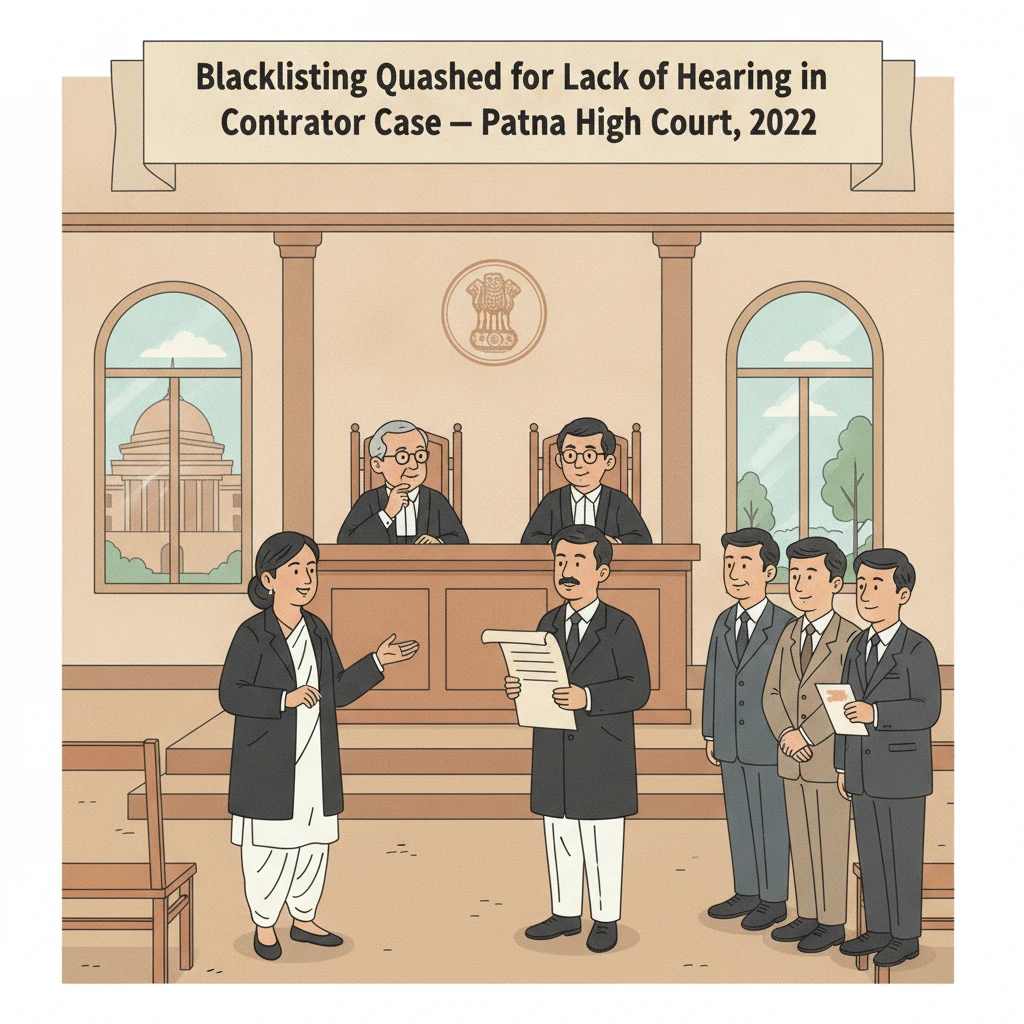
Case Background
The case arose from a construction contract between a private construction company and the Building Construction Department of the Government of Bihar. An agreement for civil construction work was executed on 04.04.2018.
The work was not completed. Both sides blamed each other for breach of the agreement and delay. At some point, the construction work stopped because of intervention by members of the general public. On the contractor’s request, the department even arranged deployment of police force at the site.
On 03.10.2020, the Chief Engineer of the Building Construction Department issued a communication declaring the contractor a defaulter and debarring it from participating in any future tender with immediate effect. This order did not record that any show cause notice had been issued or that any hearing had been granted.
Aggrieved, the contractor filed Civil Writ Jurisdiction Case No. 2625 of 2021 before the Patna High Court. It sought quashing of the order dated 03.10.2020 and also asked for directions regarding closure of the contract, final measurements, release of payments, time extension, refund of deductions, release of security deposit and issuance of a completion certificate.
During hearing, counsel for the contractor chose to confine the writ petition only to the issue of debarment/blacklisting. For the remaining grievances regarding contract payments and closure, the contractor sought liberty to take appropriate action as per the agreement and law, before the proper forum. The Court granted this liberty.
What the Court Examined and Decided
The Patna High Court, speaking through the Hon’ble Chief Justice and Hon’ble Mr. Justice S. Kumar, identified one central question: can a contractor be blacklisted or debarred from all future works without even issuing a show cause notice or otherwise complying with basic principles of natural justice?
The Court first noted that the respondents did not dispute that the impugned communication dated 03.10.2020 had debarred the petitioner from participating in other civil works with immediate effect. It was also not disputed that no notice to show cause or prior intimation of such proposed action had been given.
Attention was drawn to the Bihar Contractors Registration Rules, 2007. Under Rule 11, a contractor can be debarred only in terms of the conditions specified there. Sub-rule (kha) of Rule 11 clearly requires that before entering a contractor’s name in the blacklist, or demoting or suspending registration, a notice stating reasons must be issued:
“(kha) fdlh fof’k”V Js.kh ds Bsdsnkj dks dkyh lwph esa ntZ djus vFkok inkour (Demote) djus vFkok fuyacu djus ds iwoZ dkj.k crkvks uksfVl fn;k tkuk vko’;d gksxkA”
The Court observed that, in this case, the authorities had not followed this mandatory requirement. Without deciding whether the facts actually justified debarment under Rule 11, the Court focused on the legal effect of passing a blacklisting order in violation of the Rules and natural justice.
Counsel for the contractor relied on several Supreme Court judgments dealing with blacklisting and natural justice: State of Orissa v. Balram Sahu, (2009) 2 SCC 652; Patel Engineering Limited v. Union of India, (2012) 11 SCC 257; Gorkha Security Services v. Government (NCT of Delhi), (2014) 9 SCC 105; and Kulja Industries Limited v. Chief General Manager, Western Telecom Project BSNL, (2014) 14 SCC 731.
The Patna High Court summarised the principles laid down in these decisions. It explained that:
First, blacklisting prevents a person from entering into any lawful contractual relationship with the government for gainful purposes. Under Article 298 of the Constitution, government has power to carry on trade and enter contracts, but this power is subject to fundamental rights including Articles 14 and 21. Public contracts must be handled with equality of opportunity; the State cannot arbitrarily pick and choose whom to deal with.
Secondly, while a private individual may choose not to deal with someone, the government does not have such freedom. It must avoid discrimination among similarly placed persons. Blacklisting deprives a person of equal opportunity in public contracts, even when that person is otherwise eligible. Anyone doing business with the State has a legitimate expectation that State action will be lawful.
Thirdly, the usual defence that no prejudice was caused by not issuing a show cause notice is generally not available to the State in blacklisting matters. A show cause notice must ordinarily precede any order of blacklisting. Such an order is not a routine step; it leads to serious civil consequences and is often described as “civil death” for the business.
Fourthly, because of the stigma and far-reaching impact, an order of blacklisting must be issued with great caution. It fully prevents the blacklisted entity from receiving government contracts. Any such order is open to challenge on the grounds of violation of natural justice and disproportionality. A fair hearing on a proper show cause notice is an essential precondition.
The Court then referred to a more recent Supreme Court decision, Vetindia Pharmaceuticals Ltd. v. State of Uttar Pradesh, (2021) 1 SCC 804. There, the Supreme Court reiterated that blacklisting can cause a “civil death” to an organisation, with consequences extending well beyond the present contract. The judgment also emphasised that, with proper notice and consideration of reply, the authorities might have chosen a different period or form of debarment. The need for objective guidelines on duration of debarment, as noted in Kulja Industries, was again highlighted.
The Patna High Court further recalled that principles of natural justice apply whenever a person suffers civil consequences or prejudice due to administrative action. Civil consequences include interference with property rights, civil liberties, material loss or non-pecuniary harm. However, courts usually intervene only when breach of natural justice has caused avoidable prejudice, as indicated in Natwar Singh v. Director of Enforcement, (2004) 13 SCC 255 and SEBI v. Akshaya Infrastructure (P) Ltd., (2014) 11 SCC 112.
The Court also cited H.L. Trehan v. Union of India, (1989) 1 SCC 764, where the Supreme Court held that even where a statute permits action without a hearing, it would be arbitrary and violative of Article 14 to act without hearing in certain situations. This reinforced that fairness and opportunity to be heard are central to administrative justice.
Applying these principles, the Court returned to the facts. The agreement had been signed on 04.04.2018. Both parties were in communication over the difficulties in execution. Work had halted due to third-party interference from members of the public, and the department had arranged for police deployment at the contractor’s request. In such a situation of ongoing communication, the least that could be expected from the department, before taking the extreme step of blacklisting, was to ask the contractor to show cause why such action should not be taken.
Because this basic step was not taken, the Court held that the debarment order violated both the Bihar Contractors Registration Rules, 2007 and the fundamental principles of natural justice. It therefore quashed and set aside that part of the communication dated 03.10.2020 (Annexure-1, page 28) by which the contractor was debarred.
For the remaining reliefs relating to contract closure, payments, extension of time, release of security deposit and completion certificate, the Court simply granted liberty to the contractor to pursue its remedies before the appropriate forum as per the agreement and law. Those issues were not decided in this writ.
The Court expressed concern that authorities were ignoring the Rules and natural justice, thereby generating unnecessary litigation and affecting public work and interest. While refraining from imposing costs or initiating proceedings against the responsible officer in this case, the Court warned the State to be careful in future.
The Principal Secretary, Building Construction Department, Patna, was directed to ensure that authorised officers take action for blacklisting strictly in accordance with law. The State’s counsel undertook to inform the Principal Secretary about this order.
With these directions, the writ petition was disposed of, and any interlocutory applications were also treated as disposed.
Why This Judgment Matters
This judgment makes it very clear that a government department in Bihar cannot suddenly blacklist a contractor without first giving a fair chance to explain. A simple letter declaring a firm a “defaulter” and debarred from all future tenders, without any prior notice, will not stand.
For contractors and small businesses, especially in Bihar’s construction sector, this decision reinforces that their livelihood cannot be taken away by arbitrary orders. If they are to face serious consequences like blacklisting, they must first get a show cause notice and an opportunity to reply.
For government officers, the judgment is a warning. They must follow the Bihar Contractors Registration Rules, 2007 and basic natural justice. Otherwise, their actions may be struck down, causing delay in projects and avoidable court cases.
More broadly, the ruling strengthens trust in public contracting by insisting that the Patna High Court will protect equality of opportunity and fairness in government dealings with private contractors.
Legal Issues and Answers
Issue: Can a contractor be blacklisted/debarred from future tenders by the Building Construction Department without prior show cause notice or hearing?
Answer: No. The Patna High Court held that such debarment, without issuing a show cause notice and complying with the Building Construction Departmentand principles of natural justice, is illegal and liable to be quashed.
Issue: What is the effect of violation of natural justice in blacklisting matters?
Answer: Since blacklisting has serious “civil death” consequences and affects equality of opportunity in public contracts, any order passed without a fair hearing is contrary to Articles 14 and 21, and courts will interfere.
Cases Cited by the Court
- State of Orissa and others v. Balram Sahu, (2009) 2 SCC 652
- Patel Engineering Limited v. Union of India and another, (2012) 11 SCC 257
- Gorkha Security Services v. Government (NCT of Delhi) and others, (2014) 9 SCC 105
- Kulja Industries Limited v. Chief General Manager, Western Telecom Project Bharat Sanchar Nigam Limited and others, (2014) 14 SCC 731
- Vetindia Pharmaceuticals Ltd. v. State of Uttar Pradesh and another, (2021) 1 SCC 804
- Natwar Singh v. Director of Enforcement, (2004) 13 SCC 255
- SEBI v. Akshaya Infrastructure (P) Ltd., (2014) 11 SCC 112
- H.L. Trehan v. Union of India, (1989) 1 SCC 764
Case Details
Case Number: Civil Writ Jurisdiction Case No. 2625 of 2021
Case Title: M/s Satyendra Kumar and Co. Const. Pvt. Ltd. v. The State of Bihar and Others
Citation: 2022 (1) PLJR 806
Coram: Hon’ble the Chief Justice Sanjay Karol and Hon’ble Mr. Justice S. Kumar
Advocates: Mr. Sanjay Singh, Senior Advocate for the petitioner; Mr. Syed Iqbal Ahmad, Standing Counsel 20 for the respondents; Mr. Mahtab Alam, Advocate for the respondents
Nature of the Case: Writ petition (civil) challenging blacklisting/debarment order and seeking consequential contractual reliefs
Date of Judgment: 24.01.2022
Link to Judgment: Click here to read the full judgment of the Patna High Court
If you found this explanation helpful and wish to stay informed about
how legal developments may affect your rights in Bihar,
you may consider following Samvida Law Associates for more updates.







