

Case Background
The petitioner, Broad Son Commodities Private Limited, had obtained rights to mine sand in Bhojpur district under the Bihar Minor Mineral Concession Rules, 1972.
A written agreement dated 13.04.2015 granted settlement rights for five calendar years, from 2015 to 2019.
The agreement fixed the settlement amount for 2015 as Rs. 7,15,26,793. For each subsequent year, the amount was to increase by 120% of the immediately previous year’s settlement amount. In simple terms, every year’s payable amount was 1.2 times the previous year’s figure.
This 2015 agreement did not contain any clause giving the petitioner an automatic right to extension or renewal of the lease after 2019.
Under Rule 34 of the 1972 Rules, a mining grant can be renewed, but only on an application by the lessee. The petitioner did not apply for such renewal.
Meanwhile, issues relating to sand mining in the concerned area were pending before the Supreme Court of India and also before the National Green Tribunal. Because of these pending proceedings, the State could not auction the sand ghats or grant fresh mining leases in the normal way under the rules.
To avoid a complete stop in sand supply, the State of Bihar took a policy decision. Through notifications and communications dated 27.12.2019 (Annexures 8 and 9), the Government allowed existing sand ghat lessees to continue mining by way of extension, on revised terms. The extension was to run up to 31.10.2020 or until fresh environmental clearance and further orders were in place, whichever came earlier.
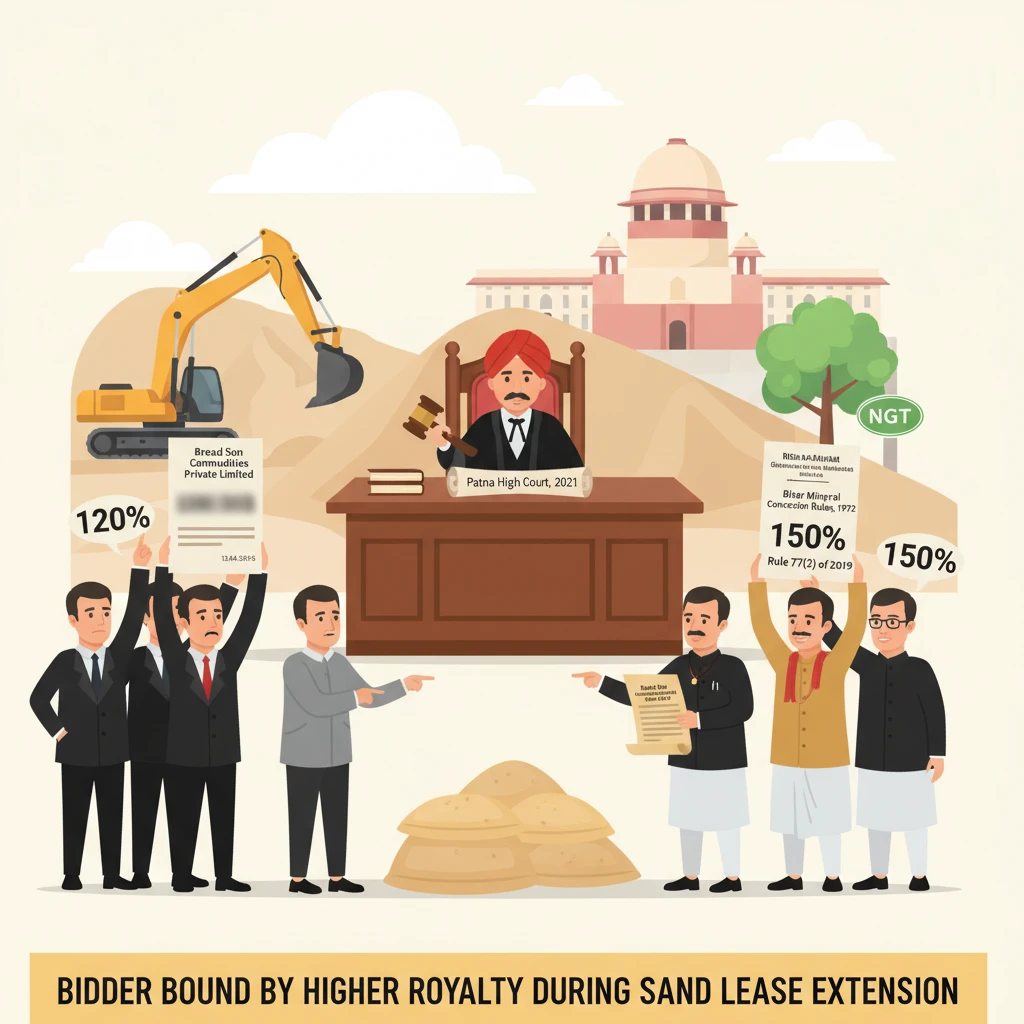
Under this policy, the settlement amount for the extended period was fixed at 150% of the settlement amount for 2019, i.e. a 50% enhancement over the last year’s amount, instead of the earlier pattern of 120% of the previous year.
The petitioner accepted this extension, continued mining operations during the extended period, and paid royalty at the enhanced rate of 150%.
Only after enjoying the benefit of continued mining for the extended period did the petitioner approach the Patna High Court on 29.01.2021 by filing the present writ petition.
What the Court Examined and Decided
The main question framed by the Patna High Court was whether the conduct of the petitioner disentitled it from claiming that the State’s action in granting extension of the mining lease at a slightly higher amount was unconscionable, illegal, arbitrary or unreasonable.
The petitioner sought several reliefs. In essence, it wanted the Court to direct the State to charge royalty for the extended period strictly according to the original 2015–2019 settlement terms and the 2013 Sand Policy. It asked for a declaration that the extensions from 01.01.2020 to 31.10.2020 and from 01.11.2020 to 31.12.2020 were merely continuations of the earlier settlement, and therefore the terms, including royalty calculations, could not be changed.
It further requested a direction that royalty during this extended period should be at 120% of the 2019 rate. The petitioner argued that the Government’s decision to fix the amount at 150% of the 2019 rate was incorrect, illegal and amounted to an impermissible alteration of contractual terms. It also attacked memo nos. 4948 and 4949 dated 27.12.2019, saying they were only meant to extend the existing lease, not modify its conditions.
In short, the petitioner wanted refund of what it termed as “excess” royalty for the extended period and a finding that charging 150% was unjustified.
To support its claim, the petitioner argued that the Government decision amounted to an “extension”, not a “renewal”. It relied on the Supreme Court decision in Provash Chandra Dalui v. Biswanath Banerjee, 1989 Supp (1) SCC 487, which explains the difference between “extension” and “renewal”. According to that judgment, “extension” generally means continuing the same lease for a further period, while “renewal” involves a fresh lease.
The petitioner also cited State of Gujarat v. Nirmalaben S. Mehta, (2016) 9 SCC 240, where the Supreme Court reiterated the legal distinction between extension and renewal. Based on these judgments, the petitioner argued that since the State itself used the word “extension”, it could not change the financial terms of the original lease.
Another plank of the petitioner’s argument was that the case involved unjust enrichment by the State and misuse of a dominating bargaining position. The company suggested that it had no real choice but to continue under the new rate because of the State’s control.
The Court first noted some undisputed facts. The 2015 agreement had no clause for automatic extension. The petitioner did not apply for renewal under Rule 34 of the 1972 Rules. The right to continue mining after 31.12.2019 flowed only from the State’s policy decision reflected in Annexure 8, not from the original agreement or any statutory right.
That meant the petitioner was free either to accept the extension on new terms or to reject it and hand back the mining site. It chose to accept, mined sand throughout the extended period, and only later challenged the higher rate.
The Bench held that by continuing mining operations and paying at the enhanced rate without any protest, the petitioner had accepted the new terms. Section 8 of the Indian Contract Act, 1872 was relied upon, which says that performance of the conditions of a proposal, or acceptance of any consideration for a reciprocal promise, amounts to acceptance of that proposal.
The Court also referred to Bharat Petroleum Corporation Ltd. v. Great Eastern Shipping Co. Ltd., (2008) 1 SCC 503. There the Supreme Court recognised that while silence alone usually does not amount to acceptance, silence combined with conduct can. An offeree’s conduct in acting on an offer can create an “agreement sub silentio”.
Applying these principles, the Bench held that the petitioner’s conduct clearly showed acceptance of the extended lease on the 150% rate. The company had not only impliedly accepted the change in terms but had acted substantially in furtherance of that acceptance by continuing to mine.
The Court then examined whether there was any basis to treat the State’s decision as unconscionable or against public policy. The petitioner had relied on Central Inland Water Transport Corporation Ltd. v. Brojo Nath Ganguly, (1986) 3 SCC 156. In that case, the Supreme Court discussed unconscionable contracts—those so unfair or unreasonable that they shock the conscience of the court and may be void as against public policy.
The Patna High Court reproduced key paragraphs from Brojo Nath Ganguly explaining that such contracts are those containing terms that are irreconcilable with what is right or reasonable. However, the Court found that the petitioner’s case did not meet this high threshold. The enhancement here was from 120% to 150% of the previous year’s settlement amount, i.e. an additional 30%. In the peculiar circumstances of pending litigation before the Supreme Court and the National Green Tribunal, the Court did not consider this increase to be grossly disproportionate or shocking.
Another important aspect considered was the source of the Government’s power. The Court traced Annexure 8 to Rule 77(2) of the Bihar Minerals (Concession, Prevention of Illegal Mining, Transportation & Storage) Rules, 2019. This rule authorises the State Government, in public interest, to grant mining leases or settlements and to relax normal rule conditions, including by prescribing different terms and conditions, provided reasons are recorded in writing.
The policy of extending existing leases at 150% of the 2019 settlement amount was taken under this special relaxation power because usual auctions could not be held due to the pending court and tribunal matters. The Court held that using Rule 77(2) in such a situation was within the Government’s legal powers.
On the argument that the higher royalty would raise retail sand prices and hence was against public interest, the Court saw no evidence. It noted that no retailer had come forward with any grievance. It recalled that pricing and policy choices of this kind are matters of State policy and cannot be interfered with unless they are arbitrary, capricious, illegal or unreasonable, which was not the case here.
The Court also invoked the Supreme Court’s ruling in M.P. Mittal v. State of Haryana, (1984) 4 SCC 371. That case holds that High Courts, while exercising writ jurisdiction under Article 226 of the Constitution, can refuse relief where a petitioner seeks to use the court to secure a dishonest advantage or perpetuate an unjust gain.
Here, the Patna High Court noted that the petitioner waited until after the benefit of extension and continued mining had been fully enjoyed to challenge the rate. The writ petition filed in January 2021 came much after the decision of 27.12.2019 and the subsequent mining operations. In the Court’s view, this conduct amounted to an afterthought and was “nothing short of dishonesty”.
Considering all these factors, the Court concluded that the petitioner was bound by the new terms of extension, including the 150% rate, and that there was no unjust enrichment by the State or abuse of a dominant position.
Consequently, the Court refused to disturb the State Government’s decision dated 27.12.2019 (Annexure 8) and the related communication (Annexure 9). It held that they were valid exercises of power under Rule 77(2) of the 2019 Rules and did not violate public policy.
The writ petition was dismissed, and any interlocutory applications were also dismissed.
Why This Judgment Matters
This judgment is important for contractors and companies dealing with government mining leases and other resource contracts in Bihar.
First, it shows that if a lessee voluntarily accepts an extension offered on revised terms, continues to work, and pays under those terms, it cannot later demand a refund claiming the terms were unfair.
Second, the decision confirms that the State of Bihar can, in special situations and in public interest, relax its own mineral rules under Rule 77(2) of the 2019 Rules and fix different financial terms, as long as reasons are recorded.
Third, the Court emphasised that writ jurisdiction under Article 226 is discretionary. If a party has already taken full benefit from a government decision and then challenges it only to gain financially, the High Court can refuse relief.
For sand ghat operators and other mining lessees, the message is clear: once you accept a policy decision, work under it, and earn profits from it, you cannot later disown the same decision merely because you want to pay less royalty.
Legal Issues and Answers
- Issue: Can a lessee, after accepting and acting upon an extension of a sand mining lease at a higher royalty rate, later challenge that rate as unconscionable, illegal, arbitrary or unreasonable and seek refund?
Answer: No. The Patna High Court held that by continuing mining under the extended terms and paying at 150%, the petitioner accepted the offer under Section 8 of the Contract Act and is bound by it. The enhancement was within the State’s power under Rule 77(2) of the 2019 Rules and was neither unconscionable nor against public policy. - Issue: Was the State’s policy decision dated 27.12.2019, granting extension of existing sand leases at 150% of the 2019 settlement amount, beyond its powers or contrary to public interest?
Answer: No. The Court held that the decision was a valid exercise of relaxation power under Rule 77(2) of the Bihar Minerals (Concession, Prevention of Illegal Mining, Transportation & Storage) Rules, 2019, taken due to pending proceedings before the Supreme Court and the National Green Tribunal, and it did not violate public policy.
Cases Cited by the Court
- Provash Chandra Dalui v. Biswanath Banerjee, 1989 Supp (1) SCC 487 (cited by the petitioner on distinction between extension and renewal of leases).
- State of Gujarat & Ors. v. Nirmalaben S. Mehta & Ors., (2016) 9 SCC 240 (relied upon for the same principle regarding extension and renewal).
- Bharat Petroleum Corporation Ltd. v. Great Eastern Shipping Co. Ltd., (2008) 1 SCC 503 (relied upon by the Court to show that acceptance can be inferred from conduct and silence).
- M.P. Mittal v. State of Haryana & Ors., (1984) 4 SCC 371 (relied upon to emphasise the High Court’s discretion to deny relief where a petitioner seeks an unjust advantage).
- Central Inland Water Transport Corporation Ltd. v. Brojo Nath Ganguly & Ors., (1986) 3 SCC 156 (discussed on the concept of unconscionable contracts and public policy; distinguished on facts).
Case Details
Case Number: Civil Writ Jurisdiction Case No. 3203 of 2021
Case Title: Broad Son Commodities Private Limited v. The State of Bihar & Ors.
Coram: Hon’ble the Chief Justice Sanjay Karol and Hon’ble Mr. Justice S. Kumar
Date of Judgment: 14.12.2021
Citation: 2022 (1) PLJR 1
Advocates: Mr. Suraj Samdarshi, Advocate for the petitioner; Mr. Sunil Kumar Mandal, Standing Counsel-3 for the State; Mr. Ravi Ranjan Kumar Singh, Assistant Counsel to SC-3 for the State.
Nature of the Case: Writ petition under Article 226 of the Constitution challenging State Government policy and royalty demand relating to extension of sand mining settlement.
Link to Full Judgment: https://patnahighcourt.gov.in/viewjudgment/MTUjMzIwMyMyMDIxIzEjTg==—ak1–Ie0Tei3c–ak1–Y=
If you found this explanation helpful and wish to stay informed about
how legal developments may affect your rights in Bihar,
you may consider following Samvida Law Associates for more updates.







