

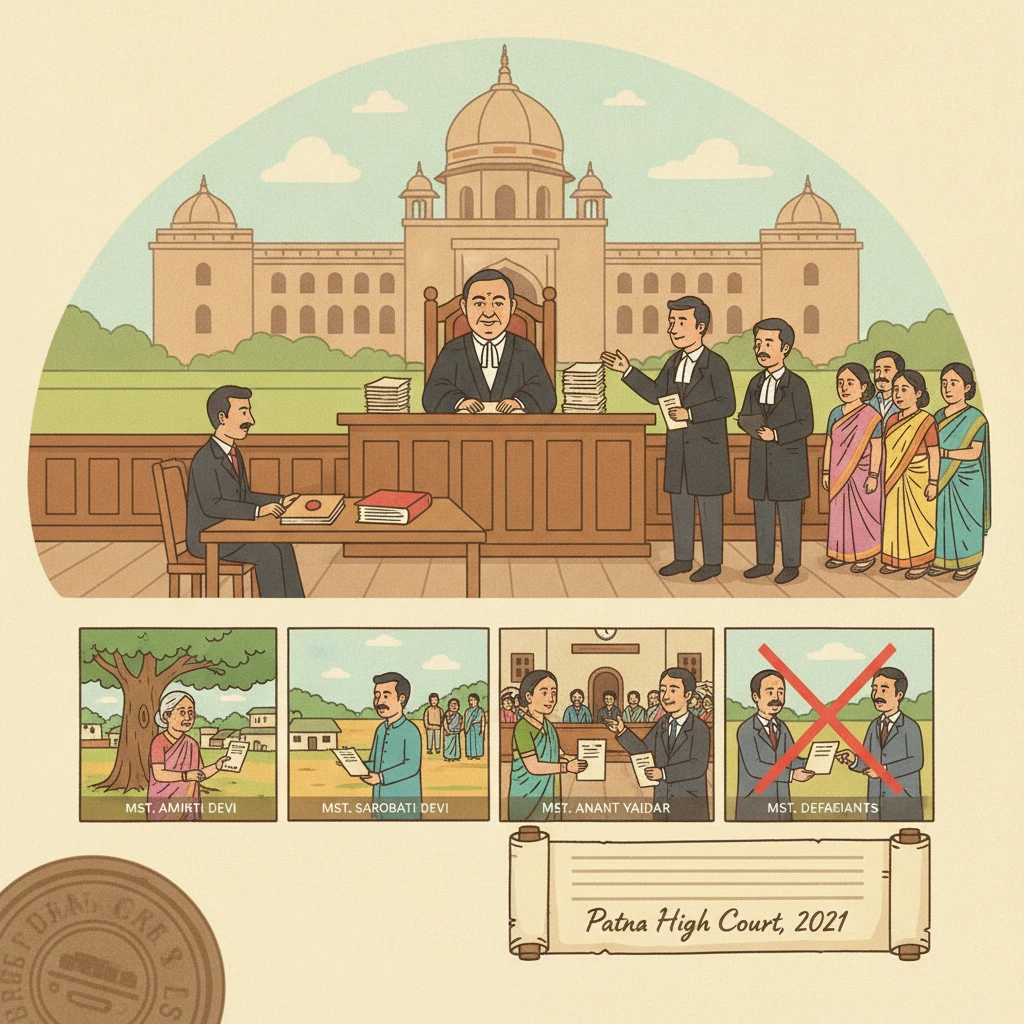
Case Background
The dispute arose from agricultural lands in village Fulwan @ Devipur, P.S. Manigachhi, District Darbhanga. The parties are close relatives from the same family. The plaintiffs and the first set of defendants trace their title to one Mithu Yadav and his widow, Mst. Amirti Devi.
According to the plaintiffs, Mst. Amirti Devi executed four sale deeds in the years 1940, 1945, 1957 and 1958 in favour of Late Ajodhi Yadav, plaintiff no. 1 in the suit. On this basis, they claimed that they were in continuous possession of the lands described in Schedules 1 and 2 of the plaint.
Later, a fifth sale deed dated 12.04.1965 (marked Ext. 2A) was allegedly executed regarding some of the same properties. By this time, Amirti’s daughter, Mst. Sarobati Devi (defendant third party), had received the lands under a deed of gift dated 03.07.1944. The plaintiffs claimed that when the 1965 sale deed was about to be executed, they learnt about this earlier gift.
The 1965 sale deed was compulsorily registered on 07.01.1966 in Registration Case No. 44 of 1965, as Mst. Sarobati was allegedly reluctant to register it. In order to avoid complications arising from the earlier gift, the plaintiffs say they decided to repurchase all the property that plaintiff no. 1 had earlier bought from Amirti, this time from Sarobati. For this purpose they used a benamidar, Anant Yadav (defendant second party), said to be the cousin of plaintiff no. 1, in whose name the sale deed was taken.
The plaintiffs alleged that this benamidar, acting dishonestly, later executed two sale deeds dated 24.02.1971 in favour of the first set of defendants, thereby transferring the suit lands to them without any right or authority.
On these facts, in 1971 the plaintiffs filed Title Suit No. 21 of 1971 before the Munsif, Darbhanga. They sought declaration of their title, confirmation of possession over the lands in Schedules 1 and 2, a permanent injunction restraining the first set of defendants from interference, and, in the alternative, recovery of possession if they were dispossessed during the suit.
The suit was contested only by the first set of defendants. The second and third party defendants, including the alleged benamidar Anant Yadav and donor/donee Amirti and Sarobati, did not contest.
By judgment dated 31.08.1978 and decree dated 16.09.1978, the trial court rejected the plaintiffs’ claim of title under the four earlier sale deeds and the 1965 deed in the name of Anant Yadav. However, relying on a Survey Knowing Pleader Commissioner’s report, it found the plaintiffs in possession of 3 kathas 15 dhurs (broken up as 1 katha 10 decimals and 12 kanmas in plot no. 164, 11 decimals in plot no. 528, and 1 kattha 14 dhurs in plot no. 326) and decreed the suit partly to that extent by confirming their possession.
Both sides appealed. The plaintiffs filed Title Appeal No. 89 of 1978/9 of 1984. The first set of defendants filed a cross-appeal challenging even the limited relief granted. The 2nd Additional Sub-Judge, Darbhanga, by judgment dated 12.01.1985 and decree dated 28.01.1985, dismissed the plaintiffs’ appeal, allowed the cross-appeal and set aside even the part decree regarding possession.
Aggrieved, the plaintiffs filed Second Appeal No. 154 of 1985 before the Patna High Court. This second appeal came to be decided on 16.12.2021 by Hon’ble Mr. Justice Ashutosh Kumar.
What the Court Examined and Decided
The Patna High Court began by noting the limited scope of second appeal: it could interfere only on substantial questions of law. Four such questions were framed, all revolving around the rejection of the plaintiffs’ claim under the sale deeds, their plea of benami purchase, alleged long possession, and the correctness of the appellate court’s fact findings.
The central question was whether the plaintiffs were able to prove that the land was really purchased by them in the name of defendant second party, Anant Yadav, as a benamidar, and whether they had any subsisting right, title or long-standing possession over the suit land.
The trial court had framed detailed issues on maintainability, limitation, court fees, non-joinder of parties, benami nature of the transaction, title under the five sale deeds (four in favour of Ajodhi Yadav and one of 1965 in favour of Anant Yadav), possession, and entitlement to relief.
On the benami question, the trial court accepted that there was family relationship between the plaintiffs and Anant Yadav but held that the plaintiffs had failed to prove any motive or reason why they would purchase the land benami in his name. The custody of documents relating to compulsory registration and the sale deeds with the plaintiffs was considered but not taken as proof of benami.
The court also examined a hand-note standing in the name of one Nasib Lal Yadav, which the plaintiffs relied on to show that plaintiff no. 1 had financed the purchase. Nasib Lal, examined as P.W. 23, stated that defendant third party (Sarobati) had borrowed money from him and executed the hand-note. The trial court reasoned that, if plaintiff no. 1 had actually paid the money, his name would have appeared in that document. This weakened the plaintiffs’ claim that they had paid the consideration for the 1965 sale deed (Ext. 2A).
On these materials, the trial court held that defendant second party was not a benamidar for the plaintiffs. The lower appellate court agreed with this finding and the High Court found no reason to interfere.
The High Court highlighted the logic used by the courts below: if the plaintiffs were already in possession of all the lands on the basis of four earlier sale deeds executed by Amirti, there was no sensible reason to again purchase the same land in the name of a benamidar from Sarobati. If, on the other hand, they did manage to get the lands sold to the benamidar, it indicated that they were not in actual possession and that Sarobati, as donee under the 03.07.1944 gift, was the real person in possession.
The plaintiffs had also tried to challenge the deed of gift itself as forged and inoperative. The High Court held that this stand was self-contradictory. On the one hand they said the gift deed was not effective; on the other hand they claimed to have purchased from the donee via a benamidar. A party cannot, in the Court’s words, “blow hot and cold in the same breath.” Acceptance of one stand would exclude the other.
On the issue of title under the four sale deeds (of 1940, 1945, 1957 and 1958) and Ext. 2A of 1965, the courts below found that the plaintiffs could not prove their validity and effect. For example, regarding one document Ext. 2G of 1940, relied on to show possession over 1 kattha 10 dhurs in plot no. 174, the plaintiffs did not examine the scribe or attesting witnesses, nor explain their non-examination, and the deed itself was not registered. This undermined their claim.
In contrast, the first set of defendants produced two sale deeds (Ext. B and B1) executed by defendant second party Anant Yadav in their favour. They examined D.Ws. 2, 13 and 19, who consistently stated that the land was sold for Rs. 4,000/-. They also proved a receipt of Rs. 4,000/- (Ext. A(1)) as being in the handwriting of defendant second party. The courts accepted this evidence and held that the first set of defendants had properly purchased the land.
Regarding possession, the trial court had initially found that the plaintiffs were in possession of some parts of the lands, mainly on the strength of a report by a Survey Knowing Pleader Commissioner dated 21.09.1976. The report suggested that part of the suit land had amalgamated with the plaintiffs’ adjacent land, and on that basis, the trial court confirmed their possession over 3 kathas 15 dhurs.
The appellate court, however, held that this was erroneous. It pointed out that the plaintiffs had failed to prove their title over the entire suit land. The question of amalgamation was never pleaded as an issue in the title suit. Therefore, evidence based on the Pleader Commissioner’s report was beyond the pleadings and could not be used to confer even partial relief.
The Patna High Court endorsed this reasoning. A court cannot rely on evidence which travels beyond the case as pleaded by the parties. Since the plaintiffs were not shown to have continuous long possession of the land, they could not succeed merely on the basis of the Commissioner’s report that some lands stood amalgamated.
The High Court also addressed the argument that, since defendant second party (the alleged benamidar) did not contest the suit or the appeal, the plaintiffs’ case should be believed. The Court rejected this. The real contest over title and possession was between the plaintiffs on one side and the first set of defendants on the other, who claimed to have purchased from defendant third party and to be in possession. The silence of the benamidar could not by itself prove the plaintiffs’ case or undo the documentary and oral evidence led by the contesting defendants.
Ultimately, the High Court concluded that the findings of fact recorded by the first appellate court were fully supported by the evidence on record. The part decree granted by the trial court was rightly set aside because it rested on evidence beyond the pleadings. The plaintiffs had failed to establish that Anant Yadav was their benamidar, that they had paid consideration for the 1965 sale, or that they were in continuous long possession of the suit land.
Accordingly, the High Court held that there was no merit in the second appeal, answered the substantial questions of law against the plaintiffs, and dismissed the appeal. The result is that the plaintiffs’ suit for declaration of title, confirmation of possession and injunction stands dismissed in entirety, and the sale in favour of the first set of defendants remains undisturbed.
Why This Judgment Matters
This decision is important for people involved in family property disputes and benami transactions in Bihar and elsewhere.
First, it shows that a mere allegation that land was bought in the name of a relative as a benamidar is not enough. The party must clearly prove who paid the money, why a benami arrangement was needed, and how they remained in control of the land.
Second, long use or partial possession has to be proved through proper, pleaded facts and reliable evidence. A commissioner’s report cannot create title or override gaps in the basic documents. Courts will not grant relief based on facts that were never pleaded in the plaint.
Third, parties cannot take self-contradictory stands. Here, the plaintiffs both challenged and relied upon the same gift and sale transactions. The Patna High Court underlined that a party cannot “blow hot and cold” to suit convenience.
Last, the judgment confirms that non-contest by a co-defendant (like a supposed benamidar) does not automatically strengthen another party’s claim. What matters is the evidence actually produced and the legal pleadings on record.
Legal Issues and Answers
-
Issue: Did the plaintiffs prove that defendant second party was their benamidar and that they had subsisting title under the sale deeds of 1940, 1945, 1957, 1958 and 12.04.1965?
Answer: No. All courts found that benami purchase was not proved, the consideration was not shown to have been paid by the plaintiffs, and the sale deeds relied on by them did not establish title. -
Issue: Were the plaintiffs entitled to a decree on the alternative ground of continuous long possession, supported by the Survey Knowing Pleader Commissioner’s report?
Answer: No. The plaintiffs failed to prove continuous long possession, and the Commissioner’s report on amalgamation was beyond the pleadings and could not be the basis of a decree. -
Issue: Were the findings of the lower appellate court on fact and law so erroneous that the Patna High Court should interfere in second appeal?
Answer: No. The High Court held that the appellate court’s findings were based on proper appreciation of evidence and correct legal principles, and therefore refused to interfere.
Cases Cited by the Court
The judgment text provided does not mention or rely upon any earlier reported decisions. No case law citations are recorded.
Case Details
Case Number: Second Appeal No. 154 of 1985; arising from Title Suit No. 21 of 1971 and Title Appeal No. 89 of 1978/9 of 1984
Case Title: Sarv Narayan Yadav & Anr. v. Ram Phal Yadav
Coram: Hon’ble Mr. Justice Ashutosh Kumar
Citation: 2022(1) PLJR 528
Judgment Date (Second Appeal): 16.12.2021
Advocates:
- For the Appellants/plaintiffs: Mr. Vishwanath Prasad Singh, Sr. Advocate; Mr. Ajit Kr. Singh, Advocate; Mr. Rajesh Kumar, Advocate
- For the Respondent first set: Mr. Hemendra Prasad Singh, Sr. Advocate; Mr. Md. Sufiyan, Advocate; Mr. Thakur Brajesh Singh, Advocate; Mr. Farooque Ahmad Khan, Advocate
Nature of the Case: Second appeal in a title suit for declaration of title, confirmation of possession, permanent injunction and, in the alternative, recovery of possession relating to agricultural land.
Link to Full Judgment: Patna High Court Judgment
If you found this explanation helpful and wish to stay informed about
how legal developments may affect your rights in Bihar,
you may consider following Samvida Law Associates for more updates.







