
Case Background
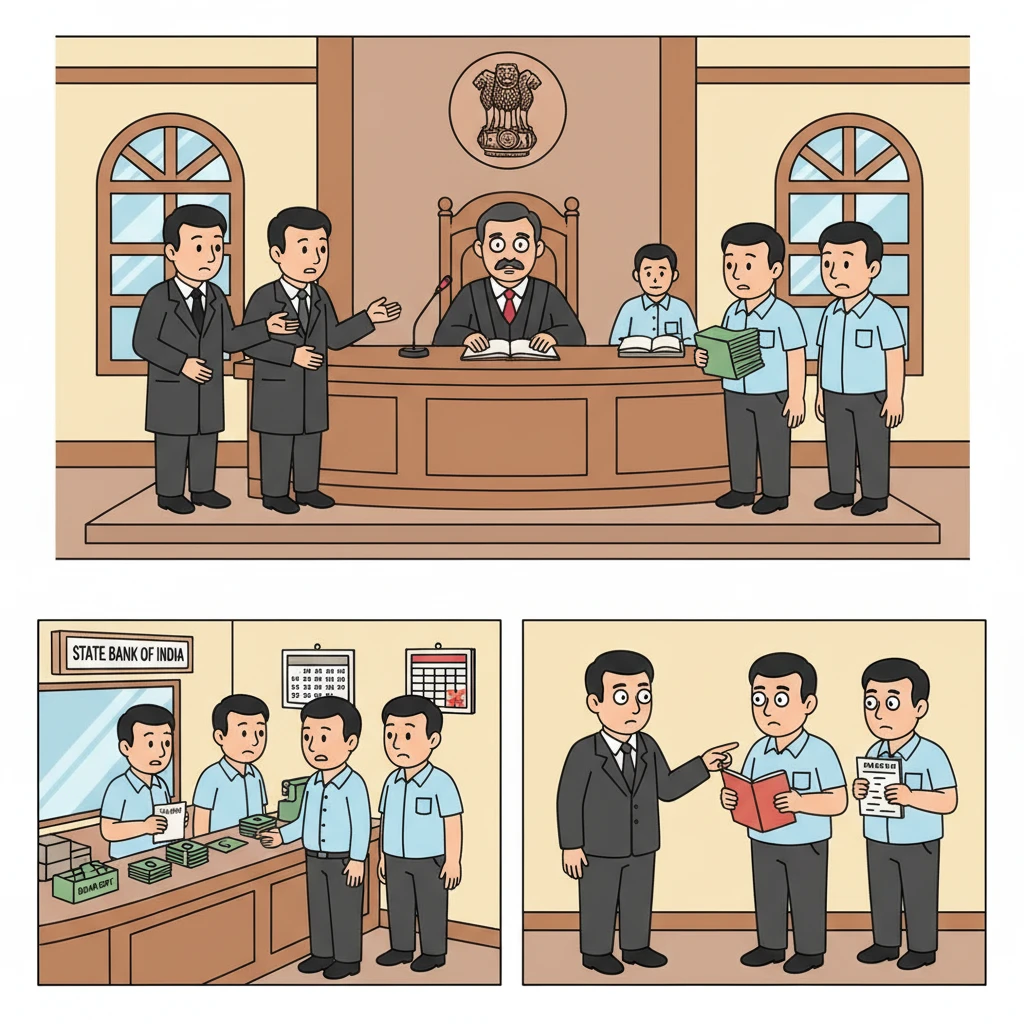
Three writ petitions were filed in the Patna High Court by employees working as Assistants at the Bodh Gaya Branch of State Bank of India. All three were posted as Single Window Operators at the bank counter.
They faced departmental proceedings on allegations of mishandling cash commission collected against Bihar Government Staff Selection Commission fees or application money. After the enquiry, the Regional Manager-cum-Disciplinary Authority, Regional Business Office, State Bank of India, Gaya, passed orders dated 09.06.2016 removing them from service.
The punishment orders provided that they would be removed from service with superannuation benefits as otherwise due under the rules or regulations, and without disqualification from future employment. Their period of suspension was ordered to be treated as suspension only, not as duty. These orders relied on paragraph 5(j) of the Memorandum of Settlement dated 10.04.2002 for workman staff in banks.
The employees filed departmental appeals. The Deputy General Manager-cum-Appellate Authority, Zonal Office, State Bank of India, Bhagalpur, dismissed their appeals by orders dated 14.11.2016 and 15.11.2016, thereby affirming the punishment.
Aggrieved, the employees approached the Patna High Court through Civil Writ Jurisdiction Case Nos. 1112, 1665 and 1039 of 2017. Since the facts and issues were common, the High Court heard all three matters together and disposed them of by a common judgment dated 01.05.2019.
What the Court Examined and Decided
The core allegations against the petitioners related to the period between 25.08.2014 and 29.04.2014, when they were working as Single Window Operators at the Bodh Gaya Branch.
According to the bank, during this period the petitioners received cash towards bank commission when customers deposited Bihar Government Staff Selection Commission fees or application money. This commission was to be deposited in a specific Commission Account of the bank.
The bank alleged that the total commission amount actually deposited in the Commission Account was less than what had been collected from customers. The shortfall varied for each petitioner. It was further alleged that the employees later deposited the missing amounts only after a memorandum was issued to them pointing out the discrepancy.
On this basis, the bank treated the conduct as misappropriation of funds. A second, related charge was that since the full commission amount was not deposited on the same day as receipt, the bank was kept out of those funds for some time. The bank claimed this caused loss and showed mala fides and breach of trust in performance of duties.
The bank therefore labelled the conduct as “gross misconduct” under paragraph 5(j) of the Memorandum of Settlement dated 10.04.2002 for workman staff. After departmental enquiries, the disciplinary authority imposed the penalty of removal from service with limited benefits, which was then upheld by the appellate authority.
Before the Patna High Court, the petitioners attacked these orders on several grounds. First, they argued that there was non-application of mind by both the disciplinary and appellate authorities. According to them, the authorities failed to properly consider the explanations and grounds raised.
Second, they alleged discriminatory treatment. They pointed out that two other bank employees, Kunal Bhushan and Kumari Megha Gupta, who were also involved in similar transactions, had been given only minor punishment. Those employees were punished by lowering of the scale of pay for one year without cumulative effect, under Clause 6(e) of the Settlement dated 10.04.2002, whereas the petitioners had been removed from service.
Third, the petitioners argued that the punishment was disproportionate to the charges. They said that while working as Single Window Operators, they were handling several tasks at once. The process of accepting Government challans and cash commission involved multiple stages. Because of the heavy workload and high volume of transactions in the branch, some challans might have been inadvertently left out at the time of depositing commission in the Commission Account.
They claimed that any lapse was not deliberate. Whenever discrepancies were noticed, the amounts were promptly deposited, and therefore it was unfair to treat this as gross misconduct deserving the maximum penalty of removal from service.
They also broadly alleged that the departmental proceedings suffered from lack of transparency and fairness, and that there were several lapses in the way the enquiry was conducted.
The bank, through its counsel, defended the orders. It argued that the explanations offered by the petitioners were unsatisfactory. As bank officers handling public money, their conduct was expected to be above board. When the enquiry showed that the bank had been kept out of its commission amount, the bank considered this a serious breach of trust.
The bank submitted that the petitioners had deposited the missing amounts only after being called upon to do so, not on their own. It further argued that the cases of Kunal Bhushan and Kumari Megha Gupta were substantially different. According to the bank, the quantum of money not deposited by those two employees was much less. For this reason, they were awarded lesser punishment in the form of temporary reduction of pay scale, and the principle of parity did not apply.
The bank heavily relied on Clause 5(j) of the Bipartite Settlement dated 10.04.2002, which defines “gross misconduct” as “doing any act prejudicial to the interest of the bank or gross negligence or negligence involving or likely to involve the bank in serious loss”. It argued that keeping the bank out of its commission funds and allowing a possibility of recurrence justified treating the conduct as gross misconduct and removing the petitioners from service.
However, the Patna High Court did not enter into a detailed examination of these rival factual and legal arguments. Instead, the Court focused on the question of proper forum and remedy.
The bank’s counsel contended that if the petitioners were aggrieved by the punishment, they should approach the Labour Court. The employees, by nature of their duties, were “workmen” and the bank was an “industrial undertaking” under the relevant law. Therefore, a dispute of this kind was an “industrial dispute” under the Industrial Disputes Act, 1947.
The Court accepted this line of reasoning. It noted that the petitioners were workmen within the meaning of Section 2(s) of the Industrial Disputes Act, 1947. The bank was an industrial undertaking as defined under Section 2(j). The dispute regarding dismissal from service was an industrial dispute under Section 2(k) of the Act.
Given this statutory framework, the Court held that the proper and efficacious remedy for the petitioners was to move the Labour Court or Industrial Tribunal under the Industrial Disputes Act. These specialised forums are meant to examine such service disputes of workmen, including questions about fairness of departmental enquiries and proportionality of punishment.
The Court also observed that this was not a case where a writ petition should be entertained straightaway after a departmental proceeding. Without going into the merits of the findings or the proportionality of the punishment, the Court decided to decline interference under its writ jurisdiction.
Accordingly, the Patna High Court directed the petitioners to exhaust the alternative statutory remedy available to them under the Industrial Disputes Act, 1947. The Court specifically stated that it was not expressing any opinion on the factual or legal contentions raised by either side.
With these observations and directions, all three writ petitions were disposed of. The removal orders therefore remained in force, but the petitioners retained the right to challenge them before the appropriate Labour Court or Tribunal.
Why This Judgment Matters
This judgment is important for bank employees and other workers who face departmental proceedings and punishments like dismissal or removal.
The Patna High Court made it clear that when an employee is a “workman” and the employer is an industrial undertaking, disputes about dismissal, suspension, or disciplinary action should first go to the Labour Court or Industrial Tribunal under the Industrial Disputes Act, 1947.
For affected employees, this means that filing a writ petition directly in the High Court may not succeed, even if they feel the enquiry was unfair or the punishment too harsh. The High Court may refuse to examine the case on merits and send them to the labour forum instead.
The decision also underlines that specialised labour forums are considered an “efficacious remedy”. They are better equipped to look deeply into evidence, departmental procedures, and the proportionality of punishment.
At the same time, the Court did not close the doors on the petitioners. It allowed them to pursue their rights under the Industrial Disputes Act. Their allegations of discrimination, non-application of mind, or harsh punishment can still be examined, but by the proper forum.
Legal Issues and Answers
-
Issue: Can workmen employed in a bank directly challenge disciplinary removal orders in the Patna High Court through writ petitions?
Answer: No. Since they are workmen and the bank is an industrial undertaking, their dismissal dispute is an industrial dispute. They must first exhaust the efficacious remedy before the Labour Court or Industrial Tribunal under the Industrial Disputes Act, 1947.
Cases Cited by the Court
- The judgment does not mention or rely upon any other decided case by name or citation.
Case Details
Case Numbers: Civil Writ Jurisdiction Case No. 1112 of 2017; Civil Writ Jurisdiction Case No. 1665 of 2017; Civil Writ Jurisdiction Case No. 1039 of 2017.
Case Title: Ravi Shankar Sinha v. The State Bank of India & Ors; Vijay Ram v. The State Bank of India & Ors; Nagendra Singh v. The State Bank of India & Ors.
Citation: 2019(3) PLJR 268.
Coram: Hon’ble Mr. Justice Ashutosh Kumar.
Date of Judgment: 01.05.2019.
Advocates: For the petitioners (in all three cases): Mr. Gautam Kumar Kejriwal, Advocate; Mr. Atal Bihari Pandey, Advocate; Mr. Alok Kumar Jha, Advocate. For the respondents/Bank: Mr. Kaushlendra Kumar Sinha, Advocate; Mr. Sanjiv Kumar, Advocate.
Nature of the Case: Writ petitions under civil writ jurisdiction challenging departmental removal orders and appellate orders passed by State Bank of India authorities.
Link to the Judgment: https://patnahighcourt.gov.in/viewjudgment/MTUjMTExMiMyMDE3IzEjTg==-OlsEdbof4CM=
If you found this explanation helpful and wish to stay informed about
how legal developments may affect your rights in Bihar,
you may consider following Samvida Law Associates for more updates.







