

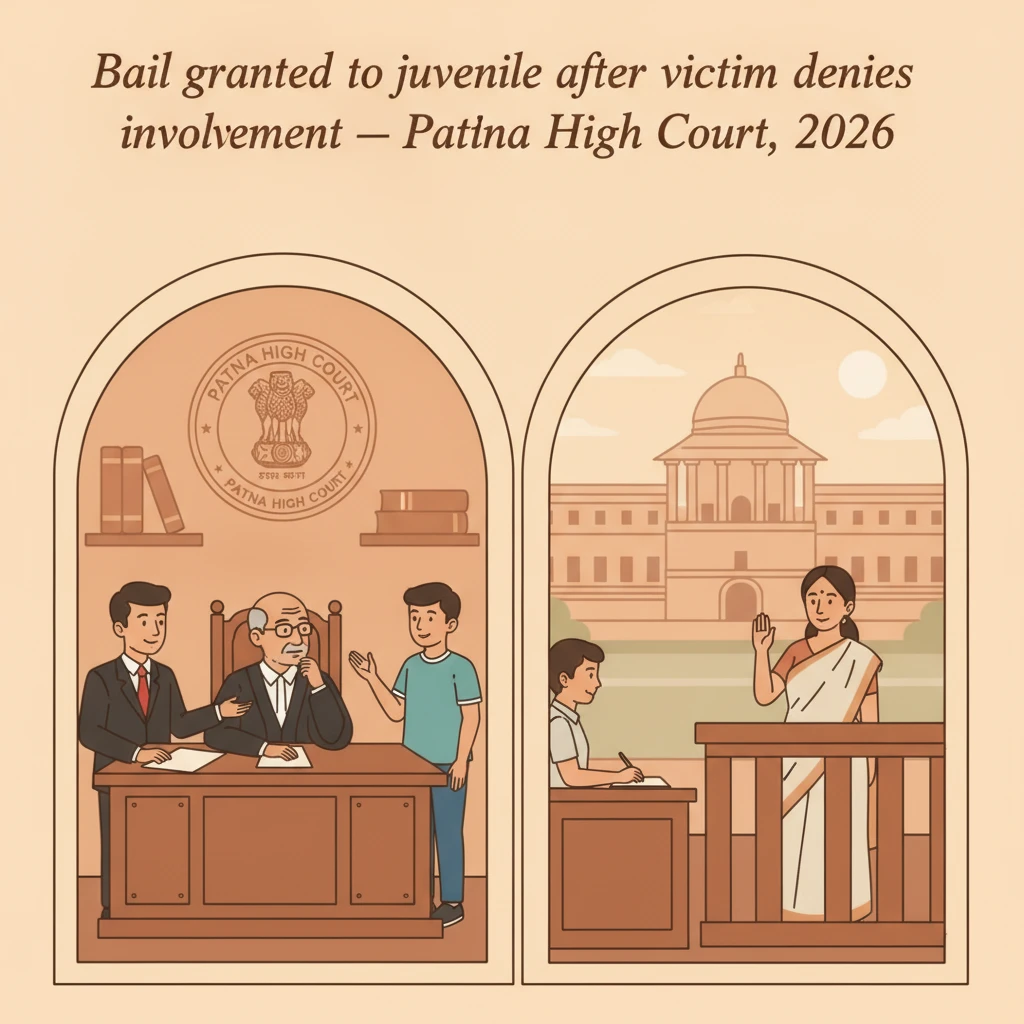
Case Background
The case started with Maner P.S. Case No. 728 of 2023, registered on 08.10.2023 in District Patna. The First Information Report (FIR) was lodged on the basis of the fardbeyan of the victim herself.
In the FIR, the victim alleged that the appellant and five other co-accused had committed gang rape upon her. It was also stated that the appellant was one of the accused persons arrested at the place of occurrence.
After investigation, the police submitted charge-sheet against the appellant and other co-accused under Sections 376(D) and 120(B) of the Indian Penal Code. During the inquiry before the Juvenile Justice Board, Patna, the appellant’s age was assessed.
By order dated 31.01.2024, the Juvenile Justice Board found that the appellant was 16 years, 10 months and 18 days old. Thereafter, his age and maturity were assessed under Section 15 of the Juvenile Justice (J.J.) Act.
On this assessment, the case of the appellant was sent to the Children Court for his trial as an adult. The Special (Child) Case No. 18 of 2025 was thus taken up before the Ist Additional District and Sessions Judge-cum-Special Judge, Juvenile Court, Patna.
In that court, the appellant’s regular bail application was considered and rejected by order dated 08.10.2025. It was noted that his earlier bail application had also been rejected and a revision petition filed against that rejection order had already been dismissed.
Aggrieved by the fresh rejection of bail, the appellant filed Criminal Appeal (SJ) No. 4630 of 2025 before the Patna High Court. The appeal came up before Hon’ble Mr. Justice Jitendra Kumar and was decided on 04.05.2026.
What the Court Examined and Decided
The Patna High Court heard three sides: the learned counsel for the appellant, the learned Additional Public Prosecutor (APP) for the State, and the learned Amicus Curiae appointed in the matter.
The appellant’s counsel argued that the appellant was innocent and falsely implicated. He pointed out that a joint trial of the appellant and another juvenile co-accused was going on before the Children Court.
During this trial, the victim herself had been examined as a witness. According to the appellant’s counsel, the victim clearly stated before the Children Court that the appellant and the other co-accused were not involved in the offence committed against her.
The victim also said that they were not present at the place of occurrence and that she was seeing the appellant and the co-accused for the first time in court. On this basis, the appellant’s counsel submitted that the prosecution case against the appellant did not stand anymore.
In such a situation, counsel argued, there was no justification for detaining the appellant either in an Observation Home or any other institution. Continued detention, he suggested, would only be punitive and not grounded in evidence.
On the other hand, the learned APP for the State strongly opposed the prayer for bail. He stressed that the alleged offence was very serious in nature, involving a charge of gang rape under Section 376(D) read with Section 120(B) of the Indian Penal Code.
The State pointed out that, before the victim’s examination in court, there was a strong prosecution case against the appellant. This was because he had been named in the victim’s own fardbeyan and was arrested from the place of occurrence, as mentioned in the FIR.
The learned Amicus Curiae assisted the Court with the legal framework for bail in cases involving juveniles in conflict with law. He referred to Section 12 of the Juvenile Justice Act, which deals with release of such juveniles on bail.
He emphasized that under Section 12, the rule is that a juvenile in conflict with law should be released on bail, and refusal of bail is the exception. However, he went a step further to argue that even this provision presupposes the existence of a viable prosecution case against the juvenile.
According to the Amicus Curiae, when at the trial stage the victim—the star witness—has already been examined and has given a clean chit to the appellant, the prosecution case against him effectively collapses. In such a scenario, keeping the appellant detained would be unjustified.
He submitted that detention and the process of reformation of a juvenile in conflict with law presuppose that the juvenile has committed an offence. Where the evidence of the victim suggests that the juvenile appears to be innocent, denial of bail would be a grave miscarriage of justice and an injustice to society at large.
After hearing all sides, the Patna High Court carefully considered these submissions. The Court agreed with the learned Amicus Curiae on the basic legal requirement.
The Court held that the first and foremost condition for detaining a juvenile in conflict with law in an Observation Home or other institution under the J.J. Act is that there must be a prosecution case supported by evidence against the accused or appellant.
If there is no evidence on record against the appellant, there is no question of depriving him of his right to liberty. In such a situation, he would be entitled to bail irrespective of Section 12 of the J.J. Act, which itself provides that bail is the rule and denial is the exception for juveniles in conflict with law.
The Court particularly took into account the evidence of the victim recorded before the Children Court during the trial. The victim had clearly deposed that the appellant was neither present at the place of occurrence nor involved in the alleged offence.
Given that the victim is the star witness in a case of this nature, her testimony was central. Once she denied any role of the appellant and said she had seen him for the first time in court, the Court found that there remained no ground to continue refusing bail.
On this reasoning, the Patna High Court concluded that there was no ground for denial of bail to the appellant. The earlier considerations about the seriousness of the offence could not override the absence of supporting evidence against him at this stage of the trial.
Accordingly, the High Court allowed the criminal appeal. It directed that the appellant be released on bail upon furnishing a bail bond of Rs. 10,000/-.
In addition to the monetary bond, the Court imposed a specific condition aimed at supervision and guidance of the juvenile. The appellant’s father was required to file an affidavit giving an undertaking.
In this undertaking, the father had to affirm that he would keep vigil on the appellant’s habits, would not allow him to come into contact with any criminal persons, and would take care of the developmental needs of the appellant. The appellant would also have to attend the Court as and when required or directed.
The Court also ordered that the Lower Court Records be sent back to the concerned court forthwith along with a copy of the judgment, so that the trial could proceed in light of the High Court’s bail order.
Finally, the High Court recorded its appreciation for the assistance rendered by the learned Amicus Curiae. It also noted his request that, since he had assisted the Court pro bono, there should be no direction for payment of any honorarium.
Why This Judgment Matters
This judgment is important for families of juveniles accused in serious criminal cases, especially in Bihar. It shows that even in grave offences like gang rape, the Patna High Court will closely look at the actual evidence on record, not just the seriousness of the charge.
The Court makes it clear that for a child in conflict with law, bail is the rule and jail or detention is the exception. More importantly, if the main witness later denies the child’s involvement, there is no reason to keep that child detained.
The decision also underlines that the purpose of the juvenile justice system is reformation and protection of rights, not punishment without evidence. Detention in an Observation Home or other institution must be based on a real, existing prosecution case.
The condition placed on the father’s undertaking shows how the Court seeks a balance: protecting society while giving the juvenile a chance to live in the community under parental supervision and continue with normal developmental needs.
For lawyers and trial courts, this judgment reinforces that they must reconsider bail when evidence changes during the trial, especially after the victim’s testimony. A rigid reliance on the initial FIR or seriousness of the allegation is not enough to deny bail to a juvenile once the evidentiary foundation weakens.
Legal Issues and Answers
Issue: Can a juvenile, sent to be tried as an adult for alleged gang rape, be denied bail when the victim later denies his involvement during trial?
Answer: No. Once the victim, the star witness, clearly states that the juvenile was neither present at the place of occurrence nor involved in the offence, there remains no ground to deny bail, and the juvenile is entitled to release.
Issue: Does detention of a juvenile in conflict with law under the J.J. Act require a subsisting prosecution case supported by evidence?
Answer: Yes. The Court held that detention in an Observation Home or other institution presupposes the existence of a prosecution case against the juvenile. In the absence of evidence, there is no justification to deprive the juvenile of liberty, and bail must be granted.
Issue: What is the general rule regarding bail under Section 12 of the Juvenile Justice Act?
Answer: The rule is that a juvenile in conflict with law should be released on bail, and denial of bail is an exception. This principle applied strongly in the present case, where the evidence against the appellant had effectively disappeared.
Cases Cited by the Court
- No prior judgments are cited or relied upon in the text of this decision.
Case Details
Case Number: Criminal Appeal (SJ) No. 4630 of 2025; arising out of Maner P.S. Case No. 728 of 2023; Special (Child) Case No. 18 of 2025.
Case Title: XXX (Real name withheld) v. The State of Bihar & XXX (Real name withheld)
Coram: Hon’ble Mr. Justice Jitendra Kumar
Citation: 2026 (3) PLJR 654
Advocates: For the appellant – Mr. Pramhansh Kumar Puri, Advocate; For the State – Mr. Bal Mukund Prasad Sinha, APP; Amicus Curiae – Mr. Bimlesh Kumar Pandey, Advocate.
Nature of the case: Criminal appeal (single judge) against rejection of regular bail in a Special (Child) case under Sections 376(D) and 120(B) of the Indian Penal Code, involving a juvenile in conflict with law.
Date of High Court Judgment: 04.05.2026
Link to full judgment: https://patnahighcourt.gov.in/viewjudgment/MjQjNDYzMCMyMDI1IzEjTg==-fyidfQE–am1–pgA=
If you found this explanation helpful and wish to stay informed about how legal developments may affect your rights in Bihar, you may consider following Samvida Law Associates for more updates.







