
Case Background
This case arose from Khutauna P.S. Case No. 19 of 2024, District Madhubani. The case was registered under Sections 399, 402, 120B of the Indian Penal Code and Sections 25(1-b)(a), 26, 35 of the Arms Act.
According to the prosecution, the police apprehended the juvenile petitioner along with three other co-accused persons. They were allegedly found assembled for making preparations to commit a crime. The police also claimed that 2–3 other persons managed to escape from the spot taking advantage of darkness.
From the other co-accused persons, the police allegedly recovered arms, ammunition and mobile phones. From the petitioner himself, only a mobile phone was recovered. No firearm or ammunition was found in his possession.
The petitioner was later also made an accused in two more cases on the basis of the confessional statement of a co-accused named Pankaj Kumar. Both of those cases were lodged on 19.01.2024. The petitioner was apprehended in the present case on 23.01.2024 and shown as one of the accused persons. Since then, he has been in custody.
In the meantime, other co-accused persons in the same Khutauna P.S. Case No. 19 of 2024 were granted bail by a Co-ordinate Bench of the Patna High Court. This was done through orders dated 30.07.2024 in Cr. Misc. No. 47886 of 2024, 05.09.2024 in Cr. Misc. No. 60492 of 2024 and 04.12.2024 in Cr. Misc. No. 82496 of 2024.
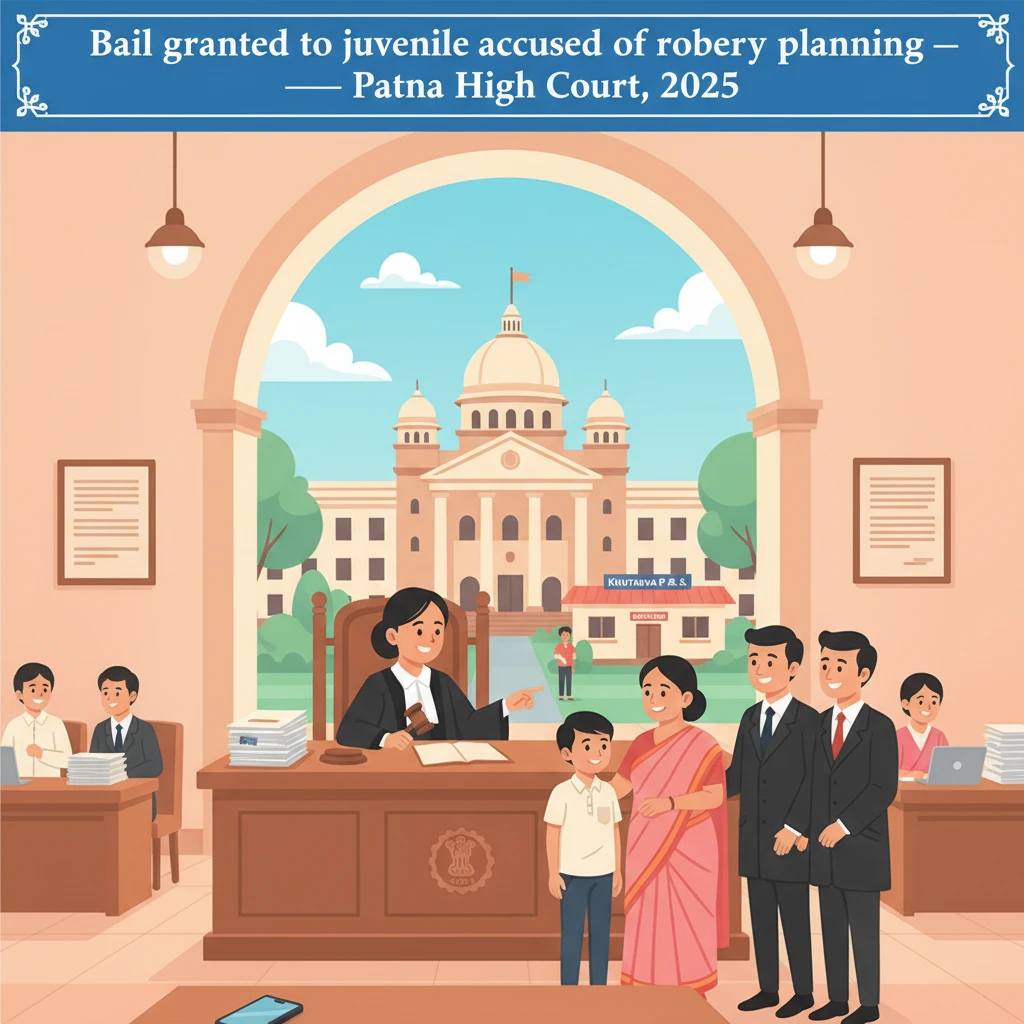
The petitioner, however, being a juvenile, had to approach the Juvenile Justice system. His case came up as Juvenile Appeal No. 07 of 2025 before the Additional Sessions Judge-I-cum-Special Judge, Children Court, Madhubani. By order dated 07.05.2025, the appellate court rejected his appeal and refused to grant him bail. That refusal order led to the present Criminal Revision No. 755 of 2025 before the Patna High Court.
What the Court Examined and Decided
The Patna High Court, presided over by Hon’ble Mr. Justice Arun Kumar Jha, heard the arguments of the petitioner’s counsel and the learned Special Public Prosecutor for the State.
The petitioner’s main grievance was that the Children Court’s appellate order dated 07.05.2025 wrongly denied him bail. His counsel argued that the order was passed without properly considering the facts and the law under the Juvenile Justice (Care and Protection of Children) Act, 2015.
The appellate court had relied heavily on the Social Investigation Report and Social Background Report of the petitioner. According to the petitioner, these reports contained false averments. The reports stated that the petitioner was not under the control of his mother, that there was absence of moral and ethical values in the house, and that there was a possibility of his involvement in anti-social activities after release.
The petitioner’s counsel strongly disputed these findings. He submitted that the petitioner had never indulged in any illegal activities earlier and that his mother was ready to take responsibility for his control and upbringing. She undertook not to allow him to indulge in any criminal activities in future.
The petitioner’s side argued that under Section 12 of the Juvenile Justice Act, 2015, seriousness and gravity of the offence cannot by themselves be grounds to deny bail to a child in conflict with law. Instead, the law requires specific, reasonable grounds to believe that releasing the child on bail would:
1) bring him into association with any known criminal; or
2) expose him to moral, physical or psychological danger; or
3) defeat the ends of justice.
The counsel submitted that no such concrete reason was recorded in the appellate court’s order. Rather, the court used general and vague expressions and also referred to the serious nature of the allegation. This, it was argued, was against the express provisions of Section 12.
The petitioner further pointed out that while co-accused were alleged to have been found with arms and ammunition, from his own possession only a mobile phone was recovered. No weapon was seized from him. He had no previous criminal antecedents before being named in two other cases, both based on the confessional statement of a co-accused Pankaj Kumar, and both lodged on the same date, 19.01.2024.
On the other side, the learned Special Public Prosecutor opposed the submissions made on behalf of the juvenile. However, the judgment does not record any detailed separate reasoning put forward by the State; it simply notes the opposition.
The Court then examined the legal framework. It reproduced Section 12 of the Juvenile Justice (Care and Protection of Children) Act, 2015. This section clearly lays down that when a person who appears to be a child is alleged to have committed any offence, whether bailable or non-bailable, and is apprehended or brought before the Board, such person shall be released on bail, with or without surety, or placed under supervision, notwithstanding anything in the Code of Criminal Procedure, 1973 or any other law.
The proviso to Section 12 permits refusal of bail only if there are reasonable grounds for believing that release is likely to bring the child into association with known criminals, expose the child to moral, physical or psychological danger, or defeat the ends of justice. In such a situation, the Board must record reasons for denying bail and note the circumstances leading to that decision.
The Patna High Court emphasized the non-obstante clause in Section 12, pointing out that it overrides the usual bail provisions of the Code of Criminal Procedure for children in conflict with law.
The Court also referred to Section 3 of the Juvenile Justice Act, which sets out general principles to be followed in the administration of the Act. The Court quoted specific principles:
(i) Principle of presumption of innocence — any child shall be presumed innocent of mala fide or criminal intent up to the age of eighteen years.
(iv) Principle of best interest — all decisions regarding the child must be based primarily on what is in the best interest of the child and to help the child develop to full potential.
(v) Principle of family responsibility — primary responsibility for care, nurture and protection of the child lies with the biological family or adoptive or foster parents.
(xiv) Principle of fresh start — all past records of any child under the Juvenile Justice system should be erased except in special circumstances.
On the basis of these provisions, the Court held that the case of any child in conflict with law for grant of bail has to be examined with the child’s best interest as the guiding factor. The gravity and nature of the offence are immaterial for considering bail to a juvenile. The duty of the Court is to ensure that decisions are taken primarily with the best interest of the child in mind.
The Court clarified that the proviso to Section 12 creates limited exceptions to the rule of grant of bail to a child. Bail can be denied only where there are concrete reasons to believe that:
1) the child will join association with known criminals; or
2) the child will face moral, physical or psychological danger if released; or
3) release of the child would defeat the ends of justice.
Applying these principles to the facts of the case, the Patna High Court found serious shortcomings in the order of the Children Court’s appellate judge. The appellate court had merely made a bland assertion that the petitioner was an active member of a gang of robbers, was criminal-minded, and was not under the control of his parents. The High Court noted that the petitioner indeed had antecedents of two cases, but the circumstances around the lodging of those cases did not rule out the possibility of false implication.
The Court observed that there was no clear reasoning shown as to how the appellate court concluded that the child was not in control of his mother, or that there was absence of moral and ethical values in his house, or that he was likely to get involved in anti-social activities after release. The High Court held that these findings were not properly supported by reasons.
The Court further held that denying bail based on the serious nature of the allegations alone was “uncalled for and unwarranted”, given the specific scheme of Section 12 of the Juvenile Justice Act.
Having regard to all the facts and circumstances and the applicable legal provisions, the Patna High Court disagreed with the findings of the appellate court. It set aside the order dated 07.05.2025 passed in Juvenile Appeal No. 07 of 2025 and allowed the criminal revision.
The Court then directed that the petitioner, being a juvenile in conflict with law, be released on bail. The conditions imposed were:
1) The petitioner must furnish bail bonds of Rs. 10,000/- with two sureties of the like amount each, to the satisfaction of the learned Additional Sessions Judge-I-cum-Special Judge, Children Court, Madhubani/concerned court.
2) One bailor shall be the mother of the petitioner.
3) The other bailor shall be a relative of the petitioner having no criminal antecedent.
4) The petitioner shall remain present before the Juvenile Justice Board on each and every date of trial of the case fixed by the Board.
With these directions, the Court effectively ensured that the child would return to the care of his family, while still being under the supervision of the justice system during the pendency of the inquiry.
Why This Judgment Matters
This judgment is important because it reinforces that, under the Juvenile Justice Act, a child in conflict with law should ordinarily be granted bail. Courts cannot refuse bail to a juvenile simply because the alleged offence is serious.
For families of children accused in criminal cases, the judgment clarifies that the law prioritises the child’s best interest and presumes the child’s innocence. The focus is on rehabilitation and family responsibility, not punishment.
The Patna High Court has also sent a message to lower courts and Children Courts that they must record clear, specific reasons if they seek to deny bail to a juvenile. Vague remarks about bad company, lack of control, or seriousness of allegations are not enough unless supported by real, reasonable grounds as required by Section 12 of the Juvenile Justice Act.
Practically, this decision will guide juvenile courts in Bihar, and especially in Madhubani and nearby districts, to apply the law more carefully when handling bail applications of children in conflict with law. It helps ensure that children are not unnecessarily kept in custody when the law itself strongly leans towards release.
Legal Issues and Answers
-
Issue: Can a juvenile accused in a serious offence like preparation for dacoity be denied bail solely on the basis of the nature and gravity of the allegation and general remarks in a Social Investigation Report?
Answer: No. The Patna High Court held that under Section 12 of the Juvenile Justice Act, gravity and nature of the offence are immaterial for grant of bail to a child. Bail to a juvenile can be refused only when there are reasonable grounds to believe that release will bring the child into association with known criminals, expose the child to moral, physical or psychological danger, or defeat the ends of justice, and such reasons must be specifically recorded. -
Issue: Whether the appellate Children Court’s reliance on vague observations that the child was criminal-minded, part of a gang, and not under parental control was sufficient to deny bail?
Answer: No. The High Court found that the appellate court had not explained how it reached these conclusions and that such bland assertions, without clear supporting grounds, could not justify denial of bail under the Juvenile Justice Act. -
Issue: What order should be passed regarding the custody of the juvenile petitioner in this case?
Answer: The High Court set aside the appellate court’s order dated 07.05.2025, allowed the criminal revision, and directed that the juvenile petitioner be released on bail on furnishing bonds and sureties, with conditions that his mother and another relative (without criminal antecedent) act as bailors, and that he appear before the Board on all dates of trial.
Cases Cited by the Court
- No previous case law has been cited or relied upon in the text of this judgment. The Court’s reasoning is based directly on the Juvenile Justice (Care and Protection of Children) Act, 2015.
Case Details
Case Number: Criminal Revision No. 755 of 2025, arising out of Khutauna P.S. Case No. 19 of 2024
Case Title: XXX (juvenile, through his mother and guardian Ramkumari Devi) vs. The State of Bihar
Citation: 2025(4) PLJR 678
Court: High Court of Judicature at Patna
Coram: Hon’ble Mr. Justice Arun Kumar Jha
Date of Judgment: 04.11.2025
Advocates: Mr. Dhirendra Kumar, Advocate for the petitioner; Mr. Ram Bilash Roy Raman, Special Public Prosecutor for the State
Nature of the Case: Criminal revision challenging an appellate order of the Children Court refusing bail to a juvenile in conflict with law
Statutes Involved: Sections 399, 402, 120B of the Indian Penal Code; Sections 25(1-b)(a), 26, 35 of the Arms Act; Section 12 and Section 3 of the Juvenile Justice (Care and Protection of Children) Act, 2015
Link to Full Judgment: Click here to access the judgment on the Patna High Court website
If you found this explanation helpful and wish to stay informed about how legal developments may affect your rights in Bihar, you may consider following Samvida Law Associates for more updates.







