

Case Background
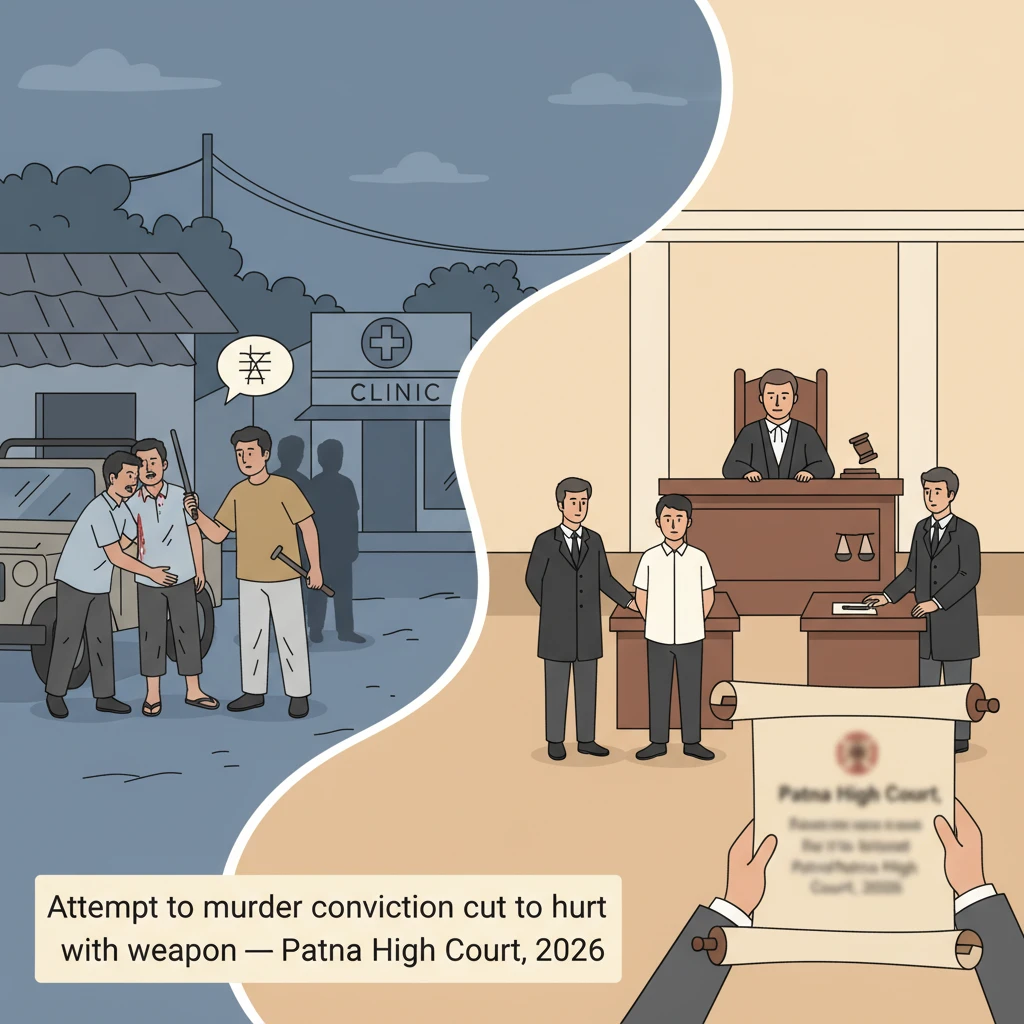
The case arose from an incident on 20.03.2005 in village Keur, Police Station Hulasganj (Ghosi), District Jehanabad. The informant, Bharteshwar Prasad, alleged that a dispute over unpaid house rent led to a violent attack outside his village home.
According to the prosecution, the informant owned a house at Islampur. The wife and sister of the appellant had been living there for about two and a half years without paying rent. The landlord was pressing for payment, which allegedly created bad blood.
On 20.03.2005, around 8:00 P.M., the informant returned from Islampur Bazaar to his house in village Keur. As he opened his door, his co-villager, the appellant, allegedly arrived with a farsa (sharp cutting weapon) and two unknown persons. Abuse followed, and then a single farsa blow on the informant’s head was alleged.
The informant became unconscious and was taken by neighbours to the private clinic of Dr. Pravin Kumar at Islampur. There, during treatment, he regained consciousness. On 21.03.2005 at about 10:30 A.M., he gave his fardbeyan to an ASI of Islampur Police Station.
On that basis, Hulasganj Ghosi P.S. Case No. 67 of 2005 (G.R. Case No. 413 of 2005) was registered on 23.03.2005 under Sections 447, 504, 341, 323, 324 and 34 IPC. After investigation, a charge sheet was submitted under Sections 447, 341, 326, 307 and 34 IPC. The case was committed to the Sessions Court, and charges were framed under Sections 447, 341, 307 and 34 IPC.
The trial court, by judgment dated 15.01.2009 and sentence dated 17.01.2009 in Sessions Trial No. 566 of 2006/138 of 2006, convicted the appellant under Sections 447, 341 and 307 IPC. He was sentenced to seven years’ rigorous imprisonment with fine of Rs. 2,000/- for Section 307 IPC, and one month’s rigorous imprisonment each under Sections 447 and 341 IPC, with default sentence, all to run concurrently.
The appellant filed Criminal Appeal (SJ) No. 133 of 2009 before the Patna High Court.
During the pendency of the appeal, an interlocutory application (I.A. No. 3 of 2018) was filed to recall an earlier order dated 27.11.2018, where the Court had been wrongly informed that the appellant had died. On 26.03.2026, the High Court accepted the explanation that this was a bona fide misunderstanding about the death of the appellant’s father, recalled the earlier order, and restored the appeal to its original file and number.
What the Court Examined and Decided
Justice Alok Kumar Pandey, hearing the appeal, had to decide whether the prosecution had proved offences under Sections 447, 341 and 307 IPC beyond reasonable doubt.
The prosecution examined seven witnesses: four claimed eye-witnesses (PW-1 to PW-2, PW-4, PW-5), the informant-injured (PW-6), and the doctor (PW-7). The defence did not lead oral evidence, but produced a voter list (Ext.-A). The defence, from cross-examination and the statement under Section 313 CrPC, was of total denial.
The appellant’s counsel argued that the case arose purely from a civil-type rent dispute and lacked intention to murder. They pointed out the delay of about three days in lodging the FIR, the recording of fardbeyan at a private clinic by a police officer from a different police station, alleged interested witnesses, and contradictions in medical evidence. They stressed that there was only one blow, no repeated assault, and that even the informant admitted that if the accused had intended to kill, he could have done so when the informant was in his grip.
The State supported the trial court’s conviction and argued that the evidence, particularly of the injured witness and medical report, proved the charges.
The High Court carefully evaluated each witness.
PW-1, a retired teacher, heard the alarm at about 7:30 P.M. and reached the spot. He stated that he saw the appellant assaulting the informant with a farsa and confirmed a rent dispute between them. In cross-examination he maintained that he saw the blow on the head. The Court found his evidence consistent with the prosecution version on time, place and manner of occurrence.
PW-2, a bataidar (sharecropper) of the informant, said he was going to tie his cattle near the informant’s house when he saw the appellant and the informant quarrelling, and the appellant gave a farsa blow on the informant’s head. He took the injured to Islampur. The Court held that his evidence on the assault supported PW-1.
PW-3, the informant’s son, was at his medicine shop at Islampur at the time of occurrence. Villagers brought his father to him in an unconscious state. He came to know from villagers that the appellant assaulted his father, and after regaining consciousness his father told him the same. The Court noted that his account was hearsay regarding the actual assault, though he supported the prosecution on the later part of events and motive.
PW-4, who was returning home with his jeep, heard a hulla at about 7:30 P.M. and saw the appellant and the informant quarrelling over rent, and the appellant hitting the informant with a farsa before fleeing with two unknown persons. He carried the injured to Islampur. In cross-examination, he admitted that the informant was in the grip of the accused and that if the accused had intended to kill, he could have done so. The Court found that while PW-4 supported the assault, his admission was important on the question of intention to kill.
PW-5, a claimed well-wisher of the informant, also spoke of a rent-related quarrel and a farsa blow on the head, followed by the victim becoming unconscious and being taken to Islampur. However, in cross-examination, his identity itself was questioned with reference to voter list entries, and he gave inconsistent statements about who arrived at the place of occurrence. Because the Investigating Officer was not examined, this discrepancy could not be resolved. The Court treated his evidence cautiously, but still noted that he supported the assault.
PW-6, the informant and injured, gave a detailed account. He said that at about 8:00 P.M. he returned home, and while opening his door the appellant came and hit him on the head with a farsa over non-payment of rent by the appellant’s wife and sister, who were tenants at Islampur. He raised an alarm, villagers gathered, he became unconscious, and he was taken to the clinic of Dr. Pravin Kumar at Islampur, where his fardbeyan was recorded after he regained consciousness.
In cross-examination, PW-6 admitted that he was not treated in any government hospital and that no X-ray was done, even though government hospitals and police stations were available at Hulasganj and Ghosi. He also admitted that the accused inflicted only one blow and that, at the time of occurrence, he was completely in the grip of the accused; if the accused had intention to kill him, he could have done so. The Court held that PW-6’s presence and injuries were unquestionable and his evidence firmly supported the time, place and manner of the incident, though there were some discrepancies on minor aspects.
PW-7, Dr. Pravin Kumar, stated that on 20.03.2005 at about 9:00 P.M. he examined the informant at his clinic at Islampur. He found a longitudinal cut wound on the right side of the scalp, 4.5 inches long and 1.05 inches deep, with parietal bone cut and fresh hematoma. He opined that the injury was caused by a sharp cutting double-edged weapon, was within six hours old, and was grievous in nature. He proved the injury report (Ext.-3).
In cross-examination, he admitted that he had not written in the injury report that the injury was dangerous to life, and that he first said so in Court. He also admitted that he had not advised X-ray examination and that he was the informant’s tenant. The Court relied on him for the basic medical facts but treated his later attempt to label the injury as “dangerous to life” with caution.
The Court then considered the legal position on injured witnesses and Section 307 IPC. Relying on Supreme Court decisions in Brahm Swaroop v. State of U.P. (AIR 2011 SC 280), Mano Dutt v. State of Uttar Pradesh ((2012) 4 SCC 79) and State of U.P. v. Kishan Chand ((2004) 7 SCC 629), the Court reiterated that evidence of an injured witness generally has high credibility as it carries a “built-in guarantee” of presence at the scene.
However, for Section 307 IPC (attempt to murder), the Court stressed that intention or knowledge to cause death is essential. This has to be inferred from factors like nature of weapon, part of body targeted, nature of injury, circumstances of the act and conduct of the accused. Merely causing grievous injury with a sharp weapon is not enough if intention or knowledge to cause death is not established.
Applying these principles, the Court accepted that the appellant had indeed assaulted the informant with a farsa on the head, causing a grievous scalp injury. This was supported by consistent ocular testimony and medical evidence. Minor inconsistencies or the non-examination of the Investigating Officer could not demolish this core of the prosecution case.
But on intention to kill, the Court laid emphasis on PW-6’s admission that only one blow was inflicted and that the appellant, despite having him fully in his grip, did not repeat the assault and could have killed him if he intended. PW-4 had given a similar version. The doctor had not described the injury as dangerous to life in the original report and had advised no X-ray. There was no clear evidence that the injury was sufficient in the ordinary course of nature to cause death.
Considering these factors, the Court held that the ingredients of Section 307 IPC were not made out. At best, the act fell under Section 324 IPC (voluntarily causing hurt by dangerous weapon). The conviction under Section 307 IPC was therefore modified to one under Section 324 IPC.
On Section 341 IPC (wrongful restraint), the Court noted that there was no specific, categorical evidence that the appellant restrained or prevented the informant from moving. The initial version and depositions did not show such restraint. Hence, no offence under Section 341 IPC was proved, and the appellant was acquitted of this charge.
On Section 447 IPC (criminal trespass), the Court referred to the statutory definition in Section 441 IPC and observed that there was no allegation that the appellant entered or remained on the informant’s property with the intention to commit an offence or to intimidate, insult or annoy. The informant’s own version was that as soon as he was opening the door of his house, the appellant came and assaulted him, and the attack took place outside the door. Thus, criminal trespass was not made out, and the appellant was acquitted of the charge under Section 447 IPC.
Finally, on sentencing for Section 324 IPC, the Court considered that the occurrence was of 2005, the appellant was about 90 years old, a first offender, had already undergone one year, one month and nine days of judicial incarceration, and had faced litigation and mental agony for 21 years. It held that sending him back to jail would be too harsh. Therefore, the sentence was reduced to the period already undergone.
With these modifications, the criminal appeal was partly allowed. The conviction was limited to Section 324 IPC with sentence of period undergone; the convictions and sentences under Sections 447 and 341 IPC were set aside.
Why This Judgment Matters
This Patna High Court judgment is important for several practical reasons.
First, it shows that even when there is a serious injury and a sharp weapon like a farsa is used, courts will not automatically treat it as an attempt to murder. The intention of the accused is crucial. If there is only one blow and no clear proof of intention to kill, the court can reduce the charge to causing hurt with a weapon.
Second, for villagers and tenants involved in rent or property disputes, this case underlines that criminal law will look carefully at how a quarrel turns violent. A civil dispute can turn into a criminal case, but the exact offence and punishment will depend on what is actually proved, not just on the seriousness of allegations.
Third, the judgment reinforces that injured witnesses are generally believed about how they were attacked, but their own admissions can also limit the seriousness of the charge, as happened here when the victim admitted that the accused did not try to kill him despite having the chance.
Finally, the Court’s approach on sentencing shows that age, time spent in jail, and long years of litigation can persuade a court to confine punishment to the period already undergone, especially for first-time offenders.
Legal Issues and Answers
- Issue: Did the prosecution prove that the appellant attempted to murder the informant under Section 307 IPC?
Answer: No. The Court held that only a single blow was inflicted, there was no repetition of assault, the injury was not clearly shown to be dangerous to life, and even the injured admitted that the accused could have killed him but did not. The conviction was reduced to Section 324 IPC. - Issue: Were offences of wrongful restraint and criminal trespass under Sections 341 and 447 IPC proved beyond reasonable doubt?
Answer: No. There was no clear evidence that the appellant wrongfully restrained the informant or entered the property with the intention required by Section 441 IPC. The assault took place outside the door, and no specific act of restraint was proved. The appellant was acquitted of both charges. - Issue: What sentence was appropriate after modifying the conviction to Section 324 IPC?
Answer: Considering the appellant’s age (about 90 years), first-offender status, prior incarceration of one year, one month and nine days, and 21 years of litigation, the Court reduced the sentence to the period already undergone.
Cases Cited by the Court
- Brahm Swaroop and another v. State of U.P., AIR 2011 SC 280.
- Mano Dutt and another v. State of Uttar Pradesh, (2012) 4 SCC 79.
- State of U.P. v. Kishan Chand and others, (2004) 7 SCC 629.
- The appellant also relied on Sivamani & Anr. v. State represented by Inspector of Police, 2023 SCC OnLine SC 1581 (noted in arguments).
Case Details
Case Number: Criminal Appeal (SJ) No. 133 of 2009; arising out of Hulasganj Ghosi P.S. Case No. 67 of 2005 (G.R. Case No. 413 of 2005); Sessions Trial No. 566 of 2006/138 of 2006.
Case Title: Akhilesh Prasad @ Akhilesh Singh v. State of Bihar.
Citation: 2026(3) PLJR 310.
Coram: Hon’ble Mr. Justice Alok Kumar Pandey.
Advocates: Mr. Ajay Kumar Thakur, Advocate and Mr. Prabhat Ranjan Singh, Advocate for the appellant; Mrs. Anita Kumari Singh, A.P.P. for the State.
Nature of the Case: Criminal appeal (single judge) against conviction and sentence under Sections 447, 341 and 307 IPC; modification of conviction to Section 324 IPC and alteration of sentence.
Date of High Court Judgment: 26.03.2026 (CAV judgment; CAV date 21.01.2026).
Link to Judgment: Patna High Court Judgment
If you found this explanation helpful and wish to stay informed about
how legal developments may affect your rights in Bihar,
you may consider following Samvida Law Associates for more updates.







