

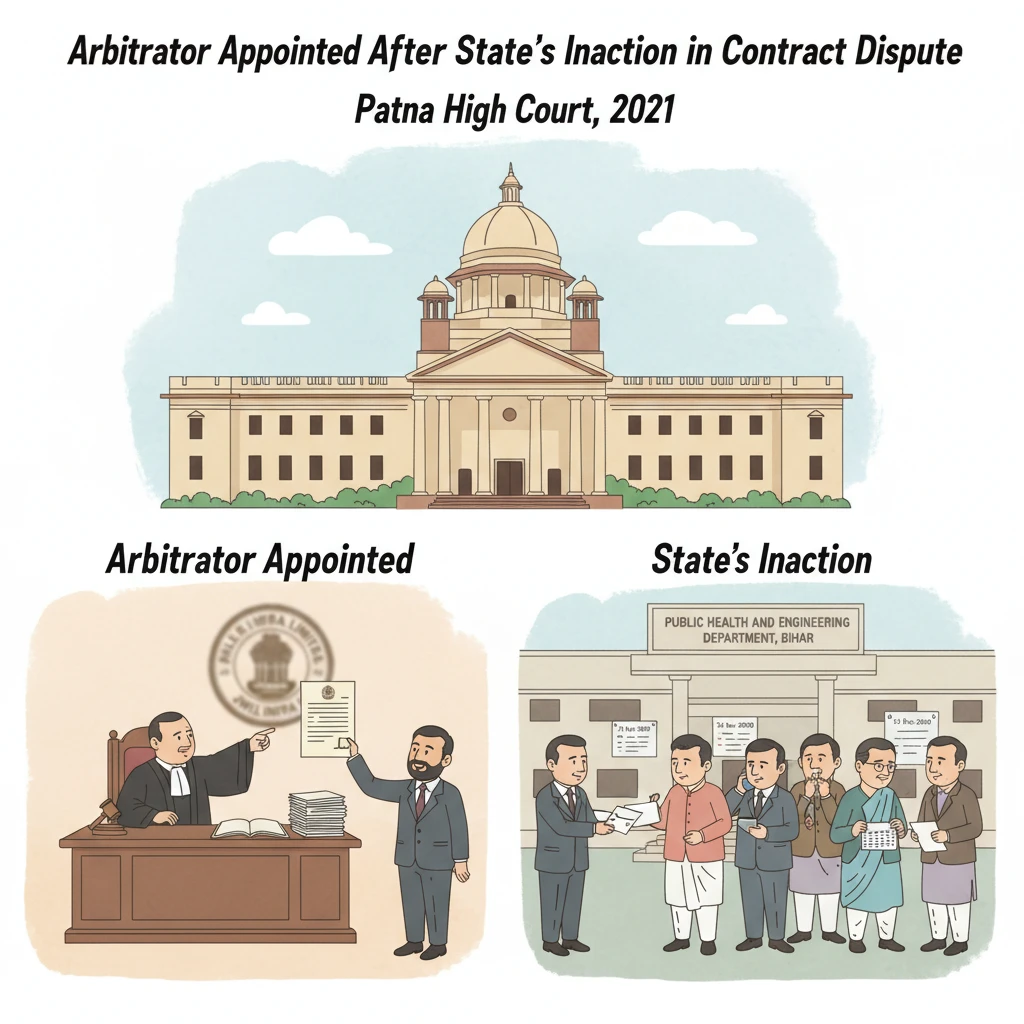
The Court found that the contract had a valid arbitration clause and that the contractor had properly invoked it.
Since the State did not appoint an Arbitrator in time, the Court stepped in and appointed a former Supreme Court Judge.
Now the dispute will be decided in arbitration, not in the High Court.
Case Background
The dispute arose from a written agreement dated 8 January 2011 between Jwil Infra Limited and the Public Health Engineering Department (PHED), Government of Bihar. The agreement contained Clause 25, which provided a step-by-step mechanism for resolving disputes through arbitration.
Over time, disputes developed between the contractor and the department. The judgment does not spell out the exact nature or amount of the claims, but it records that the disputes clearly arose from the 2011 agreement and were civil in nature.
On 24 February 2020, the contractor sent a written communication to the Chief Engineer, Public Health Engineering Department, Bhagalpur, Bihar. In this letter, the contractor asked the Chief Engineer to take a decision on its claim, referring to earlier communications. The contractor also made it clear that if no decision was taken, it would be treated as an invocation of the arbitration clause under Clause 25 of the agreement.
No one from the department responded to this communication. The record shows that some meetings did take place between the parties in an effort to resolve the dispute. However, these meetings did not lead to any settlement or decision.
After this failed effort, the contractor again wrote to the department on 24 December 2020. In this second communication, the contractor repeated its request and specifically invoked the arbitration clause. Even this letter did not receive any response from the State authorities.
Faced with silence and no appointment of an Arbitrator by the respondents, the contractor approached the Patna High Court. It filed Request Case No. 44 of 2021 under Section 11(6) of the Arbitration and Conciliation Act, 1996, asking the Court to appoint an Arbitrator.
On 15 September 2021, the Court recorded that Clause 25 of the agreement was the arbitration clause and that the contractor claimed to have exhausted the procedure and mechanism provided in it. The Court issued notice to the State respondents and gave them time to file a reply within two weeks, with a further two weeks for the contractor’s rejoinder, making it clear that no further opportunity would be given.
After considering the materials and the absence of any real dispute on key foundational facts, the Patna High Court proceeded to decide the request for appointment of an Arbitrator.
What the Court Examined and Decided
The Patna High Court, through Hon’ble the Chief Justice, examined whether it should exercise its power under Section 11(6) of the Arbitration and Conciliation Act, 1996 to appoint an Arbitrator.
First, the Court looked at the 8 January 2011 agreement between the contractor and the Public Health Engineering Department. Both sides accepted that this was a valid, binding written agreement. There was no allegation that the agreement itself was illegal or void.
Second, the Court considered Clause 25 of the agreement, which contained the arbitration clause and set out the procedure for resolving disputes. The contractor’s counsel had earlier drawn the Court’s attention to this clause. The Court recorded that this clause clearly provided a dispute redressal mechanism through arbitration.
The Court then noted that the mechanism in Clause 25 had been fully complied with and exhausted. The contractor had followed the process and waited for the authorities to act under the clause, but the authorities did not take the necessary steps to appoint an Arbitrator.
The Court specifically referred to the contractor’s communication dated 24 February 2020. In that letter, the contractor had asked the Chief Engineer, PHED, Bhagalpur, to take a decision on its claims as earlier communicated. The letter also stated that if no decision was taken, the contractor would deem the arbitration clause to have been invoked.
There was no response to this letter. Although the record showed that certain meetings were held between the parties for resolving the dispute, they did not bring about any effective solution.
Later, the contractor wrote again on 24 December 2020, reiterating its request and expressly invoking the arbitration clause. Once again, there was no response from the respondents. No Arbitrator was appointed by the State authorities despite the clear invocation of the arbitration clause.
Against this factual background, the Court listed a series of points on which there was no dispute between the parties:
(a) The written agreement dated 8 January 2011 was legal, valid and binding upon both sides.
(b) The agreement contained a valid arbitration clause.
(c) Disputes had arisen from the agreement.
(d) The disputes were civil in nature, meaning they could appropriately be decided in arbitration.
(e) There was no legal impediment to the disputes being adjudicated by an Arbitrator.
(f) The contractor had exhausted the dispute resolution process available under the agreement.
(g) Despite the contractor’s invocation of the arbitration clause, the respondents had failed to appoint an Arbitrator.
These points were crucial because, under Section 11(6) of the Arbitration and Conciliation Act, the High Court’s role is mainly to see whether there is a valid arbitration agreement, whether disputes covered by that agreement have arisen, and whether the party required to appoint an Arbitrator has failed to do so.
Since there was no dispute on these foundational aspects, the Court did not go into the merits of the underlying claims. It clarified that all pleas and issues on the merits of the dispute would remain open to be decided later by the Arbitrator.
On this basis, the Court proceeded to appoint an independent Arbitrator. It appointed Hon’ble Mr. Justice Navin Sinha, former Judge of the Supreme Court of India, as the sole Arbitrator to adjudicate all disputes arising from the 8 January 2011 agreement between the parties.
The Court directed that the learned Arbitrator would be entitled to fees as per the schedule under the Arbitration and Conciliation Act. Recognising that the dispute dated back to a 2011 agreement, the Court asked that the hearing be expedited.
The Court recorded the undertaking of both sides that they would fully cooperate in the arbitration proceedings and would not seek unnecessary adjournments. Keeping in view the Covid-19 pandemic, the Court also directed that the arbitration proceedings should be conducted through digital mode, unless the parties mutually agreed to hold physical hearings.
The Court expressed its expectation that the Arbitrator would decide the issues expeditiously. It directed the Joint Registrar (List) to communicate the order to the learned Arbitrator.
Counsel for both sides also undertook to communicate the order to the Arbitrator. They volunteered to appear before him, either physically or through digital mode, on 15 December 2021 to inform him of the Court’s order.
The Court further directed that the parties should file their statements of claim before the Arbitrator on the date of hearing fixed by him, as per mutual convenience. With these directions, the Patna High Court disposed of the Request Case and any pending interlocutory applications.
Why This Judgment Matters
This judgment shows that if a government department does not act on an arbitration clause in a contract, the Patna High Court can step in and appoint an Arbitrator.
For contractors and private parties dealing with government departments, it is important to see that the Court insisted on the basic conditions: a valid agreement, a clear arbitration clause, disputes arising under that agreement, and failure of the concerned authority to appoint an Arbitrator after proper notice.
Once these conditions were met and the State remained silent despite repeated communications, the Court ensured that the dispute would move forward through arbitration. This prevents one side, especially a government body, from blocking the resolution process simply by not responding.
The judgment also underlines that the High Court, when dealing with a request under Section 11(6), does not decide who is right or wrong in the underlying dispute. That job belongs to the Arbitrator. The Court only ensures that the arbitration process starts where the contract and law so require.
Finally, the directions for expedited hearing and the option for digital proceedings reflect the Court’s effort to move long-pending contractual disputes towards timely resolution, even during the Covid-19 pandemic.
Legal Issues and Answers
-
Issue: Whether the Patna High Court should appoint an Arbitrator under Section 11(6) of the Arbitration and Conciliation Act, 1996 for disputes arising from the 8 January 2011 agreement between the contractor and the Public Health Engineering Department.
Answer: Yes. The Court appointed Hon’ble Mr. Justice Navin Sinha, former Judge of the Supreme Court of India, as Arbitrator because there was a valid arbitration clause, disputes had arisen, the contractor had followed the contractual process, and the State failed to appoint an Arbitrator despite proper invocation of the clause.
Cases Cited by the Court
- The judgment does not record any other judicial precedents or case law being cited or relied upon.
Case Details
Case Number: Request Case No. 44 of 2021
Case Title: Jwil Infra Limited (Formerly JITF Water Infrastructure Ltd.) v. The State of Bihar & Ors.
Coram: Hon’ble the Chief Justice (Sanjay Karol, CJ)
Citation: 2022(1) PLJR 26
Date of Judgment: 24-11-2021
Advocates:
For the Petitioner: Mr. Anurag Saurav, Advocate
For the Respondents: Mr. S. Raza Ahmad, AAG-5; Mr. Alok Ranjan, Advocate
Nature of the Case: Request petition under Section 11(6) of the Arbitration and Conciliation Act, 1996 for appointment of an Arbitrator.
Link to the Judgment: Patna High Court Judgment in Request Case No. 44 of 2021
If you found this explanation helpful and wish to stay informed about how legal developments may affect your rights in Bihar, you may consider following Samvida Law Associates for more updates.







