

Case Background
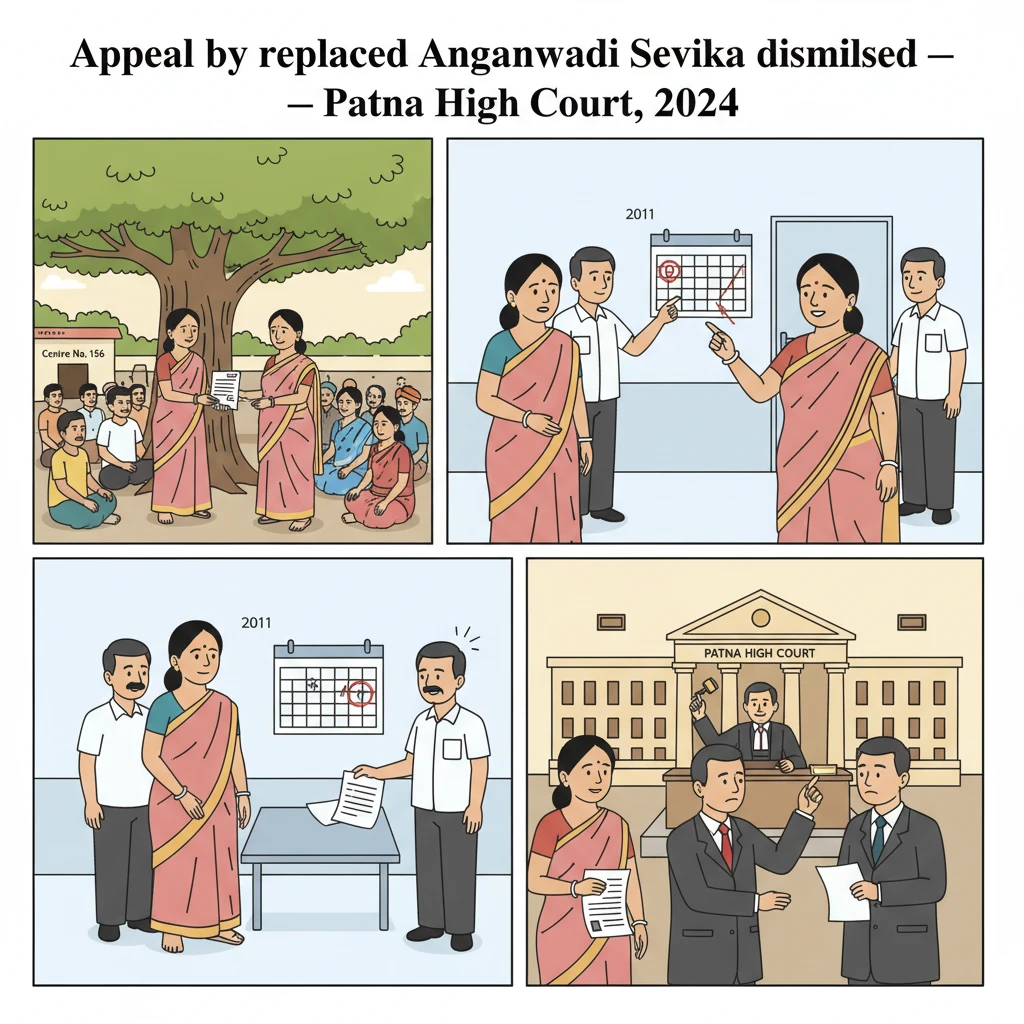
This case arises from an Anganwadi centre at Ward No. 15, Centre No. 156 in Mushahari, Muzaffarpur district, under the Integrated Child Development Services (ICDS) scheme.
Respondent no. 8 was working there as Anganwadi Sevika. She was found absent without any sanctioned leave from 27.02.2011 to 03.03.2011 during the Pulse Polio Vaccination Programme. The In-charge Medical Officer reported this to the District Programme Officer, Muzaffarpur.
An explanation was called from respondent no. 8. After that, her appointment as Anganwadi Sevika was cancelled. Feeling aggrieved, she filed an appeal before the District Magistrate, Muzaffarpur, which was registered as Appeal Case No. 15 of 2011-12.
While this appeal was pending, an Aam Sabha was held on 24.08.2016. In this Aam Sabha, the present appellant was selected as Anganwadi Sevika at the same Centre No. 156 and started working in that capacity.
Later, by order dated 17.11.2017, the District Magistrate allowed the appeal of respondent no. 8, set aside her earlier removal, and directed her reinstatement as Anganwadi Sevika at Centre No. 156. As a natural consequence, the appellant’s engagement at that centre came to an end.
The appellant submitted representations before the District Magistrate and the Commissioner, challenging this outcome, but received no relief. She then approached the Patna High Court by filing Civil Writ Jurisdiction Case (CWJC) No. 15130 of 2018, seeking to quash the District Magistrate’s order dated 17.11.2017 on the ground that it reappointed respondent no. 8 after more than seven years.
A learned Single Judge of the Patna High Court dismissed the writ petition by judgment dated 17.10.2022. The appellant then filed the present Letters Patent Appeal (LPA No. 668 of 2022) before a Division Bench.
There was a delay of 11 days in filing this appeal. The appellant filed Interlocutory Application (I.A.) No. 1 of 2023 seeking condonation of delay, which the Division Bench allowed before deciding the appeal on merits.
What the Court Examined and Decided
The Division Bench of the Patna High Court, comprising Hon’ble the Chief Justice and Hon’ble Mr. Justice Partha Sarthy (authoring the judgment), first considered the application for condoning the delay in filing the appeal.
The appellant claimed that she had been suffering from fever, cough, and cold from 14.11.2022 to 22.11.2022. According to her, she consulted her lawyer on 23.11.2022 after feeling better, and only thereafter could the appeal be filed.
The State opposed this, pointing out inconsistencies. The State’s counsel highlighted that, despite her claim of illness till 22.11.2022 and consultation with the lawyer only on 23.11.2022, the appellant had executed the vakalatnama on 21.11.2022 and requisition for a certified copy of the Single Judge’s order had been filed on 10.11.2022. It was argued that no medical documents had been produced, and that the statements in the delay petition were not accurate.
After hearing both sides and perusing the application, the Court was satisfied that sufficient cause for a short delay of 11 days had been made out. I.A. No. 1 of 2023 was allowed and the delay condoned.
Turning to the main appeal, the Bench examined the factual sequence and the appellant’s grievances against the order of the learned Single Judge.
The appellant’s core arguments were:
- Under the relevant Rules/Guidelines, appeals such as the one filed by respondent no. 8 should be decided within 30 days, but here the District Magistrate decided it after about seven years.
- By the time the appeal was decided, a fresh appointment had already been made in 2016 through Aam Sabha, in which the appellant was selected as Anganwadi Sevika, and this was not considered by the District Magistrate.
- The appellant was not impleaded as a party in the appeal filed by respondent no. 8 and therefore had no opportunity of being heard before an order was passed that removed her from the post. On this basis, she contended that the reinstatement of respondent no. 8 was unsustainable.
On the other side, learned counsel for the State supported the judgment. He submitted that there was no illegality in the District Magistrate’s order or in the Single Judge’s reasoning.
The State pointed out that respondent no. 8 had filed her appeal soon after her removal as Anganwadi Sevika in 2011 and that it was registered as Case No. 15 of 2011-12. It was undisputed that the appellant’s appointment in 2016 came later, during the pendency of this appeal. Once the appeal succeeded, respondent no. 8 was correctly reinstated on her original post at Centre No. 156.
The Division Bench then considered the material on record in detail. It noted that respondent no. 8 had been the original Anganwadi Sevika at the centre and had worked until her removal in 2011. She had exercised her right to challenge the removal by filing an appeal before the District Magistrate. While that appeal was pending, the appellant was selected in the Aam Sabha held on 24.08.2016 as Anganwadi Sevika for the same centre.
By order dated 17.11.2017, the District Magistrate allowed respondent no. 8’s appeal, set aside her removal, and reinstated her. As a natural fallout, the post reverted to the original Sevika and the appellant ceased to continue.
A key question before the Division Bench was whether the appellant, who came to occupy the post only because of the vacancy created by respondent no. 8’s removal, had any legal right to insist that she should have been heard in the appeal or that the decision could not dislodge her.
To answer this, the Court relied directly on the judgment of the Hon’ble Supreme Court in Poonam vs. State of Uttar Pradesh & Ors. [(2016) 2 SCC 779]. Paragraphs 48, 49 and 53 of that judgment were extensively quoted.
In Poonam, the Supreme Court had explained, through examples, that when an original holder of a post is removed and later challenges this removal, a person appointed in the meantime due to the vacancy is not a necessary or proper party to those proceedings.
The Supreme Court illustrated this by referring to cases of elected Sarpanch or Chairman under Panchayat laws. If a Sarpanch is removed and, during the challenge to that removal, another person is elected to fill the vacancy, the newly elected person is not a necessary party in the proceedings about the validity of removal. If the Sarpanch ultimately succeeds, he is entitled to be restored, and the later person cannot resist this.
In paragraph 49 of Poonam, the Court discussed a similar situation of a shop allotment. A shop fell vacant, a new allottee was given the shop, but the original allottee successfully challenged his cancellation in appeal. The Supreme Court held that the subsequent allottee was “neither a necessary nor a proper party”, had no locus standi to challenge the order in favour of the original allottee, and was merely a third party to the dispute.
In paragraph 53, the Supreme Court emphasised that the key question is whether there has been curtailment or extinction of an independent legal right of the subsequent person. It held that the subsequent allottee did not have an independent legal right; the original allottee’s right had only been eclipsed and, once the illegality was corrected, that right revived and could not be dented by a third party.
Applying this reasoning to the present case, the Patna High Court observed that respondent no. 8 was the original Anganwadi Sevika. Her appeal against removal was filed in 2011-12 and remained pending for no fault of hers. During that pendency, the appellant was appointed in 2016 because the post had fallen vacant due to respondent no. 8’s removal.
The Division Bench held that, just like the subsequent allottee in Poonam, the appellant’s appointment was only a result of the vacancy created by the earlier, now-corrected removal. She did not have an independent, superior legal right to the post as against respondent no. 8.
Therefore, in the appeal proceedings before the District Magistrate, which concerned only the legality of respondent no. 8’s removal, the appellant had no right or locus to be made a party or to be heard. The Court described her, again following the Supreme Court’s language, as “merely a third party to the lis in that context.”
The Bench also noted that the appeal remained pending for a long time, but there was no material to show that this delay was attributable to respondent no. 8. The Court did not hold that the belated decision of the appeal, by itself, could defeat the original Sevika’s right to reinstatement once the removal was found unjustified.
Consequently, the Court found no fault with the District Magistrate’s order reinstating respondent no. 8 and no error in the learned Single Judge’s dismissal of the writ petition. The Division Bench concluded that there was no merit in the Letters Patent Appeal and dismissed it.
Why This Judgment Matters
This judgment has important practical implications for Anganwadi workers and others holding similar local posts in Bihar.
First, it clarifies that when an original worker is removed and later succeeds in an appeal against that removal, she is entitled to get her post back. Any person appointed later against that vacancy cannot claim a stronger right to stay on the post once the original illegality is corrected.
Second, it reinforces that a later appointee, whose appointment is only because of the vacancy created by someone else’s disputed removal, is treated as a “third party” in law. Such a person usually does not have a right to be included in or to challenge the original removal proceedings.
Third, for many women serving as Anganwadi Sevikas and Sahayikas, this decision from the Patna High Court shows that appeals against wrongful removal can still succeed even if they take time to be decided, and that later appointments cannot permanently defeat their earlier rights.
At the same time, those who are appointed on posts already under dispute should be aware that their continuation is always subject to the outcome of the pending case. Their service is not treated as creating an independent and permanent legal right if the original worker is later found to have been wrongly removed.
Legal Issues and Answers
- Issue: Whether the appellant, appointed as Anganwadi Sevika in 2016 against a vacancy created by the removal of respondent no. 8, had a right to challenge the District Magistrate’s 2017 order allowing respondent no. 8’s earlier appeal and reinstating her.
Answer: No. The Court held that the appellant had no independent legal right or locus in the appeal against respondent no. 8’s removal and was merely a third party to that dispute. Once the removal was set aside, respondent no. 8’s right to the post revived and could not be defeated by the appellant’s later appointment. - Issue: Whether the delay of several years in deciding respondent no. 8’s appeal before the District Magistrate, and the fact that the appellant had been appointed during this period, could invalidate the reinstatement order.
Answer: No. The Court noted that the appeal had been filed promptly in 2011-12 and remained pending for no fault of respondent no. 8. The later appointment of the appellant, arising out of the disputed vacancy, could not override the original Sevika’s reinstated right. - Issue: Whether the 11-day delay in filing the Letters Patent Appeal should bar consideration of the appellant’s case on merits.
Answer: No. The Division Bench accepted the explanation offered by the appellant, condoned the delay, allowed I.A. No. 1 of 2023, and proceeded to decide the appeal on merits, ultimately dismissing it.
Cases Cited by the Court
- Poonam vs. State of Uttar Pradesh & Ors. [(2016) 2 SCC 779] – relied upon to hold that a person appointed because of a vacancy created by another’s removal is a third party to the dispute over that removal and has no independent locus.
Case Details
Case Number: Letters Patent Appeal No. 668 of 2022 in Civil Writ Jurisdiction Case No. 15130 of 2018
Case Title: Minu Kumari @ Minu Kumari Devi vs. The State of Bihar & Ors.
Citation: 2024 (4) PLJR 513
Court: High Court of Judicature at Patna
Coram: Hon’ble the Chief Justice K. Vinod Chandran, Hon’ble Mr. Justice Partha Sarthy
Date of Judgment: 04.10.2024
Advocates: Mr. Arun Kumar Tiwary, Advocate for the appellant; Mr. Gyan Prakash Ojha (GA-7) for the respondents/State of Bihar
Nature of the Case: Letters Patent Appeal (intra-court appeal) against the judgment dated 17.10.2022 passed in a writ petition (CWJC No. 15130 of 2018) concerning appointment and reinstatement of Anganwadi Sevika under ICDS.
Link to Judgment: Click here to access the full judgment on the Patna High Court website
If you found this explanation helpful and wish to stay informed about
how legal developments may affect your rights in Bihar,
you may consider following Samvida Law Associates for more updates.







