
Case Background
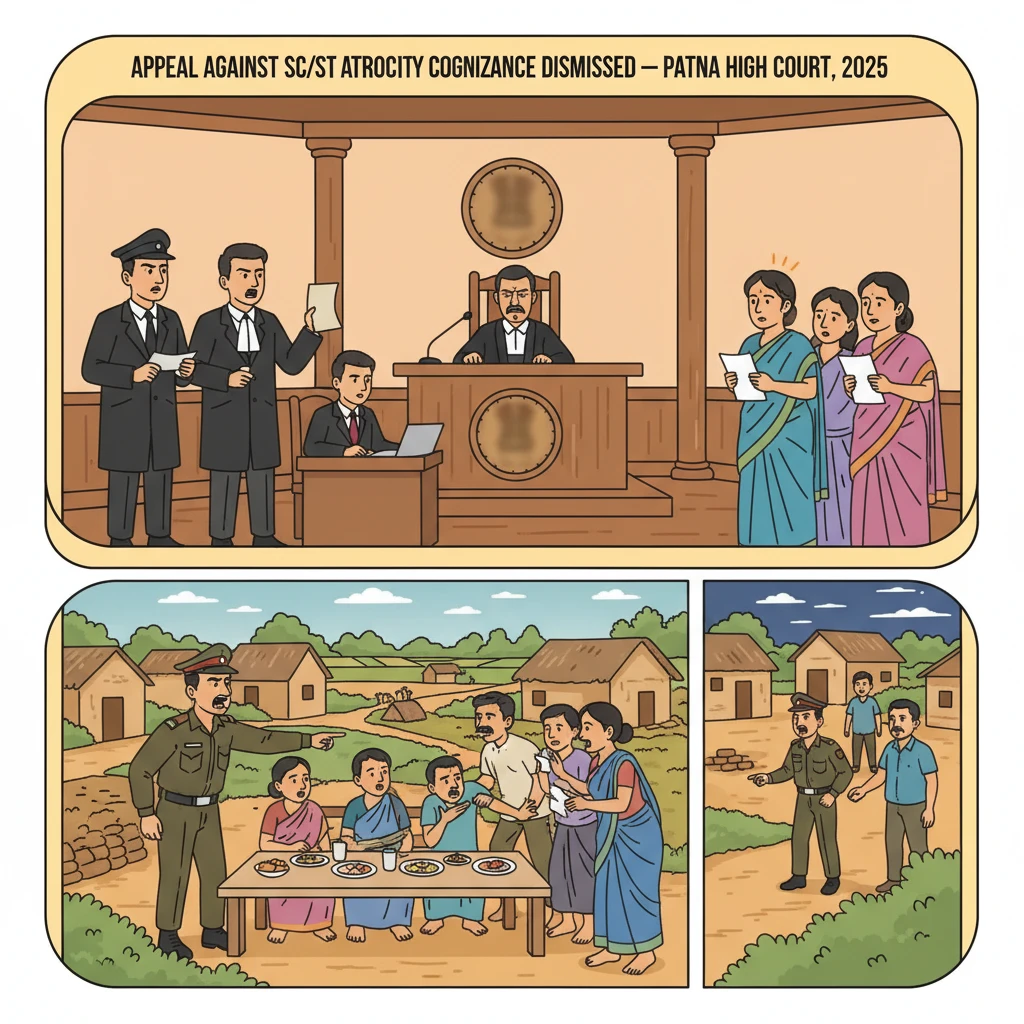
The case arose from a village dispute linked to a social function in Gaya district. According to the prosecution, the incident took place on 05.06.2021 during the tilak ceremony of the son of one Vinod Mistry. The informant, who belongs to a Scheduled Caste community, alleged that he and his family were invited to the function and were sitting at the feast.
It was alleged that during the feast, the appellant came and abused the informant and his family members and made them get up from the dining arrangement. When the informant protested, he and his cousin brother Niraj were allegedly abused and assaulted. The informant and his cousin then fled from the place to save their lives.
The informant further alleged that after this, the appellant, along with co-accused Haridwar Yadav and Mantu Yadav, went to the house of the informant’s cousin brother and again abused and assaulted the informant and his family members.
On the basis of the written statement submitted by the informant before the Station House Officer of Magadh University, Bodh Gaya Police Station, Magadh University P.S. Case No. 71 of 2021 was registered on 10.06.2021. The FIR mentioned offences punishable under Sections 341, 323, 504/34 of the Indian Penal Code and Section 3(1)(r)(s) of the Scheduled Castes and Scheduled Tribes (Prevention of Atrocities) Act.
After investigation, the police submitted charge sheet against the appellant and others under Sections 341, 323, 504, 34 of the IPC and Section 3(1)(r)(s) / 3(2)(va) of the SC/ST Act. The Special Judge, SC/ST Court, Gaya, in Tr. No. 378 of 2023, by order dated 18.07.2023, took cognizance of these offences against the appellant and two others.
The appellant then filed Criminal Appeal (SJ) No. 474 of 2024 before the Patna High Court, challenging the order of cognizance dated 18.07.2023 passed by the Special Judge, SC/ST Court, Gaya.
What the Court Examined and Decided
The appeal came up before Hon’ble Mr. Justice Alok Kumar Pandey of the Patna High Court. Both sides were heard. The central question was whether the Special Judge had wrongly taken cognizance against the appellant on the basis of the materials in the case diary and charge sheet.
The learned counsel for the appellant argued that the appellant was innocent and not at all connected with the alleged incident. It was submitted that the appellant is a personnel of the Indian Army and was posted in Gujarat, and he would only occasionally visit his native village. On this basis, the defence tried to suggest that his presence at the time of occurrence was doubtful.
The appellant’s counsel also argued that there was village-level political rivalry. It was stated that the appellant’s family had political rivalry with the winning candidates of Mukhiya and Ward Member and, due to this “dirty village politics”, the appellant was falsely implicated in the case.
Another major plank of the appellant’s case was the delay in lodging the FIR. The alleged incident occurred on 05.06.2021, while the FIR was registered on 10.06.2021, showing a delay of five days. The appellant’s counsel argued that no plausible explanation had been given for this delay, and this cast doubt on the prosecution story.
The appellant’s counsel further submitted that there was no independent eyewitness to the occurrence except the informant and his family members. These persons were described as “interested witnesses”, and on that basis, the appellant claimed that the case was not trustworthy.
On the provisions of the SC/ST Act, the appellant’s counsel stressed that the FIR did not contain any specific abusive words that indicated the caste name of the informant. It was argued that the allegations were bald and general, without mention of any caste-related slur. On this basis, the appellant contended that no offence under the SC/ST (Prevention of Atrocities) Act was made out against him.
It was further argued that the Investigating Officer, with ulterior motives and vested interest, submitted the charge sheet without proper examination of the legal requirements of the SC/ST Act. According to the appellant, the trial court had accepted the charge sheet mechanically, without application of mind, and took cognizance without any specific material against him. Therefore, the order dated 18.07.2023 was said to be unjustified, illegal, and fit to be set aside.
On the other hand, the learned counsel for the State and for respondent no. 2 (the informant) opposed the appeal. They pointed out that the appellant and the informant were residents of the same village, and the appellant was well aware of the caste of the informant and his family members.
They highlighted the allegation that at the tilak feast, the appellant abused the informant and his family members and forced them to get up from the feast. The appellant also allegedly used abusive language against the informant’s cousin brother. The State and the informant’s counsel submitted that the reason why the appellant singled out and segregated the informant and his family from others at the feast could be understood in the background of their Scheduled Caste status.
They argued that, in this way, the appellant knowingly instructed the informant and his family members not to have the feast in the tilak ceremony because they belonged to a particular community (Scheduled Caste). This, they submitted, attracted the provisions of Section 3(1)(r)(s) and 3(2)(va) of the SC/ST Act, along with the IPC sections.
The counsel for the State and the informant further submitted that the FIR had been registered for the relevant IPC sections and SC/ST Act provisions, and that the charge sheet clearly named the appellant and co-accused in column 11. They pointed out that the trial court, while taking cognizance, had referred to the re-statement of the informant and the statements recorded in paragraphs 6 to 12 of the case diary.
This included the statement of witness Prince Kumar at paragraph 6 of the case diary. The High Court quoted this statement, where Prince Kumar stated, in substance, that during the tilak ceremony of Vinod Mistry’s son, about 30–40 persons were sitting in the feast, and they were also given plates and food items. However, according to him, the appellant (Arun Yadav) said that “we people” were from a Scheduled Caste and therefore got them removed from the feast and started abusing them. When they protested, the appellant assaulted Niraj.
The High Court also noted that several witnesses—namely, Madheshwar Paswan, Fulwa Devi, Mamta Devi, Kundan Manjhi, Tanu Paswan, and Gariban Paswan—whose statements were recorded in paragraphs 7 to 12 of the case diary, supported the version of witness Prince Kumar.
From these materials, the High Court observed that there was sufficient material on record to justify the Special Judge taking cognizance against the appellant.
To underline the limited scope of interference at the stage of cognizance, the Patna High Court relied on the Supreme Court judgment in Sonu Gupta vs. Deepak Gupta and Others, reported in (2015) 3 SCC 424. In paragraph 8 of that decision, the Supreme Court clarified that at the stage of cognizance and summoning, the Magistrate needs only to see whether a prima facie case is made out. The Magistrate is not required at that stage to consider the defence version, evaluate the merits of the evidence, or decide whether the materials will lead to conviction.
Applying this principle, the High Court held that the Special Judge, SC/ST Court, Gaya, had applied his mind properly. The Special Judge considered the charge sheet, the naming of the appellant in column 11, the re-statement of the informant, and the statements of witnesses recorded in the case diary. On that basis, the Special Judge found a prima facie case and took cognizance for the offences under Sections 341, 323, 504/34 of the IPC and Section 3(1)(r)(s) / 3(2)(va) of the SC/ST Act.
The Patna High Court concluded that the order dated 18.07.2023 had been passed with due application of mind and on the basis of sufficient material. Therefore, it refused to interfere with the cognizance order.
Considering the accusations in the FIR and the material collected during investigation, the Court held that a prima facie case was made out against the appellant. As a result, the criminal appeal was dismissed at the stage of admission itself.
The Court, however, added that if the appellant has any grievance, he may raise it at the appropriate stage in the trial court, thereby keeping open all legal defences for the subsequent stages of the criminal process.
Why This Judgment Matters
This judgment is important for both accused persons and victims under the SC/ST (Prevention of Atrocities) Act. The Patna High Court has made it clear that at the stage of taking cognizance, the trial court only needs to see whether there is a prima facie case based on the FIR, charge sheet, and case diary statements.
Claims like delay in lodging FIR, political rivalry, or absence of independent witnesses are matters which can be tested during trial. They are not grounds, by themselves, to quash cognizance when there are supporting witness statements.
For members of Scheduled Caste communities, the judgment shows that if there are statements in the case diary showing that they were segregated, abused, and assaulted on account of their caste during social functions, the courts will allow the case to go to trial under the SC/ST Act.
For accused persons, it is a reminder that challenges to the merits of the case, including alibi or false implication due to politics, are generally to be raised at later stages—such as discharge, framing of charge, or trial—not at the initial cognizance stage.
Legal Issues and Answers
- Issue: Whether the order dated 18.07.2023 taking cognizance against the appellant under IPC and SC/ST Act provisions, based on Magadh University P.S. Case No. 71 of 2021, was illegal or without proper application of mind.
Answer: No. The Patna High Court held that the Special Judge had applied his mind to the charge sheet and case diary, found sufficient prima facie material, and validly took cognizance. The High Court refused to interfere and dismissed the appeal at the admission stage.
Cases Cited by the Court
- Sonu Gupta vs. Deepak Gupta and Others, (2015) 3 SCC 424 – relied upon to clarify that at the stage of cognizance and summoning, the court only examines whether a prima facie case exists and does not consider the defence version or assess whether the materials will lead to conviction.
Case Details
Case Number: Criminal Appeal (SJ) No. 474 of 2024; arising out of Magadh University P.S. Case No. 71 of 2021, District Gaya
Case Title: Arun Yadav @ Arun Kumar vs. The State of Bihar & Anr.
Coram: Hon’ble Mr. Justice Alok Kumar Pandey
Citation: 2025 (4) PLJR 393
Advocates:
- For the Appellant: Mr. Shailesh Kumar, Advocate
- For the State: Mr. Binay Krishna, Special Public Prosecutor
- For Respondent No. 2: Mr. Munish Kumar, Advocate; Ms. Minakshi Kumari, Advocate; Mr. Gaurav Kumar, Advocate
Nature of the Case: Criminal appeal (single judge) challenging an order of cognizance passed by the Special Judge, SC/ST Court, Gaya, in a case involving offences under the IPC and the Scheduled Castes and Scheduled Tribes (Prevention of Atrocities) Act.
Link to Judgment: Click here to read the full judgment of the Patna High Court
If you found this explanation helpful and wish to stay informed about
how legal developments may affect your rights in Bihar,
you may consider following Samvida Law Associates for more updates.







