

Case Background
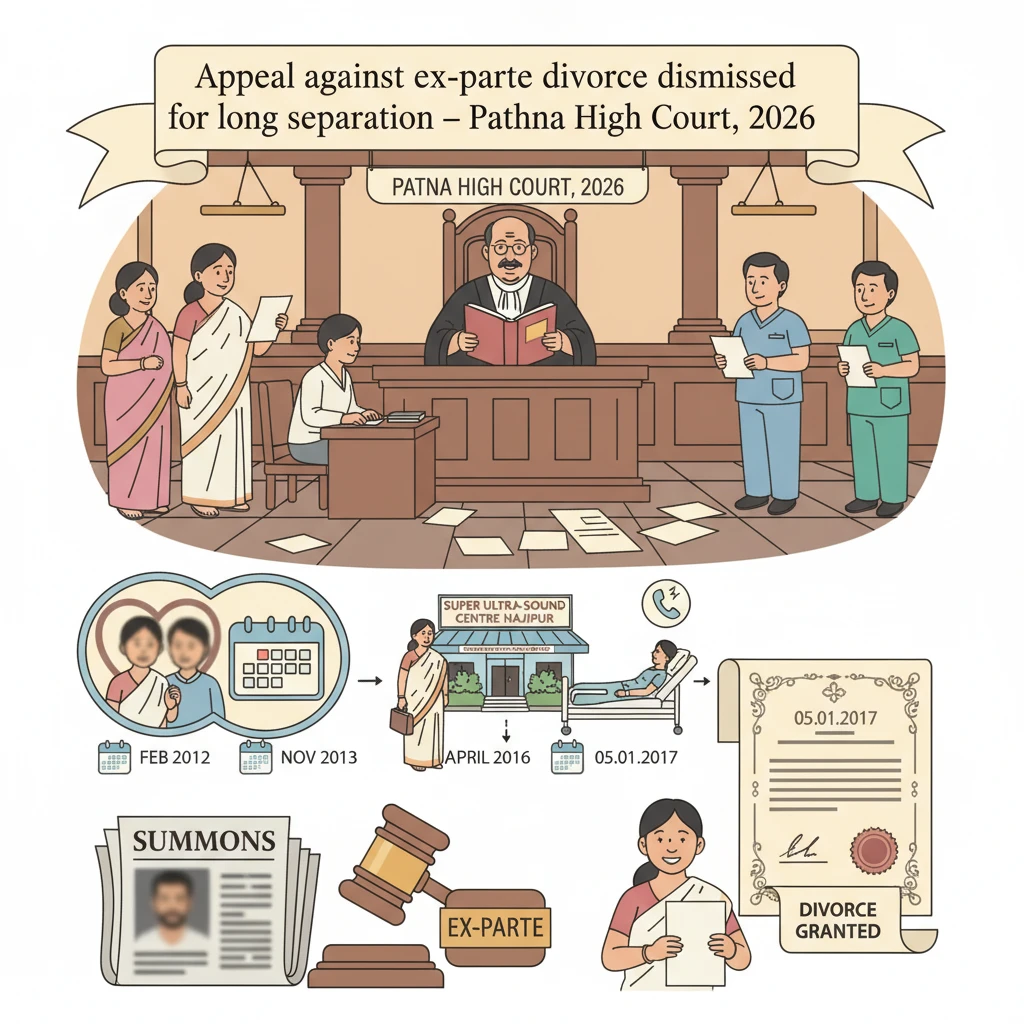
The marriage between the husband (appellant) and the wife (respondent) was a love marriage. It was solemnised on 08.02.2012 at Mumbai according to Hindu rites and customs, after they came into contact while studying in Melbourne, Australia. Their families later consented to the match.
After marriage, the couple lived together as husband and wife and the marriage was consummated. No child was born from the wedlock. In 2013, with the consent of the husband, the wife, a qualified medical professional, went to Ahmedabad to pursue higher studies in Radiology.
According to the wife, during this period the husband’s behaviour changed. She alleged that he started neglecting her, stopped proper communication and behaved indifferently. In November 2013, she suffered from a serious bone tumour, was hospitalised in Mumbai and, as per her case, the husband did not provide care or support at that critical time.
The wife further alleged that the husband developed an illicit relationship with another woman, abused her and her mother, and finally refused to cohabit or perform his marital obligations. She stated that he deserted her from February 2014 and clearly said he did not wish to continue the marriage.
Despite her efforts to restore the relationship, the wife stated that the husband did not respond and did not even make a phone call for a long period. Due to continued neglect, alleged cruelty and desertion, and her own poor health, she took up a job as a radiologist at Super Ultra-sound Centre, Hajipur, Vaishali, Bihar in April 2016.
In these circumstances, she filed a petition before the Principal Judge, Family Court, Vaishali at Hajipur under the Hindu Marriage Act, 1955 seeking dissolution of marriage, mainly on the ground of desertion under Section 13(1)(ib).
Summons were issued to the husband through ordinary process and then by substituted service. He did not appear, did not file any written statement and did not lead evidence. The Family Court proceeded ex-parte.
On the basis of the pleadings and submissions of the wife, the Family Court framed a single issue: whether the petitioner-wife was entitled to a decree of divorce from the opposite party-husband.
The wife examined herself as P.W.-1 and also produced four supporting witnesses: her mother (P.W.-2), her paternal aunt (P.W.-3), her landlord at Hajipur (P.W.-4) and an employee of the Hajipur ultrasound centre (P.W.-5). On 05.01.2017, the Family Court allowed the divorce petition ex-parte, and by decree dated 19.01.2017, dissolved the marriage.
Aggrieved, the husband filed the present Miscellaneous Appeal No. 437 of 2021 under Section 19 of the Family Courts Act, 1984 before the Patna High Court on 20.07.2021, challenging the ex-parte judgment and decree of divorce.
What the Court Examined and Decided
The appeal was heard by a Division Bench of Hon’ble Mr. Justice Nani Tagia and Hon’ble Mr. Justice Sunil Dutta Mishra. The judgment was authored by Hon’ble Mr. Justice Sunil Dutta Mishra and delivered on 06.02.2026.
The husband’s counsel attacked the Family Court decree on several grounds. First, he argued that the summons were not properly served. According to him, the husband was residing at Kolkata, but the wife had given a Mumbai address, leading to service at a place where he did not reside. He submitted that even the substituted service was based on this wrong address and, therefore, the entire ex-parte proceeding stood vitiated.
Second, counsel for the husband alleged suppression of material facts by the wife. He pointed out that other civil suits between the parties were pending, and that a subsequent settlement had been reached where both parties allegedly agreed that there was no cruelty and that they would seek divorce by mutual consent.
In this context, the husband relied on a consent term dated 21.12.2016 in Spl. Suit No.118 of 2016 (Nandita and Anr. v. Vishal Gupta). As per those consent terms, the parties had mutually agreed to obtain a decree of divorce, treated the consent terms as their consent for such a decree, and the wife had confirmed that she had no claim of any nature, including maintenance, against the husband. Both sides agreed to withdraw allegations against each other. The grievance of the husband was that the wife did not disclose this consent term before the Family Court.
Third, the husband argued that the allegations of cruelty were vague and not proved by cogent evidence, and that the Family Court had relied only on one-sided and untested statements. He also submitted that the divorce petition was specifically filed under Section 13(1)(ib) for desertion, but the Family Court treated the same facts as cruelty and granted divorce on both desertion and cruelty, even though Section 13(1)(ia) was not mentioned in the petition. On these bases, he sought setting aside of the ex-parte decree.
On the other hand, the wife’s counsel supported the Family Court’s judgment. He submitted that the Court had properly appreciated the evidence and material on record and rightly granted divorce. He also brought to the notice of the High Court that, after the decree of divorce, the wife had already remarried on 08.12.2017, had been blessed with a child, and was settled abroad with her family.
Regarding the allegation of improper service, the wife’s counsel submitted that summons were duly served and paper publication was done as per law. The husband, according to him, deliberately chose not to appear and the Family Court proceeded ex-parte only after being satisfied that service was proper.
On the legal point about non-mention of Section 13(1)(ia), he argued that non-mentioning a particular provision does not take away the jurisdiction of a court when it otherwise has jurisdiction in law. In this case, the pleadings and evidence clearly contained allegations and proof of cruelty. Therefore, the Family Court could consider cruelty as a ground.
The wife’s counsel also pointed out that she was settled in life and did not seek any permanent alimony from the husband.
After hearing both sides, the Patna High Court framed the core question: whether the divorce decree granted by the Family Court required interference in the facts and circumstances of the case.
The Bench then discussed the law on desertion under Section 13(1)(ib) of the Hindu Marriage Act. The Court explained that living together is the essence of marriage, and living apart is its negation. Desertion means total abandonment of matrimonial obligations, involving separation, intention to permanently desert, absence of reasonable cause, lack of consent of the other spouse and continuation of such separation for two years before filing the petition.
The Court clarified that desertion is not just leaving a place but walking away from the marital relationship itself. It is a continuing course of conduct, completed only when the statutory period runs out and a petition is filed. If the deserter returns before that period, desertion ends.
The Court then turned to mental cruelty. It relied on the Supreme Court decision in Rakesh Raman v. Kavita, (2023) 17 SCC 433. Quoting from Samar Ghosh v. Jaya Ghosh (2007) 4 SCC 511, it noted that long separation, absence of cohabitation, and complete breakdown of meaningful bonds with bitterness between parties can amount to mental cruelty under Section 13(1)(ia).
The Court also cited the Supreme Court’s decision in Amutha v. A.R. Subramanian, 2024 SCC OnLine SC 3822, where it was emphasised that in matrimonial disputes, courts should prioritise the welfare and dignity of both parties and that forcing an unhappy and conflict-ridden marriage to continue undermines the very purpose of marriage.
Applying these principles, the Patna High Court examined the record. It found no illegality, perversity or material irregularity in the ex-parte judgment and decree of the Family Court. The Bench held that the husband had been given sufficient opportunities to appear and contest, and that the Family Court had gone ex-parte only after being satisfied about proper service.
On the factual side, the Court noted that the marriage was in 2012 and the couple lived together only for about six months. Thereafter, their conjugal relationship snapped and there was no child from the marriage. The wife filed the divorce case in 2016. Considering the conduct of the husband, his desertion for a long period, and the evidence of cruelty, the Family Court had rightly granted divorce.
The High Court also recognised that both parties had been living separately for a long time. In such a situation, the Court observed, forcing a dead marriage to continue serves no purpose and undermines the very institution of marriage. Rather, the interest of both husband and wife is better served by allowing them to move on independently.
Importantly, the Court took note of subsequent developments: the wife had remarried on 08.12.2017 and had a child from the second marriage. Both spouses were well educated and settled in their lives. The consent term dated 21.12.2016 also showed that they had already decided to take divorce. The Court observed that their marriage had completely broken down beyond repair and any attempt to continue it would itself amount to cruelty to both sides.
In these circumstances, the Bench held that there was no reason to interfere with the Family Court’s decree of divorce. The husband’s appeal was dismissed, the divorce was upheld, and pending interlocutory applications were disposed of, with no order as to costs.
Why This Judgment Matters
This judgment is important for couples stuck in long-term separation where one spouse challenges an ex-parte divorce after many years. The Patna High Court made it clear that when both parties have been living apart for a long time and the marriage is practically dead, courts will be slow to disturb a well-considered divorce decree.
The decision shows that if a spouse ignores court summons and does not participate in proceedings, it becomes very difficult later to attack the decree only on technical grounds. The Court also affirmed that desertion for a long period, combined with lack of cohabitation and total breakdown of the relationship, can be treated as mental cruelty.
For many individuals, especially women who rebuild their lives after divorce, this judgment offers reassurance that their subsequent marriage and settled life will be protected against belated challenges, so long as the earlier decree was passed after proper service and legal procedure.
Legal Issues and Answers
-
Issue: Should the Patna High Court interfere with an ex-parte decree of divorce granted by the Family Court on grounds of desertion and cruelty?
Answer: No. The Court held that summons had been properly served, the husband chose not to appear, the Family Court correctly appreciated the evidence of long desertion and cruelty, and subsequent developments showed complete breakdown of marriage, so the decree of divorce was rightly granted. -
Issue: Does non-mention of Section 13(1)(ia) (cruelty) in the divorce petition bar the Court from granting divorce on cruelty when facts and evidence show cruelty?
Answer: No. The Court held that non-mention of a specific provision does not take away the court’s jurisdiction where it otherwise exists and where there are pleadings and evidence to support cruelty. -
Issue: Can long separation and absence of cohabitation amount to mental cruelty justifying divorce?
Answer: Yes. Relying on Supreme Court decisions, the Court held that a long period of continuous separation and complete breakdown of meaningful marital ties can constitute mental cruelty under Section 13(1)(ia).
Cases Cited by the Court
- Rakesh Raman v. Kavita, (2023) 17 SCC 433
- Samar Ghosh v. Jaya Ghosh, (2007) 4 SCC 511 (quoted within Rakesh Raman v. Kavita)
- Amutha v. A.R. Subramanian, 2024 SCC OnLine SC 3822
Case Details
Case Number: Miscellaneous Appeal No. 437 of 2021
Case Title: Vishal Gupta v. Nandita
Coram: Hon’ble Mr. Justice Nani Tagia; Hon’ble Mr. Justice Sunil Dutta Mishra
Citation: 2026(2) PLJR 317
Advocates: Mr. Rajani Kant Mishra, Advocate for the appellant-husband; Ms. Sakshi Bhatnagar, Advocate for the respondent-wife
Nature of the Case: Miscellaneous appeal under Section 19 of the Family Courts Act, 1984, challenging an ex-parte divorce decree passed by the Principal Judge, Family Court, Vaishali at Hajipur in Divorce Case No. 263 of 2016.
Link to Judgment: Click here to read the full judgment of the Patna High Court
If you found this explanation helpful and wish to stay informed about
how legal developments may affect your rights in Bihar,
you may consider following Samvida Law Associates for more updates.







