

Case Background
The matter before the Patna High Court was a Letters Patent Appeal (L.P.A. No. 1860 of 2012). It arose out of a judgment dated 10.09.2012 passed by a learned Single Judge in Civil Writ Jurisdiction Case No. 12771 of 2010.
The appellant was serving as a Sub-Inspector in the Central Reserve Police Force (CRPF). He had been dismissed from service by order dated 19.02.2007 passed by the Deputy Inspector General, CRPF, Patna.
Against this dismissal, he had availed departmental remedies. An appellate order dated 18.03.2009 and a revisional order dated 15.04.2010 confirmed the dismissal. The appellant then filed a writ petition before the Patna High Court challenging all three orders. The learned Single Judge dismissed the writ petition by judgment dated 10.09.2012.
Aggrieved by that decision, the appellant approached a Division Bench through this Letters Patent Appeal, again questioning the validity of the dismissal and the departmental proceedings leading to it.
What the Court Examined and Decided
The Division Bench, speaking through Hon’ble Mr. Justice Rajan Gupta with Hon’ble Mr. Justice Mohit Kumar Shah agreeing, focused on one central contention raised on behalf of the appellant.
The only argument pressed before the Bench was that the departmental enquiry was conducted ex parte, allegedly behind the back of the appellant. On this basis, it was argued that he had not been given adequate opportunity of defence, making the dismissal order dated 19.02.2007 and the subsequent appellate and revisional orders bad in law.
On the other side, counsel for the Union of India and CRPF disputed this narrative. They relied heavily on detailed findings already recorded by the learned Single Judge, particularly in paragraphs 8 to 12 of the judgment dated 10.09.2012.
Those paragraphs, which the Division Bench reproduced in full, show the sequence of steps taken by the department during the enquiry.
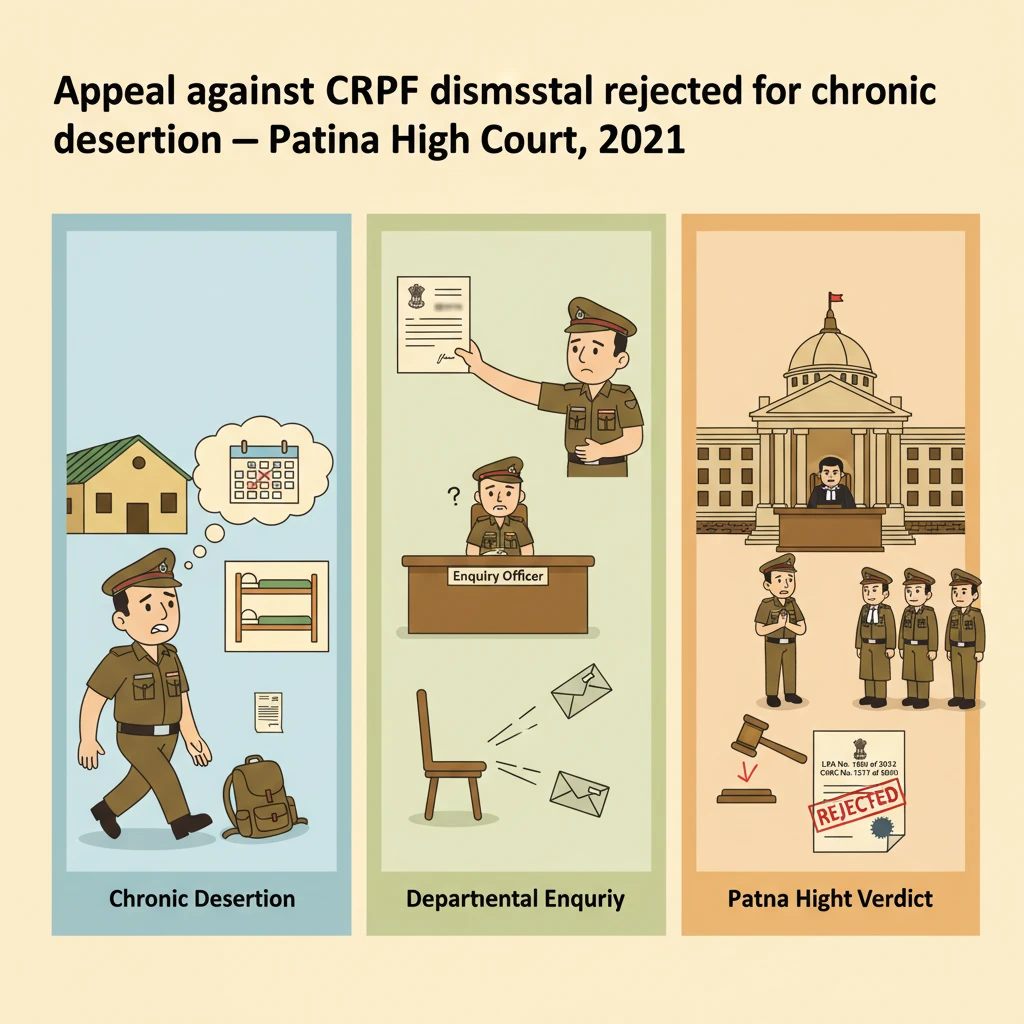
According to those findings, a memorandum of charges, along with the statement of articles of charge, imputation of misconduct, list of documents and list of witnesses, was sent to the Commandant, 4th Battalion, CRPF. These documents were handed over to the appellant on 06.10.2005.
The appellant was required to submit his written statement within a stipulated period. When no representation was received, the Commandant was appointed as Enquiry Officer by order dated 23.11.2005 to conduct the departmental enquiry.
The enquiry was fixed to start on 16.12.2005. The record, as summarised by the learned Single Judge, shows that the appellant initially appeared before the Enquiry Officer. However, his plea of “guilty” or “not guilty” could not be recorded because the appellant had already left the campus on 13.12.2005, before the scheduled start of the enquiry.
In response to his sudden absence, the Enquiry Officer sent a registered letter to the appellant on 20.12.2005, directing him to report on 02.01.2006 so that the enquiry could be completed in time. Even after receiving the letter, the appellant neither reported nor sent any communication.
When there was still no response, another letter dated 21.03.2006 was sent to the appellant at his home address, again directing him to report before the Enquiry Officer. Despite this second opportunity, he did not appear and did not send any communication.
Faced with this non-cooperation, the Enquiry Officer decided to proceed ex parte. The prosecution side produced its witnesses in the absence of the appellant. Statements of these witnesses were recorded. Importantly, copies of each witness statement were sent to the appellant at his home address by registered post.
Only after completing this process, and after giving repeated written opportunities to the appellant to appear and participate, did the Enquiry Officer proceed to finalise the enquiry report. The learned Single Judge had held that, in these circumstances, the Enquiry Officer was justified in concluding his findings and submitting the report ex parte.
Regarding the procedural rule (referred to as Rule 31) that the appellant had invoked, the learned Single Judge had accepted that it should ordinarily be followed in normal circumstances. However, in this case, since the appellant had initially appeared before the Enquiry Officer and never raised any objection then, and subsequently remained absent, the Enquiry Officer was compelled to continue ex parte. No objection on this ground was raised either before the Enquiry Officer or before the Disciplinary Authority.
The Single Judge also recorded the factual context described by the department. The appellant, being an officer of a disciplined force, had remained absent without authority for 86 days on the first occasion and 58 days on the second occasion. Further, on 16.05.2005, he again deserted his post, this time without even depositing the arms and ammunition drawn by him from the battalion.
These arms and ammunition were later recovered by the Company Commander from the appellant’s bedding and then deposited. The authorities termed this pattern as chronic desertion.
In light of these circumstances, the enquiry officer was appointed and, according to the findings recorded in the Single Judge’s order, conducted the matter properly, taking all required steps: sending copies of the charge memorandum and witness lists, and giving the appellant multiple chances to state whether he was guilty or not guilty and to present his defence.
The explanation given by the appellant in response to the charges was considered “at length” by the authorities and was found to be “absolutely frivolous and misleading,” especially given that he was found to be a chronic deserter. The view taken was that repeated desertions without valid rhyme or reason could not be tolerated in a force like CRPF.
On this basis, the learned Single Judge had concluded that the punishment imposed on the appellant was legal, justified and proper. The appellate and revisional authorities had also examined the matter in detail, addressed the points raised by the appellant and reached a specific conclusion that the charges against him stood established. They found the charges to be grave and the penalty commensurate with the gravity of the offence.
When the Letters Patent Appeal came up, the Division Bench examined the record and these findings. It noted that learned counsel for the appellant had failed to demonstrate any infirmity in the judgment dated 10.09.2012 that would justify interference.
The Bench placed emphasis on the fact that the respondents had taken “all precautions” to grant appropriate opportunity to the appellant. Despite this, the appellant had voluntarily not availed those opportunities and had been “dilly dallying all through out the enquiry proceedings.” This conduct led the Enquiry Officer to conclude the enquiry and submit his report.
The Division Bench further observed, on the basis of the record, that the charges against the appellant stood established and were “grave in nature.” Therefore, the punishment of dismissal from service was held to be appropriate and not requiring any interference.
The Bench also recorded that the appellate and revisional authorities had considered the appeal and revision filed by the appellant in detail. Having found no legal infirmity in the Single Judge’s order upholding those decisions, the Division Bench dismissed the appeal.
Why This Judgment Matters
This judgment is important for members of disciplined forces like the CRPF, especially those posted away from home in demanding conditions.
First, it shows that simply alleging that an enquiry was “ex parte” is not enough to get relief. The Court will closely examine whether the department actually tried to give opportunities and whether the employee himself chose not to participate.
Second, it underlines that repeated unauthorised absence, particularly in a paramilitary force, is treated as a very serious matter. If an officer is found to be a “chronic deserter,” dismissal can be considered a proportionate punishment.
Third, it illustrates that when appellate and revisional authorities within the department have dealt with an employee’s objections in detail, the High Court is slow to interfere unless there is clear illegality or denial of natural justice.
For personnel in uniformed services, the case reinforces that they must respond to notices, attend enquiries and raise all objections at the earliest stage. Ignoring letters or leaving the campus midway through an enquiry can later be treated as voluntary refusal to participate, weakening any claim of unfair hearing.
Legal Issues and Answers
-
Issue: Whether the departmental enquiry leading to the appellant’s dismissal from CRPF service was conducted behind his back without giving him adequate opportunity to defend himself.
Answer: No. The Patna High Court found that multiple notices and opportunities were given, the appellant initially appeared but then voluntarily remained absent, and the ex parte enquiry was justified. -
Issue: Whether the punishment of dismissal from service was disproportionate or required interference in writ or appellate jurisdiction.
Answer: No. The Court held that the charges of repeated desertion, including leaving without depositing arms and ammunition, were grave and the dismissal was commensurate and legally sustainable.
Cases Cited by the Court
- The extracted portion of the judgment does not mention any specific precedent or case law relied upon by the Court.
Case Details
Case Number: Letters Patent Appeal No. 1860 of 2012 in Civil Writ Jurisdiction Case No. 12771 of 2010
Case Title: Sunil Kumar v. The Union of India & Ors.
Coram: Hon’ble Mr. Justice Rajan Gupta and Hon’ble Mr. Justice Mohit Kumar Shah
Citation: 2022(1) PLJR 68
Advocates: For the appellant – Mr. Arun Kumar, Advocate; Mr. Parwej Khan, Advocate; Mr. Mukesh Kumar Singh, Advocate. For the Union of India – Dr. K.N. Singh, Senior Advocate, ASG; Mr. Anshuman Singh, CGC.
Nature of the Case: Letters Patent Appeal against dismissal of writ petition challenging departmental dismissal from service.
Link to Judgment: https://patnahighcourt.gov.in/viewjudgment/MyMxODYwIzIwMTIjMSNO-kLy9DsB0mt4=
If you found this explanation helpful and wish to stay informed about how legal developments may affect your rights in Bihar, you may consider following Samvida Law Associates for more updates.







