
Case Background
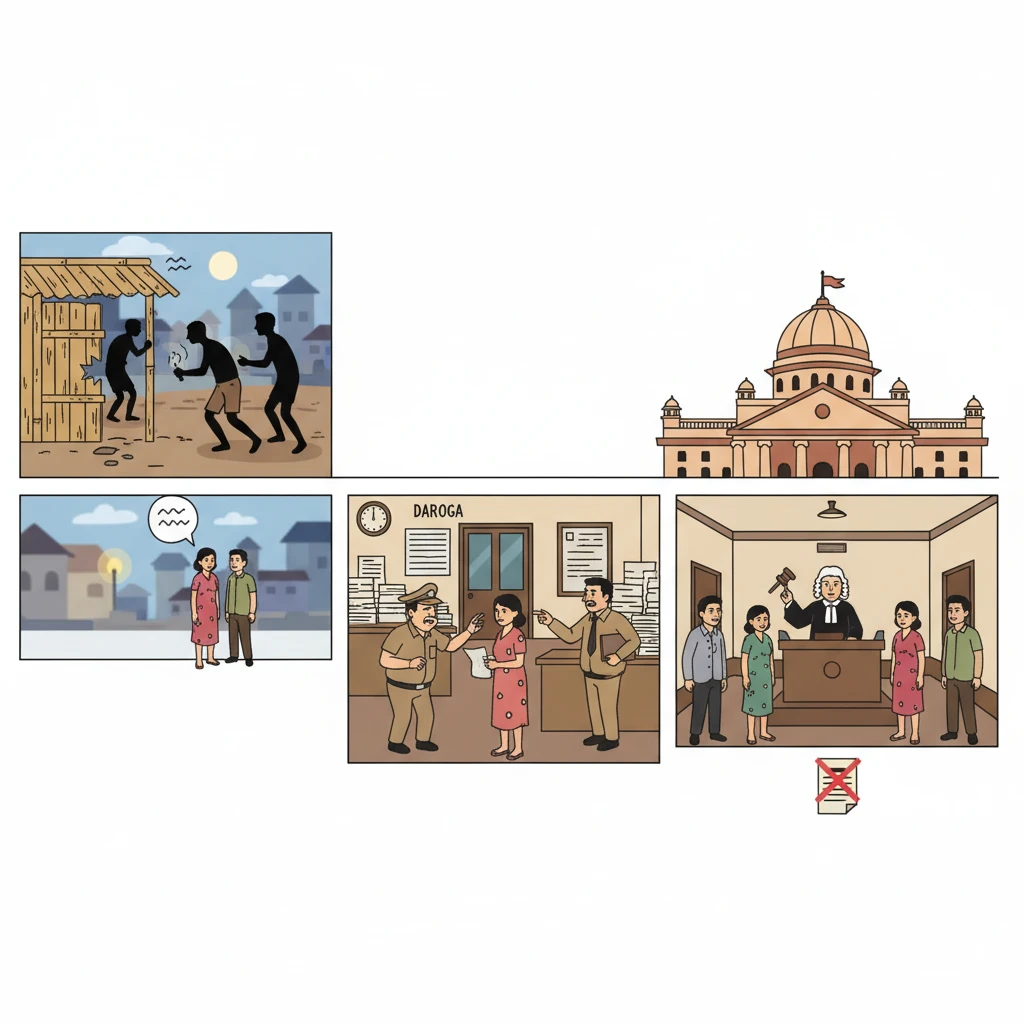
This criminal appeal arose from an incident said to have taken place on the night of 30.01.2014 at about 11:00 PM in Charpokhari, District Bhojpur. The complainant and her sister (later examined as PW-1 and PW-5) stated that they were sleeping in their family shop, which had only a bamboo door.
According to the written complaint, two local men, later arraigned as accused, allegedly broke open the bamboo door and the lock, pulled the quilt (rajai), and woke the sisters. In the light of a torch, the sisters allegedly saw that the accused were drunk and naked. The complaint stated that the accused caught hold of them, tore their clothes, made them naked, threw them down and tried to commit rape.
The complaint also recorded that when the sisters understood the situation, they raised alarm (hulla). The accused allegedly threatened them, but other persons in the area also raised alarm. According to the complaint, the accused then fled away, and the “prestige” of the sisters was saved. Their mother and bua (aunt) came, and the sisters narrated the incident to them.
The complainant further stated that she went to the police station on the very next day, i.e. 31.01.2014, narrated the incident to the Daroga (police officer), and that he visited and verified the occurrence. However, she alleged that this Daroga did not register a case and was later transferred. According to her, the new Daroga told her to approach the court, after which she filed a complaint case before the Chief Judicial Magistrate, Bhojpur, Ara.
The complaint was registered as Complaint Case No.375C/2014. The complainant’s signature was exhibited in the trial as Exhibit-1. The complaint itself was prepared on 22.02.2014, i.e. about 23 days after the alleged occurrence, and was not supported by an affidavit.
The Magistrate forwarded the complaint to the Mahila Police Station for registration of a case and submission of final form. An FIR was ultimately lodged at Charpokhari Police Station on 02.03.2014 as P.S. Case No.45 of 2014. After investigation, the police submitted charge-sheet under Sections 376, 511 and 448 of the Indian Penal Code against the two accused.
On 24.06.2015, the court took cognizance of the offences. Finding the case to be triable by a Court of Session, the records were committed to the District and Sessions Judge on 10.03.2015. The matter was later made over to the court of the Additional Sessions Judge-VII, Bhojpur, Ara, on 17.02.2020.
The accused were supplied copies and the charges were explained to them. They denied the charges and claimed trial. The Sessions Trial proceeded as Sessions Trial No.72 of 2015. On 15.02.2023, the trial court delivered its judgment, disbelieved the prosecution story, and acquitted both accused, giving them the benefit of doubt.
Aggrieved by the acquittal, the victim (appellant) filed the present Criminal Appeal (DB) No.411 of 2023 before the Patna High Court, seeking to set aside the judgment of acquittal.
What the Court Examined and Decided
The Division Bench of the Patna High Court, comprising Hon’ble Mr. Justice Rajeev Ranjan Prasad and Hon’ble Mr. Justice Sourendra Pandey, heard the appeal. The Court perused the records of the trial court, including the depositions of the witnesses.
On behalf of the appellant, learned counsel argued that the trial court had not properly appreciated the evidence. It was submitted that PW-1 and PW-5, the two sisters and alleged victims, were reliable and credible witnesses. According to the appellant’s counsel, their testimonies ought not to have been discarded and the trial court’s finding of contradictions between their statements was incorrect. Counsel argued that minor or trivial contradictions should not become grounds for acquittal in such serious offences.
The State and the counsel for respondent nos. 2 and 3 (the acquitted accused) defended the trial court’s decision. They pointed to several weaknesses in the prosecution case. It was argued that, from the evidence of PW-1, PW-2 (mother), and PW-3 (father), it appeared that the criminal case had been used as a tool to take possession of the house of one Ram Dayal. One of the accused, Satyanarayan, is the son of Ram Dayal, and on the date of the alleged occurrence the sharadh ceremony of Ram Dayal’s wife was reportedly being performed.
They further submitted that the investigating officer had not been examined at all. As a result, the place of occurrence was not firmly established in evidence. Additionally, the only independent witness, PW-4 Tulsi Singh, did not support the prosecution and was declared hostile.
The High Court then examined the evidence, beginning with the prosecution witnesses. In total, five prosecution witnesses were examined: PW-1 and PW-5 (the sisters), PW-2 (their mother), PW-3 (their father), and PW-4 (an independent witness).
PW-3, the father, deposed that he was away visiting relatives at the time of the incident and returned only the next day. He claimed that he then came to know that the accused had broken open the shop door where the sisters were sleeping and attempted to outrage their modesty. His evidence was thus purely hearsay and not based on personal observation.
The trial court had already found, and the High Court agreed, that PW-1, PW-5 and PW-2 were inconsistent and contradicted each other on key aspects of the occurrence. The High Court noted the trial court’s finding in paragraph 10 of the trial judgment that both sisters had made two different statements.
For example, PW-2, the mother, said that when she reached the shop, there were already 10–15 persons present there. However, no such independent witnesses were examined in support of the occurrence. PW-2 also did not state that she had seen the clothes of her daughters torn.
Further, PW-2 stated that she was sleeping in her house on a dark night and woke up on hearing hulla. She then went to the shop door, where she found her daughter coming out of the shop. In contrast, PW-1 and PW-5 claimed that they were sleeping inside the shop.
The High Court highlighted further contradictions that the trial court had already analysed. PW-5 stated that she used to sleep in the shop every night. PW-1, however, did not say this; she stated that she was sleeping in the shop only on the particular date of the alleged occurrence. PW-1 said that they were sleeping on a chowki, whereas PW-5 said they were sleeping on a khatia. These details, though small individually, taken together showed that the witnesses were not giving a clear, consistent version.
The independent witness, PW-4, did not support the prosecution narrative at all and was treated as hostile. This further weakened the case, especially given PW-2’s claim that 10–15 people had gathered at the place of occurrence.
The High Court also considered the procedural and evidentiary gaps. The complaint petition was prepared on 22.02.2014, about 23 days after the alleged occurrence on 30.01.2014. This petition was not supported by any affidavit. The FIR at Charpokhari Police Station was recorded only on 02.03.2014, after the complaint was forwarded. The Court considered this delay and lack of supporting material as serious factors.
Most importantly, the investigating officer was not examined in the trial. This meant that important aspects such as proper proof of the place of occurrence, the condition of the shop, the door, and any corroborative circumstances were missing from the record. The High Court considered non-examination of the investigating officer and absence of independent witnesses, despite the alleged presence of 10–15 persons, as fatal to the prosecution case.
Having reappreciated the evidence, the High Court concluded that the trial court had not committed any error in its appreciation. The contradictions between the key witnesses were material and went to the root of the prosecution story. The evidence did not prove beyond reasonable doubt that the accused had broken the shop door and attempted to commit rape as alleged.
The Court then turned to the legal standard for appeals against acquittal under Section 378 of the Code of Criminal Procedure. Relying on the Supreme Court judgment in H.D. Sundara vs. State of Karnataka (2023) 9 SCC 581, the High Court set out the applicable principles. These include:
(i) an acquittal further strengthens the presumption of innocence in favour of the accused; (ii) an appellate court can reappreciate evidence in an appeal against acquittal; (iii) after such reappreciation, the court must see whether the view taken by the trial court is a possible view on the evidence on record; (iv) if the trial court’s view is a possible view, the appellate court cannot overturn the acquittal merely because another view is also possible; and (v) interference is justified only when the only possible conclusion from the evidence is that the guilt of the accused is proved beyond reasonable doubt.
Applying these settled principles, the Patna High Court held that the trial court’s view was clearly a “possible view” based on the evidence. In view of the material contradictions, delayed complaint, non-examination of the investigating officer, and absence of independent support, the trial court was justified in giving benefit of doubt to the accused.
The High Court found no legal or factual error warranting interference. It, therefore, dismissed the appeal and confirmed the acquittal of respondent nos. 2 and 3.
Why This Judgment Matters
This decision is important for victims, lawyers, and the public because it shows how high the standard of proof is in criminal cases, especially sexual offence cases. Even serious allegations like attempted rape must be proved with consistent, trustworthy evidence.
The Patna High Court’s judgment reinforces that, in an appeal against acquittal, the appellate court does not lightly disturb the trial court’s decision. Unless the evidence clearly points only in one direction—that the accused is guilty beyond reasonable doubt—an acquittal will stand.
For complainants, the case underlines the need to report incidents promptly where possible, give consistent statements, ensure that independent witnesses (if any) are brought to court, and that investigation is properly carried through. Delays and contradictions can severely weaken the case.
For accused persons and defence lawyers, the judgment confirms that benefit of doubt is a real protection, and that the trial court’s assessment of witness credibility carries great weight. Once acquitted, the accused enjoys a strengthened presumption of innocence, which is not easily overturned.
Legal Issues and Answers
-
Issue: Whether the Patna High Court should set aside the trial court’s acquittal of the accused in an alleged attempted rape and house-trespass case arising from Charpokhari P.S. Case No.45 of 2014.
Answer: No. The High Court held that, in light of material contradictions in the prosecution evidence, delay in filing the complaint, non-examination of the investigating officer, and absence of independent support, the trial court’s view acquitting the accused was a possible and justified view. The appeal was dismissed. -
Issue: How should an appellate court approach an appeal against acquittal under Section 378 CrPC.
Answer: The Court applied the principles from H.D. Sundara vs. State of Karnataka (2023) 9 SCC 581, holding that an acquittal strengthens the presumption of innocence; the appellate court may reappreciate evidence but can interfere only if the trial court’s view is not a possible view and the only reasonable conclusion is guilt beyond reasonable doubt.
Cases Cited by the Court
- H.D. Sundara vs. State of Karnataka, (2023) 9 SCC 581, including reference to State of Karnataka v. H.K. Mariyappa, 2010 SCC OnLine Kar 5591, cited for principles governing appeals against acquittal under Section 378 CrPC.
Case Details
Case Number: Criminal Appeal (DB) No.411 of 2023, arising out of Charpokhari P.S. Case No.45 of 2014.
Case Title: XXX v. The State of Bihar & Ors.
Citation: 2026(1) PLJR 145.
Coram: Hon’ble Mr. Justice Rajeev Ranjan Prasad and Hon’ble Mr. Justice Sourendra Pandey.
Date of Patna High Court Judgment: 20.11.2025.
Advocates: For the appellant – Ms. Priya, Advocate, and Mr. Prabhat Kumar Singh, Advocate. For the State – Mr. Abhimanyu Sharma, APP. For respondent nos. 2 and 3 – Mr. Md. Ataul Haque, Advocate.
Nature of the Case: Criminal appeal (Division Bench) against judgment of acquittal passed by the Additional Sessions Judge-VII, Bhojpur, Ara in Sessions Trial No.72 of 2015, arising out of allegations under Sections 376, 511 and 448 IPC.
Link to Full Judgment: Click here to read the official Patna High Court judgment
If you found this explanation helpful and wish to stay informed about
how legal developments may affect your rights in Bihar,
you may consider following Samvida Law Associates for more updates.







