
Case Background
This case arises out of a village land dispute over Schedule “क” land described in a title suit. The original plaintiffs in Title Suit No. 09 of 2001 were petitioner no. 1 and the father of petitioner nos. 2 and 3. They had filed the suit for a declaration of their right, title and interest, along with defendant 2nd set, over the suit land.
In that suit, the present respondent no. 1 was defendant 1st set and the present respondent no. 4 (described as defendant 3rd set in the trial court) was one of the main contesting defendants. Apart from declaration of title, the plaintiffs also sought an injunction to restrain defendant 3rd set from going to the suit property.
The trial court decreed the suit in favour of the plaintiffs on 12.12.2012. Aggrieved by this decree, the defendant 3rd set/respondent no. 4 filed Title Appeal No. 05 of 2013 before the court of the learned Additional District Judge‑12th, Bhojpur at Ara. That first appeal has been pending since then.
During the original trial, on 26.08.2009, the plaintiffs had filed an application before the trial court. In that application, they informed the court that respondent no. 4 had started some construction over the suit land and that the plaintiffs had got the construction stopped with the help of the police. They essentially sought to place this conduct of respondent no. 4 on record, without at that time seeking an amendment of the plaint or additional substantive relief.
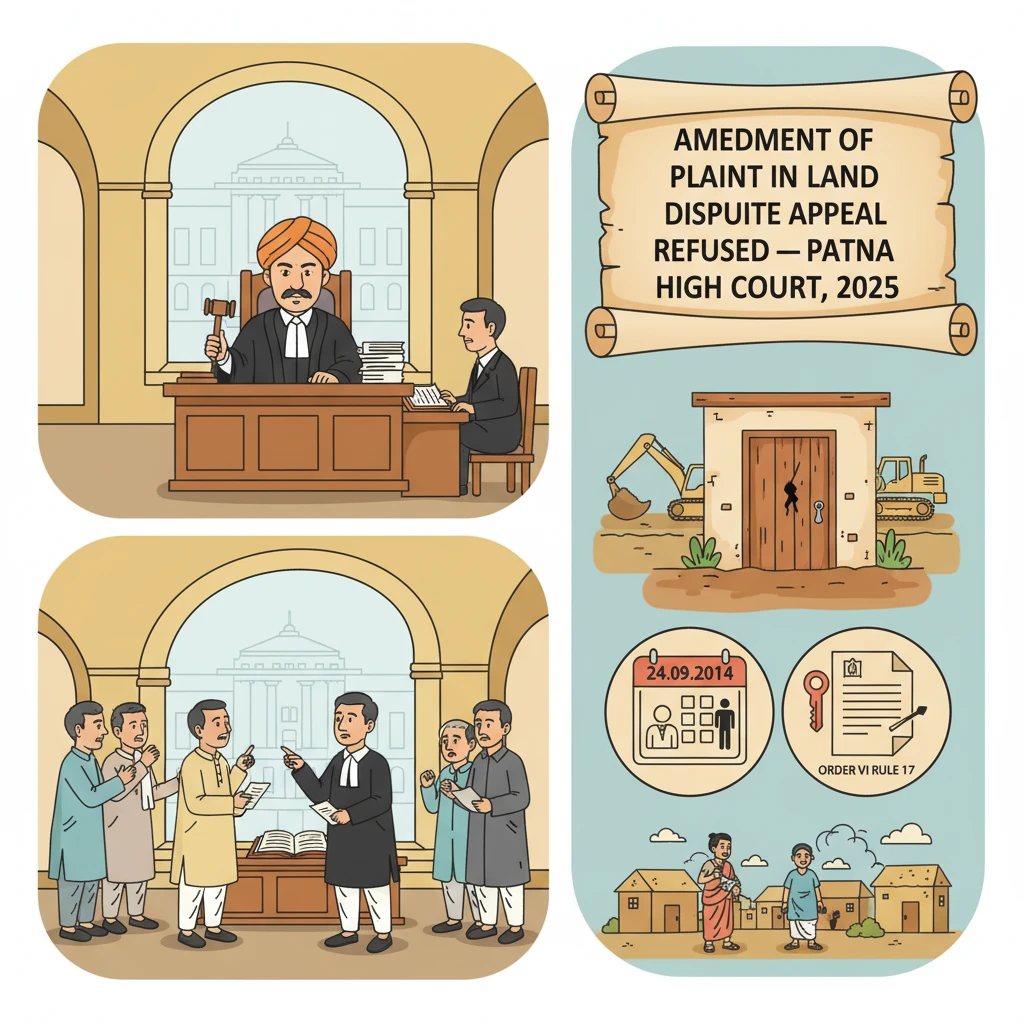
After the decree and during the pendency of the first appeal, the plaintiffs (now appellants before the first appellate court and petitioners before the High Court) decided to seek amendment of their plaint. On 10.11.2014, they filed an application under Order VI Rule 17 of the Code of Civil Procedure before the appellate court to amend the plaint of Title Suit No. 09 of 2001. Respondent no. 4 filed a rejoinder to this on 18.04.2015.
Later, on 05.06.2018, the petitioners filed another application seeking further amendment in continuation of the earlier one. Respondent no. 4 replied to this second amendment application on 12.07.2018. By order dated 29.08.2019, the learned Additional District Judge‑12th, Bhojpur at Ara dismissed both amendment petitions. That rejection order in Title Appeal No. 05 of 2013 is what the petitioners challenged before the Patna High Court in Civil Miscellaneous No. 1515 of 2019.
What the Court Examined and Decided
The core question before the Patna High Court was whether the first appellate court was wrong in refusing to allow amendments to the plaint at the appellate stage, in a suit initially filed only for declaration and injunction regarding land.
The petitioners’ counsel argued that the impugned order dated 29.08.2019 was improper and unsustainable. He said the appellate court had not properly considered the facts and binding Supreme Court judgments, particularly the decision in Life Insurance Corporation of India v. Sanjeev Builders Private Limited, 2022 SCC OnLine SC 1128.
According to the petitioners, an important subsequent event occurred during the pendency of the appeal. They claimed that on 24.09.2014, respondent no. 4, taking undue advantage of their absence from the village, broke open the lock of the only room standing on the disputed land, made some construction and dispossessed them.
They submitted that when they had originally filed Title Suit No. 09 of 2001, they were in possession of the disputed land. Therefore, they had only sought declaration of title and a simple injunction, and had not asked for confirmation or recovery of possession. When, according to them, dispossession occurred later in 2014, they felt compelled to seek amendment of the plaint to bring these subsequent facts on record.
Through the amendment applications dated 10.11.2014 and 05.06.2018, they wanted to:
- Incorporate the alleged dispossession on 24.09.2014,
- Seek to pay ad valorem court fee,
- Add a relief of delivery of possession of the suit land through court process, and
- Seek a permanent injunction restraining respondent no. 4 from going over the disputed land.
They contended that the appellate court had misconstrued their earlier application dated 26.08.2009, and wrongly assumed that they had admitted respondent no. 4’s construction as their own. They argued that the 26.08.2009 application only reported that respondent no. 4’s construction attempt had been stopped with police help and did not mean they accepted his construction on the land as theirs.
The petitioners’ counsel further argued that:
- The amendment was based on subsequent events and, if disallowed, would lead to multiplicity of litigation.
- Since an appeal is a continuation of the suit, an amendment under Order VI Rule 17 CPC can be entertained even at the appellate stage.
- A prayer for delivery of possession, when title is already in question, does not change the basic nature and scope of the suit; it only provides effective relief if the plaintiffs succeed on title.
- The appellate court failed to consider settled principles that when title is decreed in favour of a party who has been dispossessed subsequently, delivery of possession must follow.
In short, they asked the High Court to set aside the order of the appellate court and allow the amendments so that the question of possession and recovery could be decided in the existing proceedings.
On the other hand, counsel for respondent no. 4 defended the appellate court’s order and said that the present petition was based on misconceived grounds. He categorically disputed the petitioners’ claim of ever having been in possession of the suit land.
Respondent no. 4 relied on the petitioners’ own application dated 26.08.2009. In that application, the petitioners had stated that respondent no. 4 had been making construction over the purchased land of the plaintiffs bearing khata no. 109, khesra no. 7986, area four and half decimal. Even then, the petitioners had not sought amendment of the plaint or any additional substantive relief.
Respondent no. 4’s counsel argued that:
- Respondent no. 4 had been in possession from the very beginning, which is why he could construct on the land.
- In his written statement, respondent no. 4 had clearly pleaded that the suit property was a joint dwelling house without any separation of shares among co‑sharers.
- The 26.08.2009 application was filed only to create evidence, as the petitioners did not seek an injunction or substantive order, but merely asked that the application be kept on record.
- In the amendment petition dated 10.11.2014, the petitioners’ claim that respondent no. 4 had entered their house was false, since they were never in possession.
Therefore, according to respondent no. 4, there was no question of dispossession during the appeal. On these facts, counsel submitted that the appellate court’s refusal to allow amendment required no interference.
The Patna High Court examined these rival submissions with reference to Order VI Rule 17 CPC. The Court noted that this provision allows amendment of pleadings at any stage, but:
If the amendment is sought after the commencement of trial, the party seeking amendment must satisfy the court that, despite due diligence, it could not have been raised earlier.
The High Court then looked at the nature of the original suit and the pleadings. The plaintiffs had sought:
- A declaration of right, title and interest over Schedule “क” land, and
- An order restraining respondent no. 4 from going over the suit property.
Crucially, they had not sought:
- Confirmation of their possession, or
- Recovery of possession.
At the same time, respondent no. 4, in his written statement, had clearly asserted that he was in possession of the suit land, that the plaintiffs were not in possession of any part of it, and that the khatiyan was prepared jointly in the name of his ancestors.
The High Court held that it was incumbent upon the plaintiffs to clarify the issue of possession when such a categorical stand was taken in the written statement. They, however, took no steps at that time to seek amendment or additional relief.
The Court observed that, in these circumstances, even if a decree of declaration of title had been passed in favour of the plaintiffs, it would remain an “empty decree” in the absence of proper relief regarding possession. The Court further noted that the application dated 26.08.2009 itself showed that respondent no. 4 had made some construction over the suit property, yet the plaintiffs had not then sought any specific relief against him based on that fact.
The Court also pointed out that in their plaint, the petitioners had not mentioned any house standing on the suit land. They had only stated that respondent no. 4 had closed a door on the north side which they used to access their land. This, according to the Court, cast doubt on their claim of possession even at the time of filing the suit.
Given these facts, the Court held that the plaintiffs, having failed to seek amendment during the pendency of the title suit itself, could not be allowed to amend the plaint at such a belated stage in the appellate court to introduce a plea of dispossession and a claim for recovery of possession.
The Court held that where there was no original prayer for confirmation of possession, a later plea of dispossession during the appeal and a new claim for recovery of possession was “simply not permissible”.
On the reliance placed by the petitioners on Life Insurance Corporation of India v. Sanjeev Builders Private Limited, the Court stated that the facts in the present case were quite different, and therefore that decision did not assist the petitioners.
The High Court concluded that there was no error of jurisdiction on the part of the first appellate court in passing the impugned order dated 29.08.2019. Although it noted that the appellate court’s order lacked detailed reasons, it still considered the decision itself proper and affirmed it.
Accordingly, the civil miscellaneous petition was dismissed, and any interlocutory applications were disposed of. The Court expressly clarified that it had not expressed any opinion on the merits of the title dispute itself and that its observations were only for deciding the amendment issue, so as not to prejudice the trial or appellate court on merits.
Why This Judgment Matters
This Patna High Court judgment has practical importance for parties in land disputes who try to correct or expand their claims late in the day.
First, it reinforces that if a plaintiff in a title suit does not ask for appropriate relief about possession at the beginning, a later decree of declaration may be of little use. A “bare declaration” without prayer for confirmation or recovery of possession can become an “empty decree”.
Second, the decision underlines that amendments to pleadings at the appellate stage are not automatic. Even though an appeal is a continuation of the suit, the court will look at whether the party was diligent earlier, whether the issue was already apparent from pleadings like the written statement, and whether the amendment is truly based on an unforeseen subsequent event.
Third, for villagers and landholders, this case is a reminder: when filing a title suit, it is essential to be clear about who is in possession and to seek all necessary reliefs (including injunction, confirmation of possession, or recovery of possession) in the original plaint itself. Waiting until appeal stage to add these, especially when the other side has long claimed possession, is risky.
Finally, the judgment clarifies that a party cannot easily rely on general Supreme Court judgments on amendment if the factual matrix is significantly different. Courts will look closely at the conduct of the parties throughout the proceedings before allowing late amendments.
Legal Issues and Answers
- Issue: Can plaintiffs in a title suit, who did not originally seek confirmation or recovery of possession, amend their plaint at the appellate stage to add a plea of dispossession and claim delivery of possession, allegedly based on a subsequent event?
Answer: No. In the facts of this case, the Patna High Court held that such a belated amendment at the appellate stage was not permissible, particularly when doubts about possession existed from the beginning and the plaintiffs failed to act earlier. - Issue: Did the first appellate court commit jurisdictional error in rejecting the amendment applications dated 10.11.2014 and 05.06.2018?
Answer: No. The Court held there was no jurisdictional error. Although the appellate order lacked detailed reasoning, the refusal to allow amendment was found to be correct and was affirmed. - Issue: Was the petitioners’ reliance on the Supreme Court decision in Life Insurance Corporation of India v. Sanjeev Builders Private Limited (2022 SCC OnLine SC 1128) justified?
Answer: No. The Court held that the facts of the present case were quite different, and hence that judgment did not assist the petitioners.
Cases Cited by the Court
- Life Insurance Corporation of India v. Sanjeev Builders Private Limited, 2022 SCC OnLine SC 1128 (relied upon by petitioners; held to be distinguishable by the Court).
Case Details
Case Number: Civil Miscellaneous Jurisdiction No. 1515 of 2019
Case Title: Rang Bahadur Singh & Ors v. Dadan Singh & Ors
Court: High Court of Judicature at Patna, Civil Miscellaneous Jurisdiction
Coram: Hon’ble Mr. Justice Arun Kumar Jha
Date of Judgment: 21.05.2025
Citation: 2025(3) PLJR 472
Advocates:
For the petitioners: Mr. Sachchida Nand Singh, Advocate
For the respondents: Mr. Aditya Narayan Singh, Advocate; Mr. Rama Kant Singh, Advocate
Nature of the Case: Civil miscellaneous petition challenging the order of the first appellate court (Additional District Judge‑12th, Bhojpur at Ara) in Title Appeal No. 05 of 2013, by which amendment applications relating to the plaint in Title Suit No. 09 of 2001/47 of 2010 were rejected.
Impugned Order: Order dated 29.08.2019 passed by the learned Additional District Judge‑12th, Bhojpur at Ara in Title Appeal No. 05 of 2013, rejecting amendment petitions dated 10.11.2014 and 05.06.2018.
Link to Judgment: Patna High Court Judgment – Civil Misc. No. 1515 of 2019
If you found this explanation helpful and wish to stay informed about
how legal developments may affect your rights in Bihar,
you may consider following Samvida Law Associates for more updates.







