
Case Background
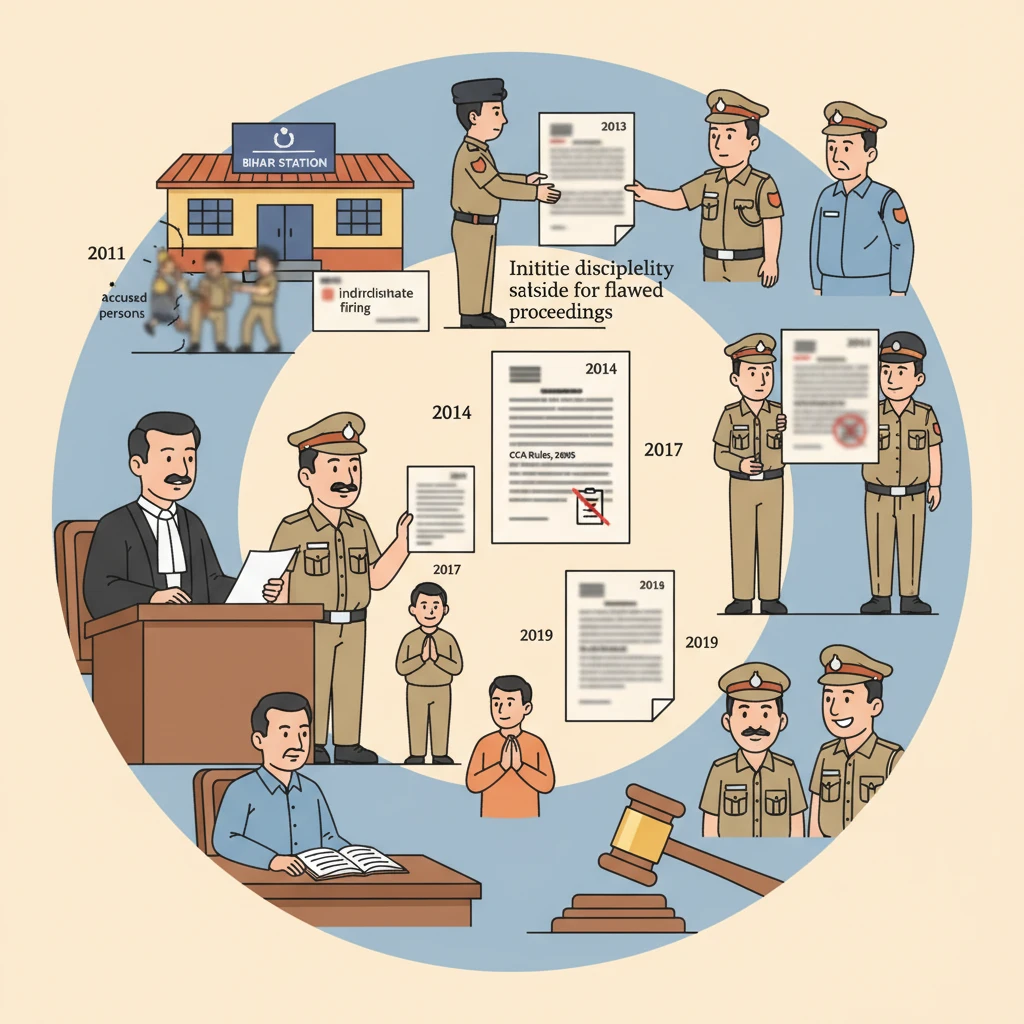
The petitioner is a Bihar Police officer who was serving as Sub-Divisional Police Officer (SDPO), Jamalpur, when an incident of indiscriminate firing took place in 2011. Allegations were made that he did not act properly in relation to the incident and the accused persons involved.
On 05.06.2013, the Inspector General of Police (Headquarters), Bihar, Patna, sent Letter No. 1992 to the Home Department. In this letter, the IG requested that departmental proceedings be started against the petitioner. The allegations included that the petitioner had assisted accused persons from one group, disobeyed the orders of his superior officers, and restrained his subordinates from arresting the accused.
On 17.11.2014, a Memo of Charge (Annexure-P/12) was issued to the petitioner. It contained three charges along with a list of documents. Importantly, no list of witnesses was enclosed with this memo. On the same date, the petitioner submitted a detailed reply to the charge memo (Annexure-P/16).
After this, for about three years, there was no progress in the departmental proceeding. Feeling harassed by the prolonged pendency, the petitioner wrote to higher authorities seeking closure of the proceeding. He addressed one letter on 14.11.2017 to the Additional Director General (Headquarters) and another on 31.07.2018 to the Director General of Police, Bihar. No action was taken on these requests.
On 07.01.2019, the Inquiry Officer requested that a Presenting Officer be appointed. After such appointment, the petitioner was asked to produce and verify documents through witnesses. The Presenting Officer produced two constables from the offices of the Inspector General, Bhagalpur, and the Superintendent of Police, Munger, as witnesses. Their role was essentially formal: they only verified documents.
The petitioner filed his defence statement on 10.06.2019. The Presenting Officer was directed to respond, and subsequently the Inquiry Officer submitted his report on 17.07.2019 (Annexure-P/29). In this report, Charge Nos. 1 and 2 were held to be proved, while Charge No. 3 was found not proved.
On 13.08.2019, the petitioner received the enquiry report along with a second show-cause notice. He immediately submitted his reply to the second show-cause. However, the disciplinary authority (respondent no. 2, Special Secretary, Home (Police) Department) did not accept his defence and, by order dated 25.02.2020 contained in Memo No. 2/M2-70-06/2013 Home (Police)/1978, imposed the punishment of withholding three annual increments with cumulative effect.
The petitioner filed a review petition against this punishment order. The reviewing authority rejected the review by order dated 14.12.2020 contained in Memo No. 2/Police-70-06/2013 Home (Police)/8509. Both these orders were challenged by the petitioner before the Patna High Court in Civil Writ Jurisdiction Case No. 6105 of 2022.
What the Court Examined and Decided
Hon’ble Mr. Justice Harish Kumar heard the matter. The core question was whether the departmental inquiry and the punishment imposed on the petitioner were legally sustainable under the Bihar Government Servants (Classification, Control & Appeal) Rules, 2005 (CCA Rules, 2005) and principles laid down by the Supreme Court.
The petitioner’s counsel, Mr. Siddhartha Prasad, mainly attacked the validity of the charge memo and the manner in which the enquiry was conducted. He argued that Rule 17(4) and Rule 17(14) of the CCA Rules, 2005 were violated. Under these rules, for a major penalty proceeding:
- Each charge must be supported by a list of documents and a list of witnesses through whom the charge will be proved.
- On the date fixed for enquiry, the disciplinary authority must produce oral and documentary evidence, and the witnesses have to be examined by or on behalf of the Presenting Officer, with a right of cross-examination to the delinquent officer.
Here, the Memo of Charge (Annexure-P/12) only contained a list of four letters as documents; there was no list of witnesses at all. The allegations against the petitioner were serious: dereliction of duty, laxity in investigation, and acts allegedly helping the accused persons. The Court observed that such charges, by their nature, could not be proved only through documents. They required proper oral evidence from key officers directly involved in the incident and investigation.
The petitioner specifically pointed out that:
- The Station House Officer (SHO) of the concerned police station was crucial to prove Charge No. 1, yet his deposition was never recorded.
- The Superintendent of Police, Munger, and the investigating officer of the concerned police case were key witnesses for Charge No. 2, but they were not examined.
- The two constables, who were produced as witnesses, were only formal witnesses who merely verified documents. None of them proved the contents of the documents.
Because these key witnesses were not produced, the petitioner had no opportunity to cross-examine them. According to the petitioner, the entire proceeding was completed on only five dates, and the Presenting Officer remained absent on three of those dates. He allegedly did not really present any case, did not lead evidence, and did not discharge his statutory role.
The petitioner further argued that the Inquiry Officer, instead of acting as an independent quasi-judicial authority, stepped into the shoes of the Presenting Officer. The report appeared to shift the burden onto the petitioner to prove his innocence, rather than requiring the department to prove the charges by legal evidence. The punishment order and review order, he contended, were perfunctory, non-speaking, and showed no independent application of mind to his defence or second show-cause reply.
In support, reliance was placed on Supreme Court judgments in:
- Satyendra Singh v. State of Uttar Pradesh, SLP(C) No. 29758 of 2018,
- Roop Singh Negi v. Punjab National Bank and Others, (2009) 2 SCC 570,
- State of U.P. & Ors. v. Saroj Kumar Sinha, (2010) 2 SCC 772.
These cases underline that:
- In major penalty proceedings, recording oral evidence is mandatory.
- Mere production or tendering of documents is not sufficient; contents must be proved by witnesses.
- The Enquiry Officer is a quasi-judicial authority, not a departmental representative, and must base findings on admissible evidence.
On the other hand, learned counsel for the State, Mr. Manoj Kumar, argued that the Praptra ‘Ka’ was revisited and a fresh memo of charge with list of evidences and exhibits was served in accordance with Rule 17(3) and 17(4) of the CCA Rules, 2005. He maintained that rules and procedures were followed, that the petitioner was given sufficient opportunity to defend, and that the petitioner could not produce cogent evidence to refute the allegations.
The State submitted that the Police Headquarters, through Letter No. 2341 dated 04.10.2018, had opined that the petitioner failed to take effective raid, search and preventive steps against the accused in the firing incident. Based on this opinion, the allegations, the defence, and the record, the Conducting Officer allegedly found the petitioner guilty of negligence, dereliction of duty, arbitrariness and dubious conduct which tarnished the image of the police force. The punishment of withholding three increments with cumulative effect was then imposed after considering an unsatisfactory reply to the second show-cause notice.
The State relied on Supreme Court decisions in:
- Tara Chand Vyas v. Chairman and Disciplinary Authority & Ors., (1997) 4 SCC 565,
- Director General, Indian Council of Medical Research & Ors. v. Dr. Anil Kumar Ghosh & Anr., (1998) 7 SCC 97,
- And a Bench decision of the Patna High Court in Anuj Kumar Singh Yadav v. The State of Bihar & Ors., 2024 (2) PLJR 30.
The Court then reminded itself of the limited scope of judicial review in disciplinary matters. Referring to Union of India & Ors. v. P. Gunasekaran, (2015) 2 SCC 610, and other cases including Associated Provincial Picture Houses Ltd. v. Wednesbury Corporation and more recent decisions, the Court noted it cannot reappreciate evidence like an appellate court. It can interfere only where there is violation of procedure, natural justice, reliance on no evidence, or conclusions so arbitrary that no reasonable person could reach them.
With this background, the Court examined Rule 17 of the CCA Rules, 2005, which governs major penalties. Rule 17(3) requires that the disciplinary authority draw up clear articles of charge. Rule 17(4) requires a list of documents and list of witnesses for each charge. Rule 17(14) requires that on the inquiry date, oral and documentary evidence must be produced, witnesses examined by or on behalf of the Presenting Officer, and cross-examined by the government servant.
Looking at the actual record, the Court found that the Memo of Charge (Annexure-P/12) carried only four letters as documents and no witness list. The nature of the charges — dereliction of duty, laxity in investigation, and alleged acts helping accused persons — clearly demanded oral evidence. Even the documents produced in the inquiry were not proved through any competent witness. The SHO, the Superintendent of Police, Munger, and the investigating officer were not examined at all.
Referring to Roop Singh Negi, the Court reiterated that departmental proceedings are quasi-judicial, and that documentary evidence must be proved through witnesses. In Saroj Kumar Sinha, it was held that even in ex parte inquiries, the Enquiry Officer must test whether unrebutted departmental evidence is sufficient; documents that are not proved cannot be relied on.
The Patna High Court also noted that in Satyendra Singh, the Supreme Court had set aside punishment in similar circumstances where no oral evidence was recorded in support of charges attracting major penalty.
On the functioning of the Presenting Officer, the Court observed, on reading the enquiry report, that he had “completely failed” to discharge his duty. He neither produced any witness nor made any real effort to bring home the charges through admissible evidence. Instead, the Enquiry Officer concluded that because the petitioner merely denied the charges but did not produce documents in his support, the charges stood proved. The Court held that this inverted the legal position: it is always the department’s duty to prove the charge, not the delinquent officer’s duty to prove his innocence.
The Court also referred to a Government Memo No. 235 dated 20.12.2017, which sets out the role of Presenting Officers and which had earlier been noted by the Patna High Court in Manoj Kumar Ram v. The State of Bihar & Ors., 2025 (2) PLJR 561. This document underlines the importance of the Presenting Officer’s role in departmental enquiries.
Given that the Presenting Officer failed to act, and the Enquiry Officer went beyond his jurisdiction by virtually prosecuting the case himself and shifting the burden of proof, the Court held that the entire enquiry was vitiated. Since Charge Nos. 1 and 2 were held proved without any admissible legal evidence, the findings could not stand in law.
The Court then examined the applicability of the decisions cited by the State. It distinguished Tara Chand Vyas and Dr. Anil Kumar Ghosh on the ground that in those cases the charges were entirely based on documentary evidence whose genuineness was not disputed, making oral evidence unnecessary. In the petitioner’s case, however, the charges were of such nature that they required oral testimony, and even the contents of documents were not legally proved.
Similarly, the Court noted that in Anuj Kumar Singh Yadav, the inquiry had been held by a competent authority in accordance with law, with sufficient evidence to support the findings and no proof of procedural prejudice. That factual scenario was completely different from the present case, where the core requirements of Rule 17 and evidentiary standards were not met.
Turning to the punishment order (Annexure-33, Memo dated 25.02.2020), the Court found it to be cryptic and non-speaking. The disciplinary authority did not discuss or analyse the petitioner’s detailed reply to the second show-cause. The order simply referred to the enquiry report and, in one line, imposed the punishment. Citing M/S Kranti Associates Pvt. Ltd. & Anr. v. Masood Ahmed Khan & Ors., (2010) 9 SCC 496, and a Division Bench judgment in Kems Services Private Limited v. The State of Bihar & Ors., 2014 (1) PLJR 622, the Court emphasised that recording of reasons is a basic requirement of natural justice and a safeguard against arbitrary exercise of power.
The review order dated 14.12.2020 (Annexure-34) was also found defective. The Reviewing Authority did not deal with the grounds raised by the petitioner or examine whether there was an error apparent on the face of the record. It repeated the same mistake of non-application of mind.
The Court recognised that in departmental proceedings, charges are proved on the standard of preponderance of probabilities, and strict rules of evidence do not apply. However, even under this flexible standard, there must be some admissible legal evidence. In the present case, there was none.
Accordingly, the Patna High Court held that both the punishment order dated 25.02.2020 and the review order dated 14.12.2020 were wholly unsustainable in law and deserved to be set aside.
The writ petition was allowed. As a result of the quashing of the orders, the Court directed that the consequences in law shall follow, and all admissible benefits be restored to the petitioner preferably within twelve weeks from the date of receipt or production of a copy of the judgment. The parties were directed to bear their own costs.
Why This Judgment Matters
This judgment is important for government employees, especially police personnel, who face departmental proceedings for major penalties. The Patna High Court has made it clear that when the State wants to impose a serious punishment like withholding increments with cumulative effect, it must strictly follow the procedure laid down in Rule 17 of the CCA Rules, 2005.
The decision shows that:
- Charges involving serious allegations like dereliction of duty and helping accused persons cannot be proved only through unproved documents.
- The department must produce real witnesses and allow cross-examination.
- The Presenting Officer cannot be a mere formality. If he fails to act and the Enquiry Officer then shifts the burden onto the employee, the entire enquiry becomes illegal.
- Punishment and review orders must contain reasons. A single-line conclusion that the reply is “unsatisfactory” is not enough.
For ordinary readers and employees, the judgment signals that they have a right to a fair hearing, to confront and cross-examine witnesses, and to expect speaking and reasoned orders. For departments, it is a reminder that shortcuts in departmental proceedings can later result in the entire action being struck down in the Patna High Court.
Legal Issues and Answers
- Issue: Whether a major penalty can be sustained when the departmental enquiry is conducted without a list of witnesses, without examining key witnesses, and without legally proving documents as required under Rule 17 of the CCA Rules, 2005.
Answer: No. The Court held that in absence of oral evidence and proper proof of documents, the findings of guilt were based on no admissible evidence, vitiating the entire enquiry and rendering the punishment unsustainable. - Issue: Whether the disciplinary authority and reviewing authority can rely solely on an enquiry report and pass cryptic, non-speaking orders without dealing with the employee’s defence and second show-cause reply.
Answer: No. The Court held that such non-speaking and unreasoned orders violate basic principles of natural justice. Reasons are the heart and soul of an order, and their absence made the impugned orders illegal. - Issue: Whether the Enquiry Officer can effectively step into the role of the Presenting Officer and shift the burden onto the delinquent officer to prove his innocence.
Answer: No. The Court reaffirmed that it is the department’s duty to prove charges. The Enquiry Officer is an independent quasi-judicial authority and cannot act as a prosecutor. Shifting the burden onto the delinquent vitiates the enquiry.
Cases Cited by the Court
- Union of India & Ors. v. P. Gunasekaran, (2015) 2 SCC 610
- Associated Provincial Picture Houses Ltd. v. Wednesbury Corporation, (1948) 1 KB 223
- Bharti Airtel Limited v. A. S. Raghavendra, (2024) 6 SCC 418
- State of Rajasthan v. Bhupendra Singh, 2024 SCC OnLine SC 1908
- State of Andhra Pradesh v. S. Sree Rama Rao, AIR 1963 SC 1723
- State of Andhra Pradesh & Ors. v. Chitra Venkata Rao, (1975) 2 SCC 557
- State Bank of Patiala v. S.K. Sharma, (1996) 3 SCC 364
- Roop Singh Negi v. Punjab National Bank and Others, (2009) 2 SCC 570
- State of U.P. & Ors. v. Saroj Kumar Sinha, (2010) 2 SCC 772
- Satyendra Singh v. State of Uttar Pradesh, SLP(C) No. 29758 of 2018
- Tara Chand Vyas v. Chairman and Disciplinary Authority & Ors., (1997) 4 SCC 565
- Director General, Indian Council of Medical Research & Ors. v. Dr. Anil Kumar Ghosh & Anr., (1998) 7 SCC 97
- M/S Kranti Associates Pvt. Ltd. & Anr. v. Masood Ahmed Khan & Ors., (2010) 9 SCC 496
- Kems Services Private Limited v. The State of Bihar & Ors., 2014 (1) PLJR 622
- Manoj Kumar Ram v. The State of Bihar & Ors., 2025 (2) PLJR 561
- Anuj Kumar Singh Yadav v. The State of Bihar & Ors., 2024 (2) PLJR 30
Case Details
Case Number: Civil Writ Jurisdiction Case No. 6105 of 2022
Case Title: Ranjan Kumar v. The State of Bihar & Ors.
Citation: 2025 (3) PLJR 547
Coram: Hon’ble Mr. Justice Harish Kumar
Advocates:
- For the Petitioner: Mr. Siddhartha Prasad, Advocate
- For the Respondents (State): Mr. Manish Kumar, GP-4; Mr. Manoj Kumar, AC to GP-4
Nature of the Case: Writ petition under Article 226 of the Constitution challenging departmental punishment order and review order in service/disciplinary matter.
Date of Judgment: 01.07.2025
Link to Judgment: Click here to view full judgment
If you found this explanation helpful and wish to stay informed about
how legal developments may affect your rights in Bihar,
you may consider following Samvida Law Associates for more updates.







