
Case Background
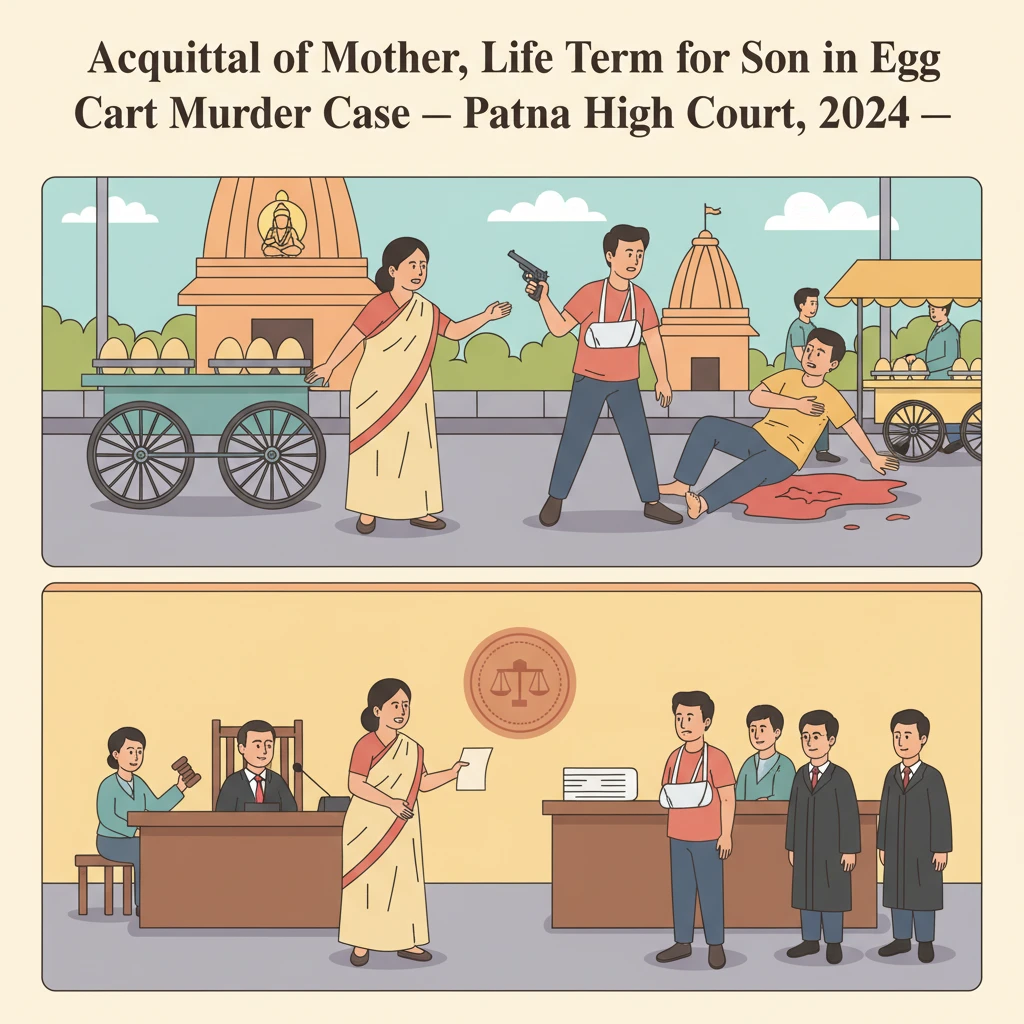
The case comes from Begusarai Muffasil P.S. Case No. 427 of 2014. The informant, Rinku Devi (PW-6), gave her fardbeyan on 07.12.2014 at 3:30 pm at Sadar Hospital, Begusarai. She stated that her husband, Rohit Tanti, used to sell eggs on a cart near Mahavir Asthan / Hanuman Mandir Chauraha at Bharra. Just beside him, one Raja Paswan also sold eggs.
On 07.12.2014 at about 1:30–2:10 pm, an altercation allegedly broke out between her husband and Raja Paswan over who would sell eggs at that spot. According to the fardbeyan, Raja’s mother, Sudha Devi, reached there and asked her son to kill Rohit. Raja, who was handicapped in the right hand, allegedly took out a pistol with his left hand and fired at the left side of Rohit’s chest. Rohit fell down bleeding. He was taken towards Sadar Hospital on the scooter of Sanjay Shah (PW-2) and died on the way.
On this statement, Begusarai Muffasil P.S. Case No. 427 of 2014 was registered under Section 302/34 IPC and Section 27 of the Arms Act. Investigation followed, and a chargesheet (No. 429 of 2014 dated 31.12.2014) was submitted against both accused under these sections.
The Chief Judicial Magistrate took cognizance on 06.01.2015 and committed the case to the Court of Session on 09.03.2015. It was tried as Sessions Trial No. 128 of 2015 before the Additional Sessions and District Judge-VIII, Begusarai.
On 01.12.2016, the trial court convicted both Sudha Devi and Raja Paswan under Section 302/34 IPC. Raja was also convicted under Section 27 of the Arms Act. On 06.12.2016, both were sentenced to life imprisonment with fine, and Raja received an additional two years’ rigorous imprisonment for the Arms Act offence. The sentences were to run concurrently.
Both convicts appealed to the Patna High Court in Criminal Appeal (DB) No. 79 of 2017 (Sudha Devi) and Criminal Appeal (DB) No. 152 of 2017 (Raja Paswan). The Division Bench (Hon’ble Mr. Justice Rajeev Ranjan Prasad and Hon’ble Mr. Justice Shailendra Singh) delivered judgment on 30.08.2024.
What the Court Examined and Decided
The Patna High Court carefully re-examined the evidence of nine prosecution witnesses, the exhibits including the fardbeyan and post-mortem report, and the defence exhibit (an affidavit of PW-6 and defence counsel).
First, the Court dealt with the challenge to the place of occurrence. The defence argued that different witnesses gave different descriptions—under an Ashoka tree, near the Hanuman temple, near someone’s house—creating doubt. The Court noted from the fardbeyan that the deceased sold eggs near Mahavir Asthan / Hanuman Mandir Chauraha, a busy crossing. PW-1 said he was at the “temple (Bharra Chowk)” and saw Rohit standing under an Ashoka tree there, quarrelling with Raja. PW-2 and PW-3 also placed the incident at Bajrangbali / Hanumanji Chowk where the temple stands. PW-4 described seeing the Hanuman temple, an Ashoka tree and then a road, with her house west of that road. PW-7, the Investigating Officer, inspected the spot and fixed the place of occurrence as a tree in the western side of the Hanuman temple premises and gave clear boundaries.
Reading these statements together, the Court held there was no real conflict: everyone was referring to the same Hanuman Mandir Chauraha area, with the Ashoka tree inside or just beside the temple premises. The place of occurrence was therefore treated as proved.
Next, the Court examined the argument of delay in recording the fardbeyan and registering the FIR. The defence said that Rinku Devi and PW-2 reached hospital around 2:00 pm, but the fardbeyan was recorded only at 3:30 pm and the FIR registered at 5:10 pm, with no immediate despatch to the Magistrate. Relying on Supreme Court decisions, they claimed this delay suggested fabrication.
The High Court rejected this. It noted that according to PW-6, the incident took place at around 2:10 pm, she first took her husband to a private doctor and then to Sadar Hospital, where the Sub-Inspector recorded her statement at 3:30 pm. Given the sequence of taking a badly injured person to medical help, about one to one-and-a-half hours was not inordinate in the circumstances. Referring to Hariprasad @ Kishan Sahu vs. State of Chhattisgarh, the Court reiterated that some delay in lodging an FIR, by itself, is not fatal unless it appears to be used for concocting a case. Here no such material was shown.
The more serious question was whether there were reliable eye-witnesses to the actual firing, particularly regarding the alleged role of Sudha Devi.
PW-1 (Parmanand Sharma), a neighbour and friend of the deceased, claimed in chief that he was at the temple and saw Raja and Rohit quarrel for ten minutes. He said Sudha Devi came, told her son to kill Rohit, and Raja then fired at Rohit’s left chest. But in cross-examination he admitted he knew for about a year that Raja carried a pistol while selling eggs yet never complained. He also deviated on the crucial point: instead of repeating that Sudha instigated, he said Raja took out his pistol and said he would kill. This inconsistency, and his close relationship with the deceased, reduced his reliability.
PW-2 (Sanjay Shah), the scooter owner, gave a somewhat different version. He said that at about 1:30 pm he reached Bajrangbali Chowk, saw Raja and Rohit quarrelling, and moved ahead. After ten steps he heard a gunshot, came back, and found Rohit shot on the chest. He clearly said he did not mention Sudha Devi’s presence or any exhortation by her. He simply saw Raja fleeing and then carried Rohit and PW-6 towards the hospital. He also stated that although he met the police officer at the hospital, his statement was not recorded there and he did not show his motorcycle to the police.
PW-3 (Ghultu Sharma), who ran a paan shop at the chowk, stated that he was in his shop around 1:30 pm and saw Raja shoot Rohit. In his examination-in-chief he said there was no other person with Raja at that time. In cross-examination he repeated that when he saw Raja there was no one else with him, and only after the firing did 10–20 people gather. His shop faced east; the firing came from the south, and he came down from his shop after hearing the sound and saw Rohit writhing on the ground. He did not speak of Sudha Devi at all.
PW-4 (Indu Devi), wife of PW-1, said she was on the roof with her husband and saw the quarrel and the firing on the exhortation of Sudha Devi. However, her husband had claimed he was at the temple, not on the roof. In cross-examination she admitted that her husband was also a witness and she was deposing whatever he had told her. The Court treated her as a tutored, interested witness and found her version unreliable.
PW-5 (Manoj Tanti), brother of the deceased, also said he was at the temple and saw the firing on Sudha’s exhortation. But in cross-examination he admitted that he had been called from Delhi and was stating what his family members had told him to say. He also stayed sitting in the temple and did not intervene even when his brother was quarrelling, and did not accompany the injured to hospital. Neither PW-2 nor PW-3 mentioned his presence at the scene or at the hospital. The Court therefore held his testimony to be unsafe to rely upon.
PW-6 (Rinku Devi), the informant and widow, stated in court that she was in the courtyard of her house, heard an uproar, ran to Mahavir Asthan, saw the quarrel, heard Sudha Devi tell Raja to shoot, and then saw Raja fire at her husband. She also claimed to have tied his wound with her saree and taken him first to a private doctor and then to Sadar Hospital. However, her house was said to be 25–30 houses away from the temple, with many other houses and a busy road in between. The Court found it hard to believe that she could hear quarrelling from such a distance while inside her courtyard.
Further, neither in her fardbeyan nor in her statement to the Investigating Officer did she say that she was present at the moment of firing or where exactly she was at that time. PW-7 specifically contradicted her on the point that she had tied the wound with her saree; he said she never told him that. She could not even name the private doctor or specify the distance. Taking all this together, the Court concluded that she likely reached the spot only after the shot had been fired and was not an eye-witness to the actual firing.
PW-7 (Investigating Officer) confirmed that the fardbeyan was recorded by an ASI at 3:30 pm and that he took over the investigation thereafter. He reached the spot at about 5:45 pm and did not find any blood stains. The Court noted that this was winter evening, several hours after the incident, and no steps had been taken to preserve the area, so absence of blood marks could not by itself discredit the prosecution completely.
PW-9 (Dr. Chakravarti Chaudhary) proved the post-mortem report (Exhibit 4). The autopsy at 4:30 pm on 07.12.2014 found a round firearm entry wound at the superomedial aspect of the left axilla, with tattooing and charring, heavy internal bleeding, and a bullet recovered from the right costo-chondral junction. He opined that death was due to haemorrhagic and psychogenic shock from severe bleeding caused by firearm injury, and time since death was 3–6 hours. The Court read this as confirming that Rohit died from a close-range shot consistent with the prosecution version as to the weapon and location of injury.
After sorting the evidence, the High Court held that only PW-2 and PW-3 were natural, reliable witnesses. Both consistently placed Raja at the scene, engaged in a quarrel with Rohit over selling eggs at the same spot, and firing at him. Their accounts were supported by the medical evidence and the general background of rivalry in egg vending.
However, these same reliable witnesses did not support the allegation that Sudha Devi was present, let alone that she had instigated the shooting. The Court also found PW-1, PW-4, PW-5 and PW-6 inconsistent and in parts tutored regarding Sudha’s presence. Therefore, common intention under Section 34 IPC could not be fastened on her.
In the final analysis, the Court held that the prosecution had proved beyond reasonable doubt that Raja Paswan intentionally shot and killed Rohit Tanti with a pistol. But it had failed to prove beyond reasonable doubt that Sudha Devi shared any common intention or even that she was present and instigated the act.
Accordingly, the Court acquitted Sudha Devi by giving her benefit of doubt, setting aside her conviction and sentence, and discharging her from her bail bond. The conviction and life sentence of Raja Paswan under Section 302 IPC and the sentence under Section 27 of the Arms Act were affirmed; he would continue to serve his sentence.
Why This Judgment Matters
This judgment is important for families involved in criminal cases arising from everyday market disputes. It shows that the Patna High Court will not blindly uphold convictions of all persons named in an FIR if the evidence against some accused is shaky.
The Court carefully separated the role of the actual shooter from the alleged instigator. Even though the incident resulted in a brutal death in a crowded chowk, the Court insisted on reliable, consistent eye-witness testimony before confirming a conviction for common intention.
At the same time, the Court showed that minor delays in registering an FIR or failure to collect blood-stained soil do not automatically destroy a murder case, especially where there is strong medical and eye-witness support as against the main assailant.
For ordinary people, the ruling underlines two points: first, that naming someone in anger in a police statement is not enough; the courts examine whether independent witnesses actually support that story. Second, where a person’s act of firing is clearly proved and matches medical evidence, the courts will uphold a conviction even if some parts of investigation were weak.
Legal Issues and Answers
- Issue: Whether the prosecution proved the place and manner of occurrence and the identity of the shooter beyond reasonable doubt.
Answer: Yes. Based on consistent evidence of PW-2 and PW-3, supported by medical findings, the Court held that Raja Paswan shot the deceased at Hanuman Mandir Chauraha, causing his death. - Issue: Whether Sudha Devi shared a common intention with her son to commit murder, justifying her conviction under Section 302/34 IPC.
Answer: No. Reliable witnesses did not support her presence or instigation; testimonies alleging her role were inconsistent or tutored, so she was acquitted on benefit of doubt. - Issue: Whether the delay of about one to one-and-a-half hours in recording the fardbeyan and subsequent registration of FIR rendered the prosecution story doubtful.
Answer: No. The Court held that the delay was explained by the need to take the injured to medical help and was not of such nature as to indicate fabrication.
Cases Cited by the Court
- Hariprasad @ Kishan Sahu vs. State of Chhattisgarh, (2024) 2 SCC 557 (relied on for principles regarding delay in lodging FIR and its effect).
- Earlier decision of the Supreme Court in Meharaj Singh vs. State of U.P., (1994) 5 SCC 188, referred to in Hariprasad (supra) and by defence, on the evidentiary value and timing of FIR.
Case Details
Case Number: Criminal Appeal (DB) No. 79 of 2017 with Criminal Appeal (DB) No. 152 of 2017; arising out of Begusarai Muffasil P.S. Case No. 427 of 2014; Sessions Trial No. 128 of 2015.
Case Title: Sudha Devi vs. The State of Bihar; Raja Paswan vs. The State of Bihar.
Citation: 2024 (4) PLJR 228.
Court and Bench: Patna High Court; Division Bench comprising Hon’ble Mr. Justice Rajeev Ranjan Prasad and Hon’ble Mr. Justice Shailendra Singh.
Date of Judgment: 30.08.2024 (uploaded and transmitted on 03.09.2024).
Advocates:
- For the appellants (in both appeals): Mr. Aaruni Singh, Advocate; Mr. Sandip Kumar Gautam, Advocate.
- For the State in Cr. Appeal (DB) No. 79 of 2017: Ms. Shashi Bala Verma, Additional Public Prosecutor.
- For the State in Cr. Appeal (DB) No. 152 of 2017: Mr. Ajay Mishra, Additional Public Prosecutor.
Nature of the Case: Criminal appeals (Division Bench) against conviction and sentence in a murder case under Section 302/34 IPC and Section 27 of the Arms Act.
Link to Full Judgment: Click here to read the full Patna High Court judgment
If you found this explanation helpful and wish to stay informed about
how legal developments may affect your rights in Bihar,
you may consider following Samvida Law Associates for more updates.







